
Properties of Matter 2nd Grade Science Stations
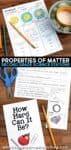
Engaging second-grade science stations that follow the NGSS science standards for states of matter. These properties of matter science stations will have your 2nd-grade students focused on reading and writing about science.
Students learn about properties of matter, test the hardness of different materials, and learn about how objects can be disassembled into small pieces and made into something new.

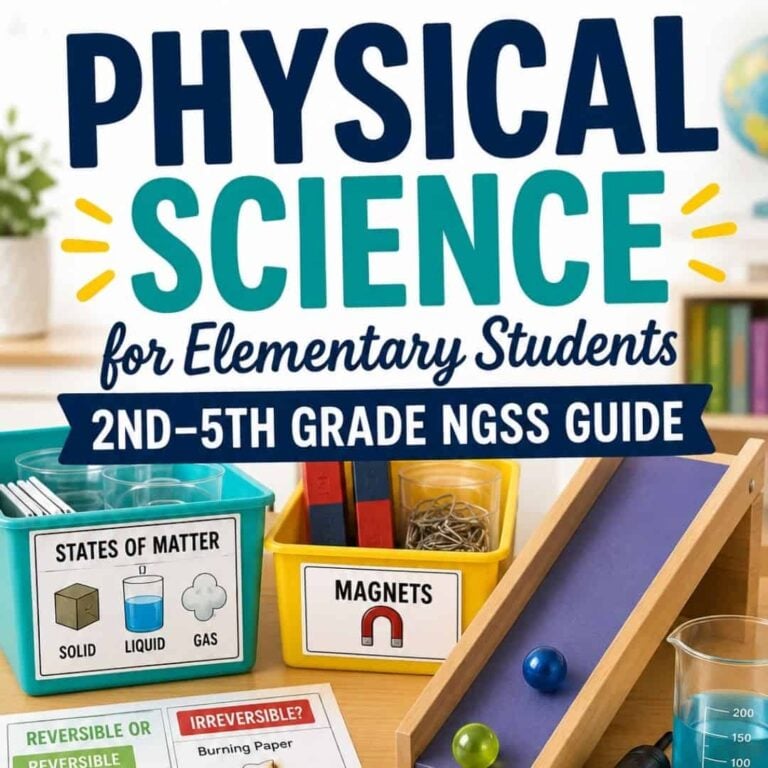
This is one piece of a larger 2nd–5th grade physical science progression. My physical science guide for elementary students shows how properties of matter fits into everything students will build on through 5th grade.
What is Included in the Second Grade Science Stations
The topics in this set of second-grade science stations focus on properties of matter, including the states of matter, hardness, and how matter changes with heat.
They contain challenging material for second graders, with new words and concepts in easy to implement, interactive stations. These science stations are designed to help students describe and classify different kinds of materials. Students also learn how to test different materials and how materials can be broken apart and built up.
Several of the stations contain follow-up activities or teacher notes that can be used to introduce or extend the learning.
Here is what is included in this set of science stations:

Structure and Properties of Matter Science Stations for Second Grade NGSS
Teach second grade students about the structure and properties of matter with 8 engaging NGSS-aligned science stations. Students explore solids, liquids, gases, observable properties, changes in states of matter, classifying materials, modeling with small pieces, and choosing materials for a purpose.
Big Idea Posters
Big Idea Posters are included in all of our science stations. These posters focus on key details. They make a great display for your science wall.

Vocabulary Cards for States of Matter
Included are two sets of vocabulary cards. One set has only the word and definition, as pictured below.

The second set of vocabulary cards includes pictures. These vocabulary cards can also be used as a ninth center, if needed. Students match the word, picture and definition.

Differentiated Responses for Each Science Station
Like all the science stations, the Properties of Matter Science Stations have a variety of ways for students to interact with the station. Each station includes five different ways to respond to the experience at the station:
- short answer questions
- fill-in the blank questions
- cut and paste (which is like the fill-in the blank)
- task cards with short answers
- task cards with multiple choice
All the variations are similar to one another, but require a different level of independence. The fill-in-the-blank or cut and paste are the easiest and perfect for your students who struggle with reading, especially if you provide them with a word bank. The short answer is the most difficult as it requires students to construct their own responses without much support.
Choose the format that best fits your classroom and students. Students are also encouraged to use their science journal via the task cards. Answer keys are included for all of the differentiated response formats.
Some activities also include a worksheet in addition to the differentiated responses. This worksheet is the “work” of the station. The differentiated responses require students to think broadly about the topic and concept.
Reading Passages
All stations, except the Watch and Play stations include reading passages. The reading passages are optional, but they do build students’ background knowledge and solidify key concepts.
The reading passages come in three formats. You’ll see versions of all of these formats in the below photographs. All versions have the same text, but different layouts.
- Full-page
- Larger format for e-reader or projection on a large screen
- Mini-book
We also support second graders with audio versions of the texts. All texts have audio files available in MP3 form. They can also be streamed via the internet.
Watch Videos about the Properties of Matter
Included in the science stations are two WATCH science stations. Students watch a video and answer questions about the video.

Like all science stations, there are a variety of ways students can respond to the videos. Below is the short answer option. It includes a word bank.

Below is the fill-in-the-blank option as well as a cut and paste extension.

Here is the second video with only the cut and paste option.

Play a Video Game about Matter Changing States
Like the WATCH station, the PLAY a Video Game Station has two video game options. Below is one game where student heat and cool a block of ice to see how it changes.
The questions in this photo are an example of the short answer task cards. Students can use their science journals to answer the questions.

Investigate Matter Changing States
The Investigate station is one of my favorites!
All stations, but the PLAY and WATCH stations include a reading passage. All reading passages also include audio versions that can be streamed to any device with internet access or loaded on via an MP3.

After students read the passage, they can do a hands-on experiment. In this experiment, students observe how coconut oil changes states as it is heated and cooled.
Here are some photographs of the coconut oil in different states and with the included worksheet filled out.


Also included are differentiated responses. Here is an example of the short answer worksheet.

Diagram Hardness Properties
The Diagram station has students read and diagram about hardness.
Below is an example of the reading passage in a mini-book format. Below is also the short answer worksheet where students answer questions and sort the hardness of the objects.

This is the hands-on activity for the Diagram station. Students do a variety of scratch tests and explore the hardness of common objects.

Read about Properties of Matter
This is the Read station. In this station, students read a passage and answer questions about it. In the photo below, you’ll see an example of the larger format displayed on an iPad.
Students read the passage and then do the worksheet. This worksheet is the cut and paste version. It also includes a light sorting activity with six pictures.

Structure and Properties of Matter Science Stations for Second Grade NGSS
Teach second grade students about the structure and properties of matter with 8 engaging NGSS-aligned science stations. Students explore solids, liquids, gases, observable properties, changes in states of matter, classifying materials, modeling with small pieces, and choosing materials for a purpose.
Model Parts of a Whole
This Model station focuses on how something can be broken apart and put back together to form something new. Students read a passage about buildings and bricks.

The activity for this science station has students cut apart the pieces of a paper robot and put them back together in as a different object. You can see one example of the new object below.

Explore Properties of Air
For this Explore station, students read about the properties of air. Students explore how boats use sails and experiment with boats and wind.

Here is an example of the short answer worksheet.

Sort States of Matter
The Sort Science Station focuses on explaining the states of matter and how molecules expand from one state to another.

The sort comes in both a cut and paste option that you see below as well as a color sorting option for small groups.


Structure and Properties of Matter Science Stations for Second Grade NGSS
Teach second grade students about the structure and properties of matter with 8 engaging NGSS-aligned science stations. Students explore solids, liquids, gases, observable properties, changes in states of matter, classifying materials, modeling with small pieces, and choosing materials for a purpose.
How to Purchase the Second Grade Science Stations for Properties of Matter
The Second Grade Science Stations for Properties of Matter can be purchased on my website or on Teachers Pay Teachers.
Other Second Grade Science Stations
Also available are other science stations for second grade NGSS.
-

-
-
-
-
-
-
-
Product on saleSecond Grade Science Stations BUNDLE – ALL Next Generation Science StationsOriginal price was: $173.43.$109.44Current price is: $109.44.
-

More Second Grade Science Ideas
Here are more blog posts with ideas and resources for second-grade science activities related to the NGSS.
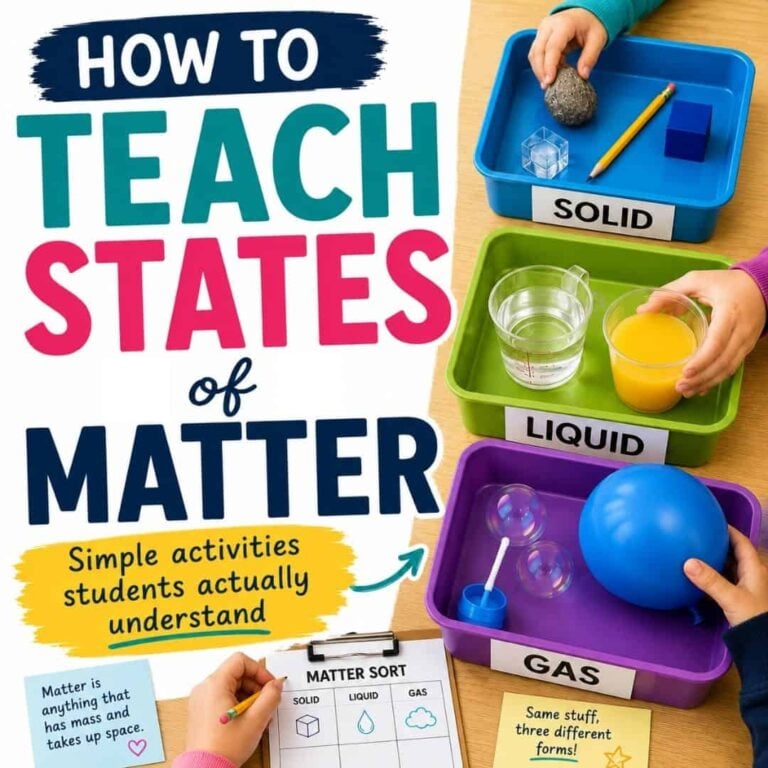


Can I purchase the vocabulary posters on matter for second grade. Solids, liquids and gases? I can not figure out if you sell your items like TPT. Thanks
Yes! I have the posters and vocabulary cards as a set on TpT here: https://www.teacherspayteachers.com/Product/Second-Grade-Science-Vocabulary-Cards-and-Big-Idea-Posters-BUNDLE-3455374