
Food chains and food webs are one of those topics that sound simple on the surface but become more complex as students move through the grade levels Students encounter the basic idea in early elementary, build understanding of how organisms depend on each other in third grade, and arrive at 5th grade ready to model how matter and energy actually move through an ecosystem. Each year adds something meaningful rather than just repeating the same vocabulary.
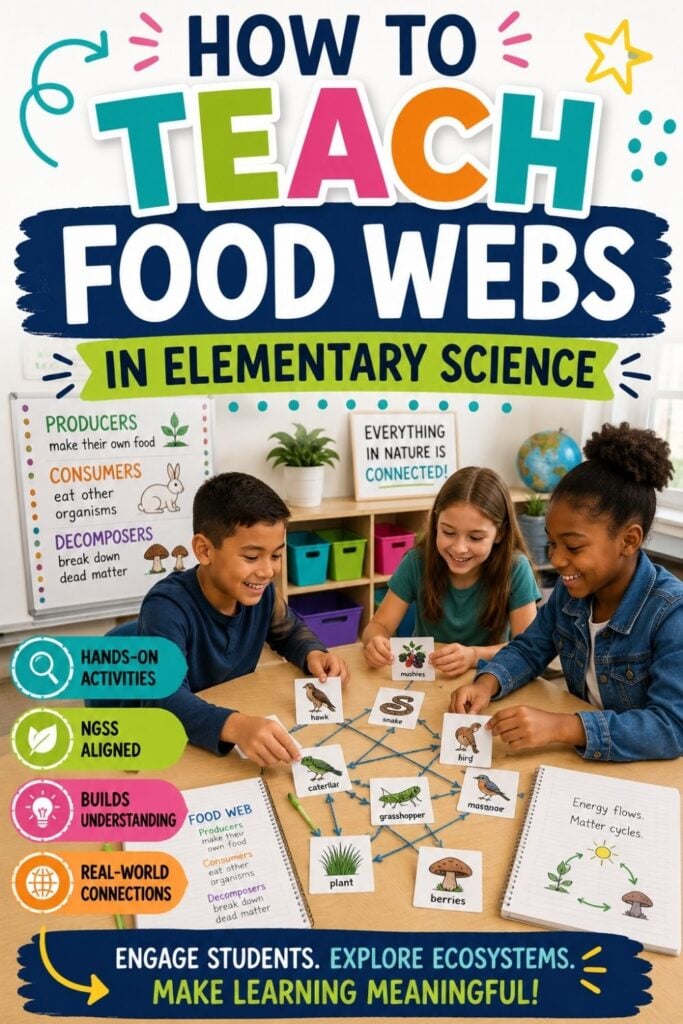
This guide walks through what to teach at each stage, which NGSS standards apply, and what resources support the instruction at each grade band.
Food Chains vs. Food Webs: What Students Need to Understand
Before diving into grade-level instruction, it helps to be clear about the distinction between these two terms, because students (and sometimes teachers) use them interchangeably when they actually refer to different things.
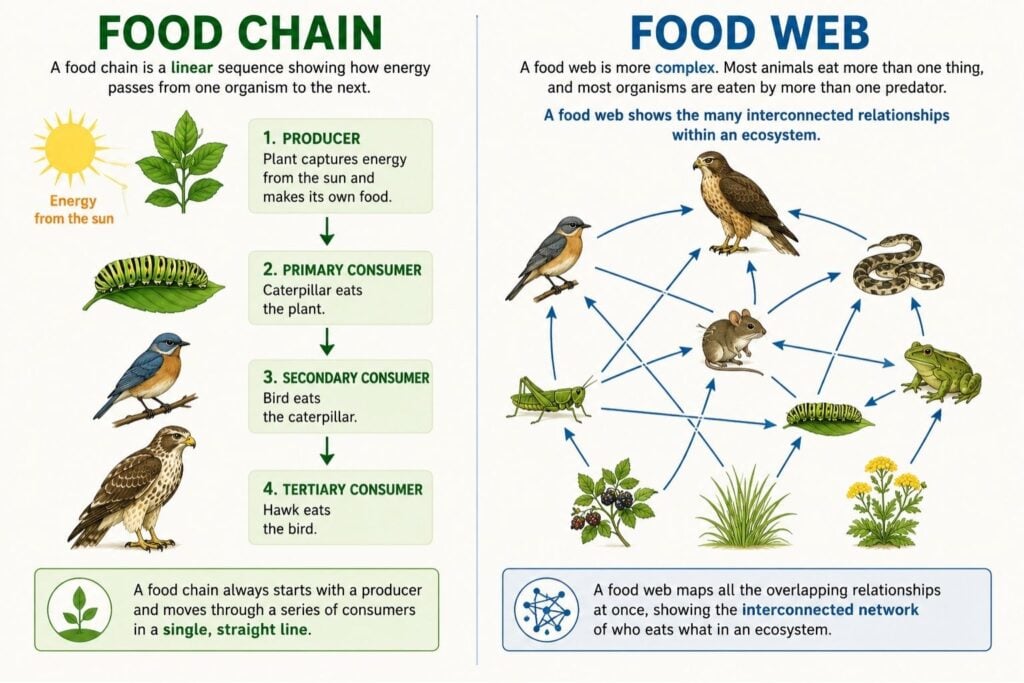
A food chain is a linear sequence showing how energy passes from one organism to the next: a plant captures energy from the sun, a caterpillar eats the plant, a bird eats the caterpillar, and a hawk eats the bird. The chain always starts with a producer (a plant or other organism that makes its own food) and moves through a series of consumers.
A food web is more accurate and more complex. Real ecosystems don’t have neat linear chains. Most animals eat more than one thing, and most organisms are eaten by more than one predator. A food web maps all those overlapping relationships at once, showing the interconnected network of who eats what within an ecosystem.
Both terms share the same core vocabulary: producers (plants and other organisms that make their own food through photosynthesis), consumers (organisms that eat other organisms for energy), and decomposers (fungi, bacteria, and other organisms that break down dead matter and return nutrients to the soil). Students who understand these three roles have the conceptual foundation for everything else in this topic.
How Food Chains and Food Webs Build Across Elementary Grades
NGSS doesn’t introduce food webs as an isolated topic. Instead, understanding builds gradually across the Life Science standards, with each grade adding a new layer of complexity.
In second grade, the foundation is about relationships: plants need sun and water to grow, animals depend on plants (and other animals) for food, and pollinators and seed dispersers connect plants to the rest of the ecosystem. Students aren’t drawing food webs yet, but they’re developing the mental model that living things are connected in ways that matter. Standard 2-LS2-1 covers plant needs, and 2-LS2-2 addresses how animals help plants reproduce through pollination and seed dispersal. These are the threads that food webs are eventually woven from.
In third grade, the focus shifts to what happens when those connections are disrupted. Standards 3-LS4-3 and 3-LS4-4 ask students to consider how organisms survive in specific habitats and what happens to populations when environments change. This is where food chain thinking becomes visible: students reason about why a change in one population (loss of a predator, introduction of an invasive species, habitat destruction) causes ripples through the whole system.
In fifth grade, the work becomes explicit and model-based. Standard 5-LS2-1 asks students to develop a model to describe how matter moves among plants, animals, decomposers, and the environment. Students learn that food webs are really matter cycles: energy flows in one direction (from producers to consumers, losing some at each step), but matter cycles continuously through the system. Decomposers are the key to understanding that cycling, which is why they deserve at least as much instructional time as producers and consumers.
Teaching Food Chains and Food Webs in 2nd and 3rd Grade
The most effective entry point in early elementary is grounding food chains in ecosystems that students can see and touch. A garden, a schoolyard, a nearby pond or field: any local ecosystem gives students real organisms to work with rather than abstract arrows on a diagram.
Start by having students observe what animals eat, then work backward: what does that organism eat? And what eats it? Building a food chain from direct observation is more meaningful than filling in a pre-made diagram. Students who construct their own chains, even simple ones, understand the concept of energy transfer better than students who label someone else’s.
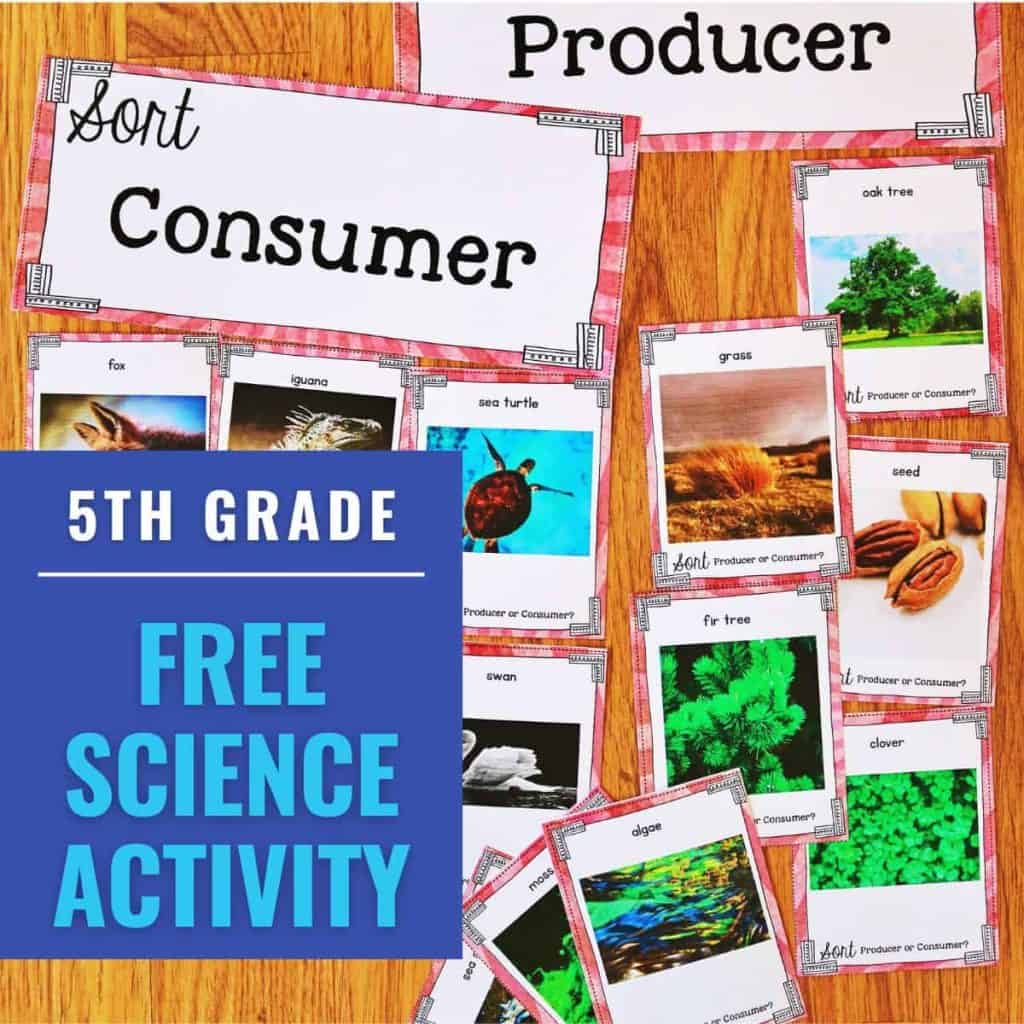
Sorting activities are particularly effective at this stage. When students sort a set of organisms into producers, consumers, and decomposers before connecting them into a food chain, they’re doing the conceptual work of the food web before they draw a single arrow. The sorting step surfaces misconceptions early: students who place mushrooms in the consumer category or aren’t sure where bacteria fit are showing you what instruction they need next.
Free 5th Grade Produces and Consumers Sorting Activity
Help your students build a stronger understanding of ecosystems with this free Producers and Consumers Sorting Activity for 5th grade. Students sort organisms by how they obtain energy, helping them practice identifying producers and consumers in a hands-on, interactive way.
Enter your email below, and I’ll send the free activity straight to your inbox.
For 2nd grade, the Habitats: Biodiversity and Humans science stations build understanding of how plants and animals depend on each other within a habitat, connecting directly to the food chain concept through the lens of what organisms need to survive.
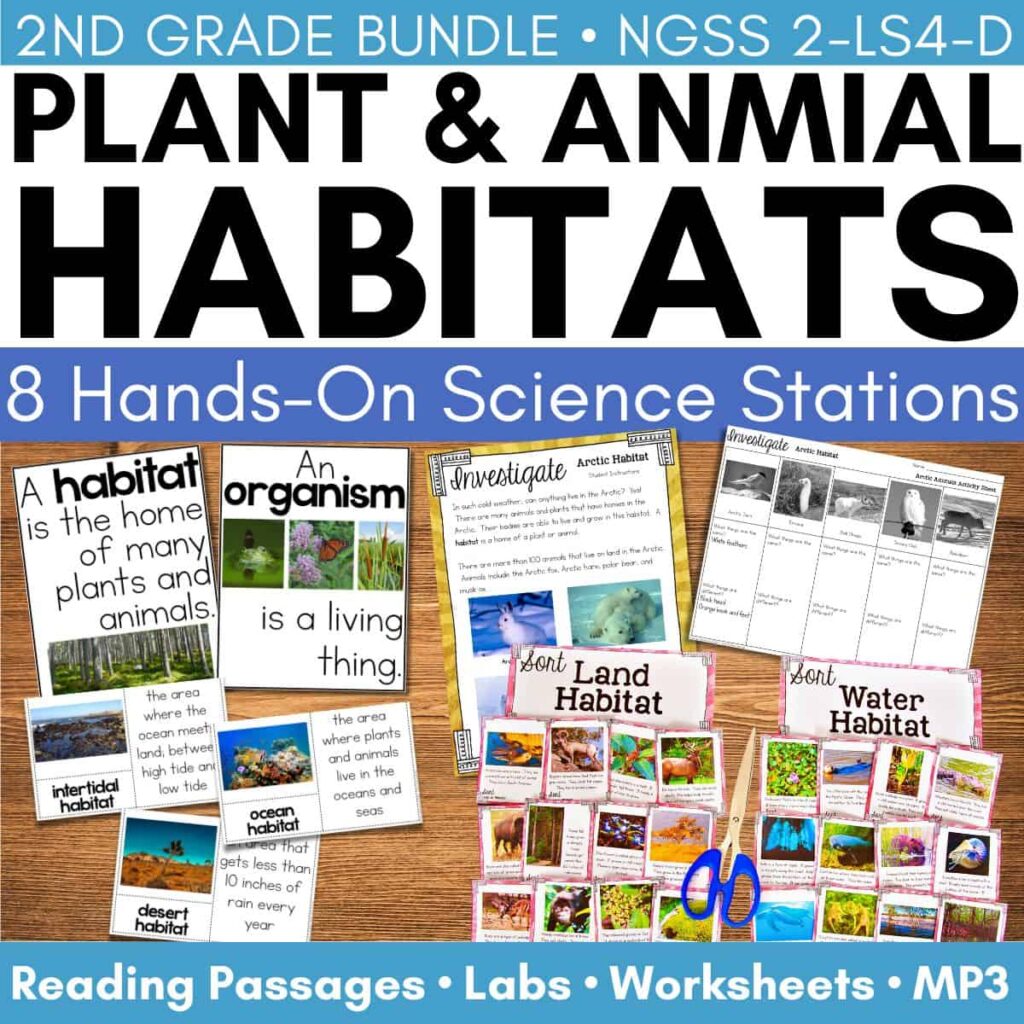
2nd Grade Habitats Science Stations | NGSS 2-LS4-1 Activities
Help students explore habitats around the world with these engaging 2nd Grade Habitats Science Stations! Students learn how plants and animals live in arctic, temperate forest, intertidal, pond, desert, land, and water habitats through hands-on activities, reading passages, videos, games, models, sorting, diagrams, and differentiated response options. Aligned to NGSS 2-LS4-1 / DCI 2-LS4.D.
For 3rd grade, the Ecosystems and Biodiversity Science Stations address standards 3-LS4-3 and 3-LS4-4 by engaging students in reasoning about how organisms interact within ecosystems and what happens when those ecosystems change. The Changing Habitats 5E Unit provides 3rd graders with a structured framework for exploring what ecosystem disruption actually looks like, from habitat loss to the introduction of non-native species.
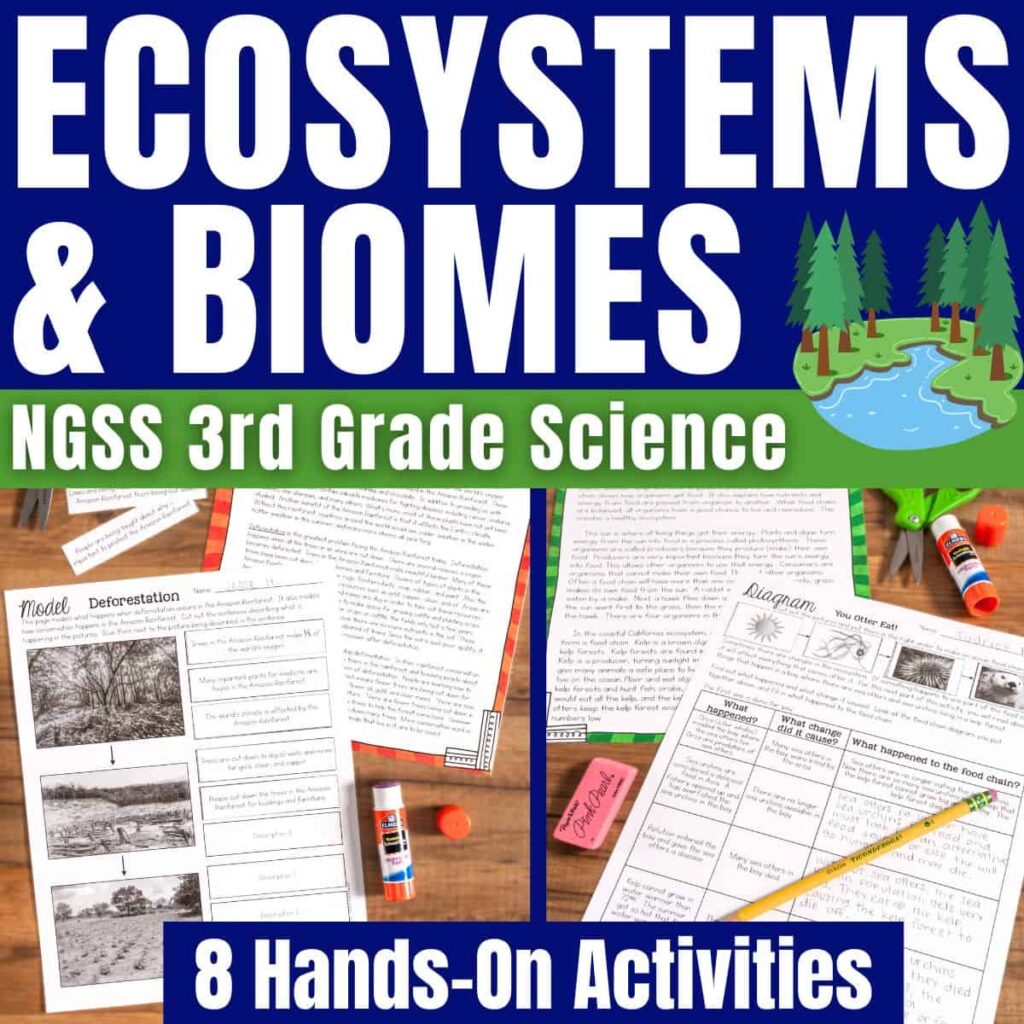
Ecosystems and Biodiversity Science Stations for Third Grade
The focus is on NGSS 3-LS2.C and 3-LS4.D and includes concepts such as food chains, food webs, traits of organisms that change due to environmental changes, how animals affect their environment, invasive species, and biomes.
For a broader set of activity ideas across the elementary grades, the Hands-on Ecosystem Activities post covers food chain construction, food web modeling, terrarium building, decomposition investigations, and more. And for instruction specifically on how human activity drives ecosystem change, the Changes in Ecosystems post walks through six teaching approaches covering pollution, invasive species, deforestation, and climate change.
Teaching Food Chains and Food Webs in 5th Grade
Fifth grade is where food web instruction reaches its full complexity. Students move from “who eats what” to “how does matter cycle through the system,” a shift that requires a more sophisticated model than a simple chain or even a web diagram.
The most important conceptual shift to support at this stage is understanding decomposers. Students who see decomposers as an afterthought (things that just “break stuff down”) miss the central role they play in returning matter to the soil so producers can use it again. Without decomposers, nutrients would stay locked in dead organisms. The whole cycle depends on them. Giving decomposers dedicated investigation time, rather than just a sentence in a reading passage, makes a real difference in whether students internalize this.
The other key move in 5th grade is transitioning from diagrams to actual models. A food web diagram shows relationships. A model of matter cycling shows what moves where and in what form. Students who build a diorama of an ecosystem, connect organisms with arrows that represent matter flow, and then reason about what would happen if one organism disappeared are doing genuine scientific modeling. That is the heart of 5-LS2-1.
The Food Webs Science Stations post walks through all eight stations in the Food Webs and Ecosystems unit in detail. The stations cover every component of 5-LS2-1: watching videos about energy flow and decomposers, playing an ecosystem game that reinforces producer/consumer/decomposer roles, investigating decomposition with real organic material, diagramming an African food web, modeling a food web in a diorama, exploring what happens when a population changes, and sorting producers from consumers.

Food Webs & Ecosystems Science Station UNIT BUNDLE
These Food Webs Next Generation Science Stations include eight different science stations where students deepen their understanding of food webs, ecosystems, consumers, producers and decomposers, and the movement of matter among plants, animals, decomposers, and the environment. The focus is on 5-LS2-1.
Tips for Teaching Food Chains and Food Webs Across Grade Levels
Use local ecosystems whenever possible. Students who learn food webs from generic diagrams (sun, grass, rabbit, fox) understand the concept less deeply than students who build a food web from organisms in their own schoolyard, neighborhood, or region. Local context makes the relationships feel real rather than hypothetical. If you can find evidence of those relationships, a spider web with a trapped insect, a bird pulling a worm from the ground, all the better.
Teach the vocabulary before the diagram. Students who don’t clearly understand what a producer is, or who confuse decomposers with consumers, will draw food web diagrams with errors they don’t recognize as such. Taking time to build and check vocabulary through sorting, matching, and discussion before students construct a web pays off in the quality of their models.
Make the disruption visible. One of the most effective moves in food web instruction at any grade is asking: What happens if we remove one organism from this web? Students who reason through a cascade (removing wolves leads to more deer, which leads to overgrazing, which leads to less plant cover, which leads to erosion) are developing exactly the systems thinking that the NGSS ecosystem standards are designed to build. That question can be asked in kindergarten with simple food chains and in 5th grade with complex food webs.
Connect food webs to photosynthesis. Students who understand that producers capture energy from the sun and store it in their tissues have a much clearer mental model of energy flow than students who just know that plants are “at the bottom” of the food chain. The energy in a hawk came from a mouse, which came from a seed, which came from the sun. That chain of energy transfer is what a food web is actually tracking.
Final Thoughts on Teaching Food Chains and Food Webs
Students who genuinely understand how energy flows and matter cycles through an ecosystem start noticing food web relationships everywhere: in the backyard, at the park, in news stories about invasive species or habitat loss. That transfer from the classroom to the world is the goal of NGSS Life Science instruction, and food webs are a natural vehicle for it.
Build the vocabulary early, use local ecosystems to make the relationships concrete, give decomposers the attention they deserve, and let the “what if” questions carry the deeper thinking. Students who arrive at 5th grade ready to build a model of matter cycling have spent several years developing the foundation that makes it possible.
Jessica BOschen
Jessica is a teacher, homeschool parent, and entrepreneur. She shares her passion for teaching and education on What I Have Learned. Jessica has 16 years of experience teaching elementary school and currently homeschools her two middle and high school boys. She enjoys scaffolding learning for students, focusing on helping our most challenging learners achieve success in all academic areas.