
Space Science for Elementary Students: A Teacher’s Guide for 2nd–5th Grade
Space science for elementary students varies by grade. The NGSS sequence builds from patterns students can observe (shadows, seasons, day and night) to the physics behind those patterns (Earth’s rotation, gravity, the scale of the universe) as students develop the reasoning skills to handle more abstract ideas.
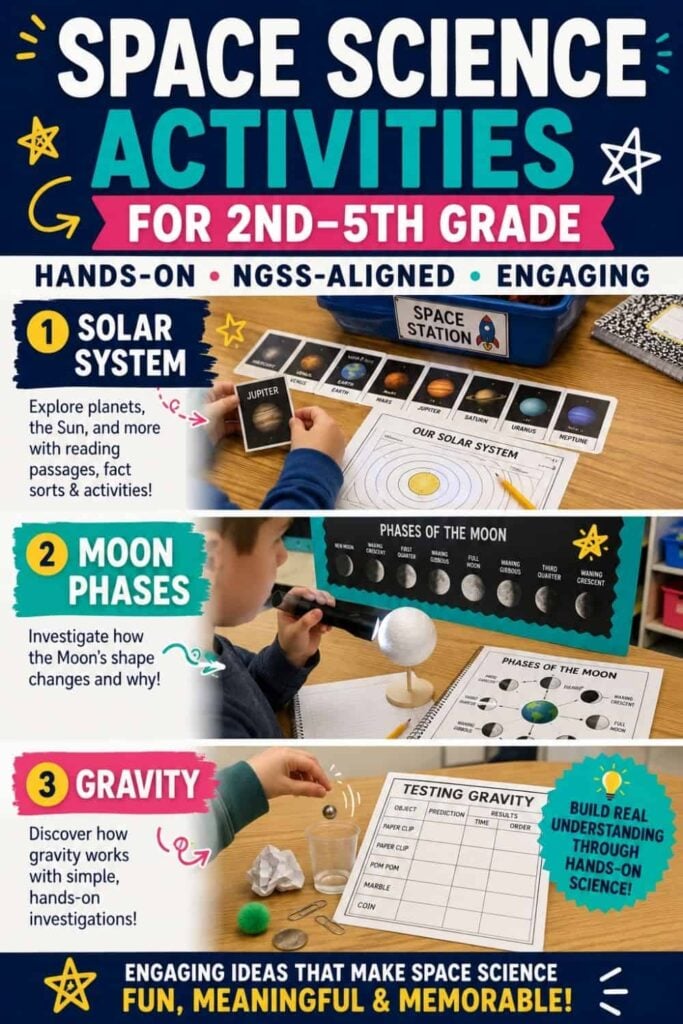
This guide walks through what’s worth teaching at each stage, which standards apply, and what resources make the content accessible for students in 2nd through 5th grade.
How Space Science Fits Into Elementary Standards
NGSS introduces space science across a wide grade band, with different entry points depending on what students are developmentally ready to understand.
In the primary grades (K–2), students observe the sky, the sun, the moon, and the stars, and describe patterns they notice over time. They’re not explaining the mechanics yet; they’re building the observational vocabulary and pattern recognition they’ll need later.
In upper elementary, the focus shifts to explanation. Fifth grade is where the most significant space science standards live: 5-ESS1-1 asks students to support an argument about the apparent brightness of stars based on their relative distance from Earth, 5-ESS1-2 focuses on patterns of day and night, shadows, seasons, and the appearance of stars, and 5-PS2-1 introduces the concept of gravitational force.
The solar system, planets, their characteristics, and the moon are commonly taught throughout 2nd–5th grade, even though NGSS doesn’t assign a dedicated standard for each level. State curricula often fill this gap, and it connects naturally to the 5th-grade ESS1 standards. A broader view of elementary Earth science, including how space science fits within it, is in the 2nd–5th Grade Earth Science Guide.
Teaching the Solar System in Elementary School
The solar system is one of those topics that students arrive already curious about. Most elementary students have opinions about which planet is most interesting long before you’ve introduced the unit. The challenge isn’t generating engagement. It’s giving that curiosity a rigorous structure.
The most productive question to frame the solar system around for upper elementary students isn’t “what is each planet like?” (which leads to fact collection) but “what patterns do you notice, and what might explain them?” Why are the inner planets rocky while the outer planets are gaseous? Why does the Moon look different sizes at different times? Why is the Sun so much larger than anything else in the solar system? These questions get students’ reasoning rather than just cataloging.
Building background knowledge before the investigation matters here. The Solar System Reading Passages give students structured nonfiction texts on every major body in the solar system, Mercury through Neptune, Pluto and the dwarf planets, the Moon, and the Sun. Each passage is available in two formats for differentiation, and the resource includes vocabulary cards, graphic organizers, and fact sorts that help students organize information as they read rather than just highlighting text. The QR code feature lets students extend their research independently at a science station or during centers, making this resource flexible enough to use across a range of instructional structures.
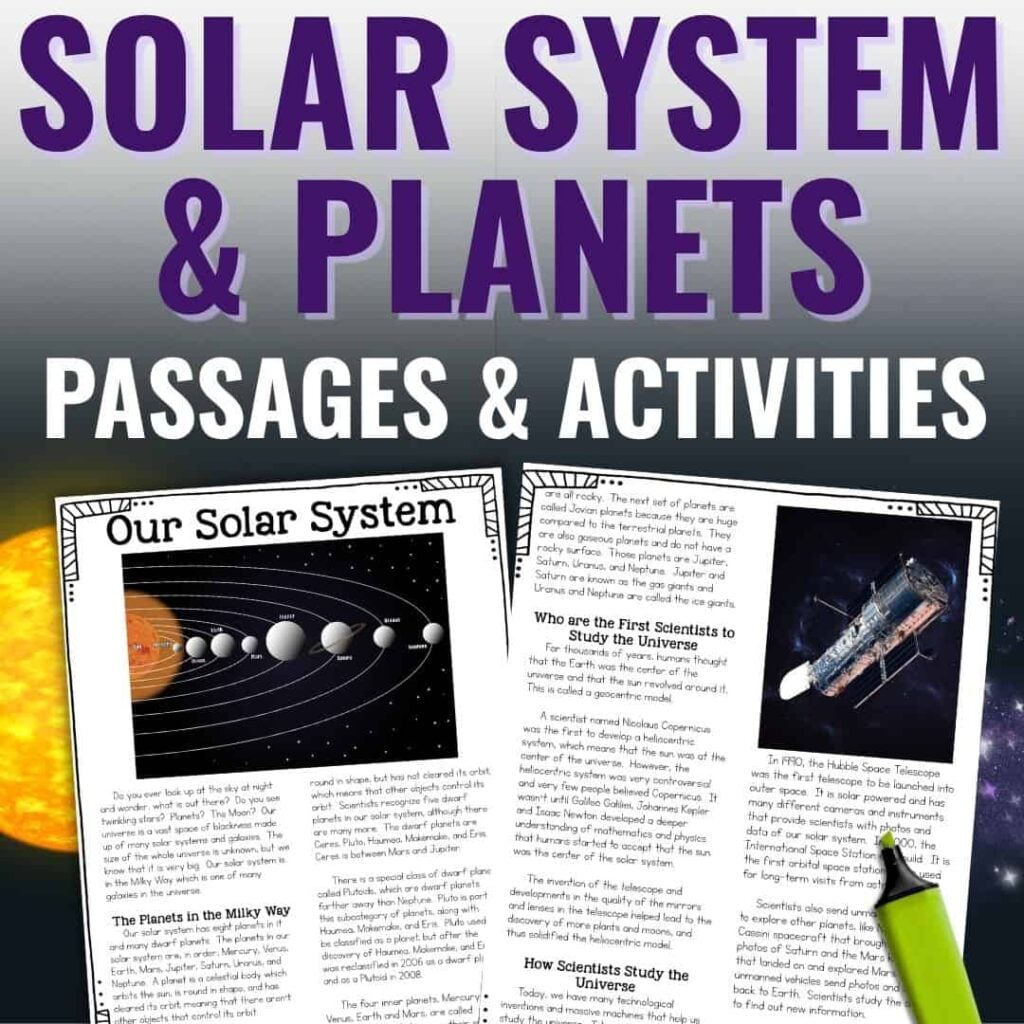
Take a look at the solar system reading passages that students can use for their research about planets.
Stars and the Sun: Teaching 5-ESS1-1
Standard 5-ESS1-1 asks students to support an argument that the apparent brightness of the sun and stars is due to their relative distance from Earth, not to the stars’ actual size or energy output. This is a conceptually demanding standard because students’ prior experience (brighter means bigger, or closer) doesn’t automatically transfer to the astronomy context without direct instruction.
The most common misconception to address upfront: students often assume the sun looks bigger and brighter than other stars because it IS bigger and more powerful than everything else. The counterintuitive truth, that many stars are vastly larger than the sun, and the sun only dominates our sky because it’s relatively close, is the kind of cognitive surprise that tends to stick. Starting with a direct challenge to the misconception, rather than building to it at the end of a unit, gives students a reason to pay attention to everything that follows.
The Universe and Stars Science Station Unit Bundle addresses 5-ESS1-1 through a full set of investigation-based stations. Science stations give students repeated exposure to a concept across different formats, reading, hands-on investigation, data analysis, and written response, which is exactly what it takes to build the kind of durable understanding this standard requires.
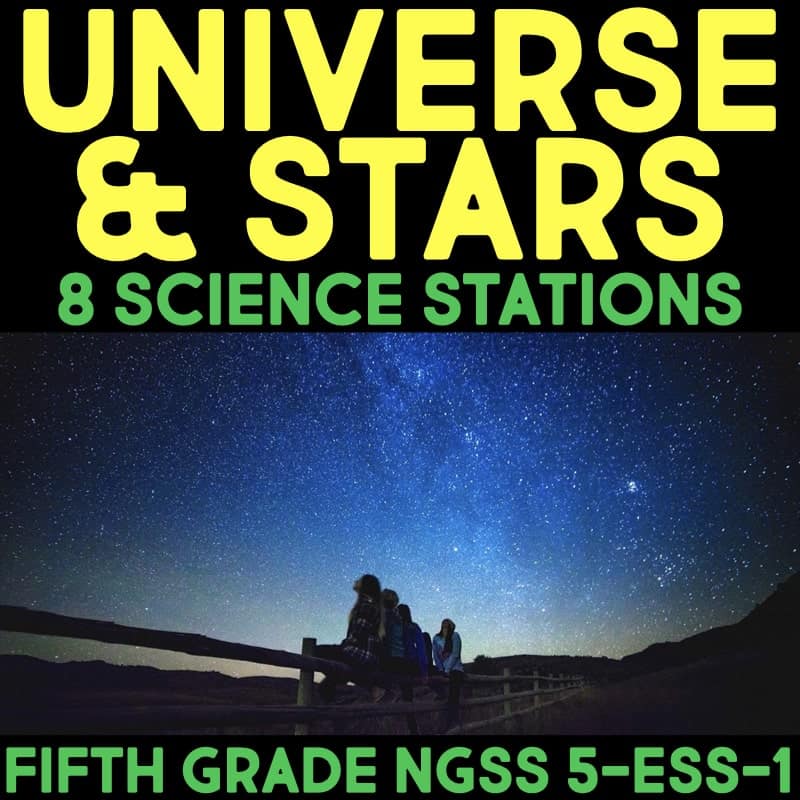
The Universe and Stars Science Station UNIT BUNDLE
These Universe and Stars Next Generation Science Stations include eight different science stations where students deepen their understanding of stars, the brightness of stars in the night sky, the various star sizes, constellations, and more. The focus is on 5-ESS1-1.
Day, Night, and Seasons: Teaching 5-ESS1-2
Day and night, the length and direction of shadows, seasonal changes, and the appearance of stars across the year are all patterns that students can observe, but explaining them requires an understanding of Earth’s rotation and its orbital path around the sun. That’s the shift 5-ESS1-2 asks 5th graders to make: from noticing the pattern to building the model that explains it.
The sequence matters here. Students who have been observing the length and direction of shadows for a few days before any instruction have something concrete to explain. Walking outside at the same time each day for a week and recording shadow direction takes five minutes and produces data that students will want to make sense of. That firsthand experience is a stronger foundation for the rotation model than any diagram you could introduce cold.
The Earth’s Place in the Universe Science Stations post covers all eight stations in the Day to Night, Season to Season unit — from shadow investigations and Earth’s rotation to moon phases and eclipses.
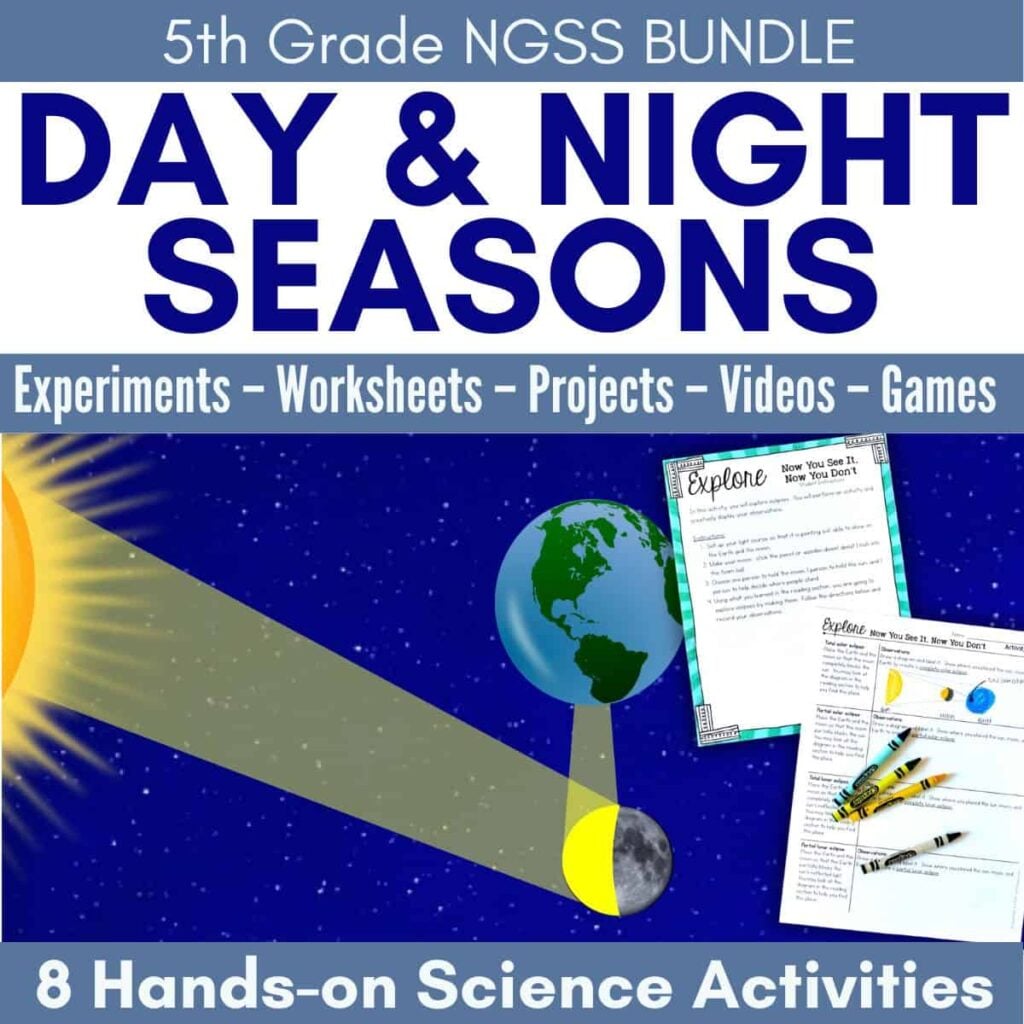
Day to Day, Season to Season Science Stations | NGSS 5-ESS1-2
Help fifth graders explore patterns caused by the Earth, moon, and sun with these Day to Day, Season to Season Science Stations! Students investigate day and night, seasons, moon phases, rotations, revolutions, Earth’s tilt, eclipses, seasonal changes, and observable sky patterns through eight NGSS-aligned stations with print and digital options. Aligned to NGSS 5-ESS1-2.
Moon Phases and Eclipses
Moon phases are one of the most reliably engaging space science topics at the elementary level, partly because students can observe them at home and partly because the pattern, waxing, full, waning, new, has an elegance that students notice once they understand it. The common confusion to address early: the phases are not caused by Earth’s shadow. Students who hold that misconception will struggle with any model-based work until it’s corrected.
The most effective approach combines observation over time with physical modeling. Students who act out the Earth-moon-sun geometry (or use a ball and a flashlight in a darkened room) develop a spatial understanding of why we see different amounts of the lit side of the moon from Earth’s surface. That physical experience transfers better to 2D diagrams than working from diagrams alone.
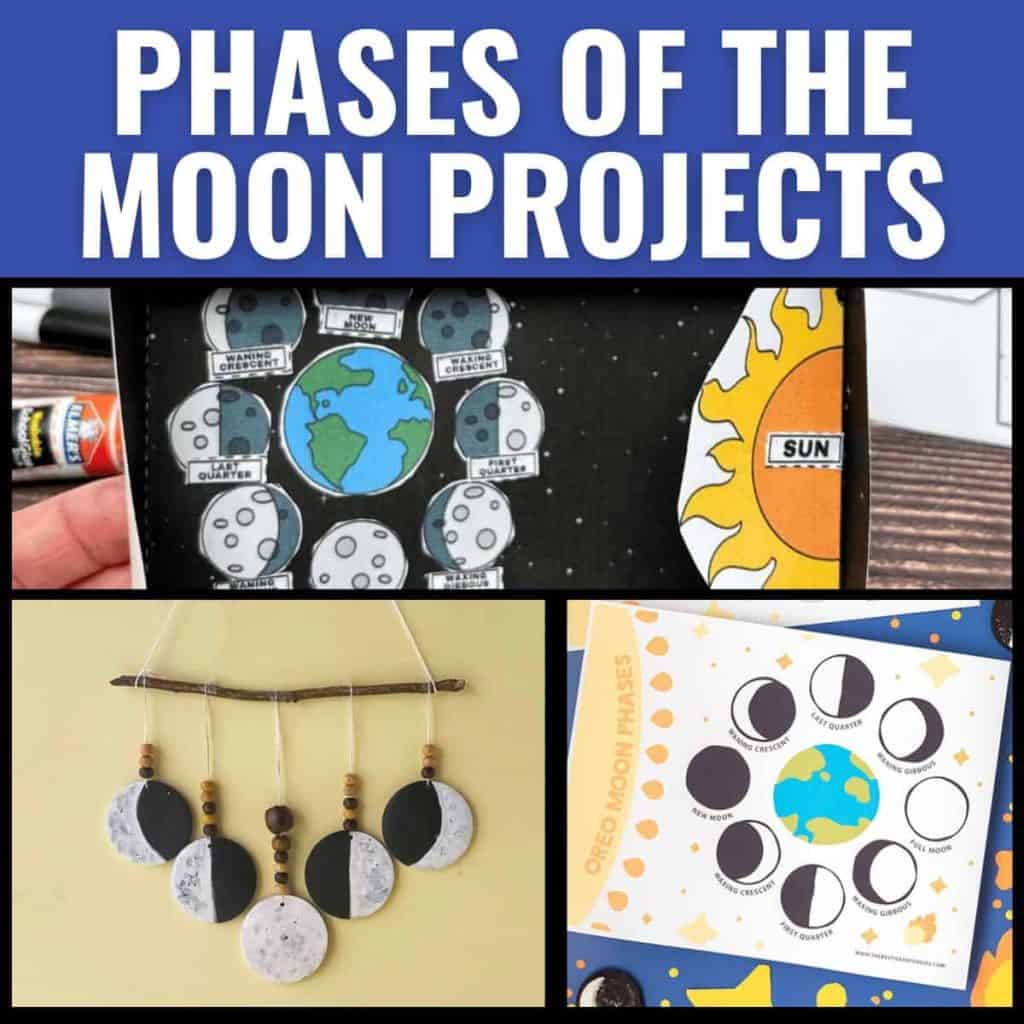
The Phases of the Moon Projects post walks through a range of investigation options — moon phase experiments, art projects, outdoor observation activities, and eclipse explorations — that can work as a unit sequence or as individual stations.
Individual stations are also available separately on TPT: a moon phases reading passage, a phases diagram activity, and an eclipse exploration station.
Gravity: Teaching 5-PS2-1
Standard 5-PS2-1 asks students to support the argument that the gravitational force exerted by Earth on objects is directed downward and that this force gives objects weight. It’s a physical science standard, but it connects directly to space science: students who understand gravity on Earth are ready to ask what gravity looks like between planets, or why orbits work the way they do.
The conceptual challenge here is distinguishing between mass and weight. Students routinely use these words interchangeably, and the distinction, mass is the amount of matter in an object, weight is the force of gravity acting on that mass, is one that requires direct instruction and multiple contexts before it sticks. Asking students to reason about what would happen to their weight on the moon, or on Jupiter, is a productive way to check whether they’ve made the distinction.
The Gravity on Earth Science Stations post covers the full set of eight stations for 5-PS2-1, investigations exploring gravitational force, mass, and weight across a range of formats.
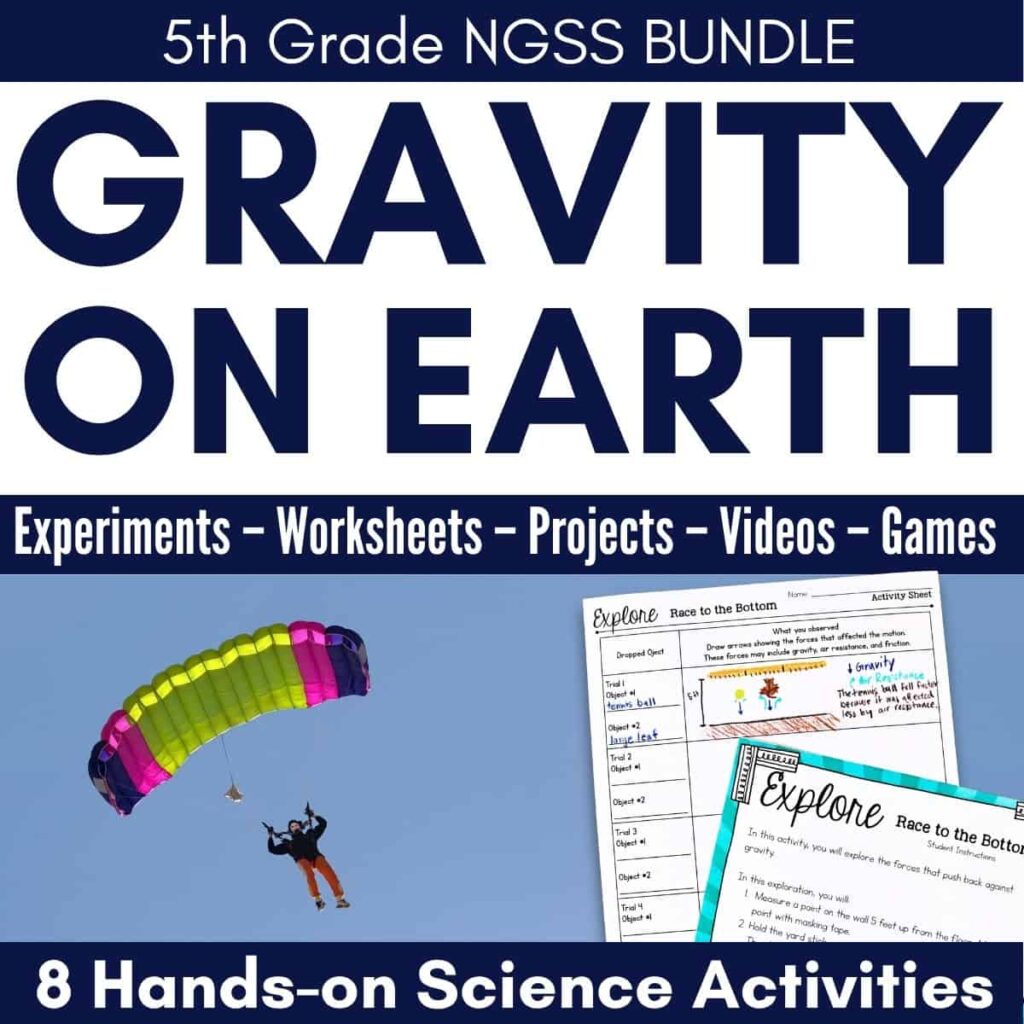
Gravity on Earth Science Stations – NGSS 5-PS2-1 Unit Bundle
Engage your 5th grade students with hands-on gravity science stations aligned to NGSS 5-PS2-1! This interactive unit includes 8 stations covering gravitational force, mass, weight, and more—plus digital Google Classroom™ components for easy implementation.
Tips for Teaching Space Science in Elementary School
Lead with observation, not explanation. Before you tell students anything about day and night, shadows, or moon phases, give them something to notice. Go outside and observe. Look up a star chart. Record sunrise and sunset times for a week. Students who arrive at the explanation through their own observations are more likely to understand and remember it than students who receive it as delivered information.
Address misconceptions explicitly and early. Space science is one of the most misconception-dense topics in elementary science. Students arrive with persistent wrong ideas: seasons are caused by distance from the sun; the moon makes its own light; stars are only visible at night because the sun “turns off.” These misconceptions don’t disappear by ignoring them. Name them, invite students to defend them, and then give them experiences that create the productive confusion that precedes real understanding.
Scale is one of the hardest things to teach. Students who are learning about the solar system have almost no intuitive sense of how large and how empty space actually is. A few minutes spent helping students experience scale, even roughly, using a hallway, a gym, or a field to represent distances between planets, makes a meaningful impression. Numbers without physical context don’t convey the reality of astronomical distance.
Connect space science back to Earth science. Gravity shapes weather patterns, tides, and the structure of Earth itself. The sun drives the water cycle and climate. Moon phases affect tides. These connections are worth making explicit rather than treating space science as a separate unit that ends when the planet’s test is over. Students who see the connections build a more coherent model of how Earth systems work.
Final Thoughts on Teaching Space Science for Elementary Students
Space science at the elementary level works best when instruction moves from observation to explanation, from the patterns students can see and record to the models that account for why those patterns exist. The NGSS sequence is designed to do exactly that, building from the primary grades through 5th grade in a way that respects both students’ developing reasoning skills and the genuine complexity of the content.
Start with what students can observe. Build toward explanation. And let the genuine strangeness of space, the counterintuitive scale, the surprising behavior of gravity, the elegance of orbital mechanics, do some of the instructional work for you. Students who leave 5th grade with a real model of why the seasons change and why stars appear bright have learned something worth knowing.
Jessica BOschen
Jessica is a teacher, homeschool parent, and entrepreneur. She shares her passion for teaching and education on What I Have Learned. Jessica has 16 years of experience teaching elementary school and currently homeschools her two middle and high school boys. She enjoys scaffolding learning for students, focusing on helping our most challenging learners achieve success in all academic areas.