
Earth’s Place in the Universe – Shadows, Day and Night & Seasons Fifth Grade Science Activities
The following science activities focus on Earth’s position within the universe. They are designed to inspire students and enhance their understanding of essential science concepts such as shadows, day-night cycles, and seasons.
Our interactive resources, aligned with NGSS 5-ESS1-2, explore intriguing topics like the daily transition from day to night, seasonal changes in star visibility, the complex orbits of Earth and Moon, and Earth’s rotation.

How We Wrote the NGSS 5-ESS1-2 Day and Night Science Activities
When writing these Earth’s Place in the Universe science activities, we focused on NGSS ESS1-2. Here is the science standard for this science unit:
NGSS 5-ESS1-2 Earth’s Place in the Universe
Next Generation Science Standards are written to be “Three Dimensional.” The three dimensions are Performance Expectation, Disciplinary Core Idea, and Science and Engineering Practices/Crosscutting Concepts.
The Earth’s Place in the Universe Science Stations Unit focuses on these standards:
- Performance Expectation 5-ESS1-2: Represent data in graphical displays to reveal patterns of daily changes in length and direction of shadows, day and night, and the seasonal appearance of some stars in the night sky.
- Disciplinary Core Ideas:
- ESS1.B: Earth and the Solar System: The orbits of Earth around the sun and of the moon around Earth, together with the rotation of Earth about an axis between its North and South poles, cause observable patterns. These include day and night; daily changes in the length and direction of shadows; and different positions of the sun, moon, and stars at different times of the day, month, and year.
- Science and Engineering Practices: Analyzing and Interpreting Data
- Crosscutting Concepts: Patterns: Similarities and differences in patterns can be used to sort, classify, communicate and analyze simple rates of change for natural phenomena.
The focus of the Day-to-Night and Season-to-Season Science Stations
The focus of the Day to Night and Seasons to Season Science Stations include:
- How the Earth’s tilt, rotation, and revolution cause the seasons on Earth to change
- Patterns that are caused by the movement of the Earth around the sun, including the apparent motion of the sun from east to west
- Phases of the moon and how rotations and revolutions of the Earth and moon cause changes in patterns on Earth
- Solar and lunar eclipses
- Seasonal changes and their causes and effects
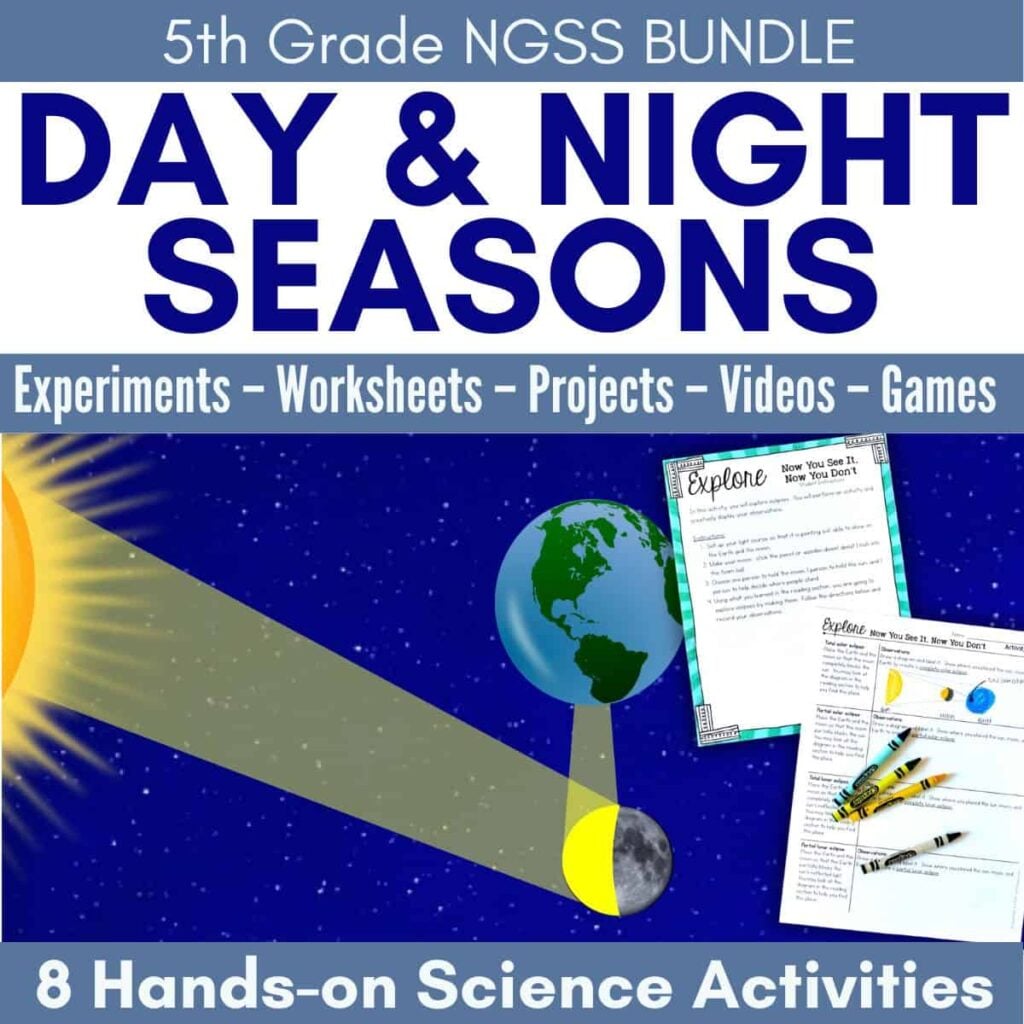
Day to Day, Season to Season Science Stations | NGSS 5-ESS1-2
Help fifth graders explore patterns caused by the Earth, moon, and sun with these Day to Day, Season to Season Science Stations! Students investigate day and night, seasons, moon phases, rotations, revolutions, Earth’s tilt, eclipses, seasonal changes, and observable sky patterns through eight NGSS-aligned stations with print and digital options. Aligned to NGSS 5-ESS1-2.
What’s Included in the Day-to-Night and Season-to-Season Science Stations
In these science stations, students are introduced to a general overview of how the Earth rotates on an axis and revolves around the sun, creating day and night and the seasons. Students learn about the seasonal appearance of stars, the orbits of the Earth and moon, the rotation of the Earth, the Earth’s axis, and more!
The science stations contain challenging material for fifth graders, with new words and concepts in easy-to-implement, interactive stations. They are designed to help students understand how the Earth’s rotation and revolution affect days, nights, and seasons.
Big Idea Posters for Day To Night and Seasons Science stations
Like all our science stations, the Days to Night and Sesons stations come with Big Idea posters that explain the core science ideas students will learn in this unit of study.
Some of the Big Ideas include:
- Seasons are caused by the Earth’s tilt toward the sun.
- The moon rotates on its axis once every 27 days.
There are 19 Big Idea Posters in this unit. Only the Day to Night and Seasons Unit Bundle includes the Big Idea Posters. The Big Idea Posters are not included with each individual station.

Vocabulary Cards for Earth’s Days and Seasons
This resource offers two sets of vocabulary cards. The first set includes vivid pictures and concise word definitions, which can be easily separated for interactive use in science centers, empowering students to match the cards. Moreover, the cards have been created to fit into pocket charts perfectly, providing more organization and the possibility of additional center activities.
The second set of vocabulary cards features words and definitions showcased in a larger font, making it perfect for crafting an impressive science word wall. It’s worth noting that both sets contain the same set of words.
The Day to Night and Seasons vocabulary cards are only available in the Unit Bundle. They are not available for each science station.


Differentiated Responses for Each Science Station
The Day to Night and Sesons Science Stations, like all science centers, offer differentiated comprehension activities for students to engage with each station. Within each station, there are five distinct approaches for students to evaluate their experience.
- short-answer questions
- fill-in-the-blank questions without a word bank
- fill-in-the-blank with a word bank
- task cards with short answers
- task cards with multiple-choice
Although similar to one another, each variation requires a different level of independence. Choose fill-in-the-blank exercises for students who struggle with reading. But go for short-answer exercises only if they can craft responses on their own.
Remember, short-answer exercises are the most challenging. Choose the format that best fits your classroom and students. Students are also encouraged to use their science journal task cards. Answer keys are included. See examples of the questions in some of the images below.
Certain activities may feature an activity worksheet along with differentiated responses. The activity sheet functions as the “work” or the station’s project, while the differentiated responses allow students to expand their thinking about the topic and concept at large.
Reading Passages about Rotations and Revolutions and More
Reading passages are included in all stations except the Watch and Play stations. Although optional, they help students build foundational knowledge and reinforce key concepts. When students lack prior knowledge on a station’s topic, they can use them to catch up.
The reading passages come in two formats. You’ll see versions of both of these formats in the below photographs. Both versions have the same text but different layouts.
- Full-page with color border
- Two-column with a black border
Google Classroom Components
All our fifth-grade science stations come with components easily integrated with Google Classroom. Google Forms and Google Slides are included for most stations.
- A Google Form™️ with Reading Passage & Differentiated Questions is available for the Watch, Investigate, Diagram, Read, Model, Explore, and Sort stations.
- Google Slides™️ with Activity Directions & Worksheets are available for the Investigate, Diagram, Model, Explore, and Sort Stations
While the majority of our hands-on activities require physical components, we have made it easy by including clear directions and recording sheets in Google Slides.
Watch a Video about Rotations and Revolutions
With this incredible WATCH a Video science center, students can the seasons and the sun in a fun and interactive way. The first video introduces the journey of a day on Earth while the second provides insight into the patterns of seasons and the impact of our sun.
Both videos complement one another. Each video has a separate set of differentiated questions so you can create two stations or utilize both videos at one science center.


Play a Game About Days and seasons on Earth
In this engaging PLAY A GAME science station, students have the opportunity to delve into the fascinating concepts of days, nights, seasons, rotations, and revolutions through an interactive board game. By applying the knowledge they have acquired from the other stations, students can strategize and further reinforce their understanding of these scientific principles.
The Play a Game station offers a variety of options, such as crossword puzzles and word searches. There are two versions of the crossword puzzle – one with a word list and one without. Additionally, digital versions of the games are available. The digital puzzle changes each time the page is loaded, giving every student a chance to work on their unique version of the game.


Investigate Patterns in the Movement
In this INVESTIGATE science station, students read about patterns that are caused by the movement of the Earth around the sun. They investigate what happens as the Earth revolves around the sun while rotating on its axis.
Like all of our science stations, differentiated questions are included. What you see in the image below is the short-answer worksheet.

As part of the investigation, students learn about the cause of day and night using a globe and a flashlight.
Diagram Moon Phases
In this DIAGRAM science station, students read about the different phases of the moon. The reading passage focuses on how the moon rotates on an axis, just like Earth, how it has no source of light and reflects the sun’s light, and how we see different phases based on its position relative to the Earth and sun. As always, reading comprehension questions are included in a variety of formats.
Students also show the moon phases in an activity with a styrofoam ball, a lamp, and their bodies. Students draw a diagram of the moon phases based on the activity.


Read About the Rotations & Revolutions of the Earth and Moon & Patterns They create
This READ science station provides students with an opportunity to learn about the ways in which the Earth’s and moon’s rotations and revolutions affect patterns on Earth. Students learn about the movement of the Earth, the seasons, and the patterns of the stars. They also learn about the movements of the moon.
Here is an example of the multiple-choice task cards.

Model the Earth’s Tilt, Rotation, Revolution, and Cause of Seasons
In this MODEL science station, students read about how the Earth’s tilt, rotation, and revolution cause the seasons on Earth to change. Students learn about the Earth’s axis and how it causes the seasons.
In the activity, students model how the Erath’s tilt affects the Earth’s seasons by using a globe and a light source to show how the Earth is positioned in space with respect to the sun for each of the four seasons. Students also change the angle of the Earth’s tilt and hypothesize how that change will affect the four seasons.


Explore Solar and Lunar Eclipses with a Hands-on Activity
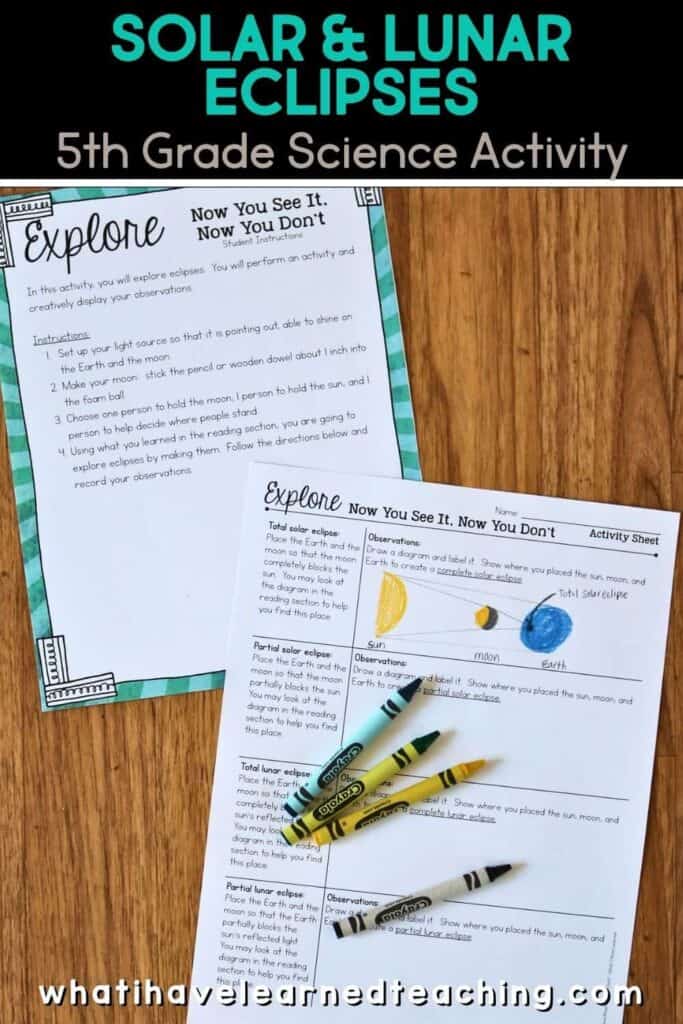
In this EXPLORE science station, students read about solar and lunar eclipses and explore these events in a hands-on activity. The reading passage focuses on how the Earth, sun, and moon interact with one another and how that interaction causes moon phases and eclipses.
For the Explore science activity students set up a light source that is able to shine on a moon on a stick. Students create eclipses by changing the placement of the Earth and moon.

Sort Seasonal Change Scenarios
In this SORT science station, students read about seasonal changes and their causes and effects. They sort several scenarios according to their season.
Students sort scenarios into groups that describe what happens in the spring or autumn, what happens in the summer or winter, or what happens at any time of the year. Here are a few examples. Can you determine how to sort them?
- There are more nighttime hours than daylight hours.
- In the Southern Hemisphere, the constellations Sagittarius and Scorpius can be seen in October.
- The Earth revolves around the sun.
- Around December 21, the Northern Hemisphere has long, dark days and cold temperatures.


Day to Day, Season to Season Science Stations | NGSS 5-ESS1-2
Help fifth graders explore patterns caused by the Earth, moon, and sun with these Day to Day, Season to Season Science Stations! Students investigate day and night, seasons, moon phases, rotations, revolutions, Earth’s tilt, eclipses, seasonal changes, and observable sky patterns through eight NGSS-aligned stations with print and digital options. Aligned to NGSS 5-ESS1-2.
How to Purchase the Fifth Grade Day to Night and Seasons Science Stations
The Day to Night and Seasons Science Station Unit can be purchased on my website or on Teachers Pay Teachers.
Other Fifth Grade Science Stations
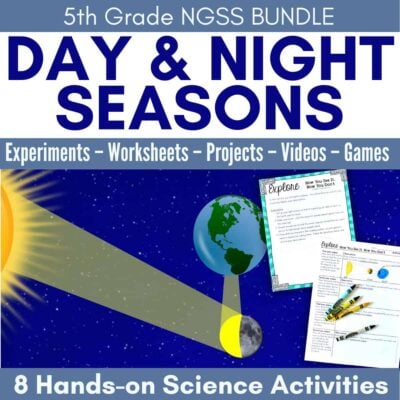
We have fifth-grade science stations for all the NGSS Standards. Click below for information about each one!
-
 Product on sale5th Grade NGSS Science Station Yearlong BUNDLEOriginal price was: $316.00.$177.87Current price is: $177.87.
 -
-
-
-
-
-
-
-
-
-
-



Jessica BOschen
Jessica is a teacher, homeschool parent, and entrepreneur. She shares her passion for teaching and education on What I Have Learned. Jessica has 16 years of experience teaching elementary school and currently homeschools her two middle and high school boys. She enjoys scaffolding learning for students, focusing on helping our most challenging learners achieve success in all academic areas.