
A Teacher’s Guide to the 4th Grade Next Generation Science Standards
Reading and understanding the 4th grade Next Generation Science Standards is challenging. They are three-dimensional with many details and nuances, yet broad and all-encompassing. The NGSS website gives us some information on how to read each standard, but it’s still hard to figure out what to teach for each topic.

We have written our 4th Grade Science Stations based on the Next Generation Science Standards. Explained below is how we have used the standards to write the units.
This blog post will tell you how to read the Next Generation Science Standards and give you an overview of their components. For a more in-depth analysis see the NGSS website or the video below.
4th Grade NGSS: Units and Performance Expectations at a Glance
When I plan for the year, I find it helpful to see all the 4th grade performance expectations grouped by unit before I try to read each standard in depth. Here is how the 4th grade NGSS standards break into units, along with the disciplinary core ideas each one covers.
Physical Science
4-PS3: Energy — Students learn how the speed of an object relates to its energy, how energy transfers between objects through sound, light, heat, and electric currents, and how to apply energy concepts to solve engineering problems. Performance expectations: 4-PS3-1, 4-PS3-2, 4-PS3-3, 4-PS3-4.
4-PS4: Waves and Their Applications — Students explore wave properties, how information can be encoded and transmitted using light or sound, and how technology uses waves to communicate. Performance expectations: 4-PS4-1, 4-PS4-2, 4-PS4-3.
Life Science
4-LS1: From Molecules to Organisms — Students investigate how internal and external structures support survival, growth, behavior, and reproduction in plants and animals. They also explore how animals use their senses to process information and respond to the environment. Performance expectations: 4-LS1-1, 4-LS1-2.
Earth and Space Science
4-ESS1: Earth’s Place in the Universe — Students examine rock formations and fossils as evidence of Earth’s history and changing environments. Performance expectation: 4-ESS1-1.
4-ESS2: Earth’s Systems — Students investigate how rainfall affects the shape of land and identify evidence of past plate movements in rock formations. Performance expectations: 4-ESS2-1, 4-ESS2-2.
4-ESS3: Earth and Human Activity — Students learn about natural hazards, how people use natural resources, and how communities can prepare for natural disasters. Performance expectations: 4-ESS3-1, 4-ESS3-2.
Engineering
3-5-ETS1: Engineering Design — Students define a problem, compare solutions, and test and refine designs. This strand is woven through the science units rather than taught in isolation. Performance expectations: 3-5-ETS1-1, 3-5-ETS1-2, 3-5-ETS1-3.
Planning a Year of 4th Grade Science with the NGSS
The 4th grade NGSS standards cover four domains — physical science, life science, earth and space science, and engineering — but most districts do not teach them in that order. A few things to keep in mind as you map units to the calendar:
Energy (4-PS3) pairs naturally with Waves (4-PS4) because both deal with how energy moves. Many teachers sequence these together in the fall or winter, then move to Earth Science units in the spring when weather and natural hazards are seasonally relevant.
Earth’s History (4-ESS1) and Earth’s Systems (4-ESS2) both involve reading rock layers and interpreting evidence of change over time — they share the same scientific reasoning skills and are often taught in the same unit or back-to-back.
Structures and Processes (4-LS1) stands on its own and works well as a shorter unit. It connects naturally to engineering design (3-5-ETS1) because the structures students study often solve survival problems that engineers replicate in technology.
Natural Hazards (4-ESS3) is a strong unit for late fall or winter, when some regions are actively experiencing storms. It gives the content an immediacy that students notice.
Engineering design is not a stand-alone unit in the NGSS — it is embedded throughout. You do not need to schedule a separate engineering block; instead, look for a design challenge in each unit.
Three-Dimensional Next Generation Science Standards
The Next Generation Science Standards (NGSS) are written to be “Three-Dimensional.” This means that the standards are classified first by their Performance Expectations (PE). These are the scientific skills and abilities that students are expected to master as they learn scientific content.
The Performance Expectation(s) are subdivided into three categories, anchored by the Disciplinary Core Idea (DCI). This is the actual science content that students learn as they master the PE. As students learn the DCI while mastering the PE, they are making connections to Science and Engineering Practices. They are also observing the Crosscutting Concepts, which are generalized scientific principles that serve as thread running through all of the fields of science (Patterns, Cause and Effect, Systems and System Models, etc.)
How to Create NGSS Lessons
To create lessons that are NGSS aligned and that are Three Dimensional, you will start with the first two dimensions, the DCI and the PE. They are related, but not mutually exclusive. Together, these components round out the standard and are the targets for assessment.

How We Wrote the 4th Grade Science Stations to be NGSS Aligned
As an example, I’ll use the Fourth Grade Standard from 4-PS3, Energy. If I decide to start constructing my unit using the DCIs, I start with the center orange box. There are several components of this DCI, each associated with one or two PEs, found in the white box.
For example, I notice that DCI 4-PS3.A has two subtopics with it. In the first subtopic, students learn about how the “faster a given object is moving, the more energy it possesses.” This corresponds with the PE 4-PS3-1, “Use evidence to construct an explanation relating the speed of an object to the energy of that object.”
The second subtopic is “energy can be moved from place to place by moving objects or through sound, light, or electric currents.” This corresponds with two PEs. The first, 4-PS3-2 has students “make observations to provide evidence that energy can be transferred from place to place by sound, light, heat, and electric currents.” The second, 4-PS3-3 has students “ask questions and predict outcomes about the changes in energy that occur when objects collide.”
Combining this DCI with the PEs, I want to make sure that students are learning about the energy of motion, they are able to formulate hypotheses, make observations, and use evidence from text, demonstrations, and experiments.
How do the Science and Engineering Practices Fit In?
The Science and Engineering Practices, found in the blue box, provides the third dimension of NGSS-aligned instruction. With Standard 4-PS3, there are three associated Science and Engineering Practices.
The first is that students are to ask questions and define problems. The second asks students to plan and carry out investigations. The third Science and Engineering Practice has students constructing explanations and designing solutions.
Together these Practices provide some more illumination to the PEs discussed above. In totality, for this standard, students will be using the steps of the scientific method to identify problems, formulate hypotheses, design and conduct experiments, make observations, and use those observations to discuss the results. Note: not all standards cover as much of the scientific method as this one does.
Additionally, students should be using engineering skills and practices in order to design solutions to problems associated with energy of motion. They should have an opportunity to solve a problem mechanically, adjusting their design as they go along.
What about the Crosscutting Concepts?
The final component, which is also part of the third dimension of NGSS, is the Crosscutting Concepts, found in the green box on the right. For this standard, students are to see how energy and matter are related by recognizing that energy can be transferred in various ways and between objects. While this will be woven throughout the lessons, I will specifically explain that, while we are looking at how energy is transferred between objects, the properties of matter (mass, density, etc.) affect how energy is transferred.
In this Standard, students will make additional connections throughout the lessons. Not all Standards have these additional connections. In this case, students will learn how engineers improve existing technologies or develop new ones, how most scientists and engineers work in teams, and how science affects everyday life. I would not develop separate lessons for these, but would instead point out how many of our classroom experiments and engineering projects model how real-life scientists and engineers approach their work. I would engage students in discussions about how what we are studying in class applies to and/or affects everyday life.
Rather than starting with the DCI, I might choose to design my unit by starting with the PE. In this case, I look in the top white box. Four PEs are associated with the various DCIs.
Either way, this Standard might be broken up into several mini-units.
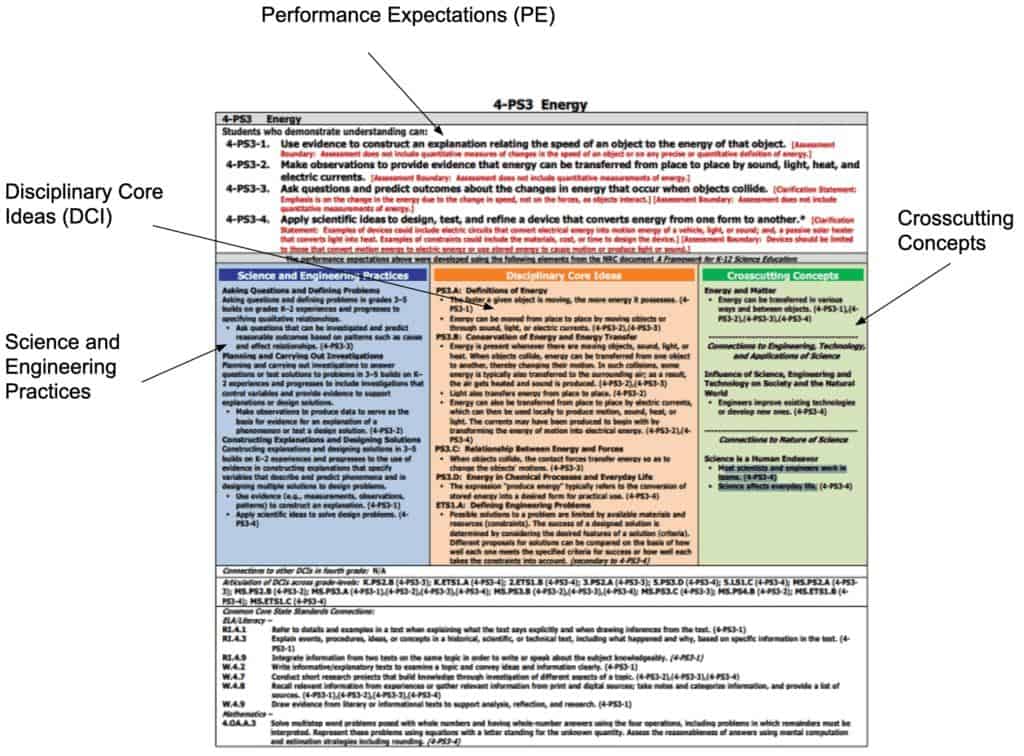
Taken from https://www.nextgenscience.org/sites/default/files/NGSS%20DCI%20Combined%2011.6.13.pdf
The Fourth Grade Science Stations
We created a line of products aligned with the Next Generation Science Standards: our Science Stations Sets. Each Station Set includes eight science stations designed as engaging instructional tools to teach the NGSS Disciplinary Core Ideas.




More Information about How to Read the NGSS
One more resource that you might find helpful is this YouTube Video that explains the dimensionality of the NGSS.

Classroom Teaching Resources We Have Written using the NGSS
We have written Science Stations and 5E Instructional Units for Second, Third and Fourth Grade using the Next Generation Science Standards.
Click here to read more about the 5E Instructional Units.
Click here for the Second Grade Science Stations.
Click here for the Third Grade Science Stations.
Click here for the Fourth Grade Science Stations.

Jessica BOschen
Jessica is a teacher, homeschool parent, and entrepreneur. She shares her passion for teaching and education on What I Have Learned. Jessica has 16 years of experience teaching elementary school and currently homeschools her two middle and high school boys. She enjoys scaffolding learning for students, focusing on helping our most challenging learners achieve success in all academic areas.