
5E Unit Plans for Third Grade – Engaging Lessons, Activities, and Experiments

These 5E Unit Plans for Third Grade are exactly the science resources teachers need to plan and implement inquiry-based science instruction. The 5E lesson plan provides the right amount of scaffolding at each phase of the learning cycle to ensure a depth of learning for each science topic.

Are you looking for 4th grade 5E Units? Click here for the 4th grade 5E Unit for Energy in Motion to get started!
5E Instructional Model Recap
During this blog post series, we discussed the 5E Instructional Model. In this model, teachers facilitate student learning in an inquiry-based model of instruction. Using questions, experiences, and research, students gain a deep understanding of science concepts. You can find out Why I Love the 5E Model of Science Instruction and Why Use the 5Es? in Parts one and two of the series. This is Part 5 about the Exploration Phase.
There are five phases of the 5E Instructional Model: Engagement, Exploration, Explanation, Extension, and Evaluation.
5E Unit Plans for Third Grade
The 5E Unit Plans for third grade guide students through their learning experience. Teachers facilitate discovery through questioning, encouraging, and supporting research projects. The 5E Unit Plans provide teacher support, questions to ask, materials lists, and three options for inquiry-based activities at each stage of the process.
They include hands-on activities and high-interest lessons to engage all styles and levels of learning. There is also flexibility within the unit plans to allow for longer or shorter teaching periods and to allow for correlation with the Science Stations.
There are three parts to each of the 5E Instructional Model phases, for a total of 15 lessons in the unit.
You can see a preview and purchase the 5E Balanced and Unbalanced Forces Unit on Teachers Pay Teachers.
What standards are addressed in the 5E lessons?
The 5E Unit Plans for third grade correlate with the NGSS Performance Expectations, not the DCI.
In the Unit Plans, we have outlined in great detail how the Unit Plans fit into the Next Generation Science Standards (NGSS) Three Dimensional standards. Within the unit, we explain how we have met the Performance Expectations, Disciplinary Core Ideas, and Science and Engineering Practices in the Unit Plan.
In fact, the 5E Instructional Model is the method that NSTA (National Science Teacher’s Association) and Achieve (authors of NGSS) recommend for best teaching practices.
How long does it take to teach the 5E Unit Plans for Third Grade?
For each Performance Expectation, we have created a unit plan that can be tailored to your needs and schedule.
There are options for finishing the process in 5 days, 7-10 days, and two weeks. You may use this product on its own or weave in our Science Stations.
We have specific suggestions for where each station fits best into the different phases of the 5E Instructional Model.
A Closer Look at each phase in a 5E Unit
The images below come from the Balanced and Unbalanced Forces 5E Instructional Unit for Third Grade. All of the units follow a similar format and include:
- Teacher Notes that Explain the 5Es and the NGSS Science Topic
- Common Misconceptions for the Science Topic
- Teaching Timeline that includes four options from 5 to 10 or 11 days
- Vocabulary Cards that match the vocabulary in the Science Stations
- Big Idea Posters
- Exit Tickets
- Engage (three parts)
- Explore (three parts)
- Explain (three parts)
- Extend (three parts)
- Evaluate (three parts)
- Powerpoint for Teacher Presentation
- Links to Google Slides for Teacher Presentation and Student Paperless Option
While we offer three parts for each section of the 5Es, we also offer a condensed teaching timeline and tell you which parts to focus on if you are not able to teach the entire unit.
Vocabulary Cards / Big Idea Posters / Exit Tickets
Each unit comes with teacher notes and materials that include background knowledge, a timeline, materials, misconceptions about the topic, and detailed lesson plans. Also included are vocabulary cards matching each science station’s vocabulary as well as big idea posters and exit tickets.

The Exit Tickets come in three formats: multiple choice, short answer, and fill-in-the-blank.
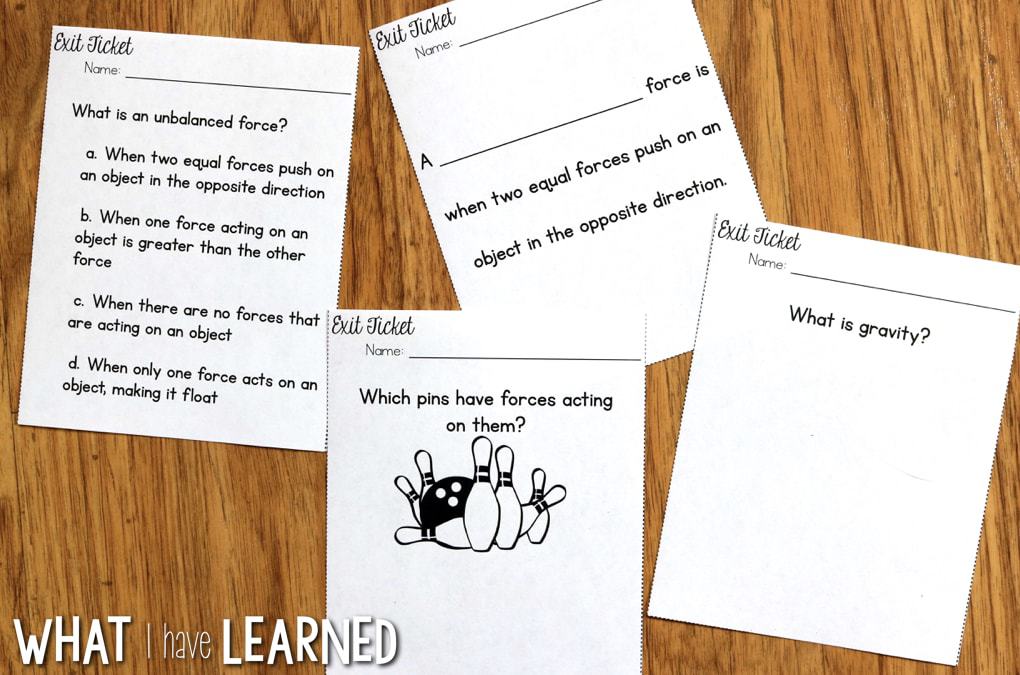
The exit tickets, vocabulary cards, and big idea posters can be used throughout the unit to check for understanding and guide student learning.
Engage 5E Science Lessons
The purpose of the Engage section of the 5E instructional model is to pique student interest and spark curiosity about the current topic. Students are encouraged to connect their prior knowledge to a current situation or example given to them by the teacher.
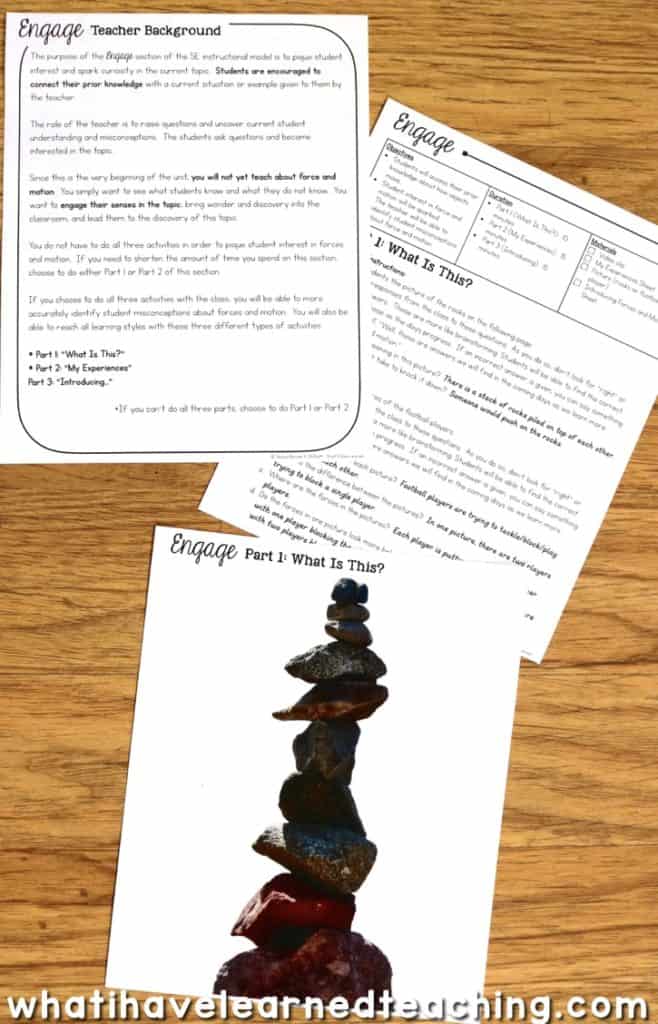
The three lesson parts of the engage section vary and include watching a video, having a discussion about a picture, analyzing what is happening in smaller pictures, and more.

You can find out more information about the Engage section in this blog post.
Explore 5E Science Lessons
The Explore section of the 5E instructional model aims to allow students to explore a new topic and gather information about it. In this section, students are given the opportunity to think creatively and build science skills.
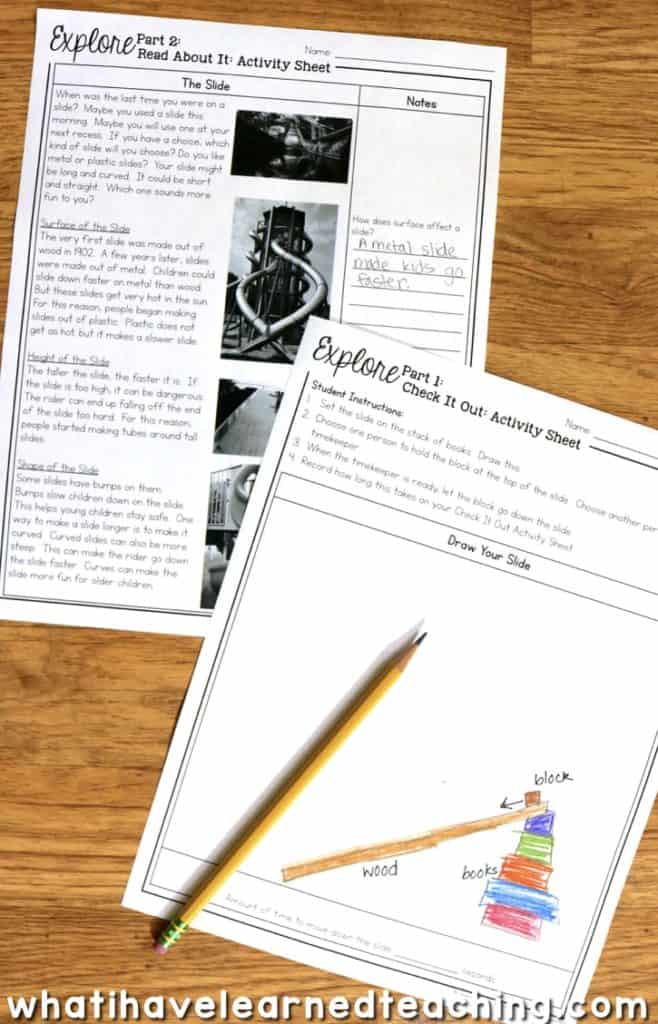
You can see two of the parts of this section above. In one part, students explore constructing a slide. In another part, students read about slides and the effects of the surface, height, and shape of the slide.
Remember at this stage students are not yet taught the vocabulary and key concepts, but they are exploring those topics through hands-on investigations.
You can read more about the Exploration phase in this blog post.
Explain 5E Science Lessons
The purpose of the Explain section of the 5E instructional model is to allow students to analyze their findings from the Explore station and make explanations of their observations. Students are able to analyze their findings and listen critically to others’ explanations.
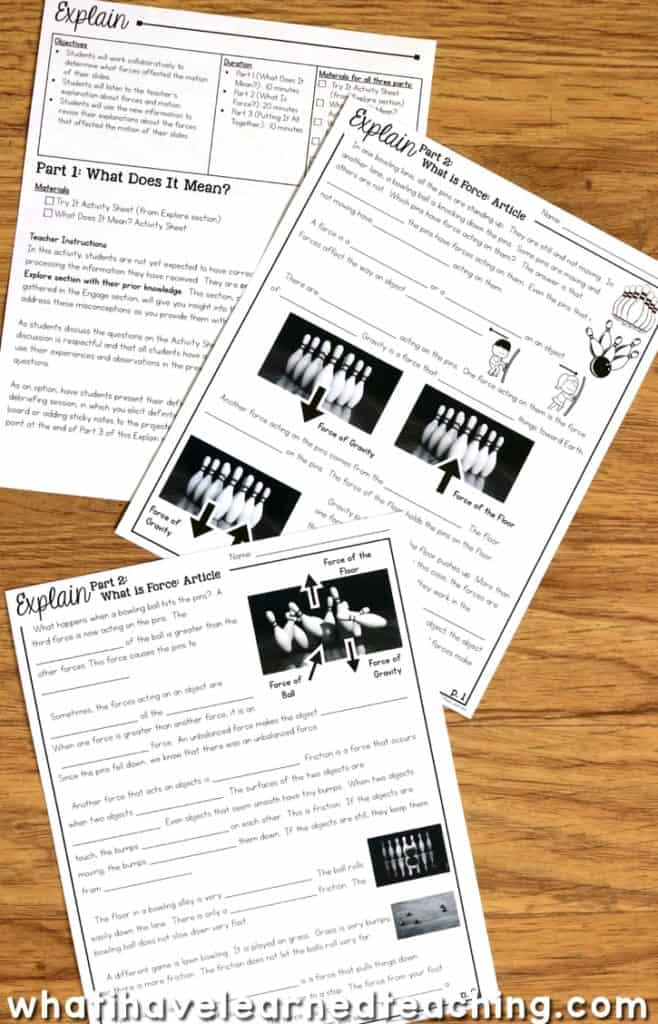
In the Explain section, students are taught the key concepts and vocabulary. Again, we provide three parts to the sections. One part has students reflect on their Explore activities and analyze them.
Another part has students read a passage. We have provided the passage in three formats. One with just the text, one with a note-taking column, and another with fill-in-the-blanks for students to use during a read-aloud of the text.
You can read more about the Explanation phase in this blog post.
Extend 5E Science Lessons
The purpose of the Extend section of the 5E instructional model is to elaborate on the instruction and the learning that has so far taken place.
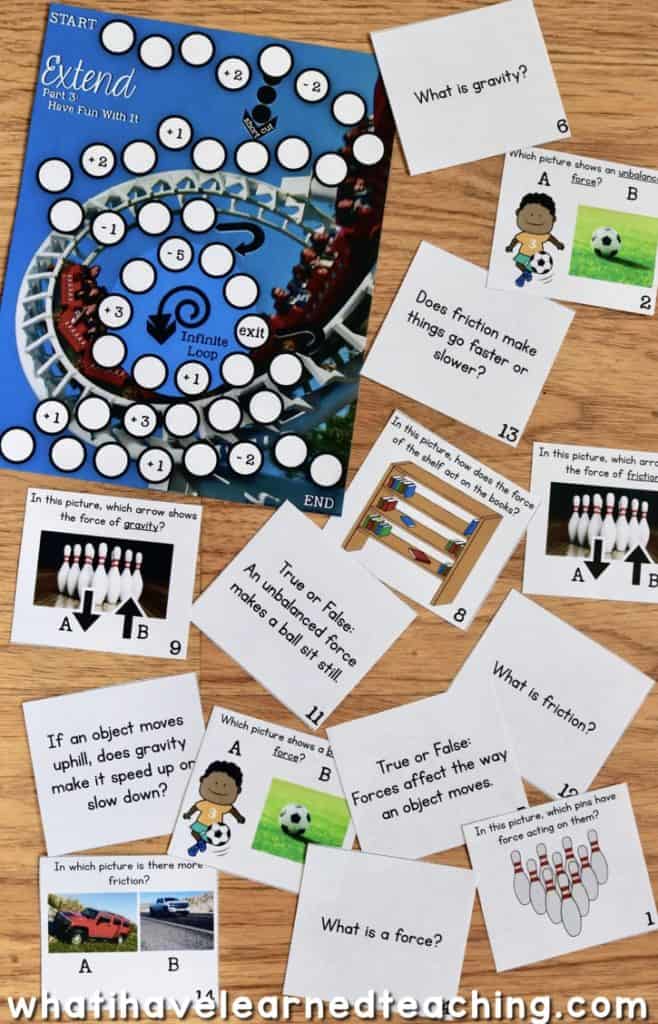
The Extension phase is where students solidify their learning and have fun with their new knowledge. This section has three parts. One part is a game like the one pictured above, where students work with a partner to answer questions.
You can read more about the Extension phase in this blog post.
Evaluate 5E Science Lessons
The purpose of the Evaluate section of the 5E instructional model is for students to demonstrate their understanding of concepts and vocabulary. Students will also demonstrate the skills they’ve developed in this unit.
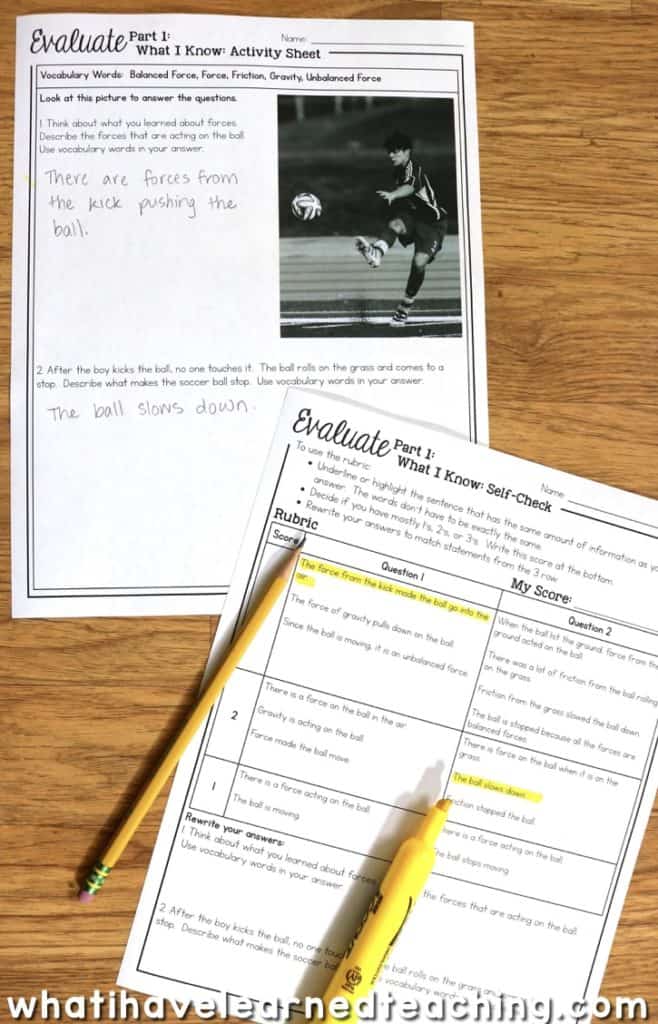
The Evaluate section also has three parts, including a student self-evaluation. Students will be able to analyze their own learning, and teachers will be able to determine the depth of student understanding.
The unit does not include a unit test. The intention of the Explain section is for students to analyze their own understanding and demonstrate their fluency with the new science concepts and for teachers to determine whether students know and understand the science concepts.
You can find out more information about the Evaluation section in this blog post.
Google Slide Resources
The Teacher Presentation is available as a Google Slide. It can help you present the content to students and engage them with colorful photos and directions.
The Student Sheets are available in Google Slides and provide a paperless option. Not all of the student sheets lend themselves to a paperless option as students are asked to draw some things. Use the slides that work best for your classroom and students.
5E Instructional Model Blog Post Series
This blog post is part of a series of posts on the 5E Instructional Model for teaching science.
Here are links to the other articles in this series:
- Part 1: Why I Love the 5E Model of Science Instruction
- Part 2: Why Use the 5Es?
- Part 3: What are the 5Es?
- Part 4: Engage Lessons
- Part 5: Explore Lessons
- Part 6: Explain Lessons
- Part 7: Extend Lessons
- Part 8: Evaluate Lessons
- Part 9: Our 5E Science Lessons
5E Unit Instructional Units
We are creating NGSS-aligned 5E Unit Plans for elementary classrooms, starting with Third Grade. In these lessons, students are led through each NGSS Performance Expectation (not the DCI) using the 5E Model of Instruction. The 5E lesson plans can be purchased on my website via the links above or on Teachers Pay Teachers.
5E Unit Plans for Third Grade
Below are our 5E Unit Plans for third grade. There are 15 units, one for each of the NGSS third-grade standards.
-

-
Product on sale5E Unit Plans for Third Grade BUNDLEOriginal price was: $148.10.$95.00Current price is: $95.00.
-
-
-
-
-
-
-
-
-
-
-
-
-




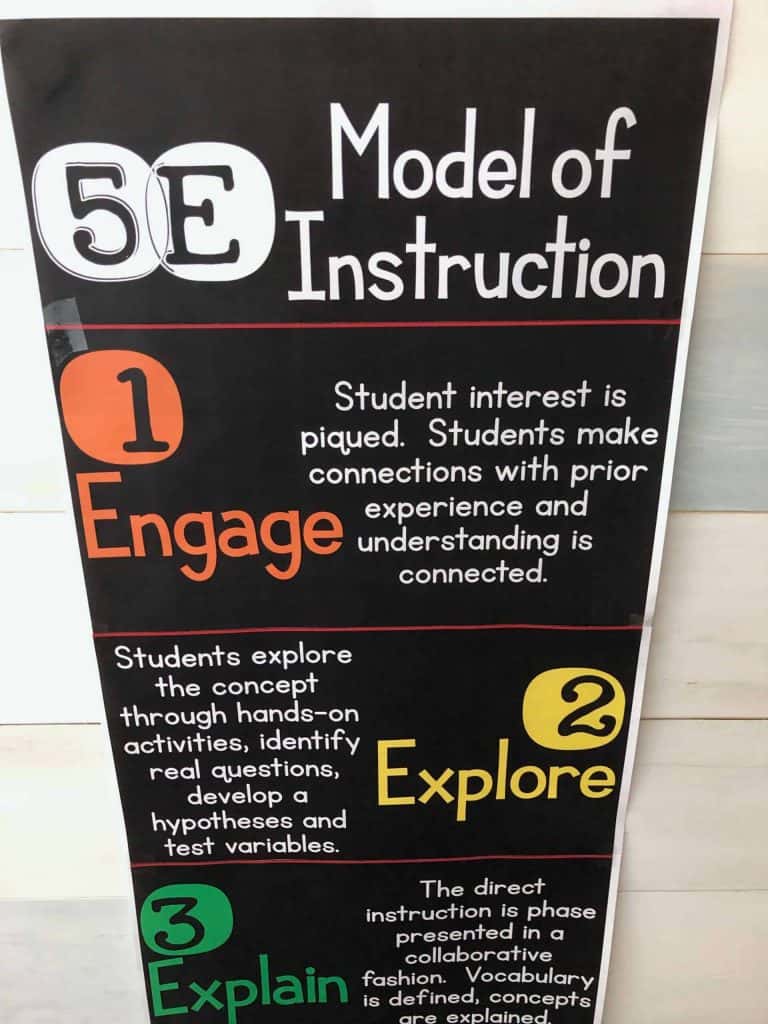
Are you interested in receiving a set of 5E Posters? These posters can be displayed individually or taped together to create a chart as you see here.

I have been a teacher for 28 years, and I have intuitively included many of the components of the 5E’s into my lessons, but I am new to this exact format.
I used to be an elementary teacher in a self-contained classroom, but due to budget cuts our school’s art and music department was eliminated. In order to give teacher’s planning time, science and computers became a special, and I now have the title of K-4 Integrated Science and Technology. I get each group of students three times, either twice for science and once for tech or twice for tech and once for science. Classes are 45 minutes long, and I embed science into the computer skills that I teach.
I am excited to change the way that I plan and sequence my activities, and I am excitedly reading the 5E series that you have provided. Having something to follow with actual samples will make it easier for me to transition and organize my materials accordingly. Thank you!
I have integrated NGSS into my curriculum as a second grade teacher. I LOVE the 5E model and the lessons/investigations look incredible and engaging! I read on TPT that you were hoping to create these for second grade. Are they available yet for purchase? I’d love to start this in the new school year.
THANK YOU!!
Kari
Awe. Thanks so much! Yes! The 5E Units are great! We will be making some for 2nd grade, but I don’t have a timeline for them yet. It won’t be before next school year though. I wish we could finish everything that quickly! It’s on our list to create and we will create them 🙂
Are the exit tickets sold separately? I just bought a few units for 3rd grade after buying your units for 4th and didn’t even realize you sold exit tickets too!
The exit tickets are only available with the 5E units, which are only available for third grade right now.
Hi there
I love your plans! Do you have them available for 5th grade with the NGSS standards? If not, will they be available in the future?
We do not have 5th grade 5E units available yet. We plan on creating them, but are taking a break from 5E unit creation.