
What Is the Evaluation Phase of the 5E Instructional Model?

During the Evaluation phase of the 5E instructional model, teachers and students assess how well the scientific concepts have been learned. Students reflect on their understanding of the topic, while teachers gather evidence of learning through a variety of assessments.
Evaluation can include both formal assessments, such as quizzes or performance tasks, and informal assessments, such as student reflections or group discussions.

In this article, you’ll learn what happens during the 5E Evaluate phase and see examples of activities teachers can use to measure student understanding.
5E Instructional Model Recap
The 5E instructional model is a framework for inquiry-based science instruction. Students develop understanding through five phases:
This article focuses on the Evaluation phase, the final stage of the learning cycle.
If you are new to the model, start with this article:
What Happens During the 5E Evaluation Phase
Students Reflect on What They Have Learned
By the time students reach the Evaluation phase, they have explored the topic, learned the scientific explanations, and applied the concepts in new situations.
Students now reflect on how their understanding has changed. They compare what they knew at the beginning of the unit with what they know now.
This self-reflection helps students recognize how their thinking has developed.
Teachers Assess Student Understanding
Teachers also use this phase to evaluate student learning.
Assessment can be informal, such as observing student discussions or reviewing concept maps. It can also be formal, such as quizzes, written responses, or performance tasks.
The goal is to determine whether students understand the key scientific concepts and vocabulary introduced during the unit.
Teachers Reflect on Instruction
The Evaluation phase is also an opportunity for teachers to reflect on their instruction.
Teachers may consider questions such as:
- Which activities helped students understand the concept best?
- Were there misconceptions that still need to be addressed?
- What changes could improve the next unit?
Reflecting on instruction helps teachers refine future lessons.
Types of Activities for Evaluating Student Understanding
Teachers can evaluate student understanding in many different ways during the Evaluation phase.
Performance Assessment
Students demonstrate their understanding by completing a task or solving a problem.
For example, students may be asked to use materials to demonstrate a scientific concept or explain how a system works.
Self-Assessment Tool with a Rubric
The student can evaluate his or her learning using a self-assessment tool. This might be a demonstration, essay question(s), or other open-ended question.
After the student demonstrates or writes answers, he or she will use a rubric to reflect on his or her answer.
Graphic Organizer
The student can use a graphic organizer to present the information he or she learned. This can be in the form of a drawing, diagram, map, graph, flow chart, or concept chart.
Worksheets, quizzes, Unit Tests
The teacher can provide worksheets, quizzes, and/or unit tests. These can use a variety of question formats, such as fill-in-the-blank, multiple choice, matching, short answer, and extended constructed response.
Checklist of Important Concepts and Vocabulary
The teacher can use a checklist of important concepts and vocabulary for students to master. Each point can be checked off as the student demonstrates mastery. This may be done using one assessment tool or a variety of them. Evidence for each point of the checklist can be compiled in a portfolio. This is especially useful for students who are English Language Learners or who have an IEP.
Construct a Model
Students can construct a three-dimensional model of the topic. This can be a scale model or diorama. Each part will be labeled. A brochure or report can accompany their work to explain anything that is not fully explained by the product itself.
Creative Assessment
Students may demonstrate understanding through creative projects such as:
- brochures
- articles
- posters
- board games
- presentations
These projects allow students to show what they know in different ways.
Oral Video or Presentation
Students can make a creative oral product. This may be a recorded interview, play or movie, debate, song, or oral report.
Ask Next Step Questions
Students ask the “next steps” question. They identify the topic that would logically flow from this one. They then design an investigation and/or experiment to study this topic and find answers.
Questions Teachers Ask During the Evaluation Phase
Teachers use a variety of questions during the Evaluation phase to assess understanding.
Examples include:
- List four things you know about ________________________.
- Something I would like to know more about is ________________________.
- Why does ________________________ happen?
- What are the similarities between _________________ and _________________? Why is this?
- What are the differences between _________________ and _________________? Why is this?
- Explain _________________ .
- Define __________________.
- Why do you think __________________? What evidence do you have?
- How would you solve this __________________ real-world problem?
- A research question is __________________. What sort of experiment would you conduct in order to answer that question?
These questions encourage students to explain their thinking and demonstrate their understanding.
Why Evaluation Happens in Multiple Ways
Evaluation in the 5E instructional model goes beyond traditional tests.
Throughout the unit, teachers observe student discussions, review concept maps, and listen to student explanations. These informal assessments provide valuable information about student understanding.
Formal assessments provide additional evidence of learning.
Student self-assessment is equally important. When students reflect on their thinking, they develop stronger metacognitive skills and gain a clearer understanding of their progress.
By the end of the Evaluation phase, students are able to demonstrate what they know and identify questions they may still have.
Example of a 5E Evaluation Activity
Here is an example of a 5E Evaluation activity:
After completing a unit on forces and motion, students design a simple experiment to demonstrate how friction affects movement.
Students explain their results and describe how friction influenced the motion of the object.
The teacher evaluates student explanations using a rubric that measures understanding of key vocabulary and concepts.
5E Instructional Model Series
This article is part of a series about the 5E instructional model for science teaching.
Here are links to the other articles in this series:
- Part 1: Why I Love the 5E Model of Science Instruction
- Part 2: Why Use the 5Es?
- Part 3: What are the 5Es?
- Part 4: Engage Lessons
- Part 5: Explore Lessons
- Part 6: Explain Lessons
- Part 7: Extend Lessons
- Part 8: Evaluate Lessons
- Part 9: Our 5E Science Lessons
5E Lesson Plans
We have created NGSS-aligned 5E Unit Plans for third and fourth grades. In these lessons, students are led through each NGSS Performance Expectation using the 5E Model of Instruction.
3rd Grade 5E Units
Here are our 5E units for third grade.




4th Grade 5E Units
Here are the 4th Grade 5E Units:
-

-
-
-
-
-
-
-
-
-
Product on sale4th Grade 5E NGSS Science Unit Plan BUNDLEOriginal price was: $138.60.$99.00Current price is: $99.00.
-
-
-
-
-
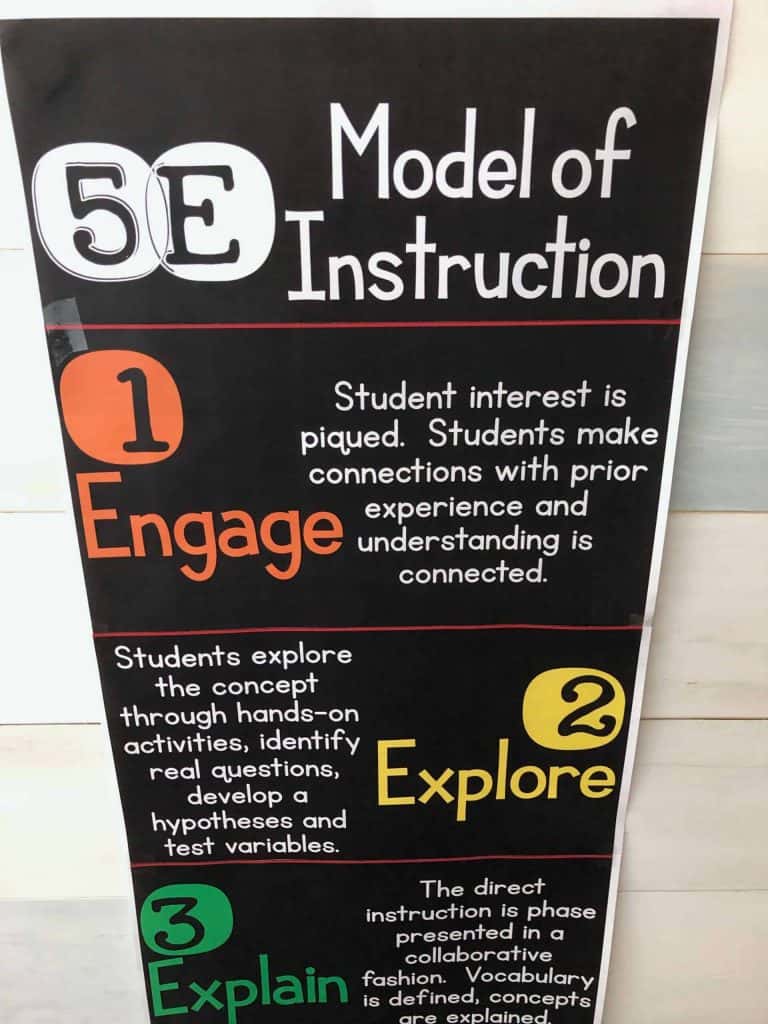
Free 5E Instructional Model Posters
Want a simple way to help students understand the 5E learning cycle?
Enter your email below and I’ll send the posters straight to your inbox.
Jessica BOschen
Jessica is a teacher, homeschool parent, and entrepreneur. She shares her passion for teaching and education on What I Have Learned. Jessica has 16 years of experience teaching elementary school and currently homeschools her two middle and high school boys. She enjoys scaffolding learning for students, focusing on helping our most challenging learners achieve success in all academic areas.