
5E Engage Phase: Activities and Examples for Science Lessons

The Engage phase of the 5E instructional model is where students become curious about a new science concept. Instead of starting with direct instruction, teachers introduce an interesting question, demonstration, or activity that captures students’ attention.

During this stage, students connect the new topic to their prior knowledge and begin asking questions about what they observe. The goal of the Engage phase is to spark curiosity and uncover what students already think they know about the concept.
In this article, you’ll learn what happens during the 5E Engage phase, along with examples of activities and questions that help students begin investigating a science topic.
5E Instructional Model Recap
The 5E instructional model is a framework for inquiry-based science instruction. Instead of beginning with lectures or definitions, students develop understanding through investigation and discussion.
The model includes five phases:
This article focuses on the Engage phase, which is the first step in the learning cycle.
If you are new to the model, start with this article:
What Happens During the 5E Engage Phase
During the Engage phase, students begin thinking about the new topic by connecting it to experiences they already have. Teachers introduce a question, image, demonstration, or discussion that encourages students to share what they know.
Students may first reflect individually and then discuss their ideas with classmates. These conversations help students articulate their understanding and begin noticing gaps in their knowledge.
Students Identify What They Want to Learn
As students discuss the topic, they begin to recognize things they do not yet understand. This curiosity drives the learning process.
Students may ask questions such as:
- Why does this happen?
- How does this work?
- What causes this change?
These questions help guide the investigations that will happen later in the lesson.
Teachers Identify Misconceptions
One of the most important goals of the Engage phase is uncovering misconceptions.
Students often come into a science lesson with ideas that seem logical but are scientifically incorrect. By listening to student responses and discussions, teachers can identify these misunderstandings.
Recording these misconceptions helps teachers revisit them later in the unit and ensure that students have corrected them by the end of the learning cycle.
8 Types of 5E Engage Activities
There are many ways a teacher can engage student interest. Below are a few ideas.
Show a Short Video Clip
A short video can spark curiosity about the topic without explaining the science behind it. Choose a clip that introduces an interesting phenomenon or surprising example related to the lesson.
Students can discuss what they noticed and write down what they already know about the topic.
internet image scavenger hunt
Using QR codes or having several bookmarked pages, have students look for certain familiar items within that topic. Students could then engage in a group discussion about things that look familiar to them about those pictures, or write where they think those objects are found. They might write what they have in common and what is different between them.
Poll Students and Graph Responses
Pique student interest (using video, pictures, a question), and then have them answer their question using Google Forms or some other survey tool. Create a bar graph from the data and project it for the class to see. You can generate some interesting group discussions from this.
Visit a webcam
This is especially useful when the teacher is introducing a topic in life science, as there are numerous web cameras on bird nests, zoo enclosures, and wildlife refuges. There are also web cameras at airports, volcanoes, geysers, and others.
Create a Concept Map
Mindmeister is a great website where students can create a digital concept map. Link concepts that are related, and create new branches easily. Alternatively, groups of students can create a concept map on paper.
KWHL activity
This can be done either in groups, individually or as a whole class. Introduce one main part of the topic, probably a single word. In the first three columns, have students list what they “Know,” what they “Want” to know, and “How” to find out about the topic. The Learn column can be revisited in the Explanation, Extension, and/or Evaluation phase of the unit.
A KWHL chart allows students to record:
- What they Know
- What they Want to know
- How they will learn it
- What they Learned later in the lesson
Demonstrate a Surprising Phenomenon
This can be a kind of “wow” demonstration that has a surprising or unexpected outcome. Students can then discuss in groups or individually what they think happened.
Use a very simple graphic organizer
If the topic you will introduce can be explained using pictures (water cycle, parts of an atom, structure of a flower), show a diagram or graphic organizer. Have students explain the parts of the diagram that they know and identify the parts that they don’t know. This could include discussion on what they are seeing and how they think these processes are taking place.
Connect the Topic to Literature
Using a book (fiction or non-fiction), magazine, or current event article, launch a discussion that connects what the students have read to the science topic that is being introduced.
Questions Teachers Ask During the Engage Phase
Teachers guide student thinking during the Engage phase by asking open-ended questions. These questions encourage students to share ideas and reflect on their prior experiences.
Example questions include:
- Some questions that engage the student may be:
- What are your experiences with ________________?
- What do you know about ___________________?
- What do you not yet know about ________________?
- What have you heard about _______________ that you are not sure is true?
- What would you like to learn about ______________?
- What sort of investigation would you need to do in order to find out about ____________?
- Why do you think ________________ happened?
What the Engage Phase Is Not
In traditional instruction, teachers often begin a lesson by defining vocabulary and explaining the concept.
The 5E instructional model takes a different approach. During the Engage phase, teachers focus on sparking curiosity instead of providing explanations. Students begin by sharing what they already know and asking questions about the phenomenon.
Let’s face it: Science is not often students’ favorite subject. It is not often that adults observe students talking about during their free time. But by connecting to prior knowledge with an interesting and evocative question, or by showing students something that grips their minds, students want to talk about the subject, even during their free time.
It is critical to keep this momentum going. Direct instruction at this point would dampen the interest that the teacher has so far generated in the students.
During the engagement phase, students are examining everything they currently know about the topic. They are beginning the conversation, studying it from the angles that they possess right now. The engagement phase is the first step in developing deep learning about the science topic.
Example of a 5E Engage Lesson
Here is an example of a 5E Engage Lesson:
Imagine students are beginning a unit on erosion.
The teacher shows a short video of waves crashing against a cliff. Students observe pieces of rock falling into the ocean.
Students discuss:
- What do you notice happening?
- What might cause the rock to break away?
- Have you ever seen something like this before?
Students record their ideas and questions before beginning investigations in the Explore phase.
5E Blog Post Series
This blog post is part of a series of posts on the 5E Instructional Model for teaching science.
Here are links to the other articles in this series:
- Part 1: Why I Love the 5E Model of Science Instruction
- Part 2: Why Use the 5Es?
- Part 3: What are the 5Es?
- Part 4: Engage Lessons
- Part 5: Explore Lessons
- Part 6: Explain Lessons
- Part 7: Extend Lessons
- Part 8: Evaluate Lessons
- Part 9: Our 5E Science Lessons
5E Lesson Plans
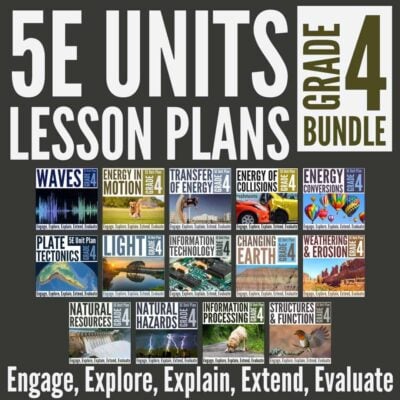
We have created NGSS-aligned 5E Unit Plans for third and fourth grades. In these lessons, students are led through each NGSS Performance Expectation using the 5E Model of Instruction.
3rd Grade 5E Units
Here are our 5E units for third grade.









4th Grade 5E Units
Here are the 4th grade units:
-

-
-
-
-
-
-
-
-
-
Product on sale4th Grade 5E NGSS Science Unit Plan BUNDLEOriginal price was: $138.60.$99.00Current price is: $99.00.
-
-
-
-
-








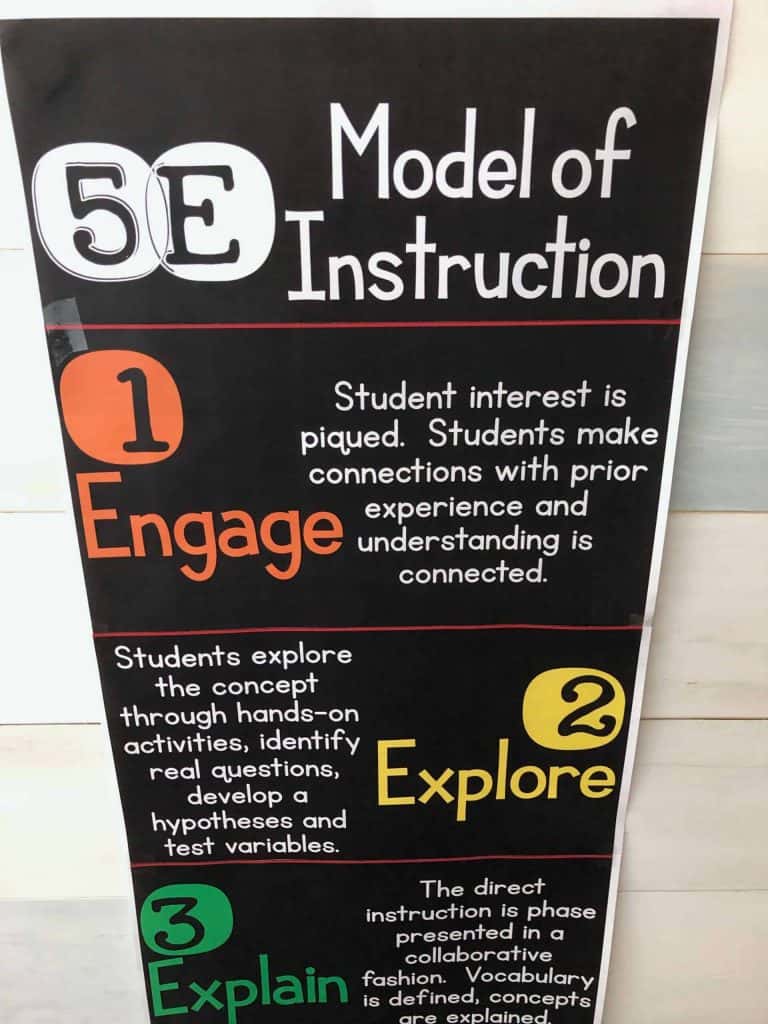
Free 5E Instructional Model Posters
Looking for a simple way to help students understand the 5E learning cycle? These free classroom posters highlight the five phases of the 5E instructional model.
You can display the posters individually during lessons or tape them together to create a visual chart of the entire learning cycle.
Enter your email below, and I’ll send the free 5E posters straight to your inbox so you can start using them in your classroom.

How do you correct misconceptions in this stage without turning to direct instruction? How do you respond if a student incorrectly answers questions such as ‘Why do you think ________________ happened?’ or what if they say something untrue for What do you know about ___________________?
At this stage, students are not expected to know the right answer. Depending on the circumstance that I discover the misconception, I either note it for myself and don’t correct it with the student at the time, or I engage the student in a diving a bit deeper and in exploring the activity. I might also say something like, “later in the week we’ll find out if . . . ” or I might also turn it back to the class and ask for other opinions. It really depends on the situation and whether I can engage the student in a conversation at the time.
This is from Jill:
This is a great question! Many students will answer these questions incorrectly. The point is that you want to find out what their misconceptions are so that you can address them directly in the Explain portion of the 5E’s, and then reevaluate during the Extend and Evaluate portions to ensure that student misconceptions do not persevere. I think, as a teacher, the Engage section can be really difficult. We teach. That’s how we are wired, what we do. We want to explain everything right away! But research shows that if students can discover the answers for themselves, that if they can have their own “Aha!” moment, in which they can see the errors in their own thinking, then their learning will be richer, deeper, and longer-lasting. Often students just want to please us and give us answers that they think we want to hear. They stop thinking, and their creative processing shuts down. They are looking to regurgitate answers and give us what we want. But we want to get those gears moving in their minds. We want them to start thinking creatively, even if it means going down the wrong path. During the next phase, the Explore phase, we begin to guide their thinking, aiming it toward the right path, by giving them very specific experiences to challenge their misconceptions, yet not shut down the creative thinking process.
So my suggestion is that you write down all these misconceptions and make sure that you address them directly during the Explain phase. You can always say to your students, “These are amazing thoughts! It’s going to be fun to discover ______________________ and learn all about it with you this next week. We will get a chance to see if any of your thoughts about it change as we learn more!” In this way, you hint that they may have misconceptions, allowing them the time and space to prepare to change their thinking, without launching into direct instructions, skipping the discovery phases.
Thank you so much for this blog. I am a Pre Kindergarten teacher. How do you modify or ask questions to students so young? Do you think that it’s important to let students dive right in or give them a introduction first. Thanks for your response and again thanks for this great blog .
The 5E Process can definitely be used for pre-K. Much of the 5E process is engaging, developing background knowledge, exploration, and the information learning of the Explain section can be done through whole group lessons and read alouds.
The questions you ask would depend on the part of the 5E process you’re in at the time. They would be similar to the questions posted in the blog posts, but perhaps a little more open-ended and more “I wonder what would happen if ___. What do you think?” type of questions. Questions also change based on how the student is responding to you.
As for diving right in or giving an introduction, the Engage section often starts with pictures or a demonstration. That is the introduction. However, it doesn’t give students information as much as it piques curiosity. We often underestimate how much children actually know about the world around them. I find that they know more than we think they do, but struggle to express that thinking. The 5E model gives them an opportunity to move through a process to learn to express their understanding of scientific topics.
You stated above “TYPES OF ACTIVITIES THAT ENGAGE STUDENTS” Are these activities already included in your bundle or is this something extra I need to come up with?
Included above are examples of ways to ENGAGE students in the new topic. We have used many of these in our 5E Units. There are three ENGAGE activities in each unit. The activities vary from unit to unit. The list above is also helpful for teachers who are not working with our units and creating their own lessons.