
How to Teach Multiplication to Elementary Students: Strategies and Models
Multiplication gets introduced twice in elementary school, and both introductions matter. In 2nd grade, the goal is conceptual. Students build a mental model of what multiplication means using equal groups, arrays, and rows and columns. In 3rd grade, the work deepens: students extend those models, develop the area model, and work toward fluency with multiplication facts.
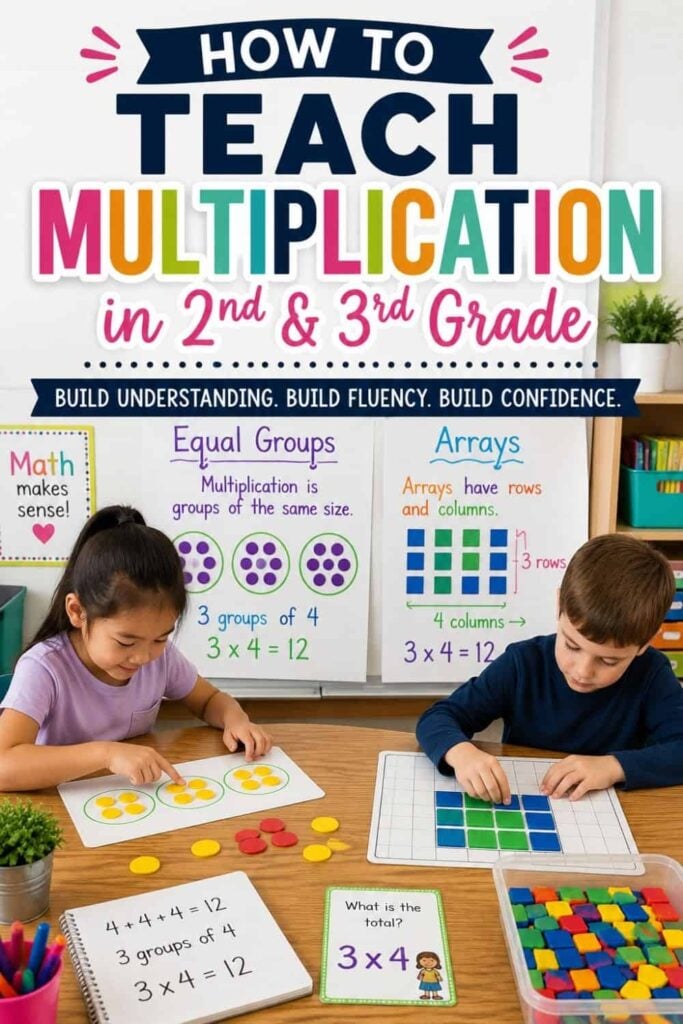
Teachers who understand how to teach multiplication can sequence their instruction deliberately, building on what students already know rather than starting from scratch each year. This post walks through the strategies and models that make the biggest difference at each stage.
Start with Equal Groups: The Foundation of Multiplication
Before students ever see a multiplication symbol, they need to understand what multiplication actually represents. Multiplication is not a trick for adding faster — it’s a way of counting equal groups. Three groups of four is not the same as memorizing that 3 × 4 = 12. It’s a quantity you can visualize, build, and reason about. That distinction matters enormously for what comes later.
The most natural entry point for equal groups is the world students already know. Tricycles have 3 wheels. A carton holds groups of 12 eggs. A hand has 5 fingers. When students brainstorm things that come in groups, they’re not doing multiplication yet — they’re building the conceptual foundation that makes multiplication make sense. Once students can see that there are multiple groups of the same size all around them, connecting that idea to a number sentence is a small step.
In 2nd grade, keep the focus on what multiplication means, not on getting answers quickly. A student who can explain “I have 4 groups of 3, so that’s 12 altogether” understands multiplication better than one who has memorized the fact but can’t explain why it works.
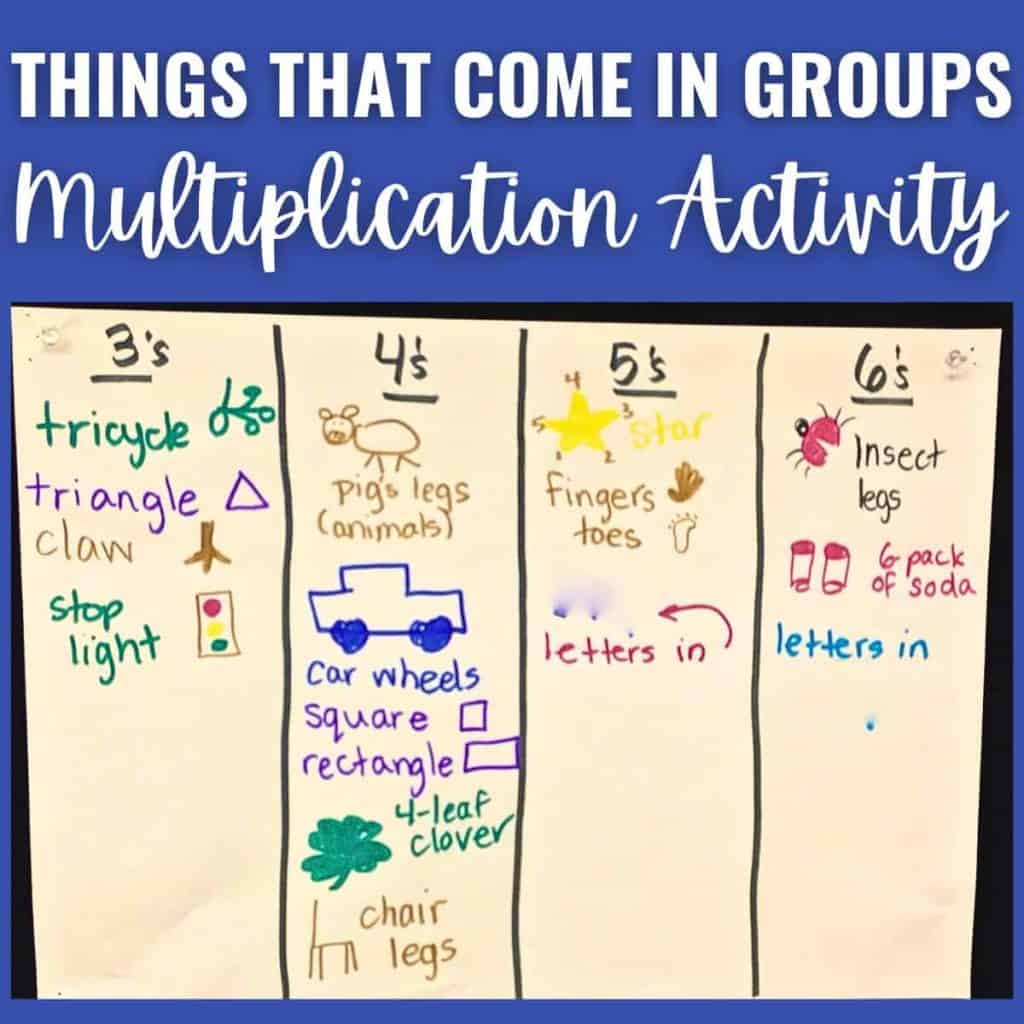
Need ideas of things that come in groups that kids can count to practice multiplication? Here’s a list I use in my classroom.
Teach Multiplication with Arrays
Arrays are the bridge between equal groups and the more formal models students will use in 3rd grade and beyond. An array organizes objects into rows and columns, making the structure of multiplication visible. A 3 × 4 array has 3 rows and 4 columns — you can count the total, see the groups, and begin to notice patterns like commutativity (3 × 4 and 4 × 3 produce the same total, but they look different).
Hands-on array work matters at this stage. Students who build arrays with tiles, counters, or stamps and physically count the rows and columns are developing a mental model they can return to when problems get harder. Candy box arrays are a natural concrete model — the grid structure of a box of chocolates is a real-world array students can immediately visualize. Flower pot arrays give 2nd graders a hands-on way to build and count equal groups in a context that makes sense to them.
Academic language is worth investing in here. Students who can say “this array has 4 rows and 6 columns” are better prepared for 3rd grade than students who can only say “there are 24 of them.” My post on teaching multiplication arrays with academic language walks through how to develop that vocabulary as students work with the models, rather than front-loading definitions before they have anything concrete to attach them to.
Partitioning rectangles is a related 2nd grade skill that directly supports multiplication. When students partition rectangles into rows and columns and count the squares, they’re building spatial understanding that makes the area model feel intuitive rather than arbitrary when it appears in 3rd grade.
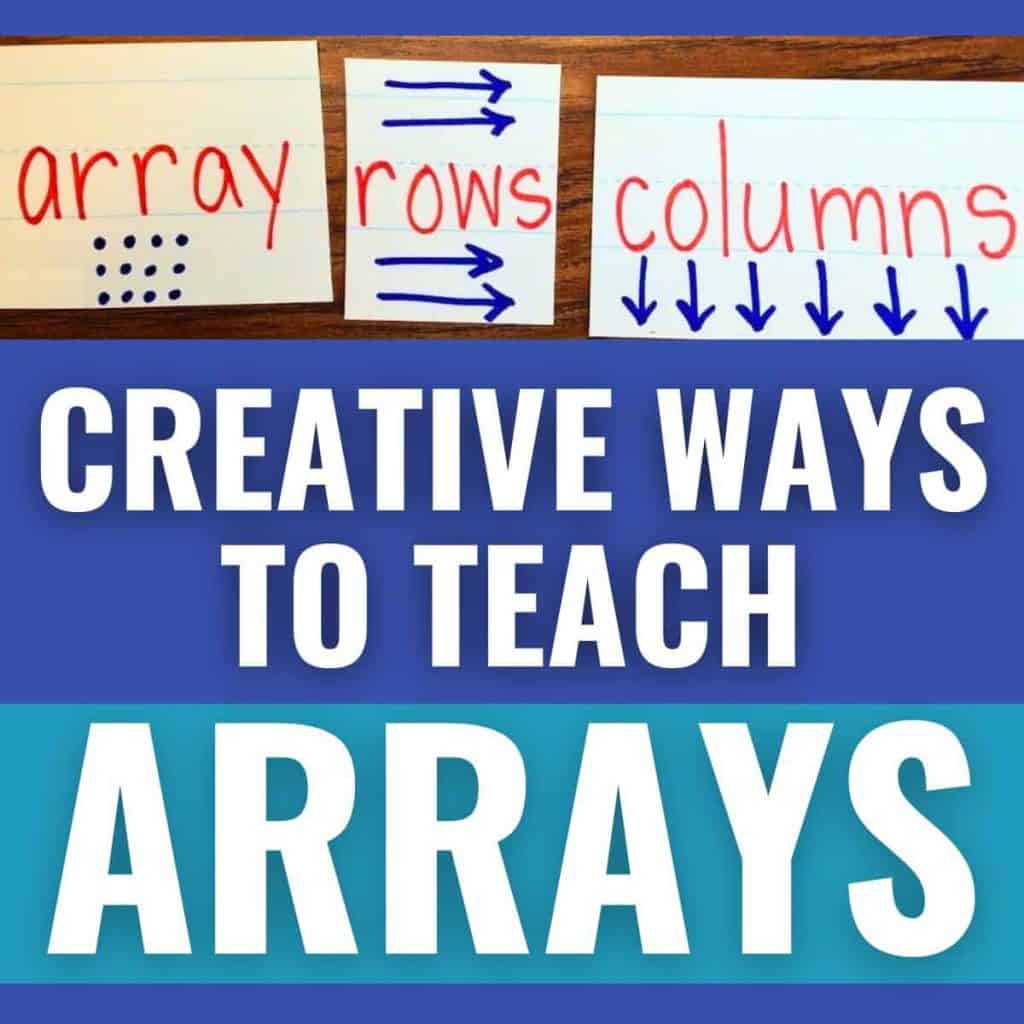
Here is how I teach arrays in my classroom. It’s all about helping students develop math langauge around multiplication.
Bridge to the Area Model in 3rd Grade
The area model is where the conceptual work of 2nd grade pays off. Students who understand arrays — rows and columns, equal groups, the relationship between multiplication and area — find the area model to be a natural extension of what they already know. Students who skipped that foundation often find it abstract and confusing.
The key move in 3rd grade is shifting from physical objects arranged in an array to a drawn rectangle where the side lengths represent the factors. A 4 × 6 rectangle has an area of 24 square units — the same result students got when they counted their 4 × 6 array of tiles. Making that connection explicit and letting students see that the area model and the physical array represent the same thing is what makes the model stick.
The post on building arrays and using an area model shows how to move students through this transition in a concrete way. Once students are comfortable with the area model, multiplication number puzzles are an effective way to deepen understanding — students work with the relationships between factors and products in a hands-on format that goes beyond simple recall.
How to Teach Multiplication Facts: Fluency That Lasts
Fact fluency is a 3rd grade priority, but the way you get there matters. Students who understand multiplication conceptually before they practice facts are better at retaining them because they have something to fall back on when memory fails. A student who can quickly reconstruct 7 × 8 by thinking “7 × 8 is 7 × 7 plus 7 more, so 49 + 7 = 56” has a much more durable skill than one who is pure retrieval — and much less likely to be derailed by a single forgotten fact.
Strategies Before Drills
Before students practice for speed, give them strategies for the facts they don’t know yet. Doubling strategies (× 2), skip counting (× 5, × 10), and the relationship between × 3 and × 6 (double the threes) all give students a way into facts that feel arbitrary. The NCTM position on procedural fluency is clear that fluency built on understanding is more durable than fluency built on memorization alone — students need both the strategies and the practice, not one or the other. The post on 6 ways to teach and practice multiplication facts covers both the strategy side and a range of practice formats that go well beyond flashcard drills.
A multiplication chart is a legitimate tool at this stage — not a crutch to avoid, but a scaffold that lets students see patterns across the whole table. Students who use a chart actively, looking for patterns and relationships, build number sense alongside fact knowledge. Multiplication chart activities give students structured ways to explore those patterns rather than just looking things up.
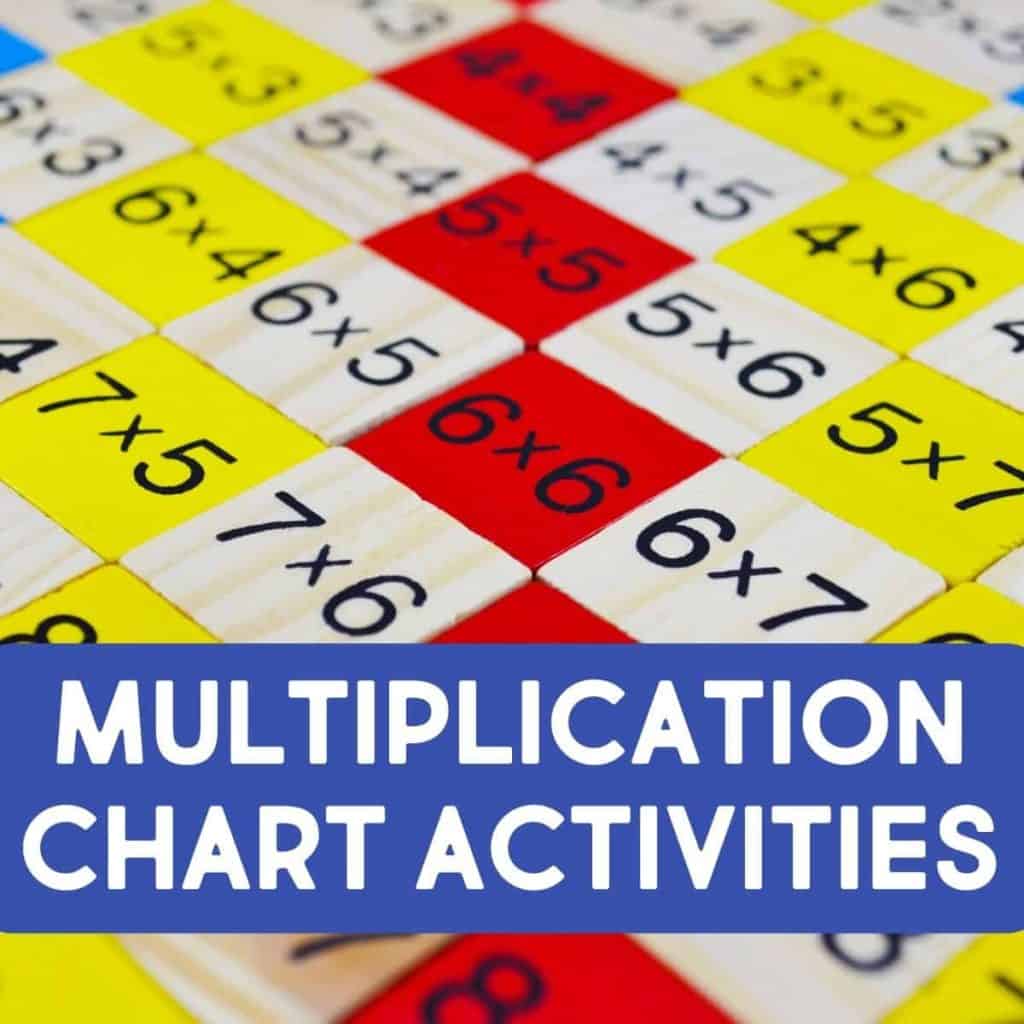
Students can work with the multiplication chart in a variety of ways to solidify their understanding of multiplication facts. Here are a few ideas.
Practice That Actually Works
Once students have strategies for the facts they’re still learning, they need repeated practice — but repeated practice doesn’t have to mean repeated worksheets. Games are one of the most effective formats for fact practice because students encounter the same facts multiple times without the repetition feeling punishing. Multiplication dice games are easy to set up, require minimal materials, and generate a high volume of practice in a short time.
For students working on memorization specifically, making multiplication memorization manageable breaks the task into a sequence that doesn’t overwhelm students — starting with the facts they already know (× 0, × 1, × 10) and building systematically from there. Students who can see how many facts they actually still need to learn, rather than staring at the whole 12 × 12 grid, approach the work with much less anxiety.
Connecting Multiplication to Word Problems
Word problems are where students find out whether they actually understand multiplication or just know facts. A student who can compute 6 × 7 but doesn’t know whether to multiply or add in a story problem hasn’t yet fully grasped what multiplication means in context.
Multiplication keywords — words like “each,” “per,” “groups of,” and “times” — can help students identify when multiplication is the right operation, but they need to be taught carefully. Keywords are a reading aid, not a replacement for mathematical reasoning. A student who circles “each” and automatically multiplies will eventually hit a problem where that strategy fails. The post on multiplication keywords covers when and how to teach them in a way that builds understanding rather than shortcut-seeking.
The most useful word problem habit to build is having students identify the number of groups and the size of each group before they write a number sentence. “There are 6 bags with 4 apples each” — 6 groups, 4 in each group — makes the multiplication structure visible in a way that keywords alone don’t.
Keeping Multiplication Practice Hands-On
Students at both grade levels benefit from practice formats that keep them active and thinking rather than passively filling in answers. A few formats are worth having in rotation throughout the year.
Number puzzles require students to work with the relationships between factors, products, and representations — connecting the array, the number sentence, and the equal groups model in a single activity. The number puzzles for third-grade math stations are built around this multi-representation approach, which makes them genuinely more demanding than a worksheet, even though they feel more like a game.
Cut-and-paste activities are self-checking in a way that standard practice isn’t — if the pieces don’t fit, the answer is wrong, and students have immediate feedback without needing the teacher to check their work. The cut-and-paste third-grade math activities cover a range of 3rd grade standards, including multiplication, making them useful for centers, early finishers, or differentiated practice.
Final Thoughts on How to Teach Multiplication
Teaching multiplication well is really a two-year project. The conceptual work you do with equal groups, arrays, and rows and columns in 2nd grade is what makes the area model, fact strategies, and word problem reasoning in 3rd grade click. Skipping that foundation — or treating the 2nd grade standards as just an introduction to get through — leaves 3rd graders who can sometimes compute but don’t really understand what they’re doing.
Start with meaning, move to models, and let fluency follow understanding. That sequence works every time.
If you’re looking for a ready-made resource that brings equal groups, arrays, and area models together in one activity, the Interpret Multiplication Number Puzzles connect all three problem types in a self-checking format that works well for math stations or independent practice. Also available on TPT.
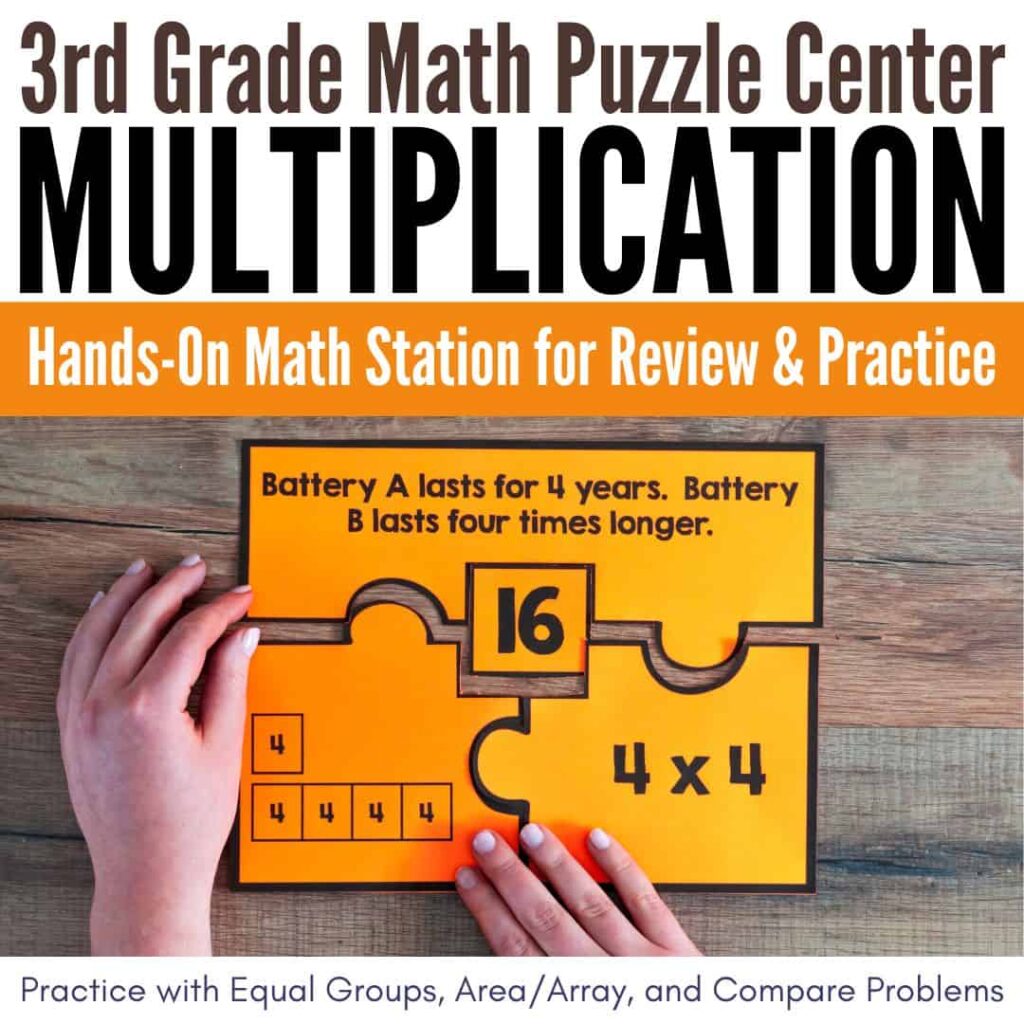
Interpret Multiplication Number Puzzles – OA1
These Multiplication Number Puzzles help students interpret products of whole numbers by reading a context and identifying the expression, model / drawing, and total number. The context describes the relationship of the numbers, but doesn’t not include the question part of a word problem. The focus is on the relationship of the numbers.
Jessica BOschen
Jessica is a teacher, homeschool parent, and entrepreneur. She shares her passion for teaching and education on What I Have Learned. Jessica has 16 years of experience teaching elementary school and currently homeschools her two middle and high school boys. She enjoys scaffolding learning for students, focusing on helping our most challenging learners achieve success in all academic areas.