
When students first encounter multiplication, they need more than a number sentence on the board. They need to see equal groups organized into rows and columns—and they need a reason to care.
That’s where candy boxes come in.
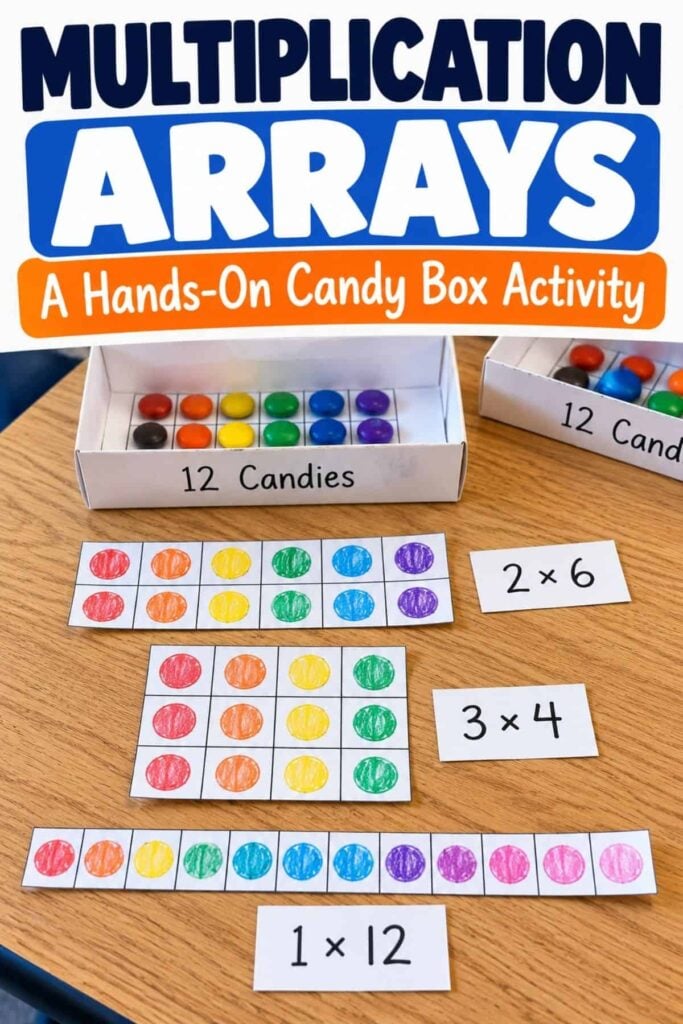
This array activity, adapted from Marilyn Burns’ About Teaching Mathematics: A K–8 Resource, gives students a concrete, memorable context for exploring arrays. Students aren’t just drawing rows and columns on grid paper — they’re designing packaging for a candy company, which turns out to be a surprisingly compelling assignment for second and third graders.
What Is a Multiplication Array?
An array is a rectangular arrangement of objects organized into equal rows and columns. Arrays are one of the most useful models for introducing multiplication because they make the structure of equal groups visible.
When students see an array, they can read it two ways:
- 3 rows of 4 = 12
- 4 columns of 3 = 12
Both equations describe the same array, building early understanding of the commutative property—even before students have that vocabulary.

The Candy Boxes Activity
Setup: Tell students they’re designing candy boxes for a company. The boxes must be rectangular or square (no L-shapes or other irregular arrangements). Each box holds a specific number of candies, and students’ job is to find every possible arrangement.
Start with three numbers: 6, 12, and 24.
Give students grid paper and have them cut out every possible rectangular array for each number. For 12 candies, for example, students would find:
- 1 × 12
- 2 × 6
- 3 × 4
- 4 × 3
- 6 × 2
- 12 × 1
Students write the multiplication expression on each array (rows × columns) and label it clearly.
The letter extension: Once students have found all the possible boxes for their number, they write a letter to the president of the candy company recommending which box they think would be best — and explaining why.
This is where the activity gets interesting. Some students argue for the largest box because it holds the most candy. Others think about which shape would be easiest to stack, display, or carry. The reasoning varies and is often surprisingly thoughtful.

What Students Learn
The candy box context keeps students focused on what they’re actually doing: finding all the ways to break a number into equal groups. As they cut and arrange, they start to notice things naturally:
- Some numbers only have two arrays (like 7: just 1 × 7 and 7 × 1). These are prime numbers, though you may not use that term with second graders yet.
- Some numbers have a square array where the rows and columns are equal (like 4: 2 × 2, or 9: 3 × 3). These are square numbers.
- Flipping an array gives a different equation but the same product — rows × columns vs. columns × rows.
You don’t need to teach these concepts explicitly during the activity. Let students discover the patterns and bring them to the class discussion afterward.

The Array Chart: Extending to 1–36
Once students are comfortable with candy boxes, extend the activity by having them find all the different arrays for every number from 1 to 36.
Students record their findings on a class chart. As each number fills in, the patterns become visible across the whole set:
- Prime numbers (2, 3, 5, 7, 11, 13…) only have two arrays each
- Square numbers (1, 4, 9, 16, 25, 36) have a square array among their combinations
- Highly composite numbers like 24 and 36 have the most possible arrays
The chart becomes a reference point for discussing number relationships throughout your multiplication unit. My second graders were still spotting new patterns weeks after we built it.

How to Use This in Your Classroom
Introduce it whole-group. Model the candy box setup with one number (6 is a good starting point—manageable but with more than one array). Think aloud as you cut and arrange on the projector so students see the process before they try it independently.
Let students work in pairs. The cutting and arranging go faster with two people, and the conversations are valuable. Listen for students debating whether 3 × 4 and 4 × 3 are really different boxes.
Debrief the letter writing together. Share a few student letters and discuss the reasoning. There’s no single right answer, which is part of the point—students use mathematical thinking to make an argument.
Use the 1–36 chart as an anchor for number talks. Return to it during morning meetings or math warm-ups. “Look at 24 and 12. What do you notice?” gives students repeated exposure to array structure without another full lesson.
For a full overview of multiplication models and strategies, see how to teach multiplication.
Arrays are one of those models that pay off over time. Students who understand arrays in second or third grade have a much easier time with area models, partial products, and eventually the distributive property. The candy box context makes the introduction concrete and memorable—which is most of the battle.
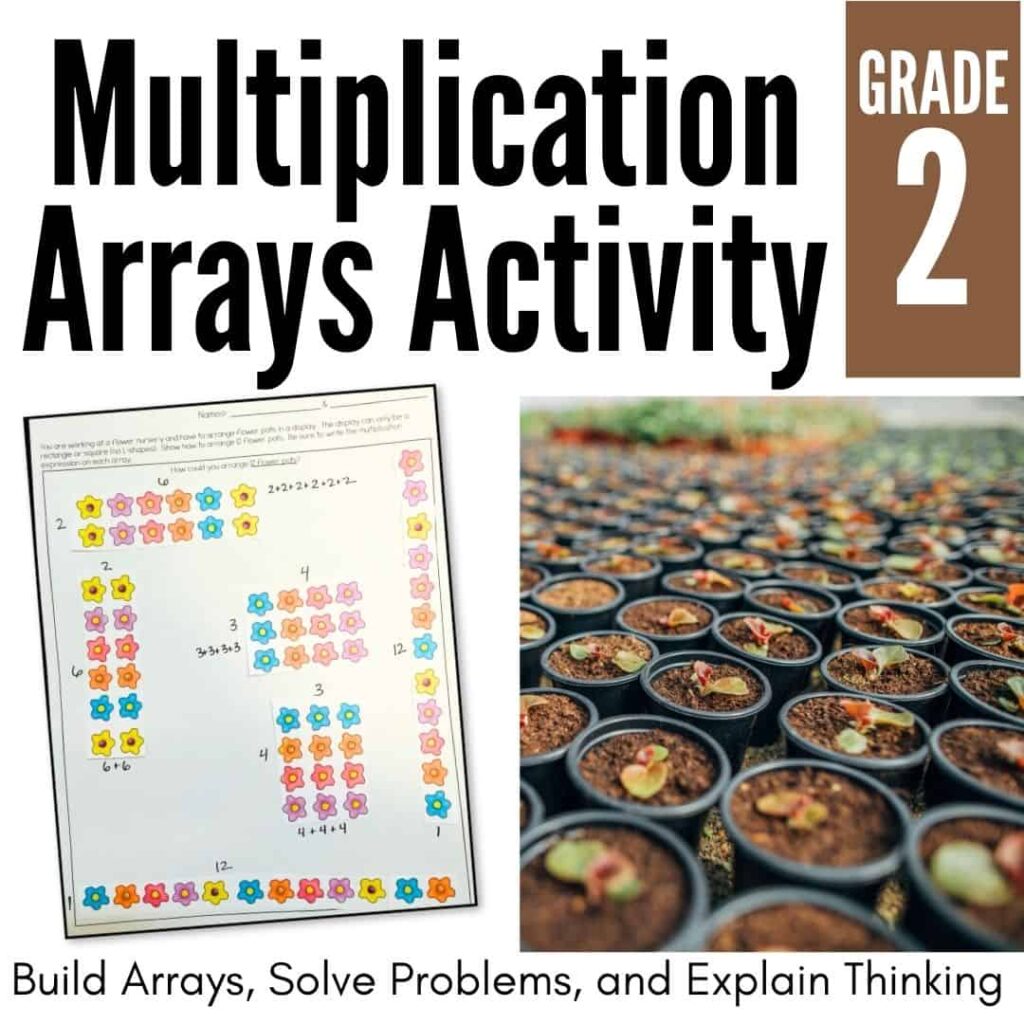
Building Arrays Flower Pot Activity | Rectangular Arrays & Multiplication Patterns
Help students explore arrays, rectangles, and multiplication patterns with this hands-on Building Arrays Flower Pot Activity! Students solve a real-world nursery display problem by arranging flower pots into rectangular and square arrays, then explain the patterns they discover through discussion and writing. Includes flower cutouts, writing pages, and extension problems.

i like this and need to do more arrays with my students. I do a lot of skip counting with my students as a way to teach multiplication. Then when they take tests they have a strategy they can use.
I am a teacher currently teaching via computer because of Covid 19. I teach 2nd grade and find your math hands on, fun and meaningful! Thank you so much!