
Physical and Chemical Changes: Activities for Grades 3-5
Teaching physical and chemical changes sounds simple until a student asks why dissolving sugar isn’t a chemical change but rusting a nail is. It’s one of those topics where students can recite the definitions and still mix up the two the moment you put a real example in front of them. The fix is hands-on observation paired with clear language about what actually counts as a new substance.
This post walks through what physical and chemical changes are, the signs that tell them apart, and the activities I reach for to make the difference stick in grades 3 through 5.
What Are Physical and Chemical Changes?
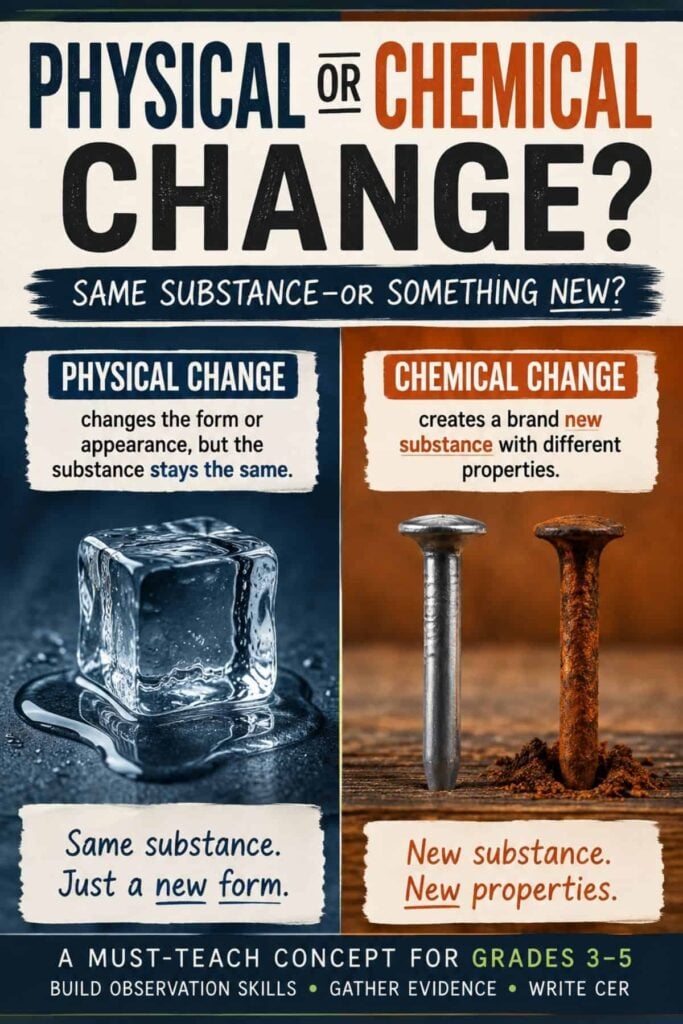
A physical change changes the appearance or form of a substance, but the substance itself stays the same. Cut paper is still paper. Melted ice is still water. A chemical change creates a brand new substance with different properties, and it usually cannot be undone. When you bake a cake or watch a nail rust, the original materials are gone, and something new has taken their place.
Here is the short version students can hold onto:
- Physical change: same substance, new form (cutting, bending, melting, freezing, dissolving)
- Chemical change: new substance formed (burning, rusting, baking, mixing baking soda and vinegar)
Physical Changes vs. Chemical Changes
The trouble for most students is that a physical change can look dramatic while a chemical change can look quiet. Tearing paper into tiny pieces looks like a big change, but it’s still paper. A clear liquid that turns slightly cloudy looks like nothing, but it can mean that a new substance has just formed. So the question is never “did it look different?” The question is “Is this a new substance?”
That’s why I teach students to watch for specific evidence rather than trusting how big the change appears.
Signs That a Chemical Change Happened
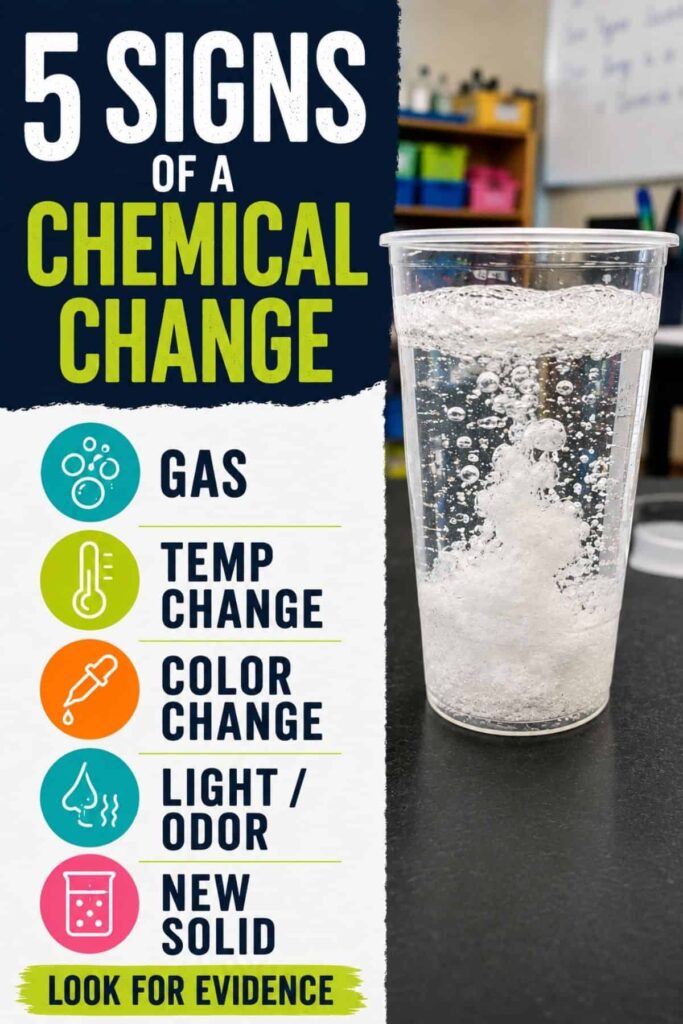
- A gas forms (bubbles or fizzing when nothing is boiling)
- The temperature changes on its own (it gets warmer or cooler)
- A new color appears
- Light or odor is given off
- A solid (a precipitate) forms when two liquids mix
One sign is a clue. Two or more is strong evidence. Teaching students to collect this evidence sets them up for the CER writing I describe further down. If you want to build their background knowledge first, a read-aloud helps. My roundup of books about properties of matter and changes in matter is a good place to start a unit.
Physical and Chemical Changes Activities for the Classroom
Upper-elementary students need more than a baking-soda volcano. By 5th grade, the work is gathering evidence and reasoning about whether a new substance formed, not just watching something fizz. These four activities give students real data to argue from, and each one maps to a 5-PS1 expectation.
Sort Real Changes: Chemical or Physical?
Set up a rotation of small changes and have students classify each one as chemical or physical based on their observations. Crushing an ice cube is physical; the water is still water. Bending a glow stick gives off light, so it’s chemical. A drop of iodine on a slice of potato turns dark blue-black, a clear color change, and a chemical reaction. Dissolving sugar in warm water is a physical change, whereas activating a hand warmer pack produces heat, indicating a chemical change. Students record what they see and defend each claim. This is at the heart of teaching physical and chemical changes because it forces students to reason from evidence rather than guess.
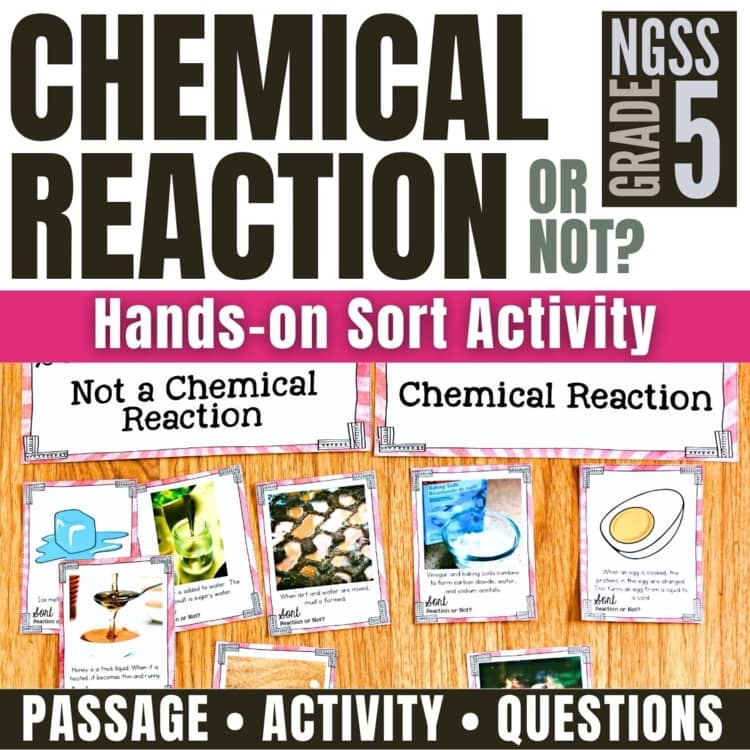
This hands-on, interactive resource helps students clearly distinguish between chemical and physical changes while reinforcing key science concepts through reading, sorting, and critical thinking.
Investigate a Two-Substance Reaction
Have students dissolve baking soda in one beaker and calcium chloride in another, record the temperature, then combine them. The mixture bubbles as a gas forms, a cloudy solid appears, and the temperature changes. Three signs at once make this one of the most convincing reactions for 5th graders, and it directly answers the 5-PS1-4 question of whether mixing two substances makes a new one. It also gives students real before-and-after data to write about.
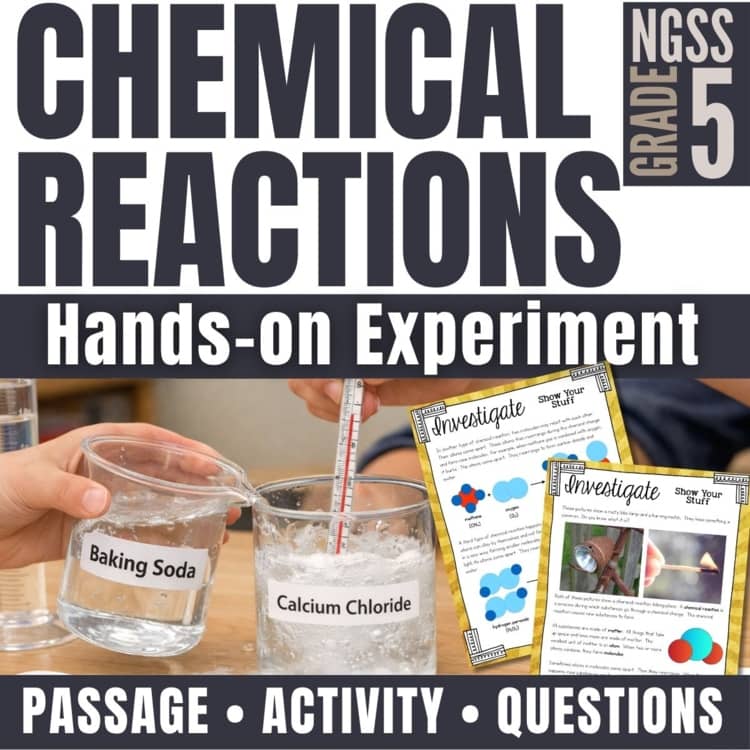
Students combine baking soda and calcium chloride, observe evidence of a chemical change, and analyze results using scientific reasoning.
Model the Reaction with Atoms
Give students colored candy or pompoms and toothpicks and have them build the reactants in a reaction, then take the atoms apart and rebuild them as the products. Modeling water splitting into hydrogen and oxygen, or sodium and chlorine combining into salt, makes an abstract idea concrete. Students can see that no atoms appear or disappear; they just rearrange, which is the perfect lead-in to conservation of matter below.
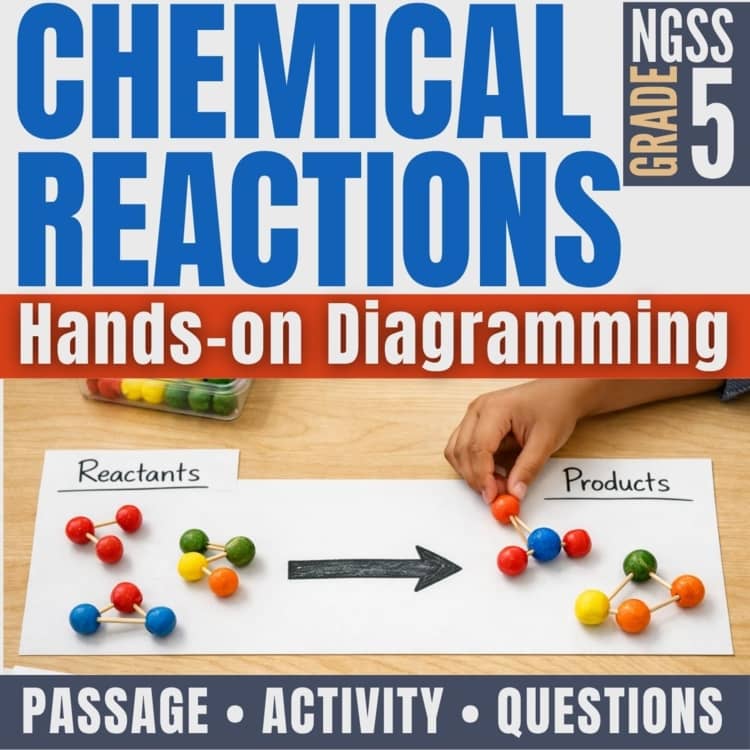
Designed to support the NGSS 5-PS1-4 standard, this Chemical Reactions Diagram activity helps students grasp how atoms rearrange during reactions by building molecule models.
Make a Brand New Substance
Mixing glue, borax, cornstarch, and warm water produces a bouncy ball, a substance with properties none of the ingredients had on their own. Students love it, and the science is solid: a new substance with new properties is strong evidence of a chemical change. Ask them to describe how the ball looks and feels compared to the runny ingredients, then explain what that tells them.
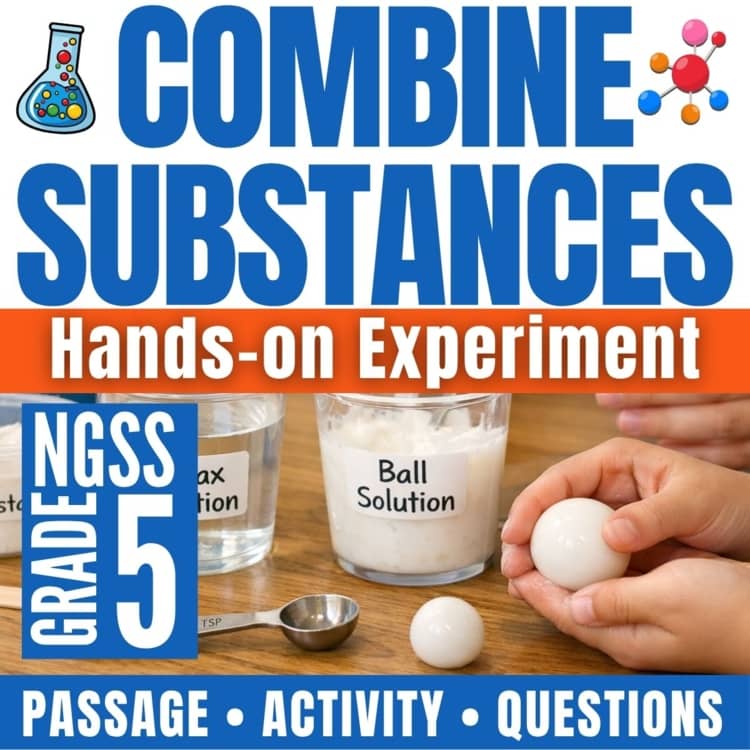
This hands-on chemical reaction experiment allows students to explore how substances combine to form new materials by creating their own bouncy ball.
Connecting Physical and Chemical Changes to Conservation of Matter
Conservation of matter is the idea that matter is never created or destroyed during a change, even a chemical one. The atoms just rearrange. Students often assume that when a gas forms or a candle burns, matter disappears, so this concept needs evidence to stand.
The atom-modeling activity above is the clearest way in. When students take apart the reactant molecules and rebuild them as products, they count the same atoms on both sides every time. Nothing is created, and nothing is destroyed; the atoms just trade partners. Once students see that with their own models, conservation of matter stops being a definition to memorize and becomes something obvious.
Conservation of Mass Science Station BUNDLE
These Conservation of Mass Next Generation Science Stations include eight different science stations where students deepen their understanding of conservation of mass, including the structure and properties of matter and chemical reactions. The focus is on 5-PS1-2.
Using Claim, Evidence, Reasoning (CER) with Physical and Chemical Changes
Physical and chemical changes are among the best topics for teaching Claim, Evidence, Reasoning, because every activity above ends with a question that students can answer with evidence. After an investigation, have students write:
- Claim: Was this a physical change or a chemical change?
- Evidence: What did you observe? (gas formed, color changed, mass stayed the same)
- Reasoning: Why does that evidence support your claim?
This moves students past “I think it’s chemical because it bubbled” toward “It’s a chemical change because a gas formed, and a new gas means a new substance was created.” That second sentence is the thinking you’re after.
Teaching Physical and Chemical Changes Across Grades
This topic shows up more than once in elementary science. In 2nd grade, students explore how heating and cooling can cause changes that are sometimes reversible and sometimes not (NGSS 2-PS1-4). By 5th grade, the expectation grows: students investigate whether mixing two substances creates a new substance and connect it to conservation of matter (NGSS 5-PS1-2 and 5-PS1-4). You can read the full standard at the Next Generation Science Standards site.
For 3rd through 5th graders, the jump is from naming a change to proving it with evidence. That’s why the activities here lean on observation and CER rather than just sorting examples into two columns. If you’re setting up rotations for this unit, my tips for running successful elementary science stations will help you keep them running smoothly.
Why Teaching Physical and Chemical Changes This Way Works
Hands-On and Visual
Students remember the balloon inflating and the glow stick lighting up far longer than they remember a definition. Watching the change gives them a concrete memory to associate with the vocabulary.
Vocabulary Development
Words like substance, reversible, gas, and precipitate stop being abstract when students use them to describe something they just saw. The activities give the vocabulary a job.
Cross-Curricular Connections
Writing a CER response blends science with informational writing, and measuring mass folds in math. You end up covering more than one standard with a single lesson.
NGSS Alignment
The observe, investigate, and explain structure mirrors what the 5-PS1 standards ask for, so students practice the science and engineering practices, not just the content.
Frequently Asked Questions
Bringing It All Together
By the end of a unit on physical and chemical changes, students should be able to observe a change, point to the evidence, and explain whether a new substance formed. That’s a bigger goal than memorizing two definitions, and it’s the kind of thinking that carries into middle school science. Start with the activities your materials closet already has, and let students argue their way to the answer.
Want these ready to go? All four activities in this post come from my Chemical Reactions Science Station Bundle, which includes the investigation, the atom-modeling station, the bouncy ball, and the chemical-versus-physical sort, plus reading passages and task cards aligned to 5-PS1.
Chemical Reactions Science Station BUNDLE
These Chemical Reactions Next Generation Science Stations include eight science stations where students deepen their understanding of chemical reactions, including how to tell whether a chemical reaction has taken place. The focus is on 5-PS1-4.
Jessica BOschen
Jessica is a teacher, homeschool parent, and entrepreneur. She shares her passion for teaching and education on What I Have Learned. Jessica has 16 years of experience teaching elementary school and currently homeschools her two middle and high school boys. She enjoys scaffolding learning for students, focusing on helping our most challenging learners achieve success in all academic areas.