
Plant Life Cycle Stages: A Teacher’s Guide for 2nd–5th Grade
When you ask students what they know about the plant life cycle stages, you usually get seeds and sunshine — and not much in between. But the full cycle is one of the most satisfying topics in elementary science to teach well, because each stage connects to something students can observe, touch, and investigate.
This guide walks through the stages, how NGSS builds that understanding across grade levels, and what actually works in 2nd-, 3rd-, and 5th-grade classrooms.
What Are the Plant Life Cycle Stages?
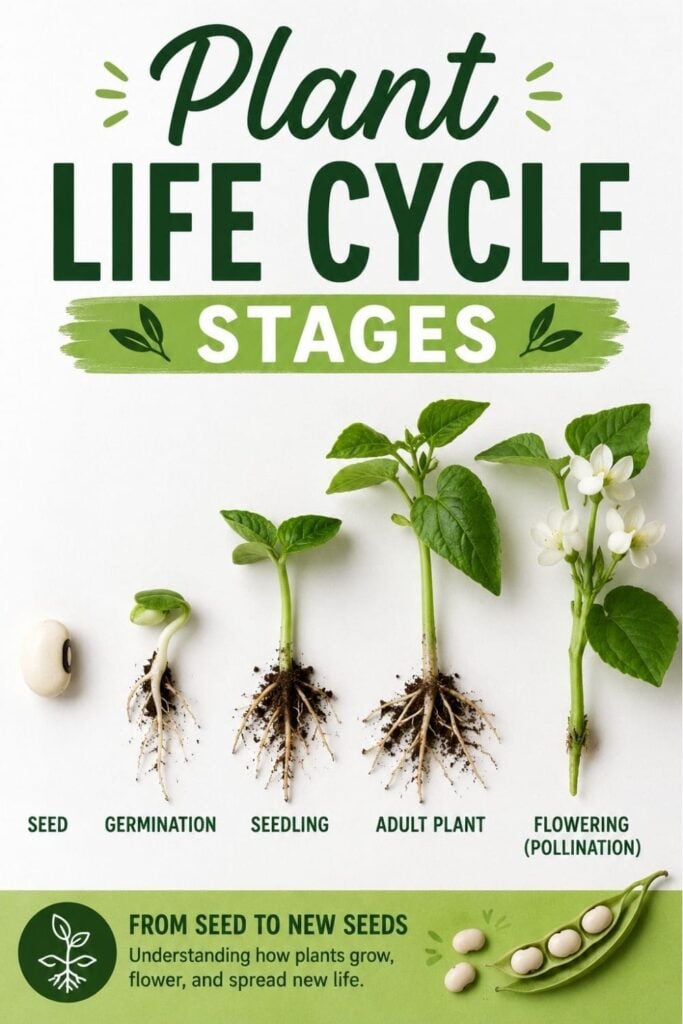
For elementary students, the plant life cycle is typically introduced with four to six stages, depending on the grade level. Here’s what each stage involves and how you might explain it to students.
Seed: Every flowering plant begins as a seed. Inside the seed is an embryo — a tiny plant waiting for the right conditions to grow. Seeds can stay dormant for months or years until they have enough water, warmth, and sometimes light to sprout.
Germination: This is when the seed starts to grow. Water triggers activity inside the seed, the root emerges first to anchor the plant and absorb moisture, and the shoot pushes upward toward light. Students often find it surprising that the root grows down before anything appears above the soil.
Seedling: Once the plant breaks through the soil and develops its first true leaves, it’s a seedling. This is when photosynthesis begins — the plant starts making its own food from sunlight, water, and carbon dioxide.
Adult Plant: As the plant matures, it develops a full root system, stem, leaves, and — for flowering plants — flowers. This is the stage that makes reproduction possible.
Pollination: Flowering plants rely on pollinators like bees, butterflies, or birds (and sometimes wind) to transfer pollen from one flower to another. Pollination leads to fertilization and seed development. This stage tends to be the most surprising for students who’ve never thought about why flowers exist.
Seed Dispersal: Once fertilized, the plant develops fruit or a seed structure. Those seeds then move away from the parent plant through wind, water, animals, or other mechanisms — and the cycle begins again.
For 2nd graders, a four-stage model works well: seed, germination, seedling, adult plant. By 3rd grade, pollination and seed dispersal become part of the picture. In 5th grade, students connect the whole cycle to photosynthesis and energy flow.
How Plant Life Cycle Stages Align With Elementary Science Standards
The way the NGSS introduces plant science isn’t accidental. It’s designed to build understanding in layers. Knowing how the standards progress helps you teach each grade well without repeating what students already know or skipping ahead to concepts they aren’t ready for.
In 2nd grade, the focus is on what plants need to grow (water, light, and nutrients from soil) and how some animals and wind help disperse seeds. Students observe the life cycle without getting into the mechanics of reproduction. The emphasis is on observation and patterns.
By 3rd grade, standard 3-LS1-1 asks students to develop models that describe how organisms have unique and diverse life cycles that all share common features: birth, growth, reproduction, and death. This is where flower anatomy, pollination, and seed structure become central teaching targets.
In 5th grade, students connect plant growth to energy. Standard 5-LS1-1 focuses on how plants get the materials they need for growth chiefly from air and water, which leads directly into photosynthesis and how that energy moves through food webs.
Understanding this progression means you can plan a unit that adds something genuinely new each year rather than covering the same ground every spring.
2nd, 3rd, & 5th Grade Science Stations
Teaching Plant Life Cycle Stages in 2nd Grade
Second grade is when most students first encounter the plant life cycle in a structured way. The goal at this stage isn’t depth. It’s to build a clear, accurate model that 3rd graders can build on. Keep the stages concrete, keep the activities hands-on, and give students something they can observe directly.
Growing Plants as a Teaching Tool
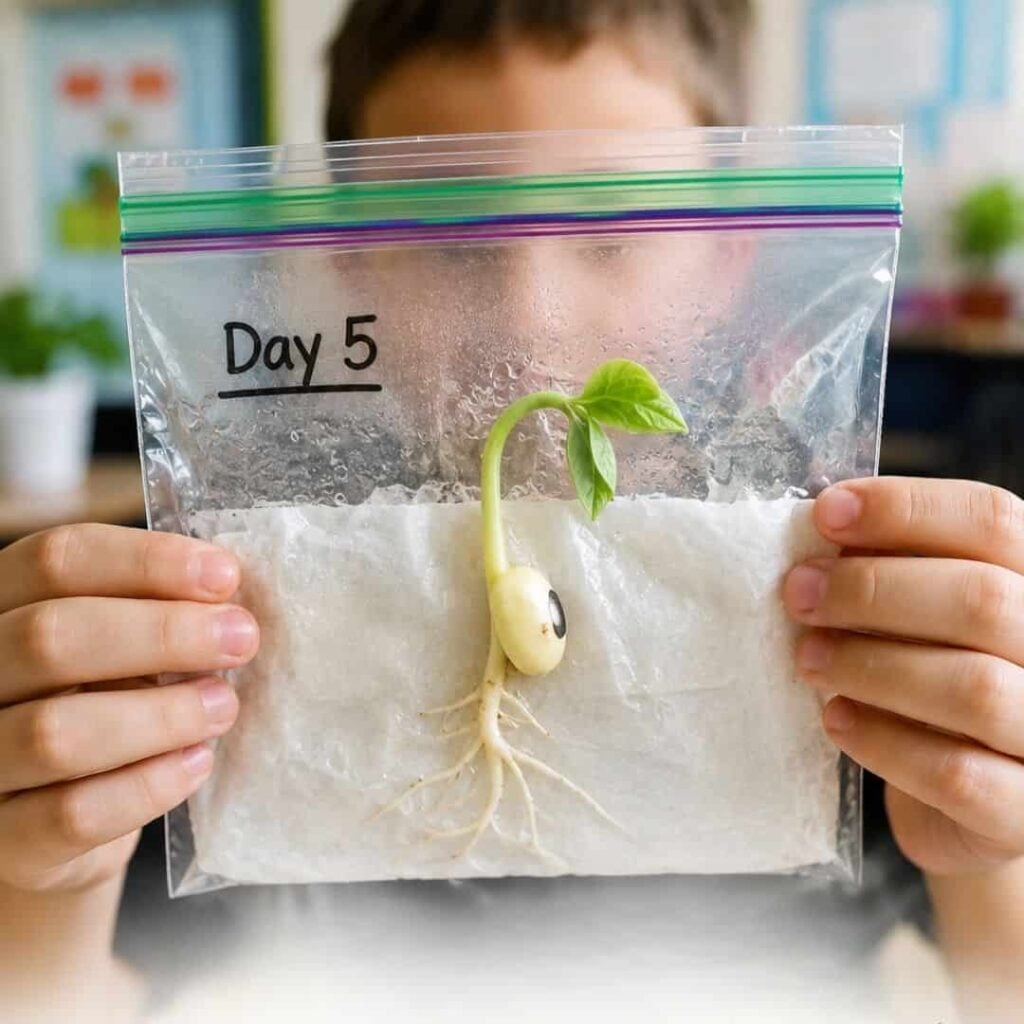
There’s no substitute for watching a plant grow. Growing bean or pea plants in clear plastic bags taped to a sunny window lets students observe germination in real time — the root, shoot, and seed leaves all become visible before the plant ever reaches soil. Students who watch a seed split open and send out its first root have a mental image that anchor charts and diagrams can’t match.
Pair the growing activity with an observation journal where students draw and label what they see each day. This builds science practices alongside content. Students are making observations, recording data, and noticing change over time.
Plant Life Cycle Anchor Charts
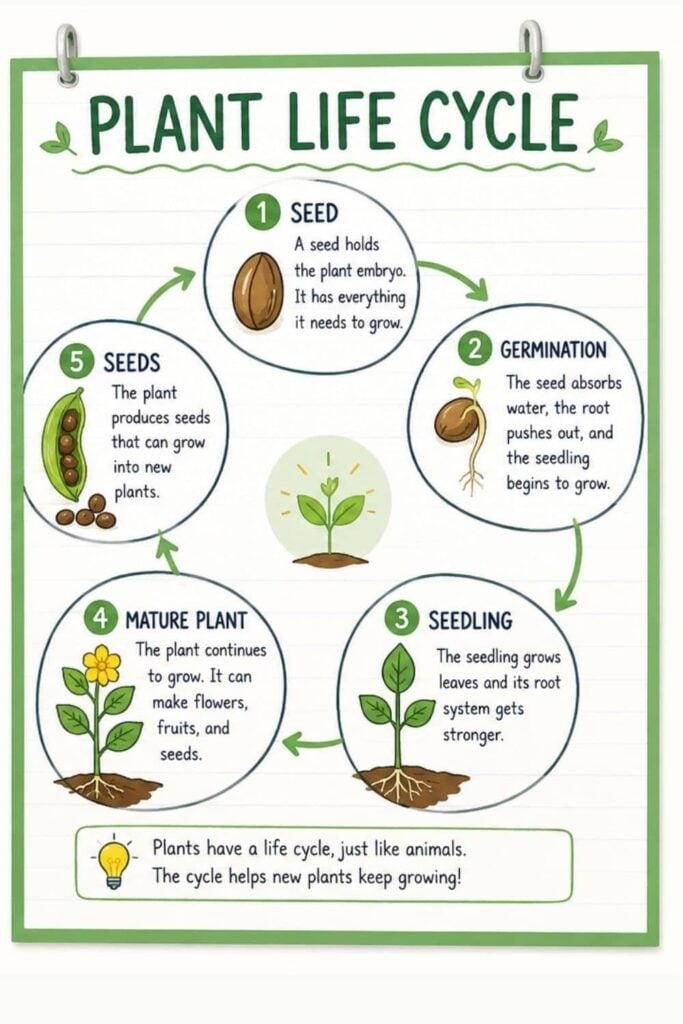
A plant life cycle anchor chart provides students with a visual reference they can return to throughout the unit. The most useful ones show each stage with a simple illustration and a brief description, something a student could explain to a classmate in their own words.
Rather than creating the chart yourself before the unit begins, consider building it with the class as you work through each stage. Students remember information better when they watch it get added to the chart over time. By the end of the unit, that anchor chart holds everything they’ve learned.
Sorting and Sequencing the Stages
Once students understand each stage individually, they need practice putting the cycle in order and explaining how one stage connects to the next. Sorting activities work well here — students sort image cards or written descriptions into the correct sequence, then talk through their thinking with a partner. The conversation that happens during the sort often reveals more about what students understand than any worksheet would.
My plant life cycle sort science center is a hands-on option that works well for independent practice or partner work. The plant growth science stations take a broader approach, rotating students through activities that build understanding of what plants need and how they grow.
If you’re looking for a complete 2nd grade plant unit, my Parts of a Plant, Pollination, Reproduction, and Grow unit includes labs, reading passages, and differentiated activities covering all the key 2nd grade plant science standards.
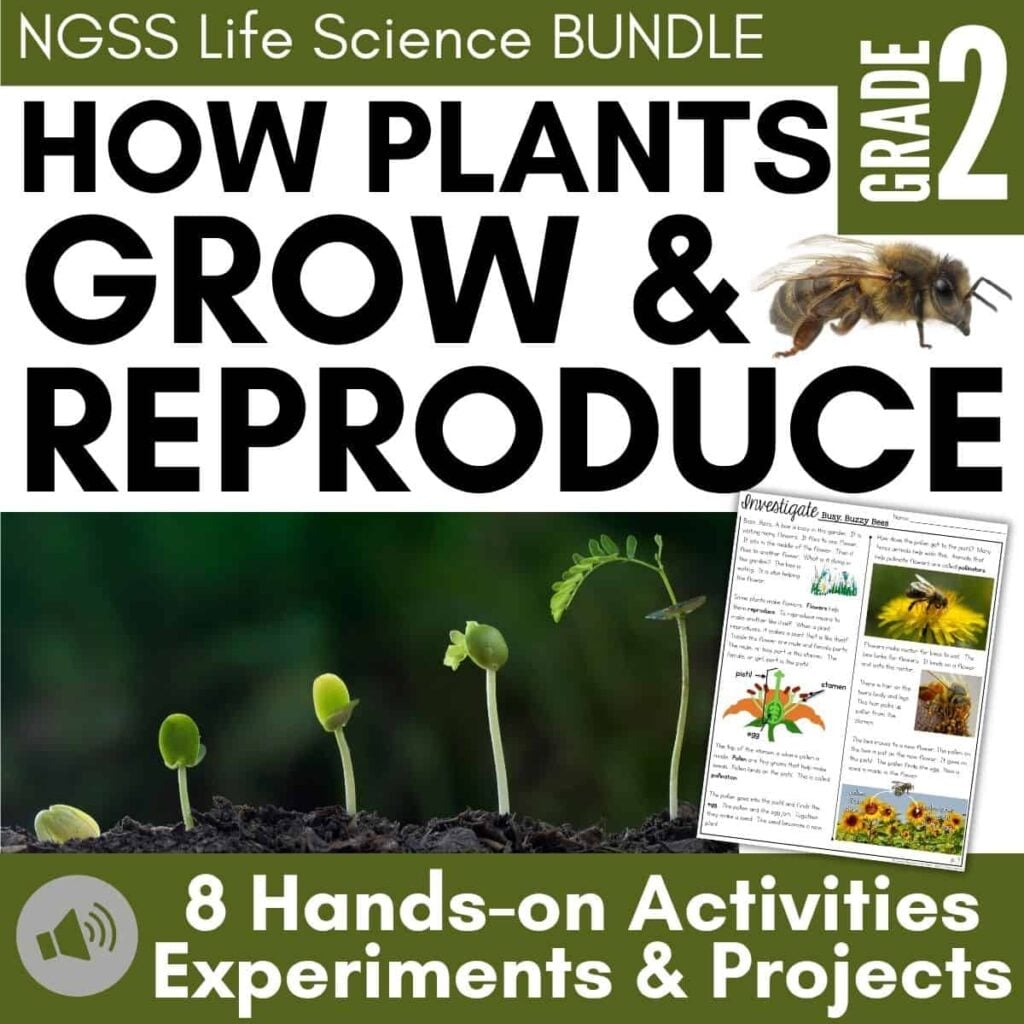
How Plants Grow and Reproduce and the Role of Pollinators
Engage your students with this hands-on plant science unit featuring 8 interactive science stations focused on plant growth, pollination, reproduction, and seed dispersal! Designed for 2nd-grade NGSS alignment, these stations help students explore what plants need to survive and how plants depend on animals in their life cycle. Includes differentiated response sheets, vocabulary cards, posters, and interactive activities, perfect for science centers or small-group instruction.
Adding Depth to Plant Life Cycle Stages in 3rd Grade
Third grade is where the plant life cycle gets more interesting. Students are ready to look inside a flower, understand how seeds are actually made, and think about why plants produce fruit. The stages are the same ones students learned in 2nd grade — but now the question shifts from “what happens?” to “how and why does it happen?”
Flower Anatomy and Pollination
Flower dissections are one of those activities that genuinely change how students see plants. When students pull apart a flower — identifying the stamen, pistil, petals, and sepals — they realize it isn’t merely decorative. It has a specific job in the life cycle.
After the dissection, connect each structure to its role: petals attract pollinators, the stamen produces pollen, and the pistil contains the ovary where seeds develop after fertilization. Students who dissect a flower and then see a bee visiting a garden understand pollination in a way that a diagram alone can’t deliver.
What Plants We Eat Can Teach Us About the Life Cycle
One of the most engaging 3rd grade connections is helping students recognize that most of the produce they eat is botanically a fruit — the mature ovary of a flowering plant containing seeds. Tomatoes, cucumbers, peppers, and bean pods are all fruits. Carrots and beets are roots. Celery is a stem. Lettuce and spinach are leaves.
Sorting activities that classify foods by their plant part make the life cycle feel immediate and relevant. My what part of the plant do we eat science sort connects plant structures directly to foods students see every day.
Seed Dispersal
Seed dispersal is often the stage that surprises students most. Plants have no legs — yet their seeds can travel miles. Burrs that hook onto clothing and fur, maple seeds that helicopter through the air, coconuts that float across oceans, and berries that pass through a bird’s digestive system. The variety of mechanisms is genuinely interesting to explore.
My seed dispersal activities post offers ideas for exploring these mechanisms through hands-on investigations, including a challenge in which students design their own seed-dispersal structures.
For 3rd grade, the Animal & Plant Life Cycle Science Stations bundle covers flower dissection, plant part classification, and life cycle sorting — all aligned to NGSS 3-LS1-1.

Life Cycles: Plants and Animals Third Grade Science Stations
The focus is on NGSS 3-LS1.B and include concepts such as animal life cycles, plant life cycles, and parts of a plant.
Connecting Plant Life Cycle Stages to Energy and Animal Life Cycles in 4th–5th Grade
By 4th and 5th grade, students are ready to see the plant life cycle as part of a larger system, one that connects to animal life cycles, food webs, and energy flow. The stages themselves aren’t new, but the questions get bigger.
Comparing plant and animal life cycles helps students identify what’s universal across living things (all organisms are born, grow, reproduce, and die) and what’s unique to plants (the role of flowers, fruit, and specialized seed structures). My life cycles of plants and animals post goes deeper on this comparison for teachers building a unit around those connections.
In 5th grade, the life cycle connects directly to photosynthesis. Students learn that the adult plant stage isn’t just about growing larger. The plant captures energy from sunlight and converts it into sugar through photosynthesis. That stored energy then moves through the food web every time an animal eats a plant. Helping students trace energy from the sun, through a plant, and into a food chain gives the life cycle a new dimension that pulls together years of science instruction.
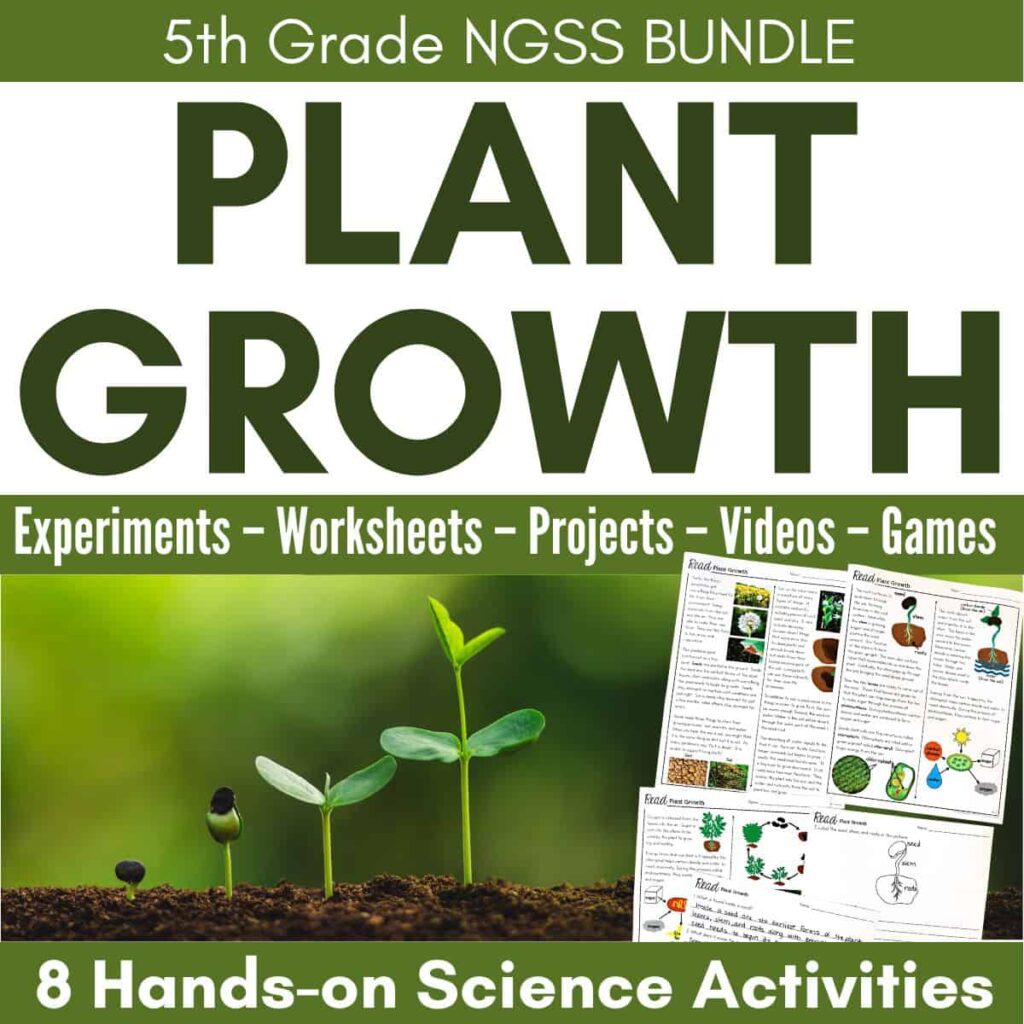
For 5th grade, my Plant Growth science stations cover what plants need and how photosynthesis works — hands-on practice that builds directly toward the energy flow concepts in the life cycle. Pair them with my Energy Flow, Cellular Respiration, and Photosynthesis unit to take students from plant growth to how that energy moves through an ecosystem.
5th Grade Plant Science Activities
Books for Teaching Plant Life Cycle Stages
A well-chosen read-aloud does something that a lab alone can’t — it slows students down to look carefully at illustrations, builds vocabulary in context, and gives them a reference they can return to later in the unit. For the plant life cycle, there are picture books that focus specifically on seeds, pollination, the full growth cycle, and the science of plant reproduction.
My plant life cycle books list pulls together the strongest options organized by what they cover, with grade-level notes so you can choose the right one for where your students are in the unit.
Final Thoughts on Teaching Plant Life Cycle Stages
Plant life cycle stages are one of those topics that reward patience and layered instruction. When 2nd graders watch a seed germinate in a plastic bag, they’re building the foundation that makes 3rd-grade flower dissections make sense — which makes 5th-grade photosynthesis click. Starting with a clear, simple model and adding to it each year is more effective than trying to cover everything at once.
Whether you’re introducing the basic stages to 2nd graders or helping 5th graders connect plant growth to energy flow, the plant life cycle gives you a thread that runs all the way through elementary science. Start with what students can see, and let the complexity build from there.
Jessica BOschen
Jessica is a teacher, homeschool parent, and entrepreneur. She shares her passion for teaching and education on What I Have Learned. Jessica has 16 years of experience teaching elementary school and currently homeschools her two middle and high school boys. She enjoys scaffolding learning for students, focusing on helping our most challenging learners achieve success in all academic areas.