
Food Webs Science Stations for Fifth Grade

“The Circle of Life.” It’s a common enough phrase that you and your students have probably heard it mentioned before. Simply put, it speaks to how every plant and animal—all living organisms—coexist in an ecosystem.
However, do you or your students know what a food web is and how energy flows through it? Do they know the difference between a food web and a food chain?

It can become rather confusing – food chains, food webs – but we’ve developed a series of science stations to help your students sort out the differences between food webs and ecosystems.
We’ve included everything required by the NGSS standards for your fifth-graders. Eight fun, engaging stations incorporating labs, experiments, videos, text, and games.
Plants are where energy enters most food webs, which makes the plant life cycle a natural companion to this unit. My guide to plant life cycle stages explains how to connect plant growth and photosynthesis to energy flow in 5th grade.
What’s Included in the Food Webs and Ecosystems Science Stations
The Food Webs and Ecosystems Science Stations were created with NGSS Standard 5-LS2-1 in mind. They help students understand how energy and matter move among animals, plants, decomposers, and ecosystems.
Your fifth-graders will also learn the roles of producers, consumers, and decomposers. The eight science centers work together to teach students about the biotic and abiotic factors of ecosystems. They include different food chains and food web patterns. By the end of the unit, students will understand how food chains and webs work within an ecosystem.
Throughout the unit, students make observations, construct explanations, use evidence to support a claim, and design solutions to problems to find answers to these questions and more. The science stations contain challenging material for fifth graders, with new words and concepts in easy-to-implement, interactive stations.

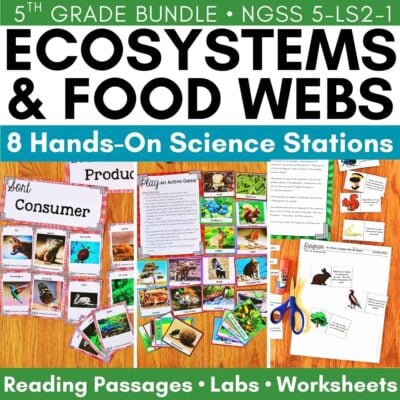
Food Webs & Ecosystems Science Station UNIT BUNDLE
These Food Webs Next Generation Science Stations include eight different science stations where students deepen their understanding of food webs, ecosystems, consumers, producers and decomposers, and the movement of matter among plants, animals, decomposers, and the environment. The focus is on 5-LS2-1.
Focus on NGSS Standards for 5-LS2-1
Next Generation Science Standards are written to be “Three Dimensional.” Performance Expectation, Disciplinary Core Idea, and Science and Engineering Practices/Crosscutting Concepts are the three dimensions.
The Food Webs and Ecosystems Science Stations Unit focuses on these standards:
- Performance Expectation 5-LS2-1. “Develop a model to describe the movement of matter among plants, animals, decomposers, and the environment.”
- Disciplinary Core Ideas:
- 5-LS2.A – “The food of almost any kind of animal can be traced back to plants. Organisms are related in food webs in which some animals eat plants for food and other animals eat the animals that eat plants. Some organisms, such as fungi and bacteria, break down dead organisms (both plants or plants parts and animals) and therefore operate as “decomposers.” Decomposition eventually restores (recycles) some materials back to the soil. Organisms can survive only in environments in which their particular needs are met. A healthy ecosystem is one in which multiple species of different types are each able to meet their needs in a relatively stable web of life. Newly introduced species can damage the balance of an ecosystem.”
- 5-LS2.B – “Matter cycles between the air and soil and among plants, animals, and microbes as these organisms live and die. Organisms obtain gases, and water, from the environment, and release waste matter (gas, liquid, or solid) back into the environment.”
- Science and Engineering Practice: Developing and Using Models
- Modeling in 3–5 builds on K–2 experiences and progresses to building and revising simple models and using models to represent events and design solutions
- Use models to describe phenomena
- Modeling in 3–5 builds on K–2 experiences and progresses to building and revising simple models and using models to represent events and design solutions
- Crosscutting Concept: Systems and System Models
- Natural objects exist from the very small to the immensely large
Big Idea Posters for Food Webs and Ecosystems
Our Food Webs and Ecosystems Science Stations Unit comes with Big Idea posters that are perfect for students to understand the science concepts at the heart of this study.
Some of the science concepts in the Big Ideas include:
- Materials and energy flow from the bottom of the food chain to the top.
- Decomposers return nutrients back to the soil for plants to use.

There are eight Big Idea Posters in this unit. The posters are included only in the Food Webs and Ecosystems UNIT BUNDLE; they are not included for each individual station.
Vocabulary Cards about Food Webs
Where would any of us be without vocabulary cards? Thankfully, your students won’t have to find out. We’ve made vocabulary cards with vibrant pictures and easy-to-understand definitions. Two sets of vocabulary cards are included with the unit.
One set contains the vocabulary word with a picture and definition. Each card has cutting lines so that you or your students can cut out the three sections of each card. Mix up all the words, pictures, and definitions, and you have an instant game your students will enjoy.
Hint: You can laminate these, too, and use them year after year, OR have students glue the completed vocabulary cards into their science notebooks.


Oh, they are the perfect size for pocket charts, too!
The second set of vocabulary cards has the word and definition in a larger font. This set is great for a science word wall. Both sets contain the same words, so you pick which one(s) are most suitable for your classroom without worrying about whether you’re covering it all.
The Food Webs vocabulary cards are only available in the Unit Bundle. They are not available for each individual science station.
Food Webs Reading Passages for six of the Science Centers
All stations, except the Watch and Play stations, include reading passages. Most reading passages are optional, but they build students’ background knowledge and solidify key concepts. Use them if your students do not have prior knowledge of the topic of the station.
The reading passages come in two formats. You’ll see versions of both of these formats in the photographs below. Both versions have the same text but different layouts.
- Full-page with color border
- Two-column with a black border
See examples of the two formats in the images below.
Differentiated Responses for Each Science Station
Not every classroom looks the same. Not every child learns the same way. That’s why all of our science stations include a variety of ways for students to interact with each station. There are five different ways to respond to each station:
- short answer questions
- fill-in-the-blank questions without a word bank
- fill-in-the-blank with a word bank
- task cards with short answers
- task cards with multiple-choice
All the variations are similar to one another but require a different level of independence. The fill-in-the-blank is the easiest and is perfect for your students who struggle with reading. The short answer is the most difficult as it requires students to construct their own responses without much support.
Choose the format that best fits your classroom and students. Students are also encouraged to use their science journal task cards. Answer keys are included.
Some of the images below include science questions in the Food Webs Unit.
Food Webs Activity Worksheets
Six of the stations focus on hands-on activities and experiments. The DIAGRAM, INVESTIGATE, MODEL, and EXPLORE stations include science activities that uniquely approach the concept of food webs.
Each of these activities also includes an activity sheet or worksheet. This activity sheet is the “work” of the station, while the differentiated responses require students to think broadly about the topic and concept.
Google Classroom Components
All of our fifth-grade science stations come with components that are easily integrated with Google Classroom. Google Forms and Google Slides are included for most stations.
- A Google Form™️ with Reading Passage & Differentiated Questions is available for the Watch, Investigate, Diagram, Read, Model, Explore, and Sort stations.
- Google Slides™️ with Activity Directions & Worksheets are available for Investigate, Diagram, Model, Explore, and Sort.
Most of the hands-on activities still require physical components, but we have provided the directions and recording sheets in Google Slides.
Food Webs & Ecosystems Science Station UNIT BUNDLE
These Food Webs Next Generation Science Stations include eight different science stations where students deepen their understanding of food webs, ecosystems, consumers, producers and decomposers, and the movement of matter among plants, animals, decomposers, and the environment. The focus is on 5-LS2-1.
Below are details about each of the science stations:
Watch a Video about Food Webs and Decomposers
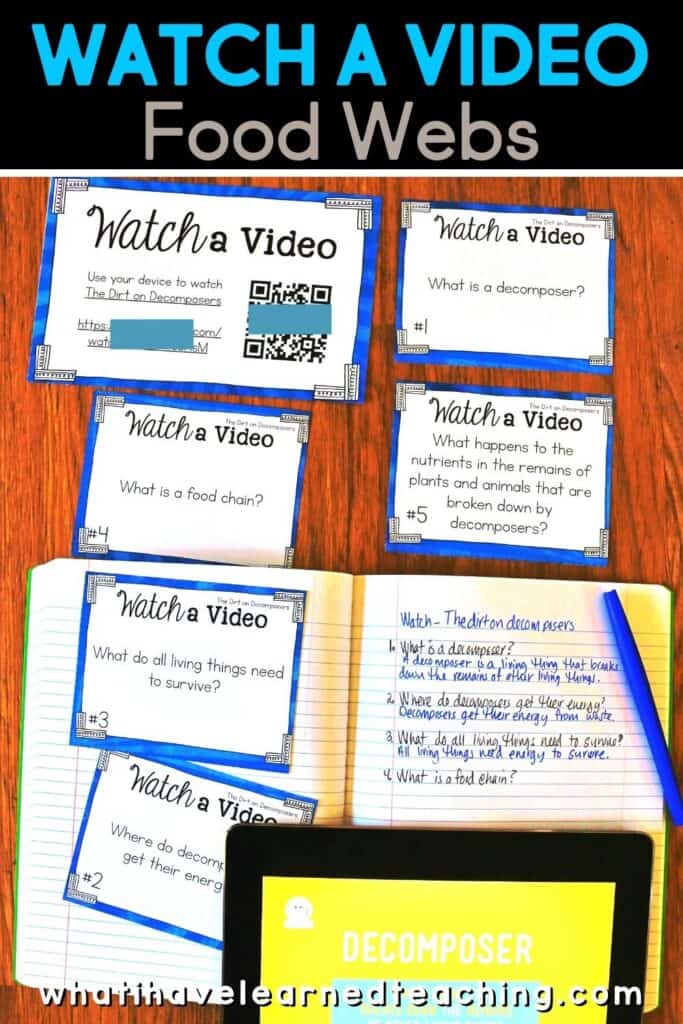
Students love this station! They can view the video individually, or you can show it to the entire class. There are two videos to choose from: one about ecosystems and the other about decomposers. While we recommend picking one video to watch, feel free to do both if you have the time.
After watching, students will answer questions about the video. This station contains several worksheets with open-ended, short-answer questions, fill-in-the-blank sentences, and more. Task cards are also included.
Play a Game About Food Webs and Ecosystems
While the Watch a Video is very popular among students, the Play a Game Station is probably the favorite. This station includes an active game, a board game, a word search, and a crossword puzzle. They are designed to reinforce what students have learned about Food Webs and Ecosystems. Plus, they are a lot of fun!
The active game is a fun way to review what students understand about the roles of producers, consumers, and decomposers in ecosystems. With the board game, students answer questions to advance their tokens on the board.
The question cards can also be used in other quiz and answer classroom games.


Also included are a crossword puzzle and word search. The crossword puzzle has two versions: one with a word list and one without.
The crossword puzzle and word search also come in digital formats. The digital form changes each time the page is loaded, so each student works on their own versions of the puzzles.
Investigate Decomposition Activity
Students read about ecosystems and food webs in the Investigate Decomposition Proposition station. They investigate the role decomposers play in an ecosystem with dead organic material.
Like all of our science stations, differentiated questions are included to help cement students’ understanding.
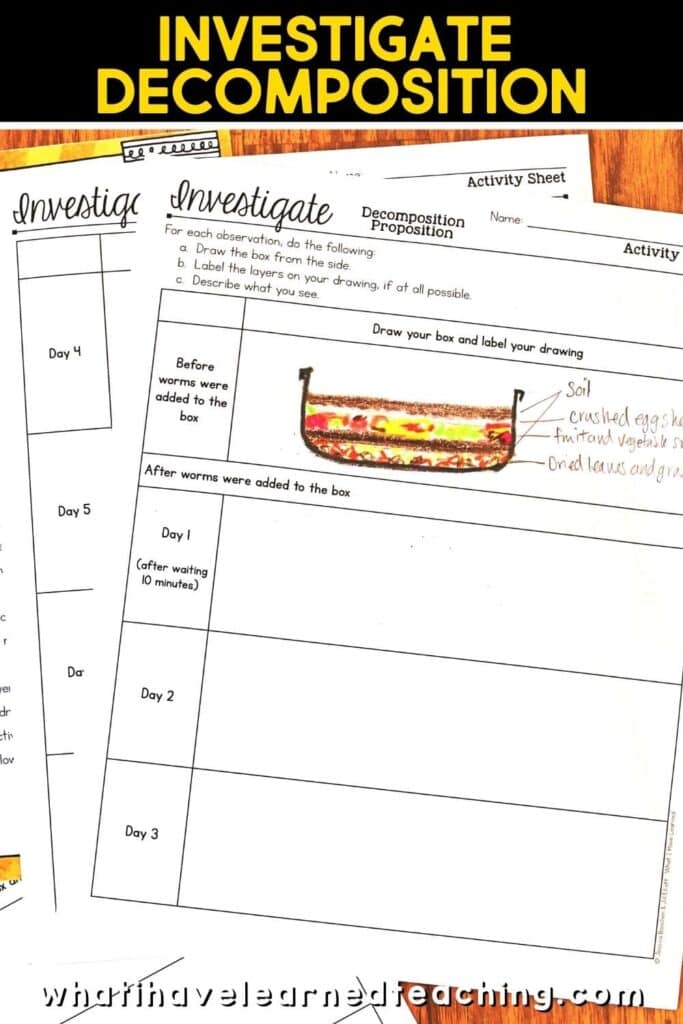
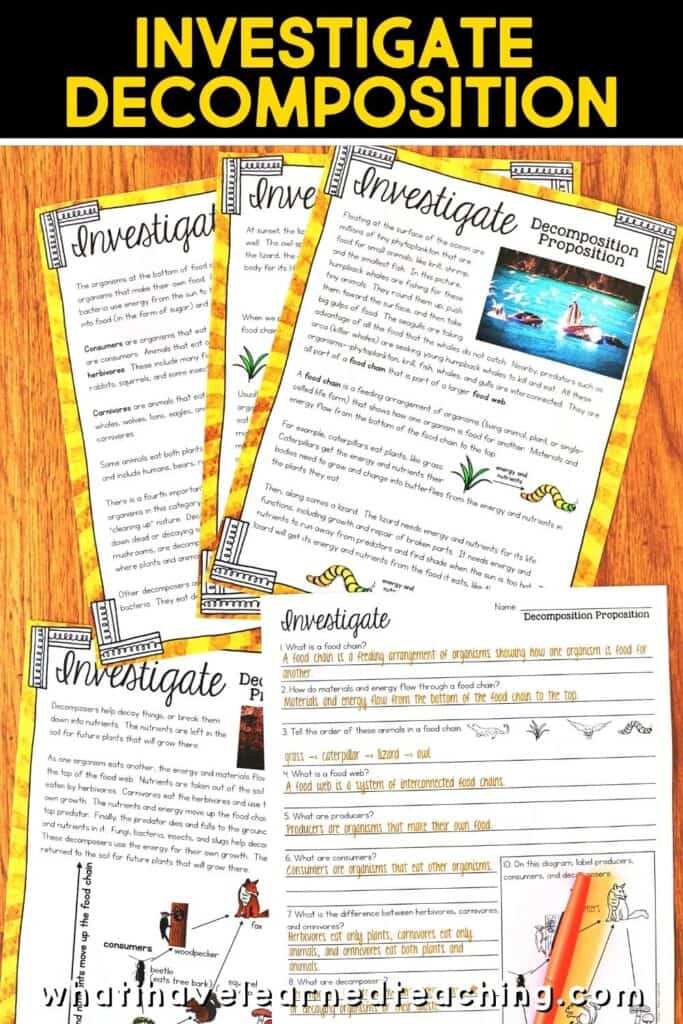
Diagram Food Web Hands-on Activity
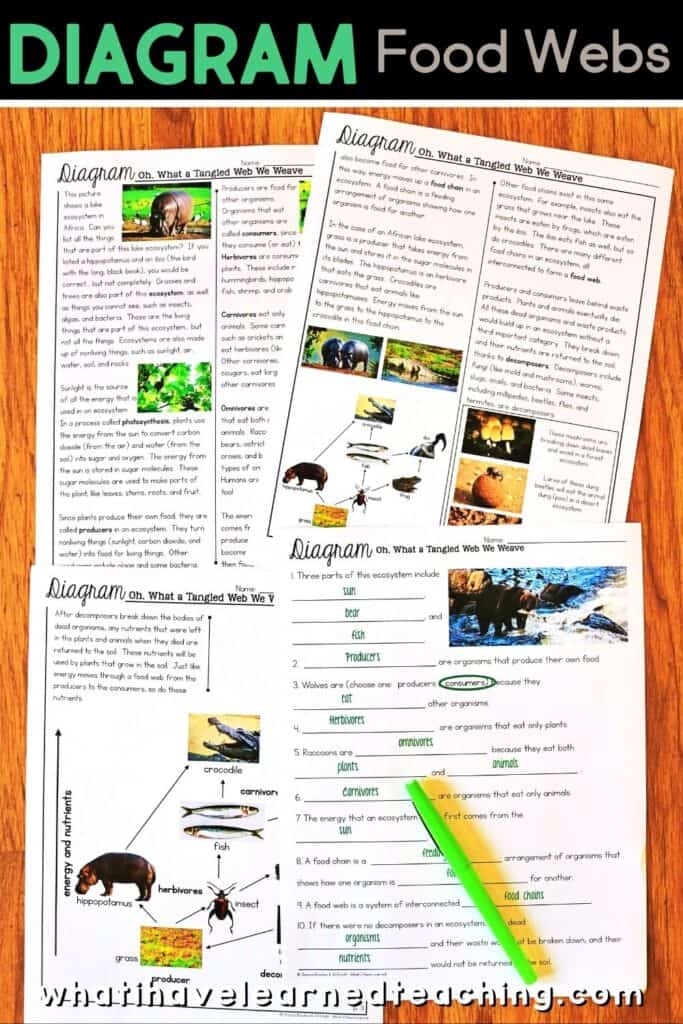
In the Diagram Oh, What a Tangled Web We Weave station, students will read about an African ecosystem and food web. The reading passage illustrates the symbiotic relationships between different organisms, from the tiniest bacteria to the majestic hippo, fostering a deep appreciation for the delicate balance of our natural world.
The cornerstone of this activity is the interactive food web diagram, a hands-on tool that visually demonstrates how energy is transferred within an ecosystem. Students cut out and connect pictures and descriptions of various organisms. This process not only reinforces their understanding of the roles played by producers, consumers, and decomposers but also highlights the importance of each organism in maintaining ecological equilibrium.
When students finish, they answer differentiated science questions to reinforce their learning.

Food Webs & Ecosystems Science Station UNIT BUNDLE
These Food Webs Next Generation Science Stations include eight different science stations where students deepen their understanding of food webs, ecosystems, consumers, producers and decomposers, and the movement of matter among plants, animals, decomposers, and the environment. The focus is on 5-LS2-1.
Read About Food Webs
This science station requires students to read a passage about ecosystems and food webs and answer questions about it. This is the only Food Webs Center where the reading passage is the station’s required work.


Model Food Web Diorama
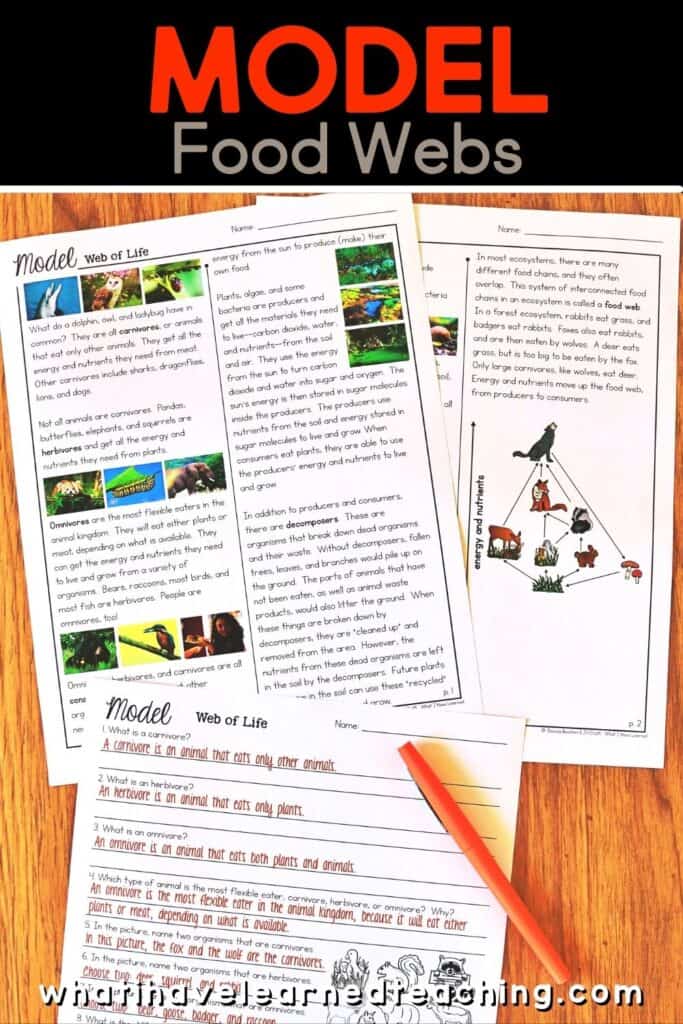
In this Model Science Station, students read about ecosystems and food webs. They create a model of this in a diorama to illustrate the connection among species. They will then answer questions about the concepts they learned.

Explore CHanges in Food Webs and Ecosystem Communities
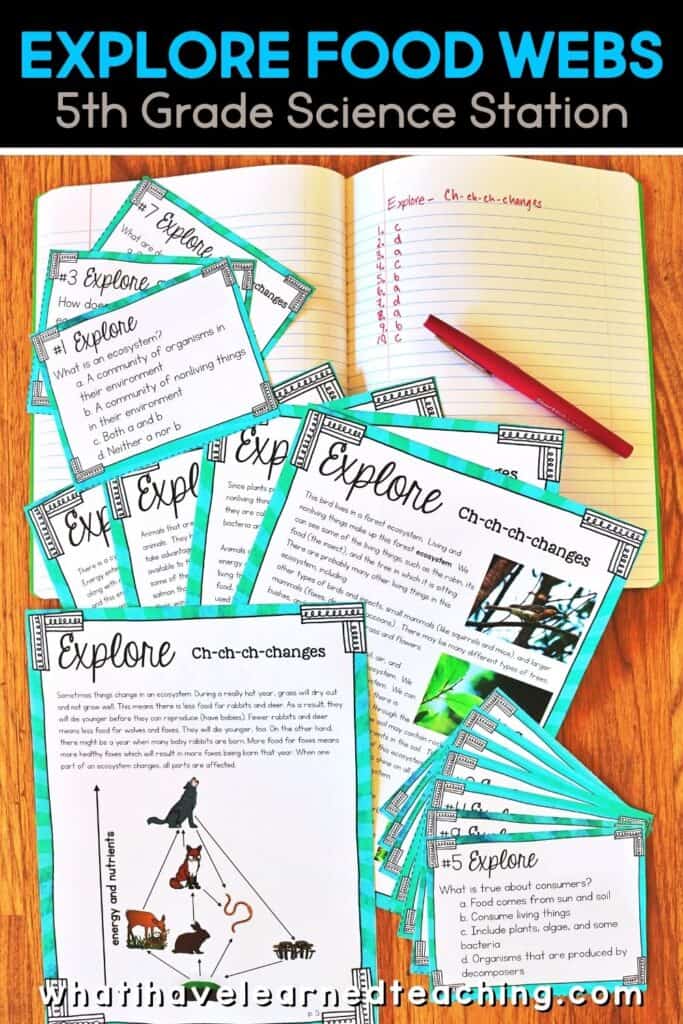
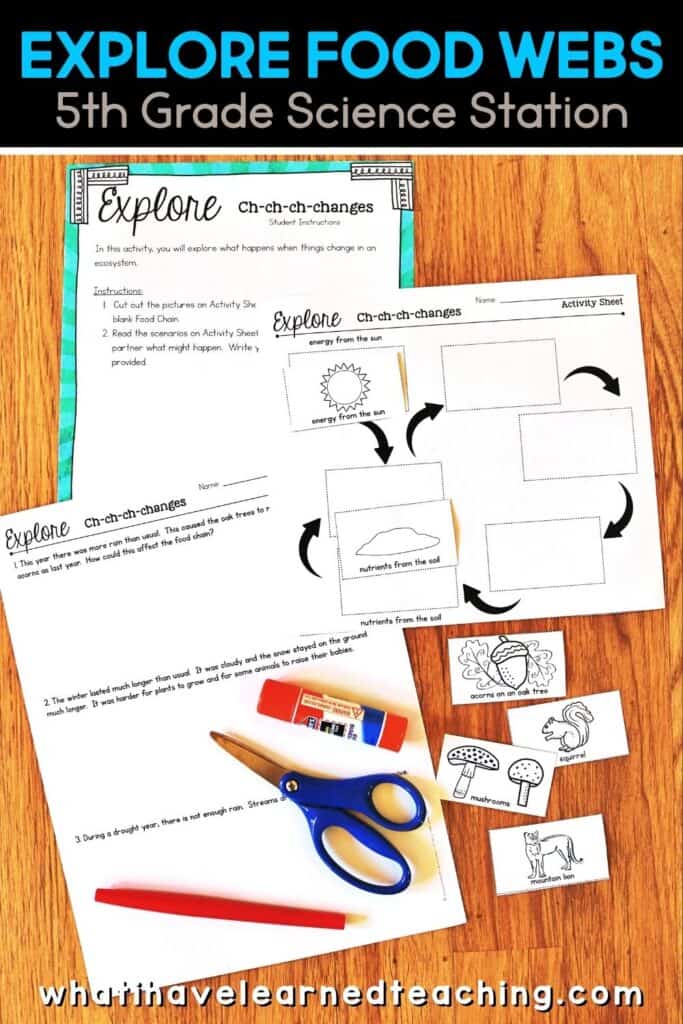
In the Explore station, students will explore what happens when something in an ecosystem changes. Students read about ecosystems and food webs and then explore what happens to the food web and energy flow when the population of one organism changes. Students will deepen their understanding of organisms’ relationships within a community.
Sort Producer or Consumer
This food webs sorting activity, tailored for 5th graders, blends educational content with hands-on learning to comprehensively understand nature’s delicate balance. Through this engaging exercise, students discover the critical roles of producers and consumers in maintaining ecosystem health.
This food webs activity encourages critical thinking and sharpens categorization skills as students learn to distinguish between these ecological roles.

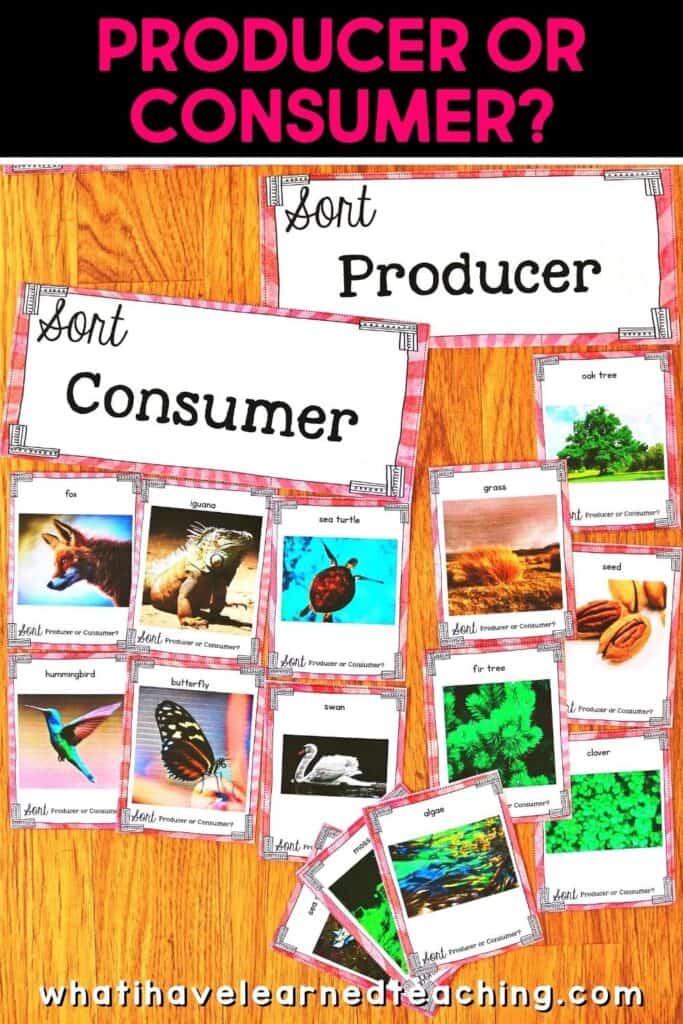
Here are a few examples. Can you sort each of the following as a producer or consumer?
- Fox
- Sea Turtle
- Grass
- Oak Tree
- Algae
Food Webs & Ecosystems Science Station UNIT BUNDLE
These Food Webs Next Generation Science Stations include eight different science stations where students deepen their understanding of food webs, ecosystems, consumers, producers and decomposers, and the movement of matter among plants, animals, decomposers, and the environment. The focus is on 5-LS2-1.
How to Purchase the Fifth Grade Energy for Life Science Stations
The Food Webs and Ecosystems Science Station Unit can be purchased on my website, or Teachers Pay Teachers.
Other Fifth Grade Science Stations
We have fifth-grade science stations for all of the NGSS Standards. Click below for information about each one!
-
 Product on sale5th Grade NGSS Science Station Yearlong BUNDLEOriginal price was: $316.00.$177.87Current price is: $177.87.
 -
-
-
-
-
-
-

Jessica BOschen
Jessica is a teacher, homeschool parent, and entrepreneur. She shares her passion for teaching and education on What I Have Learned. Jessica has 16 years of experience teaching elementary school and currently homeschools her two middle and high school boys. She enjoys scaffolding learning for students, focusing on helping our most challenging learners achieve success in all academic areas.