
Climate Vocabulary Activities for 3rd Grade Science
Climate vocabulary activities give 3rd grade students repeated, structured exposure to the terms they need to understand weather patterns, climate zones, and human impact, before those concepts show up on assessments or in science reading.
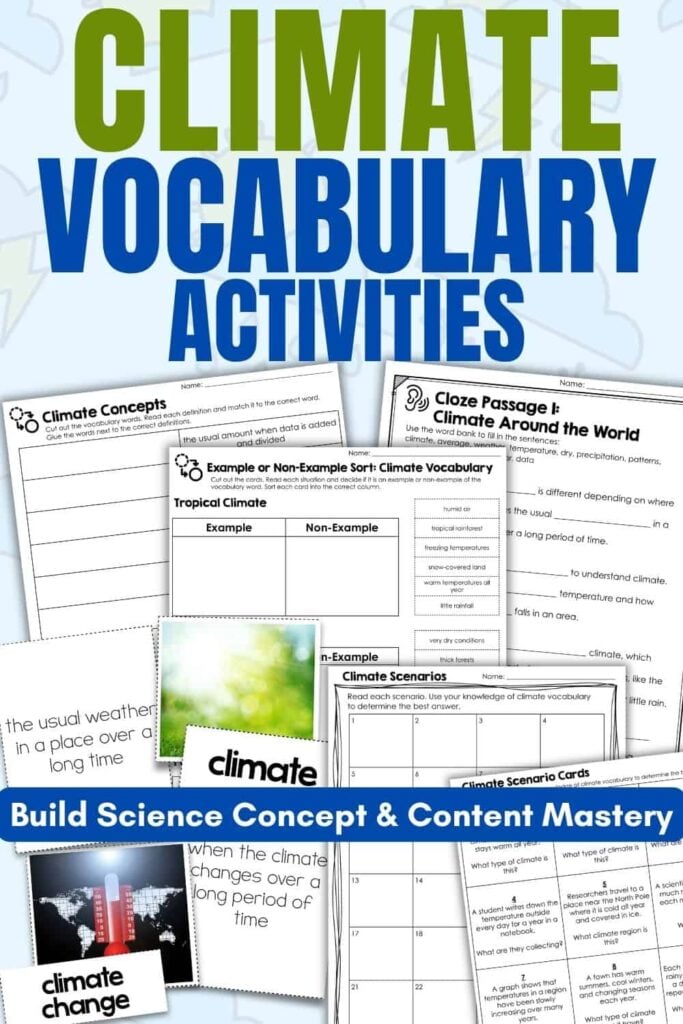
These Climate Vocabulary Activities give students repeated, structured exposure to 40+ climate and weather terms across a full instructional progression — from first introduction through application, error analysis, and peer review.
What Students Learn about Climate
This resource covers vocabulary across five thematic sets, so students build understanding in organized layers rather than learning words in isolation. Key concepts include:
- The difference between weather and climate, and the importance of long-term data
- Climate zones (tropical, temperate, polar, desert, tundra, rainforest, grassland)
- Factors that affect climate: temperature, precipitation, elevation, latitude, and coastlines
- Geography and location vocabulary: equator, region, ocean
- Human impact on climate: greenhouse gases, fossil fuels, carbon dioxide, pollution, and climate change
- Data and pattern vocabulary: trend, average, short-term, long-term, daily, yearly
Climate Vocabulary Activities Overview
The resource is built around a five-step instructional progression that moves students from initial word introduction through higher-order thinking. Here’s how the activities unfold:
Included in this set of resoruces are:
- Vocabulary cards (words, picture cards, and definitions)
- Matching and sorting activity sheets with recording sheets
- Frayer model templates
- Cloze reading passages with word banks
- Scenario cards
- Example and non-example sort sheets
- Error analysis tasks
- Quiz-Quiz-Trade cards
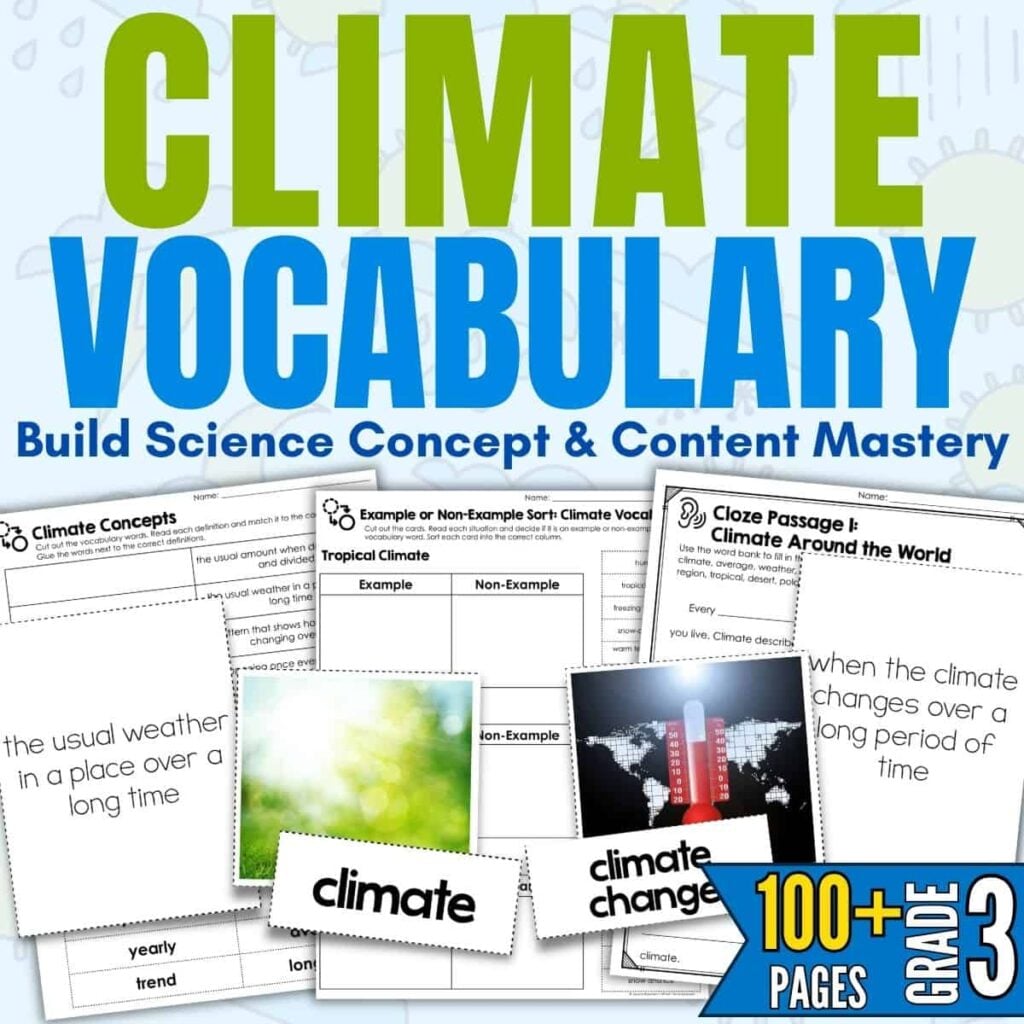
These climate vocabulary activities include interactive practice, reading comprehension, and critical-thinking tasks that help students master key concepts such as climate zones, precipitation, and human impact.
Step 1 – Introduce Vocabulary
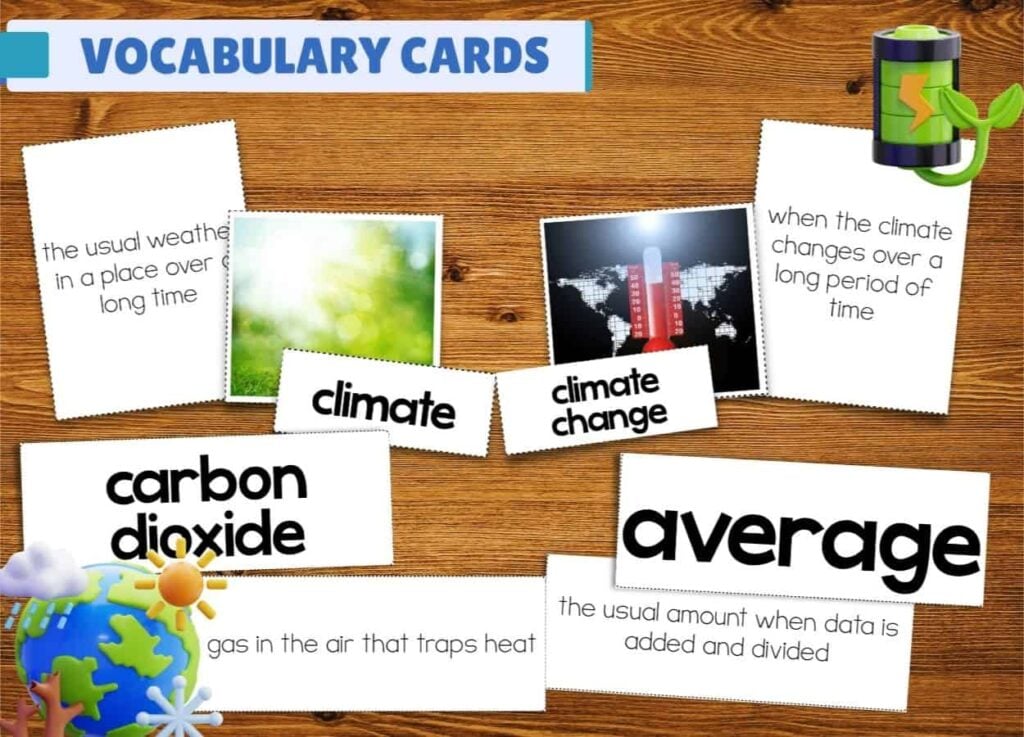
Students begin with vocabulary cards that pair each word with a picture and a definition. These cards can be used whole-group on a document camera, set up as a classroom display, or distributed to partners. The visual support makes this especially accessible for English learners and students who benefit from concrete representations.
Step 2 – Build Understanding
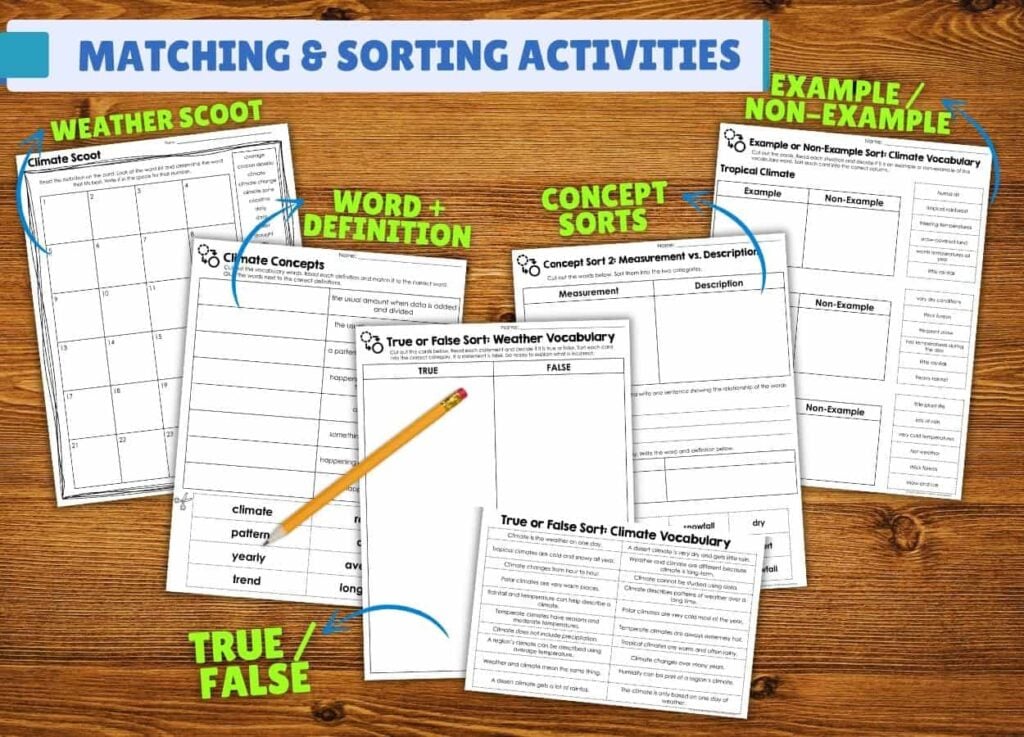
Matching and sorting activities move students from passive recognition to active categorization. Students sort words by category (climate zones, precipitation terms, human impact, etc.) and complete Frayer models that ask them to define, illustrate, give examples, and identify non-examples for key terms.
Step 3 – Apply Learning
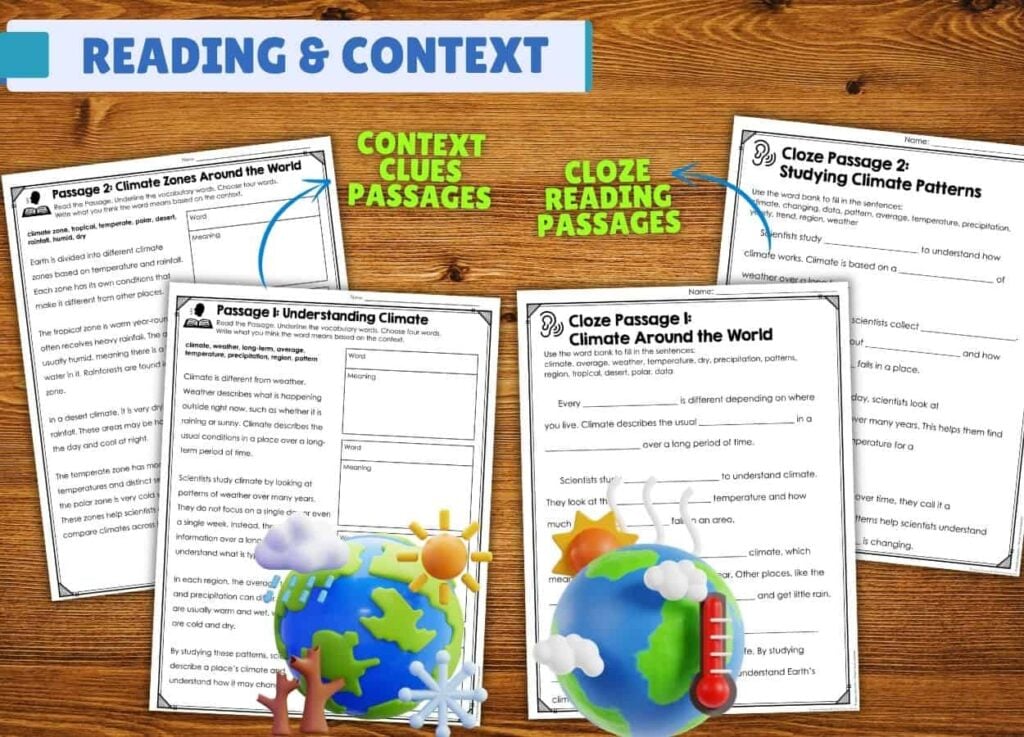
Cloze reading passages give students an authentic context for vocabulary use. Students read short passages about climate topics and fill in missing terms using a word bank. The word bank can be removed for a more challenging version or left in for support.
Step 4 – Extend Thinking
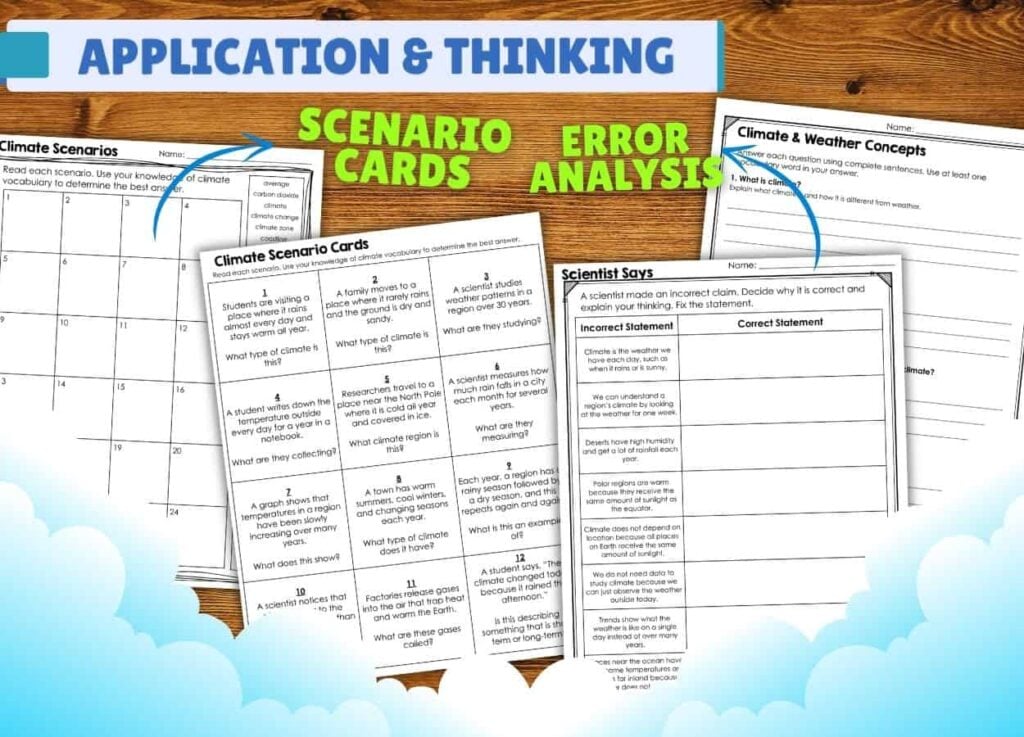
Scenario cards present real-world situations, and students must identify which vocabulary word applies and explain their reasoning. Error analysis tasks push students to identify and correct misconceptions about climate concepts — a powerful discussion starter.
Step 5 – Review and Assess
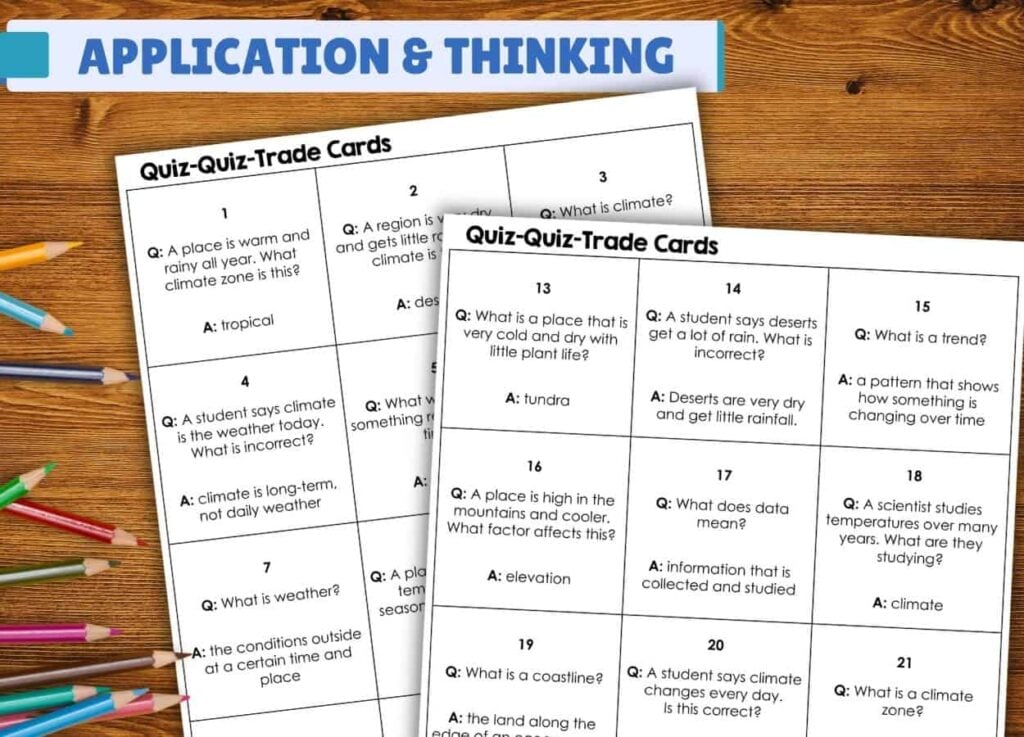
Quiz-Quiz-Trade cards make vocabulary review kinesthetic and social. Each student holds a card, pairs with a classmate, quizzes each other, trades cards, and finds a new partner. Exit tickets are also included for quick, informal assessment.
Student Sheets and Differentiation
The resource offers multiple ways to interact with the same vocabulary, which makes differentiation straightforward:
- Cloze passages with word bank: Ideal for students who need support accessing text or for English learners who know the concept but need scaffolded language practice
- Cloze passages without word bank: More appropriate for students who are ready to recall vocabulary independently or as an assessment
- Frayer models: Great for students who need deeper conceptual processing — they’re equally effective as an independent task or a collaborative one
- Error analysis tasks: Best suited for students ready to evaluate reasoning, explain thinking, and identify where misunderstandings occur
What This Looks Like in the Classroom
- Science vocabulary stations: Rotate small groups through matching, Frayer models, cloze passages, and scenario card stations over the course of a week
- Whole-class introduction and partner review: Introduce words with vocabulary cards as a class, then have partners quiz each other before independent practice
- Morning warm-up or bell ringer: Use a single cloze passage or a few scenario cards as a low-prep way to spiral vocabulary throughout a climate unit
- Quiz-Quiz-Trade as a unit review: Use the movement-based review cards the day before an assessment to re-engage students with all 40+ terms
Why This Activity Works So Well
1. Repeated Exposure Across Formats
Research on vocabulary acquisition consistently shows that students need multiple encounters with a word in varied contexts before it truly sticks. This resource provides exactly that — the same 40+ terms appear across cards, matching activities, cloze passages, scenarios, and peer quizzing. Each format asks students to use the word in a slightly different way, which deepens retention.
2. Concept Connections, Not Just Definitions
Sorting activities that group words by category (climate zones, precipitation, human impact) help students see how vocabulary terms relate to each other. When students know that “tropical,” “polar,” and “temperate” all belong to the climate zone set, they’re building a mental map of the science content — not just memorizing a list.
3. Academic Language Meets Scientific Thinking
Words like “trend,” “data,” “pattern,” and “long-term” aren’t just science vocabulary — they’re the academic language students need for science reading comprehension in upper grades and on standardized assessments. Building fluency with these terms early pays off across subjects.
4. Built-In Discussion Opportunities
The error analysis tasks and scenario cards are designed to generate conversation. When students have to explain why an answer is wrong — or justify which vocabulary word fits a real-world situation — they’re practicing the kind of evidence-based reasoning that strengthens both scientific thinking and academic writing.
Easy Differentiation Ideas
For additional support:
- Provide the word bank for cloze passages even when the answer key doesn’t require it
- Allow students to use vocabulary cards as a reference while completing matching or sorting activities
- Pair students strategically during Quiz-Quiz-Trade so struggling students review with a supportive partner
For extension:
- Challenge students to write their own scenario cards using unfamiliar vocabulary terms
- Remove the word bank from cloze activities and have students complete passages from memory
- Have students create their own error analysis tasks to stump a partner
These climate vocabulary activities include interactive practice, reading comprehension, and critical-thinking tasks that help students master key concepts such as climate zones, precipitation, and human impact.
Bringing It All Together
By the end of this vocabulary progression, students will be able to identify, define, categorize, and apply over 40 climate and weather terms in context. More than that, they’ll understand how these concepts connect — how elevation affects temperature, how fossil fuels contribute to greenhouse gas emissions, and why scientists look at long-term patterns rather than single data points. Strong vocabulary builds strong science readers, and this resource gives students the practice they need to get there.
Climate is just one piece of a rich earth science curriculum. If you’re looking for more activities, lessons, and resources to build out your earth science unit, check out the Earth Science for Elementary Students: 2nd–5th Grade Guide for ideas organized by topic and grade level.
Jessica BOschen
Jessica is a teacher, homeschool parent, and entrepreneur. She shares her passion for teaching and education on What I Have Learned. Jessica has 16 years of experience teaching elementary school and currently homeschools her two middle and high school boys. She enjoys scaffolding learning for students, focusing on helping our most challenging learners achieve success in all academic areas.