
Earth’s Hydrosphere Activities for Upper Elementary Students
Looking for engaging Earth’s hydrosphere activities for your upper elementary students? From hands-on experiments to simple models, there are many ways to help students understand how water shapes Earth’s systems. These activities focus on real-world connections, allowing students to explore how the hydrosphere interacts with the geosphere, biosphere, and atmosphere.

Find more earth science resources organized by NGSS standard in the complete elementary earth science guide.
What is the Earth’s Hydrosphere?
The Earth’s hydrosphere includes all the water on the planet, including oceans, rivers, lakes, groundwater, and water vapor in the air. It is the layer of water on the planet. This includes rivers, lakes, oceans, and even the moisture in the air.
The hydrosphere is important because it helps keep our planet cool and provides us with drinking water. It also influences storm systems, flooding, and other weather-related events. Without this layer of water surrounding us, life on Earth would not be possible.
Hands-On Earth’s Hydrosphere Activities for Upper Elementary Students
With these hydrosphere activities, students explore water filtration experiments, watershed modeling, and simulations of the water cycle. By engaging in these activities, they will develop a deep appreciation for the Earth’s hydrosphere’s impact on the geosphere, the biosphere, and even the atmosphere.
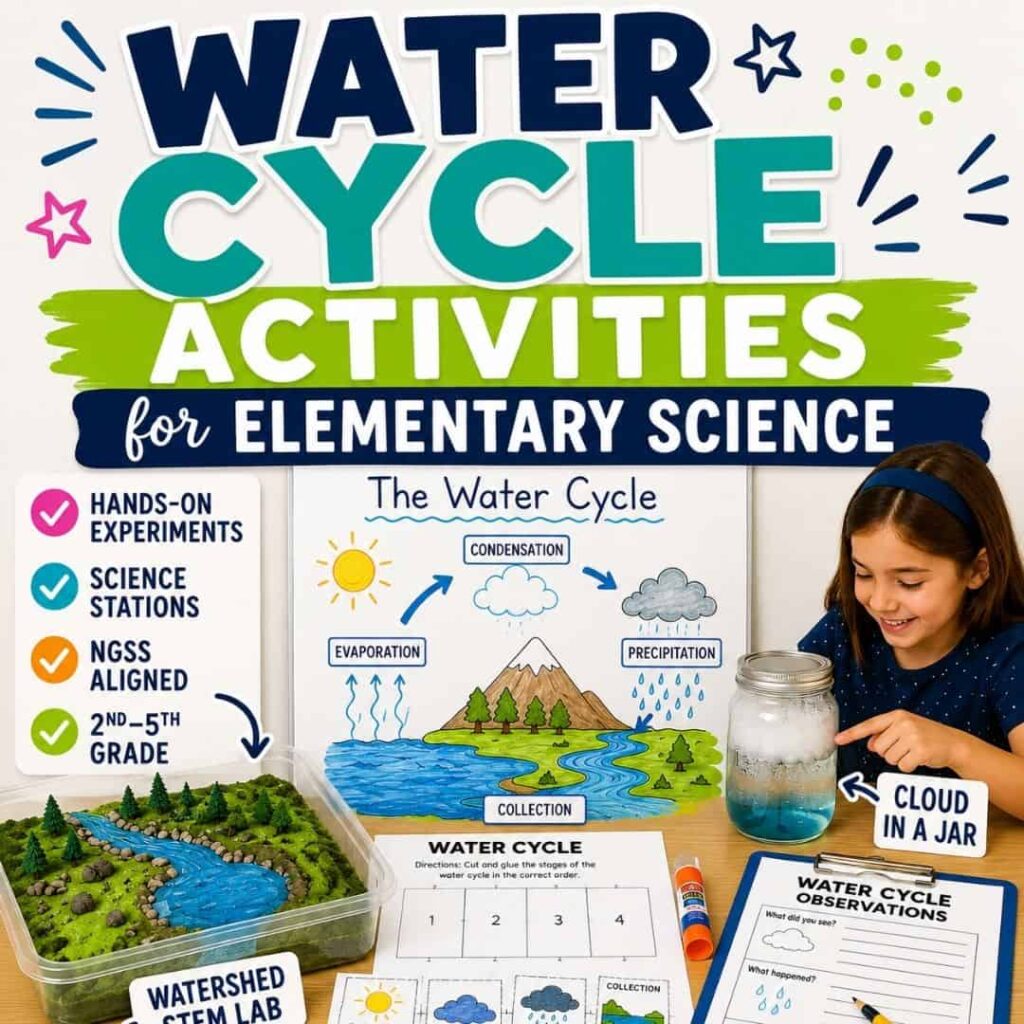
These water cycle activities tie in with the hydrosphere and how it interacts with other spheres.
Water Cycle in a Bag
This activity helps students observe how water moves through the water cycle. Water Cycle in a Bag involves filling a zip-lock bag with water and observing condensation, evaporation, and precipitation as the water cycle occurs. Through this simple yet effective experiment, students will gain an appreciation for how the hydrosphere influences other spheres on Earth.
Fill a ziplock bag with water, hang it near a window, and observe condensation, evaporation, and precipitation as the water cycle occurs. Label the bag with the water cycle process.
Water Cycle Simulation
The water cycle simulation using heat is a great way to explore the importance of the hydrosphere, as it helps students understand how evaporation, condensation, and precipitation are interconnected in Earth’s atmosphere. By providing a closed system and applying heat to the jar, students can observe the condensation and precipitation process.

Set up a water cycle simulation using a large jar, a heat source, and a plastic cover.
Watershed Model
A watershed model helps students see how water moves through land and how the hydrosphere interacts with the geosphere and biosphere. By creating a simple model, students can observe how water flows through features like mountains, valleys, and rivers—and how pollution affects water quality.
Students build a mini watershed using a container, sand, rocks, and water. As they pour water into the model, they observe how it flows across the landscape, shapes landforms through erosion and deposition, and impacts living things in the environment.

This activity connects reading and hands-on learning as students explore watersheds and the water cycle, then explain how water moves through a system and affects the surrounding ecosystem.
Water Filtration Experiment
This hands-on activity helps students understand how the hydrosphere interacts with the geosphere and biosphere through processes like filtration and water purification.
Students are given dirty water samples and materials such as sand, gravel, activated charcoal, and filter paper to design and build their own filtration systems. As they test and refine their designs, they observe how water is cleaned and discuss why clean water is essential for ecosystems and human use.
This experiment connects real-world issues to science concepts, helping students see how water moves through Earth’s systems and why it matters.
Ocean Acidification Experiment
This activity shows how increased carbon dioxide lowers pH and affects marine life.
Students add vinegar to water to model ocean acidification, then place seashells, coral, or chalk in the solution. As they observe the materials weaken or dissolve, they connect these changes to real-world impacts on marine organisms.
This experiment helps students understand how changes in the hydrosphere affect the biosphere.
Science Stations about the Earth’s Hydrosphere
We offer a variety of science activities focused on the Hydrosphere. Students can learn about how water exists on Earth in different forms and how it impacts other systems. Each science center includes a reading passage, a hands-on activity, and differentiated questions to extend learning.

In this science activity, students read about the negative impacts of human activities on Earth’s water and what is being done to address these problems. They explore natural filters in a hands-on activity.

In this sorting activity, students read about water on Earth. They will sort several water systems into freshwater and saltwater categories.

In this exploration, students read about water distribution on Earth, water scarcity, and saltwater. They explore saltwater in a hands-on activity. Students answer questions about the exploration.
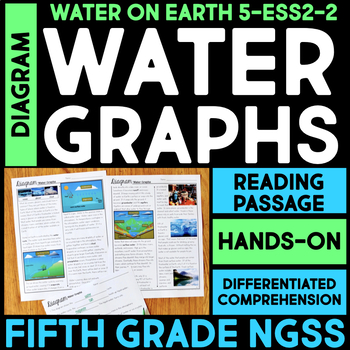
With this DIAGRAM science station, students can understand the water cycle and how water is distributed around Earth. Students create graphs that diagram water distribution.
Science Stations about the Earth’s Hydrosphere’s Effect on the Geosphere
While not specifically about the hydrosphere, the following science stations explore how water affects the land. They include explorations of floodwaters, river systems, and water erosion.

In this EXPLORE science station, students explore floods and how to keep a house safe from flooding.
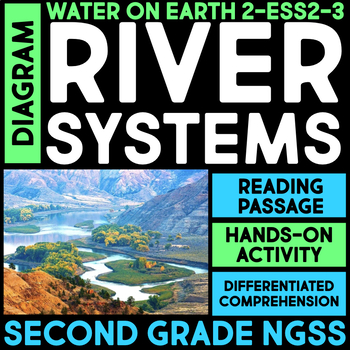
In this DIAGRAM science station, students read about river systems. They put together a diagram of a river.

In this INVESTIGATE science station, read about weathering and erosion that happen with water. They investigate this in a hands-on activity.

In this MODEL science station, read about problems that happen with weathering and erosion. Students draw models of solutions to erosion problems.
Science Stations about the Earth’s Hydrosphere’s Effect on the Biosphere
These science activities focus on how the Earth’s hydrosphere affects the biosphere by examining aquatic habitats.

In this READ science station, students read about the habitats found in different places and forms of water on Earth.

In this SORT science station, students sort plants and animals into two groups: those that live on land and those that live in water.

In this SORT science station, students read about water on Earth. They sort water bodies into habitats in saltwater and freshwater.
Conduct a Water Quality Test
Have students conduct a water-quality test to determine the presence of contaminants and pollutants in different water sources. Through this activity, they will gain a better understanding of how pollution can affect the environment and its inhabitants. Additionally, it is important to discuss with students the need to conserve our limited resources and reduce waste. This is a great way for students to learn about the importance of clean water and the effects of pollution on our water supply.
Activities about the Cryosphere
Did you know that the icy part of the Earth’s hydrosphere has its own name? The cryosphere is the frozen part of the hydrosphere and includes glaciers, ice caps, and frozen water.
Students will participate in activities such as glacier formation simulations and investigations into the effects of melting ice. Through these experiences, they will discover the cryosphere’s vital role in shaping landscapes, influencing sea levels, and impacting the broader Earth system.
Melting Ice Investigation
In this investigation, students will explore the cryosphere and its role in shaping landscapes, influencing sea levels, and impacting the broader Earth system. They will use different types of ice to observe and record the melting rate under various conditions (temperature, exposure to sunlight, etc.). By doing so, they will gain a better understanding of how changes in the cryosphere can affect other Earth systems.
Provide students with different types of ice (cubes, crushed, or blocks) and ask them to observe and record the melting rate under various conditions (temperature, exposure to sunlight, etc.). Have a discussion about the melting polar ice caps and how this investigation relates to climate change.
Glacier Formation
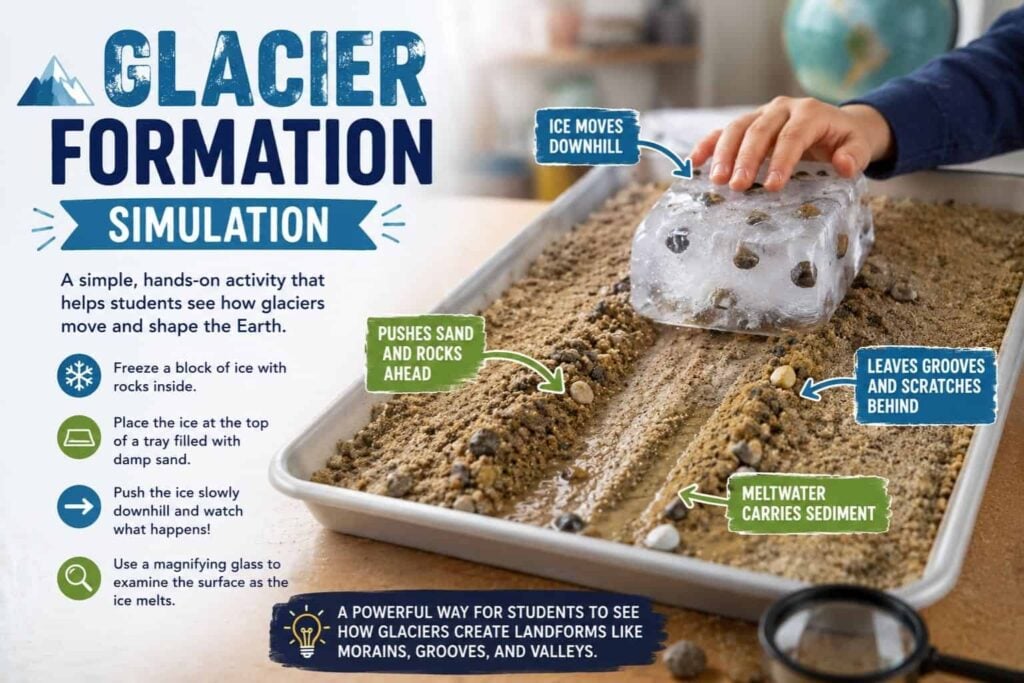
Fill a shallow tray with damp sand or a mixture of sand and soil. Slightly tilt the tray to create a gentle slope. Freeze a large block of ice in a plastic container ahead of time. Before freezing, mix in small rocks, gravel, or pebbles to represent sediment carried by a glacier.
Place the ice block at the top of the tray, then have students slowly push it downhill while observing what happens to the sand and rocks beneath. As the ice moves, it scrapes the surface, pushes sediment forward, and leaves small ridges behind that model glacial landforms like moraines.
Students can use magnifying glasses to examine:
- grooves or scrape marks in the sand
- piles of sediment pushed to the front or sides
- rocks deposited as the ice melts
You can also have students compare:
- movement with smooth ice vs. rocky ice
- wet sand vs. dry sand
- steep slopes vs. gentle slopes
The most effective part of the model is not the melting itself — it’s the movement of the “glacier” across the surface. That movement helps students visualize how glaciers shape Earth’s surface over time.
Science Stations about the Cryosphere
We also have several science stations that focus specifically on the Earth’s Cryosphere. These stations focus on glaciers and glacial erosion.

In this MODEL science station, students read about the water cycle and how most freshwater is found in glaciers and ice caps.

In this Model, a Glacier science station, students learn about how glaciers affect the physical environment. Students read about how glaciers play a role in the weathering and erosion of mountains and valleys. Students will model glaciation in action.

In this EXPLORE science station, students read about glaciers and explore how they are made.
More Activities about the Earth’s Hydrosphere
PBS Learning Media has a great site with videos and interactive lessons that are aligned with the NGSS. The Earth’s Hydrosphere section focuses on the role of water in Earth’s systems, components of the hydrosphere, the water cycle, and ocean systems. There are a variety of lessons for grades 3-12.
This lesson from NASA shows students how to use measurements and data to investigate freshwater sources.
A Complete Unit of 5th Grade Science Activities about Earth’s Spheres and Systems
These Earth’s hydrosphere activities give students hands-on ways to explore how water shapes our planet.
If you want a complete set of ready-to-use lessons, check out these Earth’s spheres science stations that include hydrosphere-focused activities and more.
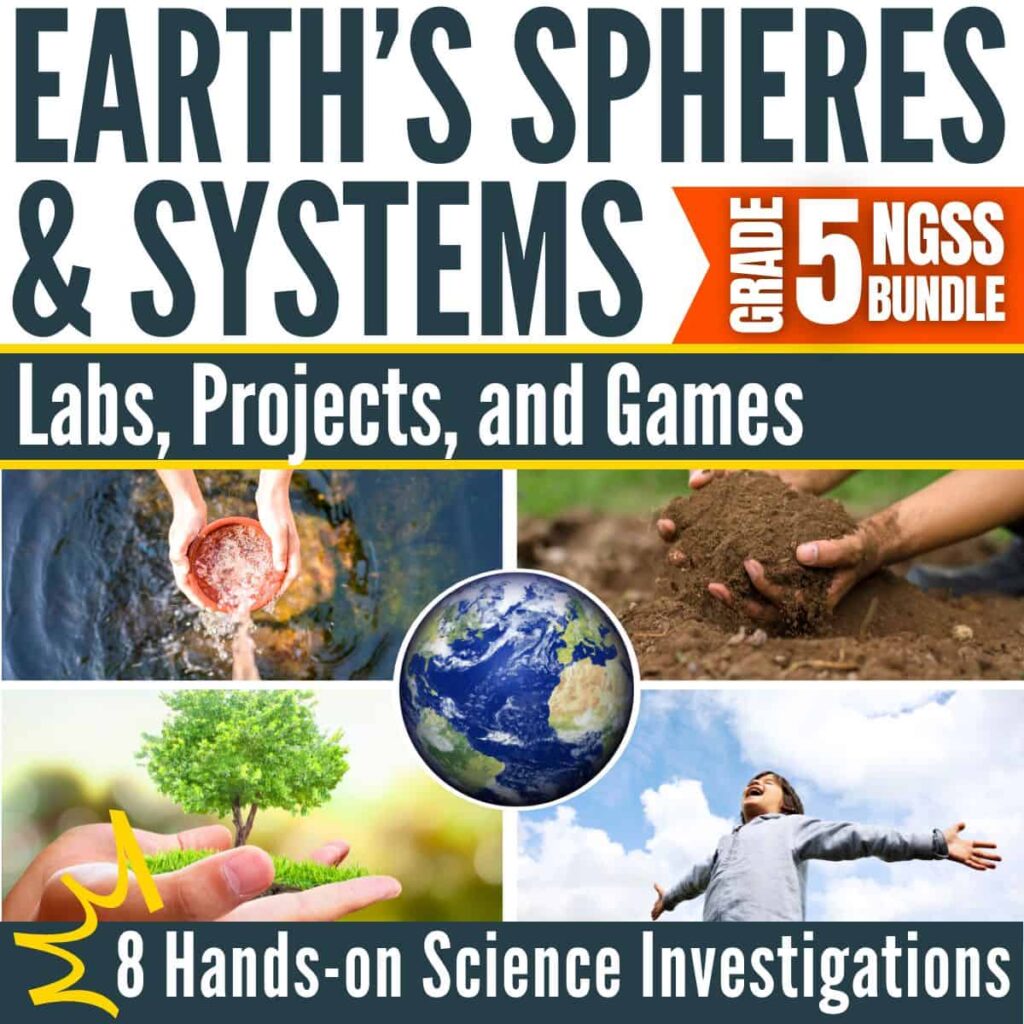
Earth’s Spheres and Systems Science Station UNIT BUNDLE
These Earth’s Spheres and Systems Next Generation Science Stations include eight different science stations where students deepen their understanding of the Earth’s Spheres, the five layers of the atmosphere, the kingdoms in the biosphere, and the systems in the geosphere. The focus is on 5-ESS2-1.
Jessica BOschen
Jessica is a teacher, homeschool parent, and entrepreneur. She shares her passion for teaching and education on What I Have Learned. Jessica has 16 years of experience teaching elementary school and currently homeschools her two middle and high school boys. She enjoys scaffolding learning for students, focusing on helping our most challenging learners achieve success in all academic areas.