
Investigate Clouds with a Cloud in a Jar: A Hands-On Way to Teach Weather & the Water Cycle in 3rd Grade
Teaching weather and the water cycle in third grade works best when students can see the science happening. Clouds feel abstract when they live only in diagrams or textbooks, yet they become far more concrete once students watch water vapor change right in front of them.
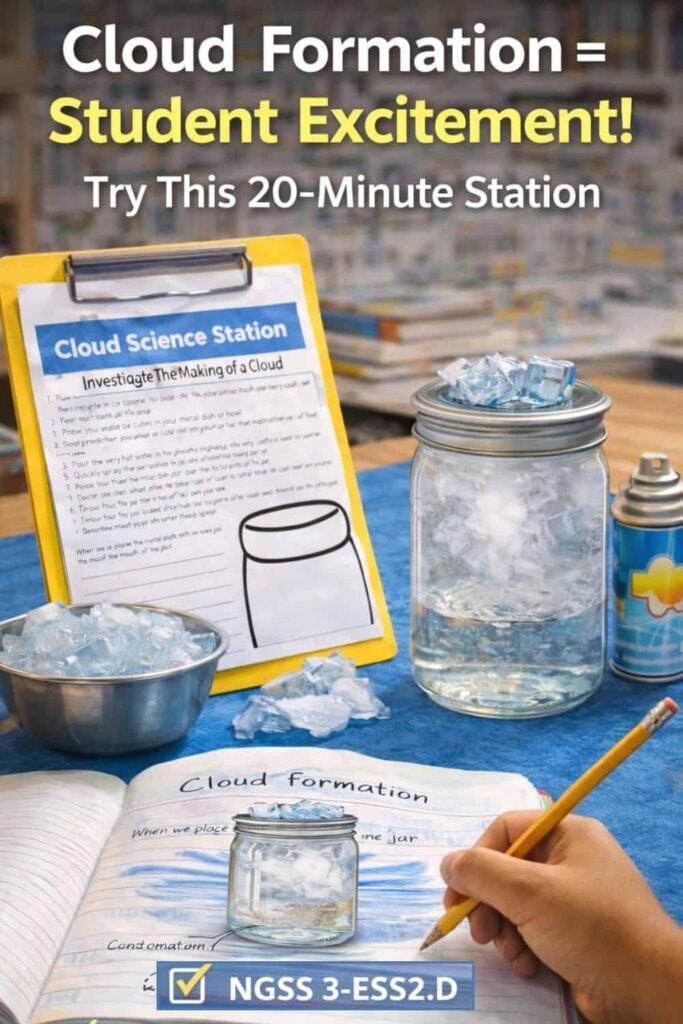
The Investigate Clouds Science Station gives students that experience. Through a short reading, structured investigation, and guided reflection, students build a clear understanding of how clouds form and how they connect to the water cycle and weather patterns. This station fits smoothly into a weather and climate unit and works well for centers, small groups, or whole-class science blocks.
Planning your whole earth science unit? The 2nd–5th Grade Earth Science Guide pulls together every standard, every grade level, and all the resources on this site in one place.
Why Cloud Formation Matters in 3rd Grade Science
Clouds are a key part of the NGSS standard 3-ESS2.D, which focuses on weather patterns and climate. At this grade level, students are expected to understand:
- How the sun drives evaporation
- How condensation leads to cloud formation
- How clouds connect to precipitation and weather events
This investigation supports those goals through observation, explanation, and vocabulary development. Students do not just memorize cloud types. They connect physical changes in matter to real-world weather.
What’s Included in the Investigate Clouds Resource
This teaching resource is one complete Investigate Science Station within a larger Weather & Climate unit. Everything needed for instruction, student work, and assessment is included.
Student Reading Passage
Students read a clear, age-appropriate passage explaining:
- The water cycle
- Evaporation, condensation, and precipitation
- How clouds form
- Types of clouds and the weather they predict
The reading supports science content knowledge and nonfiction reading skills aligned with RI.3 standards.
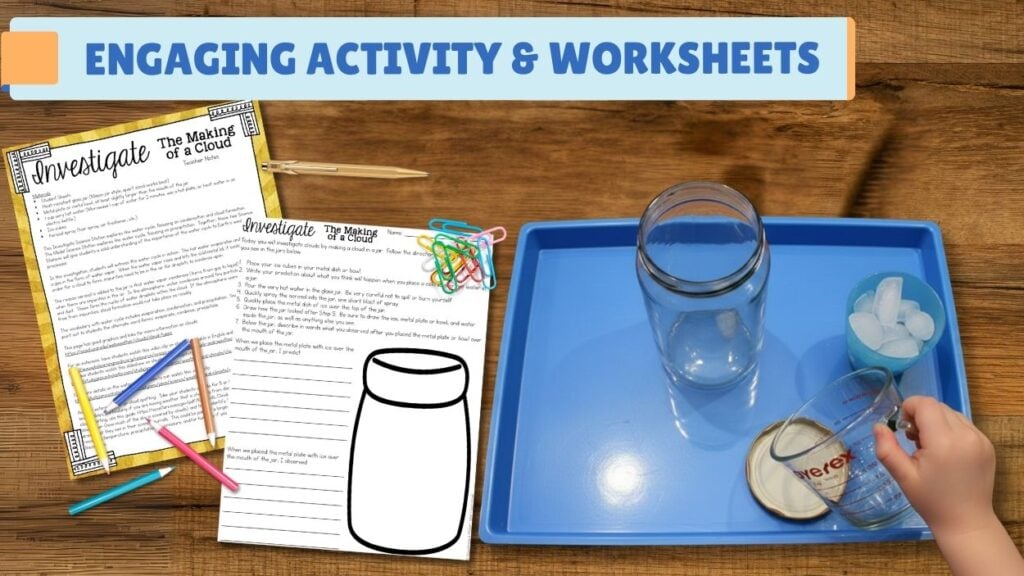
Hands-On Investigation: Make a Cloud in a Jar
Students create a model of cloud formation using:
- Hot water
- Ice
- A metal lid
- Aerosol particles
They observe evaporation, condensation, and cloud formation in real time, then record predictions, observations, and explanations.
Student Worksheets and Response Pages
Students respond through:
- Prediction and observation recording
- Short-answer questions
- Fill-in-the-blank options with word banks
- Reflection prompts tied to the investigation
Multiple formats allow you to choose what fits your students best.
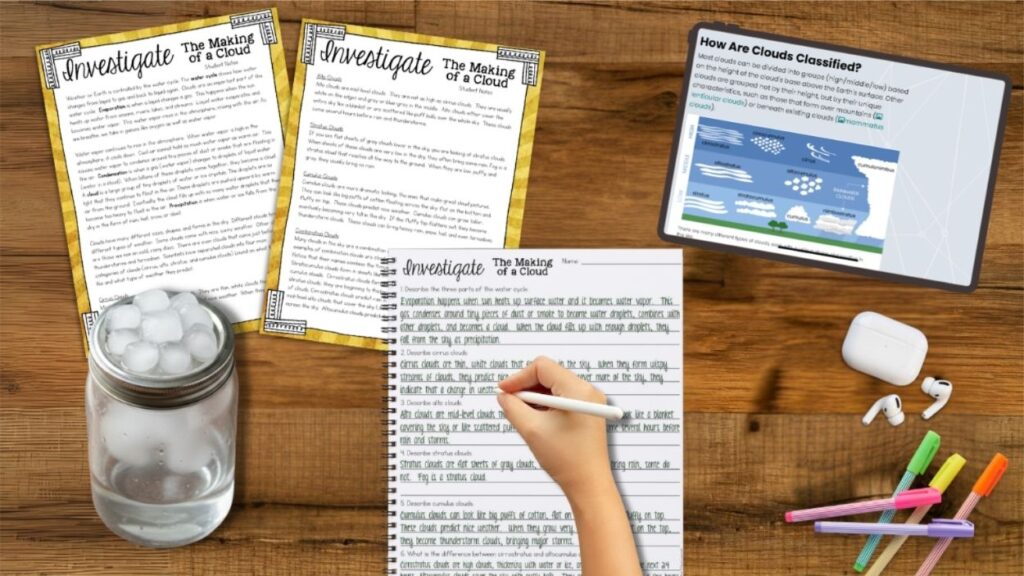
Task Cards and Science Journal Options
The station includes task cards that let students respond in science journals, on worksheets, or through discussion. This flexibility works well for centers or rotating groups.
Digital Components
Links to Google Forms and Google Slides provide a digital option for reading passages, questions, and activity directions. Teachers can choose question types before assigning the form.
Answer Key and Teacher Notes
Clear answer keys support quick grading. Teacher notes explain the science behind the investigation and offer guidance for instruction and extensions.

This resource allows students to observe the water cycle in action by creating a cloud in a jar, helping them understand how clouds form and connect to real-world weather patterns.
Why Teachers Choose This Cloud Investigation
This station works well in real classrooms for several reasons:
- Students see condensation and cloud formation rather than only reading about it
- The investigation links directly to the vocabulary students must master
- Reading, writing, and science are combined in one lesson
- Materials are simple and classroom-friendly
- Multiple response formats support differentiation
Teachers often notice stronger student explanations after this activity, especially when students describe how clouds form and why precipitation happens.
Tips for Teaching Cloud Formation Successfully
Preview Vocabulary Before the Investigation
Introduce evaporation, condensation, and precipitation with simple examples before starting. Students use these terms more accurately during the investigation when they hear them ahead of time.
Model Safety and Expectations
Hot water is involved, so demonstrate steps clearly. Assign roles such as reader, recorder, and observer to keep groups focused.
Pause for Observation Talk
Before students write, pause and ask:
- What do you notice on the lid?
- What changed inside the jar?
- Why do you think that happened?
These quick discussions improve written explanations later.
Connect to Outdoor Observations
After the investigation, have students look at the sky over several days. Students can sketch clouds, name types, and predict weather in their science journals.
Link Back to the Water Cycle
Revisit evaporation and condensation using the jar model. Students often grasp these processes better once they see them happen.

When to Use This Resource
This station works well:
- During a weather and climate unit
- As part of a science center rotation
- In small-group instruction
- As a hands-on follow-up after direct instruction
The activity fits comfortably into a 20-minute station block and can stand alone or pair with other weather stations.
A Simple Way to Make Weather Science Stick
Cloud formation is one of those topics students remember best when learning feels active. This investigation turns an abstract idea into something students can observe, describe, and explain using scientific language.
If you want your third graders to move past memorization and toward real understanding of weather patterns, the Investigate Clouds Science Station provides a strong foundation they can build on throughout the year.
Jessica BOschen
Jessica is a teacher, homeschool parent, and entrepreneur. She shares her passion for teaching and education on What I Have Learned. Jessica has 16 years of experience teaching elementary school and currently homeschools her two middle and high school boys. She enjoys scaffolding learning for students, focusing on helping our most challenging learners achieve success in all academic areas.