
Supporting ELL Students in the Classroom: Strategies That Work
You have a new student in your classroom, and she speaks very little English. She watches everything carefully, follows what other students do, and rarely raises her hand. You want to help her, but you’re not sure where to start.
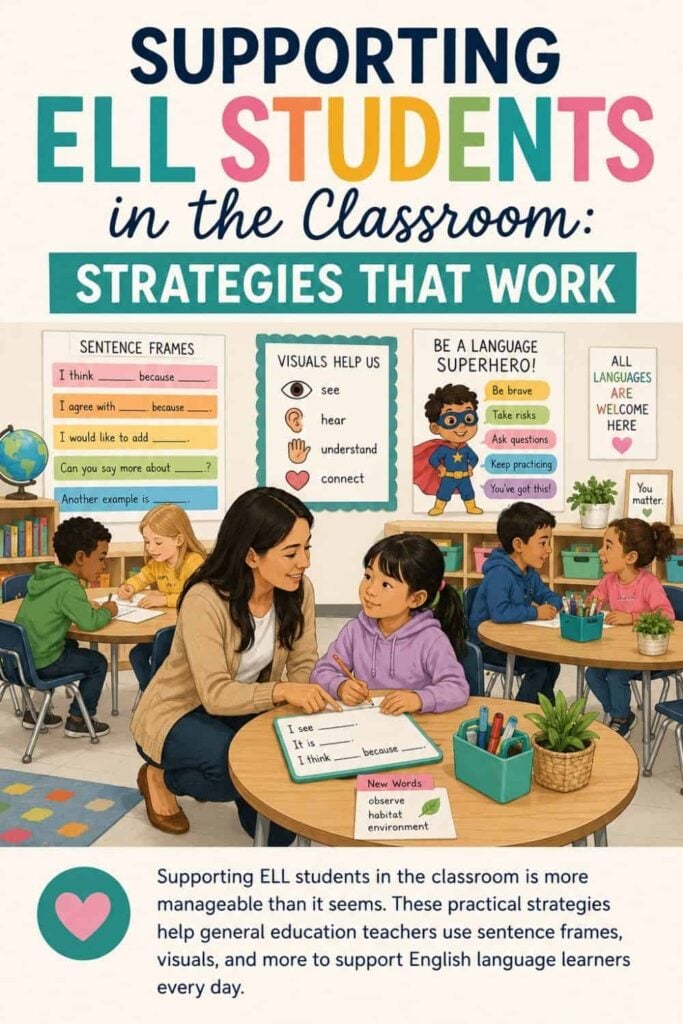
Supporting ELL students in the classroom doesn’t require a master’s degree in ESL. It does require a few key strategies and a willingness to adjust how you set up your environment and deliver instruction. Here’s what works.
Set Up Your Classroom Environment for ELL Students
Before your ELL students walk through the door, your classroom environment can already be working for them. The goal is to make the physical space as readable as possible, not just for students who are learning English, but for everyone.
Label everything. Bookshelves, supply bins, classroom areas — anything students interact with regularly should have a clear label with a picture alongside the word. Use a clean, readable font and make sure the images actually match what’s being labeled. A fuzzy clip art pencil next to the word “pencils” isn’t nearly as useful as a clear photograph.
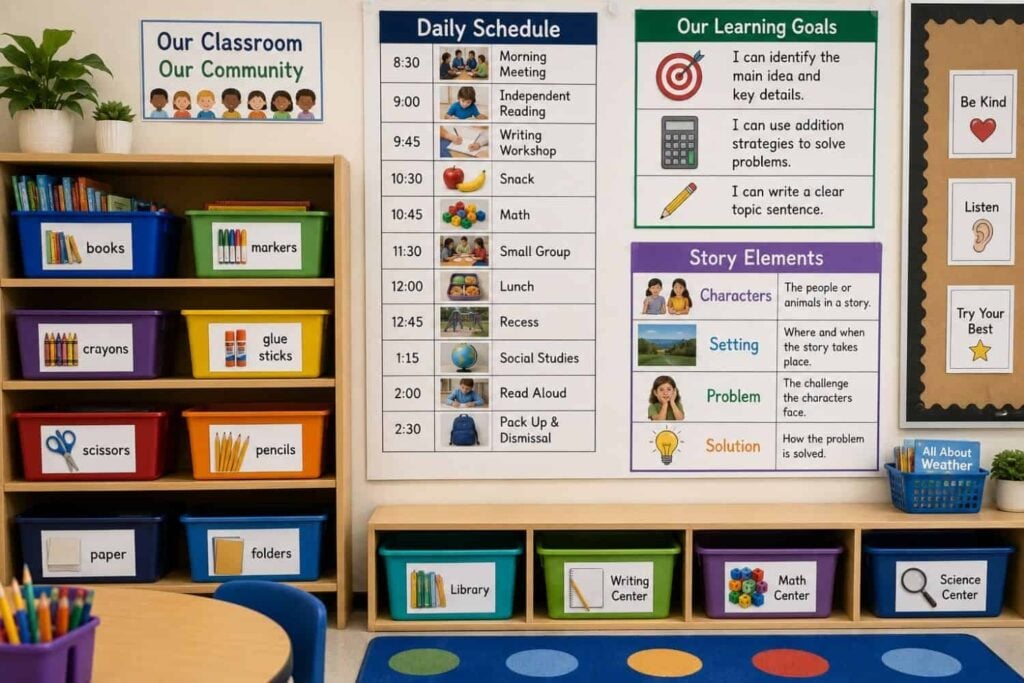
Display your daily schedule visually, with pictures representing each part of the day. When a student doesn’t yet understand the words “morning meeting” or “independent reading,” a small icon next to each item helps them follow along and feel less lost. Post your learning objectives in the same spot every day so students know exactly where to look.
Anchor charts are your friend here too. Any chart you’d normally make for the class — story elements, math strategies, writing steps — becomes even more valuable for ELL students when key words include a visual alongside them. You’re not doing extra work. You’re making what you already do more accessible.
Understand the Stages of Language Acquisition
One of the most helpful things you can do for yourself as a classroom teacher is to understand that language learning follows a predictable path. ELL students don’t go from no English to fluent English overnight — and knowing what to expect at each stage helps you set realistic expectations and respond appropriately.
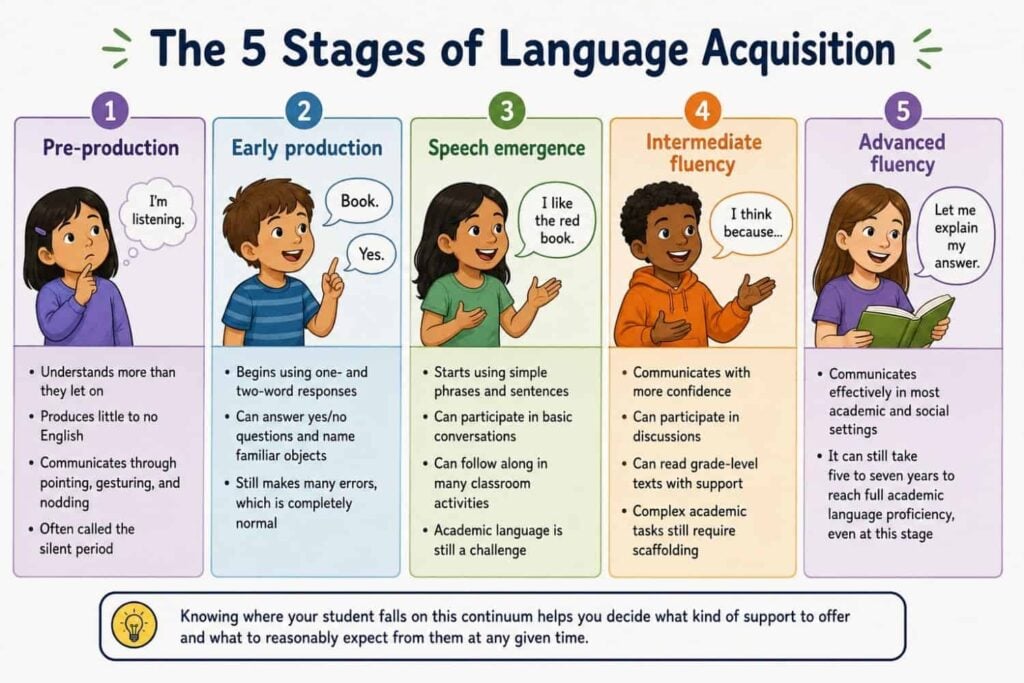
There are five general stages most language learners move through:
- Pre-production — The student may understand more than they let on, but produces little to no English. They communicate through pointing, gesturing, and nodding. This is often called the silent period.
- Early production — Students begin using one- and two-word responses. They can answer yes/no questions and name familiar objects. They still make many errors, which is completely normal.
- Speech emergence — Students start using simple phrases and sentences. They can participate in basic conversations and follow along in many classroom activities, though academic language is still a challenge.
- Intermediate fluency — Students communicate with more confidence. They can participate in discussions and read grade-level texts with support, though complex academic tasks still require scaffolding.
- Advanced fluency — Students can communicate effectively in most academic and social settings. It can still take five to seven years to reach full academic language proficiency, even at this stage.
Knowing where your student falls on this continuum helps you decide what kind of support to offer and what to reasonably expect from them at any given time.
Honor the Silent Period
When a new ELL student stays quiet during class discussions or doesn’t respond when called on, it can feel like something is wrong. Most of the time, nothing is wrong. They are in the silent period — taking everything in, processing the language around them, and building their understanding before they feel ready to produce language themselves.
The silent period is a well-documented stage in second language acquisition, and it can last anywhere from a few weeks to several months depending on the student. During this time, do not push students to speak in front of the class. Instead, give them low-risk ways to participate — thumbs up or down, pointing to a picture card, showing their work to a partner. These kinds of responses let students engage without requiring oral language production before they’re ready.
Resist the urge to interpret silence as disengagement. In many cases, the student is working harder than anyone else in the room.
Use Sentence Frames to Build Academic Language
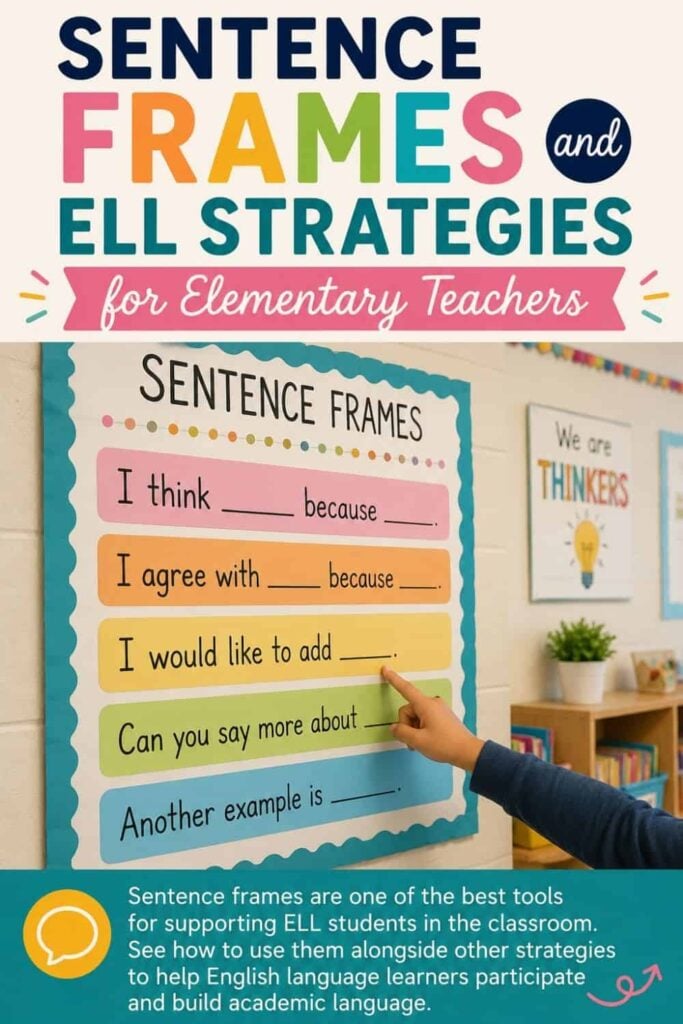
Sentence frames are one of the highest-leverage tools you have for supporting ELL students — and they benefit every learner in your classroom, not just English language learners. A sentence frame is a partially completed sentence that provides students with a structure for participating in academic conversations and writing before they have the language fluency to construct it themselves.
Some examples:
- “I think ___ because ___.”
- “The author’s purpose is ___ because ___.”
- “I agree/disagree with ___ because ___.”
- “First ___, then ___, finally ___.”
- “The problem is asking me to ___. I know that ___. So I will ___.”
Post these where every student can see them and require all students to use them during discussions and written responses. When sentence frames become a class norm rather than a crutch for one student, ELL students can use them without feeling singled out.
Vary your frames by content area. Math sentence frames look different from reading frames, which look different from writing frames. The more specific the frame is to what students are actually doing, the more useful it becomes. If you’re building a sentence frames library for your classroom, consider having a set for each subject area posted in the relevant part of your room.

This post has suggestions and ideas on how to use sentence frames to develop academic langauge in elementary classrooms.
Differentiate for ELL Students by Proficiency Level
Not all ELL students need the same support. A student in the pre-production stage needs very different scaffolding than a student at an intermediate fluency level. Differentiating for ELL students doesn’t mean creating entirely separate lessons — it means adjusting the access points within the lesson you’re already teaching.
Some practical ways to differentiate within a lesson:
- Chunk reading passages into smaller sections and provide picture support for key vocabulary
- Read directions aloud and model what the completed task should look like
- Reduce the number of answer choices on assessments for students at early proficiency levels
- Allow students to draw or label rather than write full sentences when appropriate
- Provide sentence starters for any writing task
- Focus vocabulary instruction on the words that are most essential for understanding the core concept — don’t expect ELL students to master every term on a long list
The goal isn’t to lower expectations. It’s to make grade-level content accessible while students are still building language skills. The concept and the thinking can stay at grade level even when the language output looks different.
How You Speak Makes a Difference
Most teachers don’t think much about how they deliver verbal instruction — it just happens. But for ELL students, the way you speak matters as much as what you say. A few small adjustments to how you talk in your classroom can significantly increase how much ELL students understand.
- Slow down. Not dramatically, but intentionally. Give students time to process each sentence before moving to the next.
- Avoid idioms and figurative language unless you’re explicitly teaching them. “It’s raining cats and dogs” or “hit the nail on the head” are completely opaque to a student who is still building their literal English vocabulary.
- Extend your wait time. Research consistently shows that waiting three to five seconds after asking a question — instead of the typical one to two seconds — dramatically improves the quality of student responses. For ELL students, that extra time allows them to translate, process, and form a response. If you call on students too quickly, many will simply stop trying to answer.
- Gesture and point while you speak. If you’re talking about the directions on the board, point to them. If you’re explaining where to put a paper, show it. Non-verbal cues add a layer of meaning that supports comprehension.
- Repeat key phrases without changing the words too much. When you restate something three different ways, you’ve essentially given the student three new phrases to decode instead of one.
Build Relationships with Students and Families
Getting to know your ELL students as people — not just as language learners — makes a real difference in how quickly they feel comfortable in your classroom. Start with names. Take the time to learn how to pronounce each student’s name correctly. Ask them to say it for you. Write it down phonetically if you need to. A student whose name is consistently mispronounced loses a small piece of their confidence and sense of belonging every time it happens.
As you build rapport with the student, invite them to share aspects of their culture, family, and experiences — but don’t put them on the spot. Let it happen naturally, over time, as they feel more comfortable. Some students will open up quickly. Others need weeks before they’re ready to share much at all.
Family connections matter here too. Reach out to parents early, and if at all possible, send home written materials in the family’s home language. When families feel welcomed and informed, students tend to be more engaged at school. Your school’s ESL teacher or office staff may be able to help with translation if you don’t have the resources to do it on your own.
Collaborate with Your ESL Teacher
Your school’s ESL teacher is one of the most valuable resources you have when you’re supporting ELL students in the classroom. They know your students’ proficiency levels, their language backgrounds, and the specific accommodations that will help each student access content. Make it a point to talk to them regularly — not just when something goes wrong.
Share your upcoming units with them in advance. If you’re starting a science unit on ecosystems next week, give the ESL teacher a heads-up so they can build relevant vocabulary with the students in advance. That pre-teaching makes a significant difference in how much the student can follow along when you get to the lesson.
Ask them for modifications specific to each student’s level. A blanket strategy doesn’t always work — what helps a student at early production is different from what helps a student at intermediate fluency. The ESL teacher can help you calibrate.
Create an Accepting Classroom Culture
Everything else on this list works better when your whole class understands and genuinely values what it means to welcome someone who is different from them. Don’t leave this to chance. Be intentional about building a classroom culture where differences — in language, in background, in experience — are treated as assets rather than problems.
Use read-alouds as an entry point for conversations about acceptance and perspective-taking. A few titles that work well for elementary classrooms:
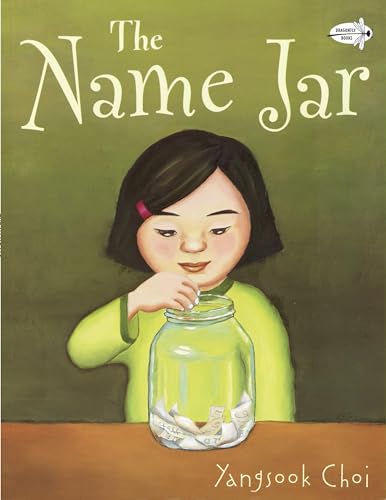
- The Name Jar by Yangsook Choi — A girl from Korea navigates whether to use her Korean name or choose an American one. A natural opening for talking about identity and belonging.
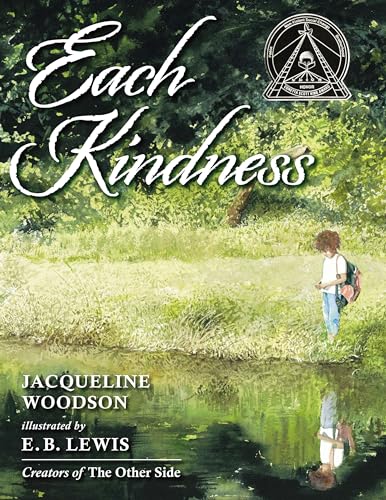
- Each Kindness by Jacqueline Woodson — A quiet, powerful book about what happens when we don’t extend kindness when we have the chance.
- The Proudest Blue by Ibtihaj Muhammad — A story about being proud of who you are when others don’t understand.


These conversations aren’t separate from academic instruction. They’re part of building a classroom where every student — including your ELL students — feels safe enough to take risks and make mistakes. That sense of safety is what makes language learning possible in the first place.
Frequently Asked Questions About Supporting ELL Students
Final Thoughts
Supporting ELL students in the classroom is one of those things that feels overwhelming until you start. Once you have a few solid strategies in place — a visual environment, sentence frames posted, a relationship with the ESL teacher — it becomes part of how your classroom works for everyone. These students bring remarkable resilience and perspective to your classroom. The strategies here will help you meet them where they are and build from there.
Jessica BOschen
Jessica is a teacher, homeschool parent, and entrepreneur. She shares her passion for teaching and education on What I Have Learned. Jessica has 16 years of experience teaching elementary school and currently homeschools her two middle and high school boys. She enjoys scaffolding learning for students, focusing on helping our most challenging learners achieve success in all academic areas.