
Animals That Weather Rocks Activity for 4th Grade Earth Science
One of the harder ideas to get across in a weathering and erosion unit is that weathering isn’t just something wind and rain do. Living creatures are among the most consistent rock breakers on the planet, digging, boring, and tunneling through rock and soil every single day.
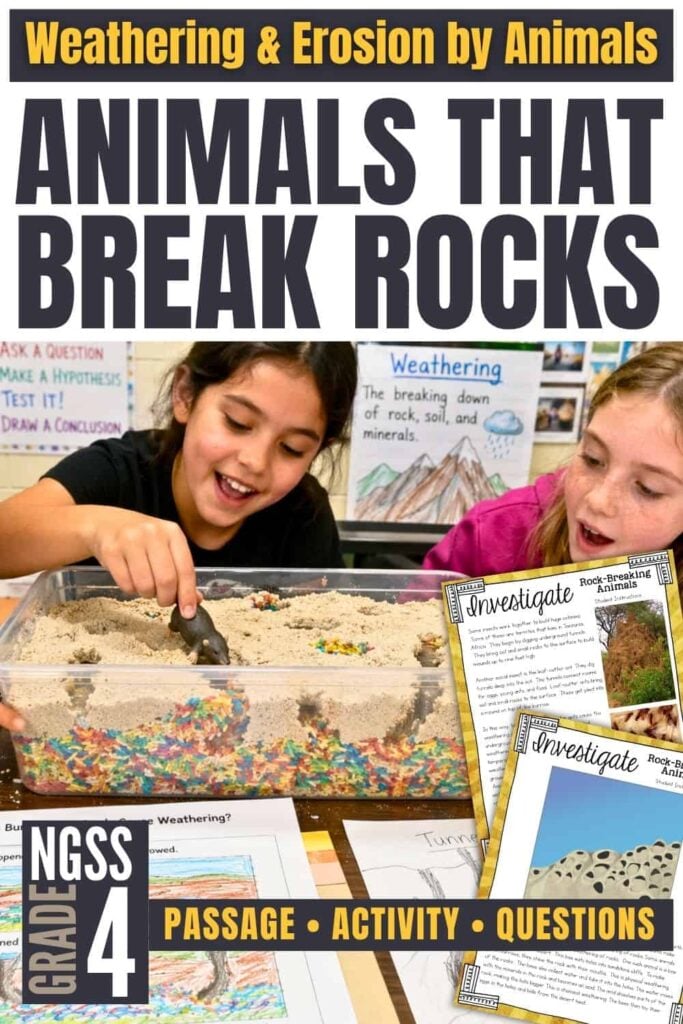
This animals that weather rocks activity puts that idea directly in students’ hands. They read about the animals responsible, then model the process themselves using kinetic sand and colored rice to see how burrowing moves material from deep layers up to the surface. It’s part of a Weathering and Erosion unit for 4th grade.
What Students Learn about Animals that Weather Rocks
Students read a nonfiction passage that builds the background knowledge they need before starting the investigation. The reading covers:
- The difference between physical weathering (breaking rock without changing its composition) and chemical weathering (changing a rock’s chemical makeup)
- How ice wedging forces water into cracks and splits rock apart over time
- How burrowing animals—including prairie dogs, earthworms, moles, muskrats, and frogs—move sediment from deeper layers to the surface
- How rock clams bore directly into rock to create shelters, physically breaking it apart
- How Utah desert bees drill into sandstone to build nesting chambers
- How colony insects like African termites and leaf-cutter ants move enormous amounts of material over time
- How all of this movement creates and transports sediments
Two reading passage options are included: Passage 1 covers the full range of weathering types, including temperature change weathering; Passage 2 focuses on the animal weathering content without the temperature change section. Both versions cover the core concepts students need for the investigation.
Animal Weathering Activity Overview
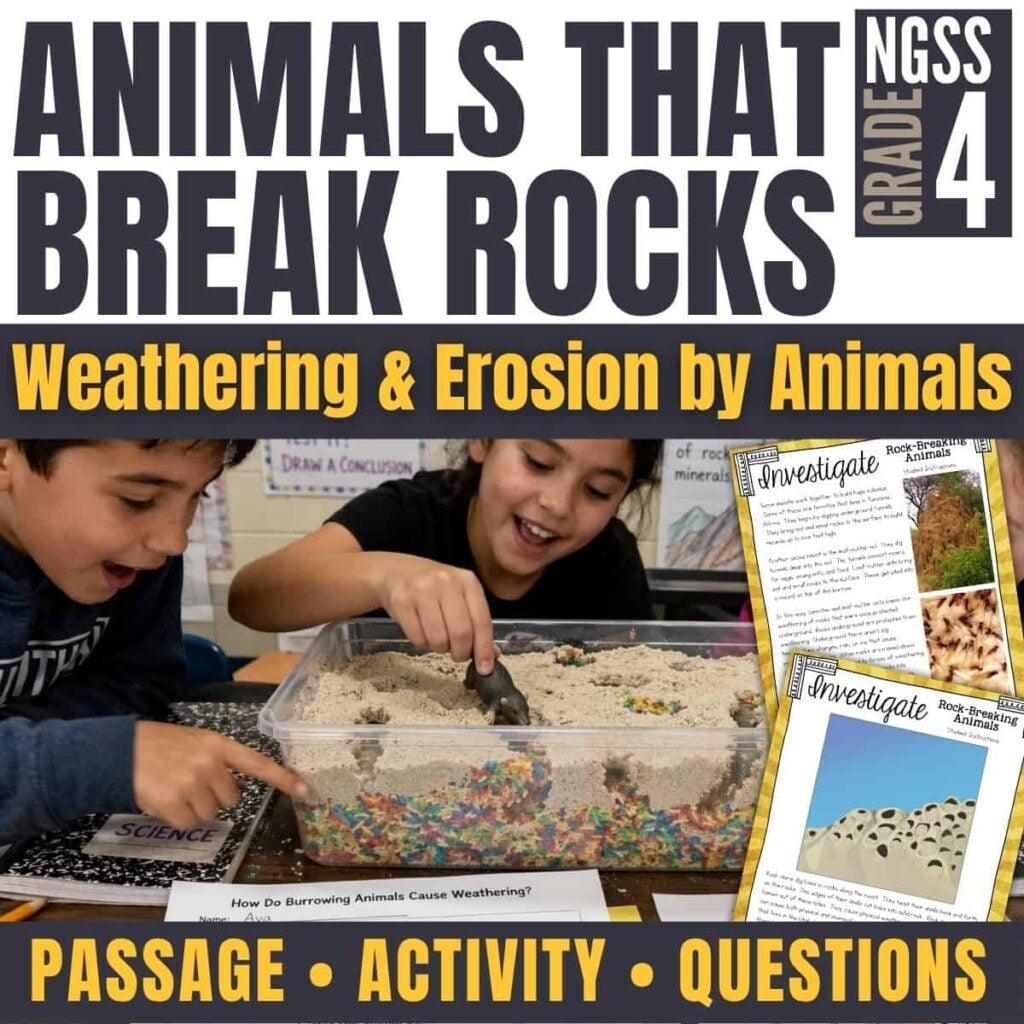
Students build a model of animal burrowing using kinetic sand and colored rice to represent rock layers. As they move their burrowing animal through the sand, the rice layers shift upward—showing exactly how digging brings deeper material to the surface.
Here’s how the investigation runs: students fill the shoe box halfway with kinetic sand, layer the three colors of rice at different depths to represent rock strata, then use the plastic animal to create at least 5 tunnels and 3 exit holes. As they work, they watch the colored rice appear at the surface—a direct model of how burrowing animals bring deeper rock and sediment layers up over time. It’s a simple setup with a clear illustration of the weathering process.
Designed for 4th grade and aligned with NGSS 4-ESS2-1, this engaging investigation helps students explore how natural processes—including the actions of burrowing animals and plant roots—cause physical weathering over time.
Student Sheets and Comprehension Questions
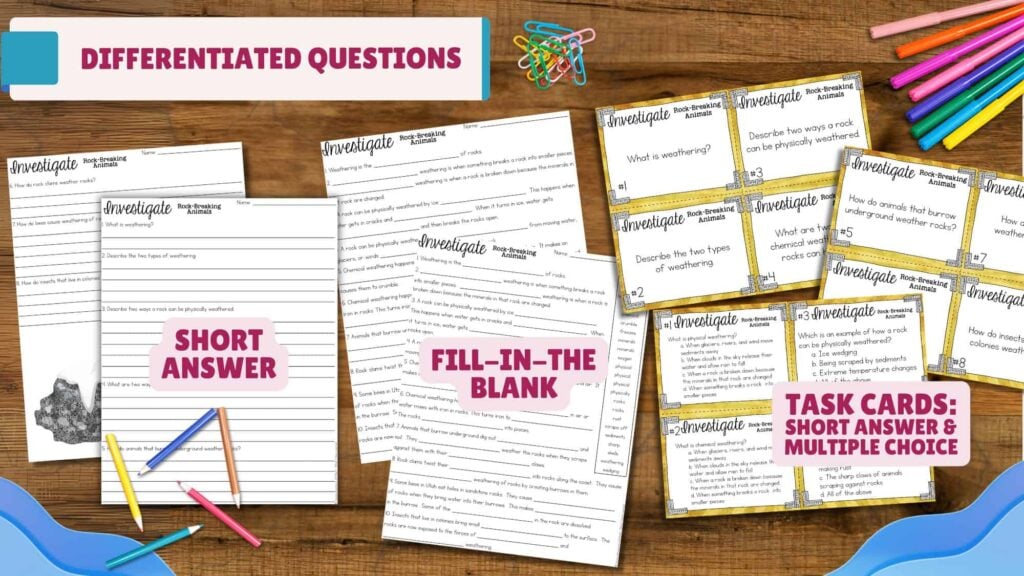
Four differentiated versions of the student sheets are included, so you can hand out what fits your class.
The short answer worksheet has 8 questions that cover everything from defining weathering to explaining how specific animals—rock clams, desert bees, and colony insects—break down rock in different ways. It requires full written responses and works well as a graded assignment.
The fill-in-the-blank without a word bank uses the same 8 questions in sentence-completion format, but students need to recall vocabulary on their own. It’s a solid middle-ground option—easier to complete than open-ended short answer but still requires real understanding.
The fill-in-the-blank with a word bank gives students the vocabulary needed to complete each sentence. This version works well for students who need language support but grasp the concepts.
The multiple-choice task cards put all 8 questions on individual cards with four answer options each. They work well at a station, in small groups, or as a low-stakes formative check.
What This Science Activity Looks Like in the Classroom
- Station rotation: Set up the kinetic sand and materials at one station while other groups work independently. The setup takes about 5 minutes and can be reused across multiple class periods.
- Whole class investigation: Read through the passage together, then have every student or pair complete the burrowing model at their desk before answering questions independently.
- Partner work: Pairs take turns operating the burrowing animal while the other records observations, then both complete their chosen student sheet on their own.
Why This Animal Weathering Activity Works So Well
1. Students See the Concept in Action
It’s one thing to read that prairie dogs bring sediment to the surface. It’s another to watch colored rice layers migrate upward as a plastic animal moves through kinetic sand. The model makes an invisible geological process visible, and students remember what they saw. That visual experience carries into their written responses.
2. Vocabulary Is Built in Context
The key terms—weathering, physical weathering, chemical weathering, ice wedging, sediments—appear in the reading passage before students encounter them in the questions. By the time they’re answering comprehension questions, they’ve already seen each term used in context multiple times. The word bank version adds one more layer of support for students who need it.
3. Cross-Curricular Connections
The reading passage addresses ELA standards 4.RI.1, 4.RI.3, 4.RI.4, and 4.RI.7—students are citing evidence, explaining connections between concepts, determining the meaning of vocabulary, and interpreting visual information as they learn science content. Those connections are built into the activity, not grafted on.
4. NGSS Alignment
The activity addresses 4-ESS2.A (Earth Materials and Systems) and 4-ESS2.E (Biogeology), specifically the idea that living organisms affect Earth’s surface. Students aren’t just memorizing facts about animals—they’re building a conceptual model of how living things contribute to geological processes over time.
Easy Differentiation Ideas for the Animals That Weather Rocks Activity
For additional support:
- Use the fill-in-the-blank with word bank student sheet
- Allow students to reference the reading passage while answering questions
- Pre-highlight key vocabulary terms in the reading passage before distributing
For extension:
- Have students research one additional animal not mentioned in the passage and explain how it contributes to weathering
- Ask students to sketch and label their burrowing model before and after the investigation, noting where each colored rice layer ended up
- Challenge students to estimate how much material a prairie dog colony might move in a year based on information in the passage
Bringing It All Together
By the end of this activity, students can explain the difference between physical and chemical weathering, name specific animals that contribute to each type, and describe how burrowing changes the position of rock and sediment layers. The hands-on model makes the concept stick in a way that reading alone doesn’t—and the differentiated question sets mean every student can demonstrate what they learned.
Designed for 4th grade and aligned with NGSS 4-ESS2-1, this engaging investigation helps students explore how natural processes—including the actions of burrowing animals and plant roots—cause physical weathering over time.
Jessica BOschen
Jessica is a teacher, homeschool parent, and entrepreneur. She shares her passion for teaching and education on What I Have Learned. Jessica has 16 years of experience teaching elementary school and currently homeschools her two middle and high school boys. She enjoys scaffolding learning for students, focusing on helping our most challenging learners achieve success in all academic areas.