
Do your students struggle to express their thinking in math? Mine do! Developing students’ language skills by focusing on mathematical vocabulary and using sentence frames in math helps students learn the language of math!
I am so focused on developing my students’ math skills with the Standards for Mathematical Content that I forget that I also need to implement (and assess) the Mathematical Practice Standards. That is until they sneak up on me and I realize I haven’t been effectively teaching them!

How do I help my (mostly low-income English learner) students express their thinking in math? With a lot of vocabulary development, sentence frames, and oral practice. Here are some ways we work with vocabulary and sentence frames in math.
Vocabulary Development
We all know that developing vocabulary in math is important. Math is like another language. There are so many new terms and concepts that students need to learn.
There are two types of vocabulary words, New Labels (for a known concept) and New Concepts (where the concept is new. The label may or may not be new.). Both of those types of vocabulary words are taught differently, depending on your student’s background knowledge and grade level.
New Labels
New labels are easier to teach and students just need to play with examples of the new label over many different situations. An example of this might be labeling an addition or subtraction problem.
First and second-grade students know that an addition problem looks like this: 3 + 2 = 5, but they may not know that the labels for the numbers are addend and sum. They only need to learn the new word, not the new concept. Having a matching activity or sorting activity will help them learn the new labels.
New Concepts
New concepts are much more difficult to teach and require many more experiences and interactions with the concept. They cannot be easily learned through definitions and are abstract.
First, there is the label, then there is learning what the label means. Often learning the concept before the label will be easier. Students need multiple examples over a variety of contexts to really know and understand the new concept.
An example is a concept of decomposing. This is a somewhat new concept and students explaining how they decompose numbers is a critical skill.
The concept of decomposing needs to be taught with many interactions and examples of breaking numbers apart and putting them back together. Number Talks are a great resource for teaching students how to decompose numbers.
Vocabulary might include: decompose, break apart into ___ and ____.
A math sentence frame might be There are ___ tens and ____ones. I can break apart the ___ tens in ___ tens and one ten. (after you have taught the concepts of tens and ones). The sentence frames will be specific to how you teach decomposing (more on sentence frames later).
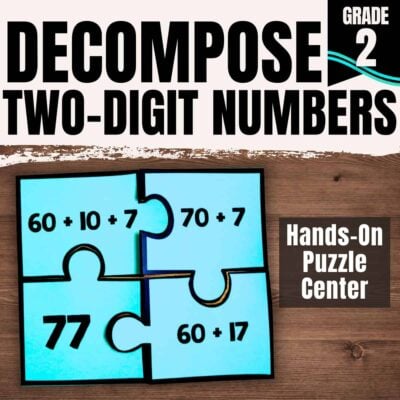
I do have a product that works on decomposing and composing two-digit numbers to help students with two-digit addition and subtraction. This was perfect for my second grade students toward the second half of the year after we had done many number talks and examples as a whole class.
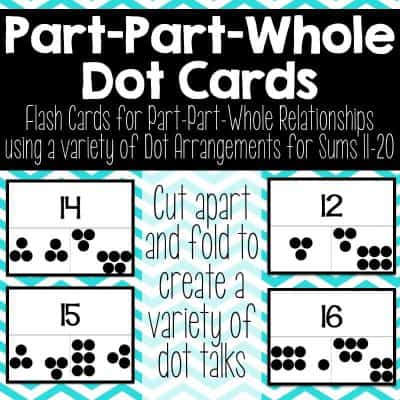
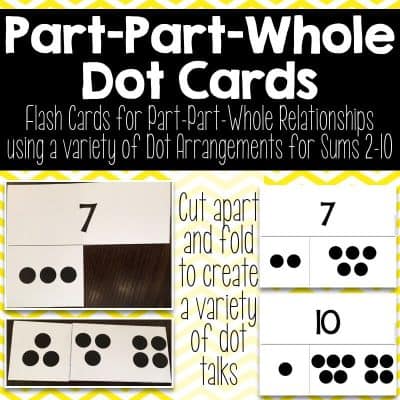
Another resource for Kindergarten and First grade students are Part-Part-Whole Dot Flash Cards. These are prefect for Number Talks and decomposing numbers to 20.

As for vocabulary cards and lists, there are a ton of vocabulary lists and cards both free and paid on Teachers Pay Teachers. Or, you can simply write the words on sentence strips and cut them apart.
The important thing is that students have a written visual of the word, that they practice it orally, and that they know what the word means.
Math Sentence Frames for English Learners
The other resource that helps students express their understanding is sentence frames. Sentence Frames give students a framework to use the new vocabulary they’re learning.
The example above, There are _____ tens and ____ ones. is a perfect sentence frame when learning about place value or describing how a number can be broken apart.
Sentence Frames are very different from Sentence Stems. Sentence Stems or Sentence Starters start the sentence for the students, but require that students finish the sentence on their own.
I use Sentence Starters when I ask a student to answer something in a complete sentence and they’re struggling to start the sentence. The Sentence Starter gives them a kick start, but students are able to complete the sentence on their own. They have enough background knowledge and language skills to finish the sentence.
Sentence Frames are used when students are unable to express their thinking because the sentence or concepts are too complex and they need additional support beyond Sentence Stems / Starters. Sentence frames have a complete thought and blank spaces for the vocabulary or phrases. Sentence Frames are very specific and work with the vocabulary and concepts you’re teaching students.
When using Sentence Frames, you’ll want to use them heavily at first, for new concepts, and then start releasing students from them and taking away the sentence frames, integrating more sentence stems / starters.
This way, students don’t become dependent on the sentence frames in math and start applying their own semantic skills in working with the content. When to do this varies with each student and each group of students. It totally depends on their background knowledge, grade level, math skills, and level of English.
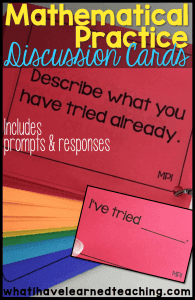
In my classroom, I use these Mathematical Practice Discussion Cards.
These are mainly sentence stems / starters, not sentence frames. They can be used once students have a solid understanding of the concept, but need some help expressing their thinking. Use sentence frames to teach the new concept, first, before using this discussion cards.
I print each Mathematical Practice Standard on separate colored paper, laminate them and stick them on a ring. Students turn to a certain color when I want them to practice a certain standard.
How do I use Vocabulary and Sentence Frames in Math?
What does this look like in practice? We’ve been working on geometry for the past couple of weeks. Students use the new vocabulary (names of the shapes) to describe the angles and sides of two-dimensional shapes.
The sentence frame: ________ has ______ sides / angles. is perfect for students to express their understanding of a shape.
New labels might be the name of the shape.
New concepts might be the sides and angles and putting those together with the name of the shape to describe it. A complete thought (multiple sentences) might look like: The shape has ____ sides. It also has ____ angles. I know it is a _____. I would love for my second graders to be so articulate with their descriptions of shapes!
This week, we started multiplication and students use vocabulary such as row, column, array, sum, equal, etc. The sentence frames that we’re using are: There are ______ rows and ____ columns. The addition problem is _____ plus ______ plus _____ . . . equals _____. (the ellipse is for the repeated addition. It varies for each model). Familiar vocabulary for students will be addition, plus, equals.

After we built each array, I had students say the sentences out loud as a group to practice the new language. Once students understood how to build an array, they built their own versions, wrote the number of rows and columns and the addition equations on their desks. Then they used the sentence frames to tell their partner about their array.

I put these on my whiteboard and was able to easily erase and write what went in the blanks for each sentence. I’ve also used sticky notes to change the content easily.
Although I’m focusing on Oral Practice in my next post, I do want to emphasize that it’s important that students practice the vocabulary and sentence frames before you expect students to use them consistently. Most students will need a lot of practice in a variety of contexts and situations.
So, how do you help students express their understanding of mathematical concepts?

Thank you so much for all this information! As a special educator working with students with expressive language delays, this is so helpful for all educators and families to keep in mind. Thanks again for the concrete next steps! Jen
Hi Jessical
I have found your information on sentence frames extremely useful for a maths assignment . I need to quote where I found this information and an author . What would the author be?
Normally you would include the source of information for an assignment, which in this case would be the URL of the webpage.
do you have any videos on teaching multiplication or division word problems?
I do, but only within my How to Teach Word Problems Course: https://premium.whatihavelearnedteaching.com/word-problems-course/