
Composing and Decomposing Numbers: K–2 Math Strategies
Do your students struggle to compose and decompose numbers when adding and subtracting? My students struggle to break a number apart and use its pieces for computation. This type of number sense takes a ton of practice, and it’s hard work!
The old catchphrases, like borrowing and carrying, are no longer in use with the Common Core. They have no meaning related to mathematical thinking, so I think it’s a good thing that we don’t use them. Likewise, catchy phrases and poems are fun to memorize, but I wonder how much the students understand and can explain what is happening in the process.
My goal is for my students to understand how numbers work and how they can be broken apart and put back together in different ways. I want them to think flexibly about numbers and apply that flexibility to addition and subtraction. This is the foundation of place value in K-2.
Decompose Smaller Numbers
At the beginning of the year, we started with decomposing and composing smaller numbers to make 10. Using +8 and +9 facts, we looked at how making 10 can help us solve problems.
Although I gave students the strategy, it took a lot of practice for them to understand the benefit of using it rather than counting on their fingers. I created a packet of math stations centered around Using 10s to Add (+9 & +8). This began our journey of decomposing numbers.


Using 100 to Add Just Like Students Use 10 to Add
Later in the year, when we transitioned to adding larger numbers, we revisited the make-10 strategies to add numbers, but also worked on adding tens and making 100.
One strategy that worked well for students was having them draw sticks representing the number of tens in each number, then count and cross off each stick as they counted. When a student reached 100, he or she stopped, wrote 100, then started over and counted the remaining sticks.
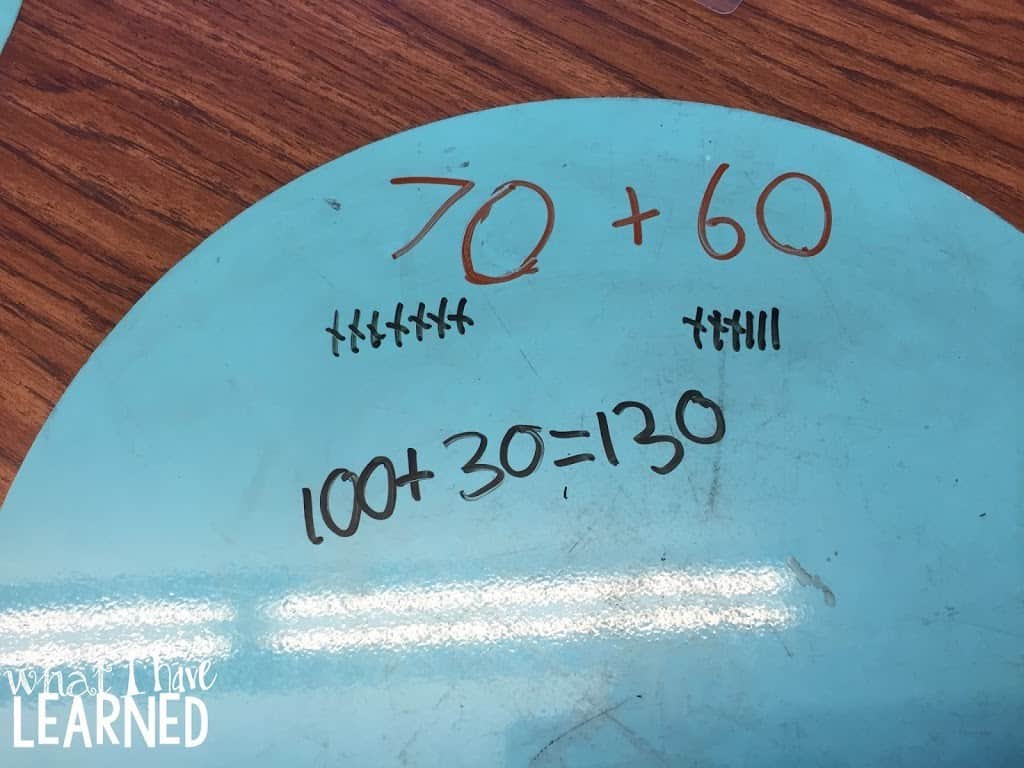
Through this exercise, students began to see “friendly numbers” and how to use 100 when adding.
Decomposing Number Puzzles
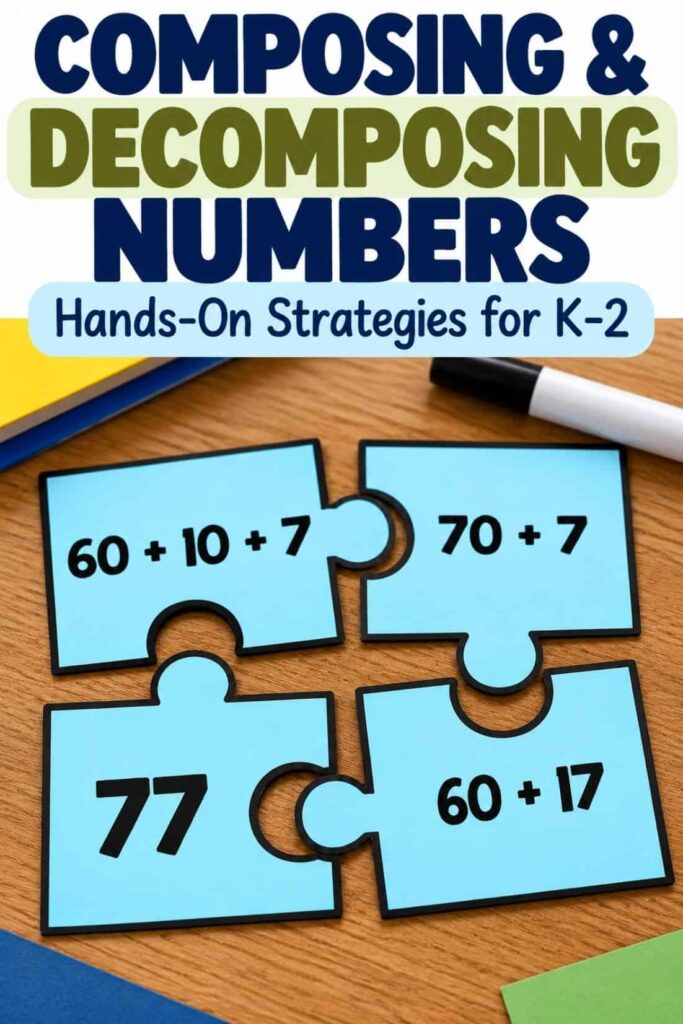
Another resource that we have used this year has been Decomposing Number Puzzles. These have helped students see how 44 is 40 + 4, which is also 30 + 14 and 30 + 10 + 4. Not all of my kiddos have made the jump to see how all these numbers are related and how to decompose numbers. We still have quite a bit of work left!

We used the number puzzles in November and I pulled them out again in the Winter to review with a few of my students who need to solidify it a bit further.
Attaching Language to the Concept
The last thing I have done recently is to give students sentence frames when subtracting. A couple of weeks ago, I switched from writing a horizontal problem to giving students a vertical subtraction problem. They didn’t know what to do! This was so hard for them!
My solution was to give students sentence frames. I started with simple ones, like, “There are/aren’t enough ones to subtract _____ ones. You don’t have to / have to decompose a ten. Now there are ___ tens and ___ ones.”

In all honesty, I wouldn’t have a student decompose a ten to subtract 4, but we needed to practice the concept with smaller numbers before moving on to larger numbers.
Decompose a Ten is a set of sentence frames and scoot-type activities in which students determine whether they need to decompose a ten before solving problems.

Other Tools
We’ve also used number lines, and I’ve had students draw out base-10 blocks. My students have had the most success with using number lines and counting up from the subtrahend.
I have a set of math station activities where students practice subtracting using a variety of strategies and tools. These activities really get students thinking about math and being flexible with numbers.
Frequently Asked Questions
How do you develop a conceptual understanding of composing and decomposing numbers in your classroom? How do you help students think flexibly about numbers? I’d love to hear more ideas!
Free Two-Digit Math Activities
If you teach second grade, you might like a few pages from some of my two-digit addition and subtraction products. I’ve compiled this PDF of resources as a sampler from several different products that really emphasize all the work we do in our classroom to develop these strategies in depth.
Different components of the sampler can be used with a whole group or a small group and are perfect for helping your students think outside the box when solving multi-digit addition and subtraction problems.


My granddaughter is in the 3rd grade and is struggling with 3 digit addition and subtraction decomposing. She is also in need of help with creating and solving rectangular arrays. I really need some help to assist her with her homework.
You know, I grew up with borrowing and carrying, and it worked great and everyone understood it. This nonsense confuses kids; parents cannot help. No wonder everyone is going to home school.
Hmm . . . we homeschool.
I still believe that students should be able to think about numbers flexibly, whether they’re in a public classroom or homeschool. Making 10 to add, learning how to regroup the tens to the ones place and know the value of each place, it’s actually similar to what we grew up with, but with some key changes. Some of the bigger changes now are about how to demonstrate, explain, and add language to all the great things going on in our students’ minds as they engage with math.
I agree when we adults do addition by making 10 or hundred first and then add the remaining ones or tens and never literally sit and regroup or think of what is carried over. When children can be exposed to such conceptual understanding directly with simple and comprehensive activities we need to embrace new methodologies rather contemplating the way we learnt as the style of living in all generations matter.
omg could not agree more D G!
Thanks for this! This has helped an older “borrower” (me) become an expert in “decomposition” to help my second grade child who was struggling with the concept via virtual learning. I still prefer my way, because it’s how I learned, but in essence it’s the same thing, and at least my child and I now have a shared language for this concept!
I really appreciate the time you took to share your experience.
You flat out said some kids in the class don’t get it… Maybe show both ways and let them see the difference between methods. My child knows how to add and subtract, I showed her ways to figure it out if she needed to get to a number she knew, through decomposing into the mix and it’s gotten confusing! What happened to using a scrap piece of paper for side math if needed. Every child learns different, stop trying to through this in their face. Parents need to be able to help teach their children.
I totally agree with you. Not all kids get this composing and decomposition of numbers. Let them have options and use whatever method they find comfortable. Why tell a kid the days of borrowing and carrying over are done? Come on!
As a child, I watched my second-grade teacher explain borrowing/regrouping for subtraction and thought to myself, “That is a crazy thing to do!” I ignored the teacher and added from bottom to top. I simply filled in the missing number in the answer place. In my mind, subtraction was simply the reverse of adding down. My teacher asked me how I got my answers and I explained adding up. There is no need for borrowing/regrouping so it is quicker and easier. You do have to carry over the extra”1″ to the next place value. The answer is always correct.
123 Ones: 6 + “7” = 13. Write 7 in the ones answer place. Carry the 1 to the tens place.
-56 5 + 1 + 6 = 12 write 6 in the tens answer place. Done!
67 is the answer