
Teaching Geometry in Elementary School: Shapes, Area & Perimeter
Geometry can feel like the easiest math unit to teach because students already know what a square looks like. But teaching geometry in elementary school well means going beyond shape names. The CCSS Geometry domain builds from recognizing and sorting shapes in kindergarten to classifying 2D figures by properties in 5th grade, and concepts skipped in early grades often show up as gaps when students reach area, perimeter, and angles in 3rd and 4th grade.
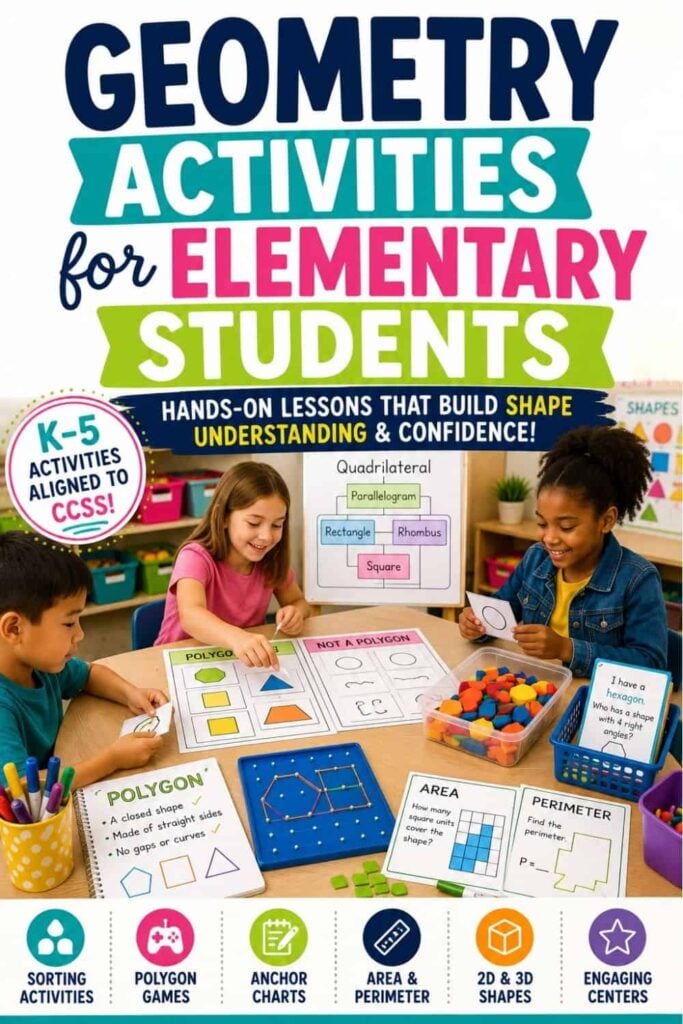
This guide covers the geometry standards by grade band, with strategies and activities for each stage.
How Geometry Builds Across Elementary Grades
Understanding where the standards are headed helps teachers make better decisions about what to emphasize at each grade level. The CCSS Geometry (G) domain has a clear progression, but it’s easy to lose sight of how each piece connects to the next.
In kindergarten through 2nd grade, the focus is on recognizing, naming, and describing shapes — both 2D and 3D. The key conceptual shift comes in 1st grade (1.G.1), where students move from identifying shapes by appearance to understanding defining attributes. A shape is a rectangle, not because it looks like one, but because it has four straight sides and four right angles. That distinction matters more than it seems in the early grades because it’s the foundation for every classification students will do later.
In 2nd and 3rd grade, students begin working with polygons in earnest. 2nd graders draw shapes with specific attributes and partition shapes into equal shares. 3rd grade (3.G.1) introduces the formal concept of a polygon and asks students to understand that quadrilaterals can be categorized into subcategories — that a square is a rectangle, that a rhombus is a parallelogram — relationships that require careful attention to attributes.
In 4th grade, the geometry work shifts to lines, angles, and symmetry. Students classify triangles by angle measure and side length, identify parallel and perpendicular lines, and recognize lines of symmetry. The 4th grade standards (4.G) are heavy on vocabulary and visual discrimination, which makes them a natural fit for sorting tasks and anchor chart reference work.
In 5th grade, students work with the coordinate plane and classify 2D figures into a hierarchy of categories, building on everything they learned about attributes and subcategories in 3rd and 4th grade.
Area and perimeter — while technically in the Measurement and Data domain (3.MD, 4.MD) — are often taught alongside geometry and connect directly to students’ understanding of 2D shapes. They fit naturally into the geometry unit at 3rd and 4th grade and are included here for that reason.
Teaching 2D and 3D Shapes in K–2
The most important thing to get right in K–2 geometry is the shift from visual recognition to attribute-based thinking. Young students identify shapes by appearance: “It looks like a triangle.” The goal is to move them toward: “It has three straight sides and three angles, so it’s a triangle.” That shift takes deliberate instruction.
Start with sorting. Give students a mix of shapes and ask them to group shapes that belong together, then explain what their groups have in common. This surfaces how students are currently thinking — are they grouping by color, size, or actual geometric attributes? It also sets up the vocabulary work that follows. Students need the words (sides, angles, vertices, faces, edges) before they can describe their thinking precisely.
In 1st grade, the concept of non-defining attributes is worth teaching explicitly. A square is still a square whether it’s big or small, tilted or upright, red or blue. Showing students rotated shapes and asking “Is this still a triangle?” builds the flexible thinking they’ll need in 3rd grade when they start categorizing polygons. The 2nd Grade Geometry Practice resource gives students repeated practice with shape attributes and classification in a format that works well for review and centers.
Teaching Polygons in 2nd and 3rd Grade
The concept of polygons is one of the richest geometry topics in elementary school because it brings together attribute-based thinking, vocabulary, and classification all at once. A polygon is a closed figure with straight sides, and the not-a-polygon examples are just as important as the examples.
Non-polygon sorting activities are especially effective here. When students have to decide whether a figure is a polygon and explain why, they must articulate its defining attributes rather than merely recognize familiar shapes. A curved figure isn’t a polygon. An open figure isn’t a polygon. A figure with one curved side and several straight sides isn’t a polygon. Working through these cases with students builds a much more durable understanding than just defining the term. The Polygon Not-a-Polygon Sort provides students with a cut-and-paste activity for this exact task, building the classification skills they need before moving to subcategories.
Once students understand what makes a polygon, 3rd grade takes them into the subcategory of relationships among quadrilaterals. This is genuinely tricky for students (and for some teachers) because it requires holding multiple attributes in mind at once. A square has four right angles and four equal sides. A rectangle has four right angles. So a square is a rectangle — but most students’ instinct is to treat them as separate categories. Sorting activities that involve grouping shapes and asking students to justify the grouping are more effective than simply explaining the relationships.
For polygon vocabulary work, a game format builds fluency without the pressure of a worksheet. The Polygon I Have Who Has game gives students repeated exposure to polygon names and attributes through a whole-class or small-group format that keeps everyone engaged. Pair it with the Polygon Sorting and Matching Activity, which has students match polygon names, visual models, and attribute descriptions.
Anchor charts earn their wall space in a polygon unit. When students navigate quadrilateral subcategories, a visual reference that clearly shows the relationships—squares inside rectangles inside parallelograms—helps them hold the structure in mind as they work. The Polygon Anchor Chart Activities resource builds this reference while reinforcing the connections between shape attributes and categories.
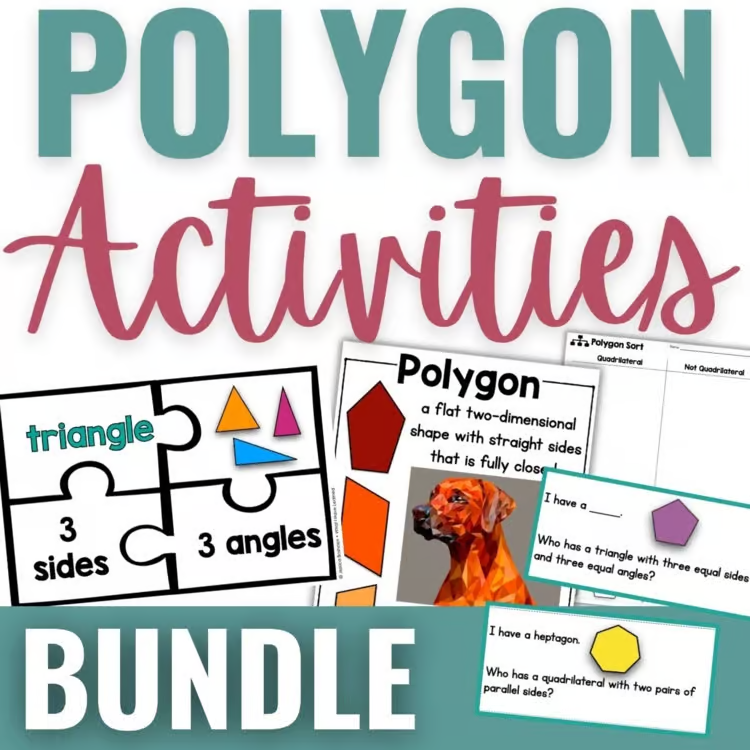
This comprehensive Polygon and Geometry bundle of math activities is perfect for 3rd grade elementary students. It includes a variety of resources designed to strengthen geometry skills and build a solid understanding of polygon attributes, classifications, and history.
Teaching Area and Perimeter in 3rd and 4th Grade
Area and perimeter arrive in 3rd grade and stay through 4th. They’re often taught back-to-back, which is efficient, but it also creates one of the most persistent misconceptions in elementary math: students confuse the two. Keeping them clearly separated in instruction, at least initially, prevents that confusion better than teaching them together and then trying to untangle it.
Start area with unit squares before moving to the formula. When students cover a rectangle with square tiles and count them, they understand what area means. The formula (length × width) is a shortcut for that counting process, and students who understand it that way are much less likely to accidentally use the perimeter formula when they need area. 3rd grade area work (3.MD.C) includes finding area by counting unit squares, using the distributive property, and connecting to multiplication — so the geometric concept and the multiplication fact fluency are reinforcing each other.

Measurement and Geometry Cut and Paste Math Activities for Third Grade
This is for the Measurement & Geometry standards only.
Perimeter is more intuitive for most students once they understand it means measuring around the outside — but they still need experience with problems that require them to find a missing side length, or that give them the perimeter and ask for a side length. These are the problems that show whether students understand the concept or just the procedure.
For hands-on practice, the Perimeter and Area Number Puzzles give students a self-checking center activity that covers both concepts across multiple problem types. Number puzzles work especially well for area and perimeter because students can confirm their answer by checking whether the pieces fit — the format gives immediate feedback without teacher intervention.
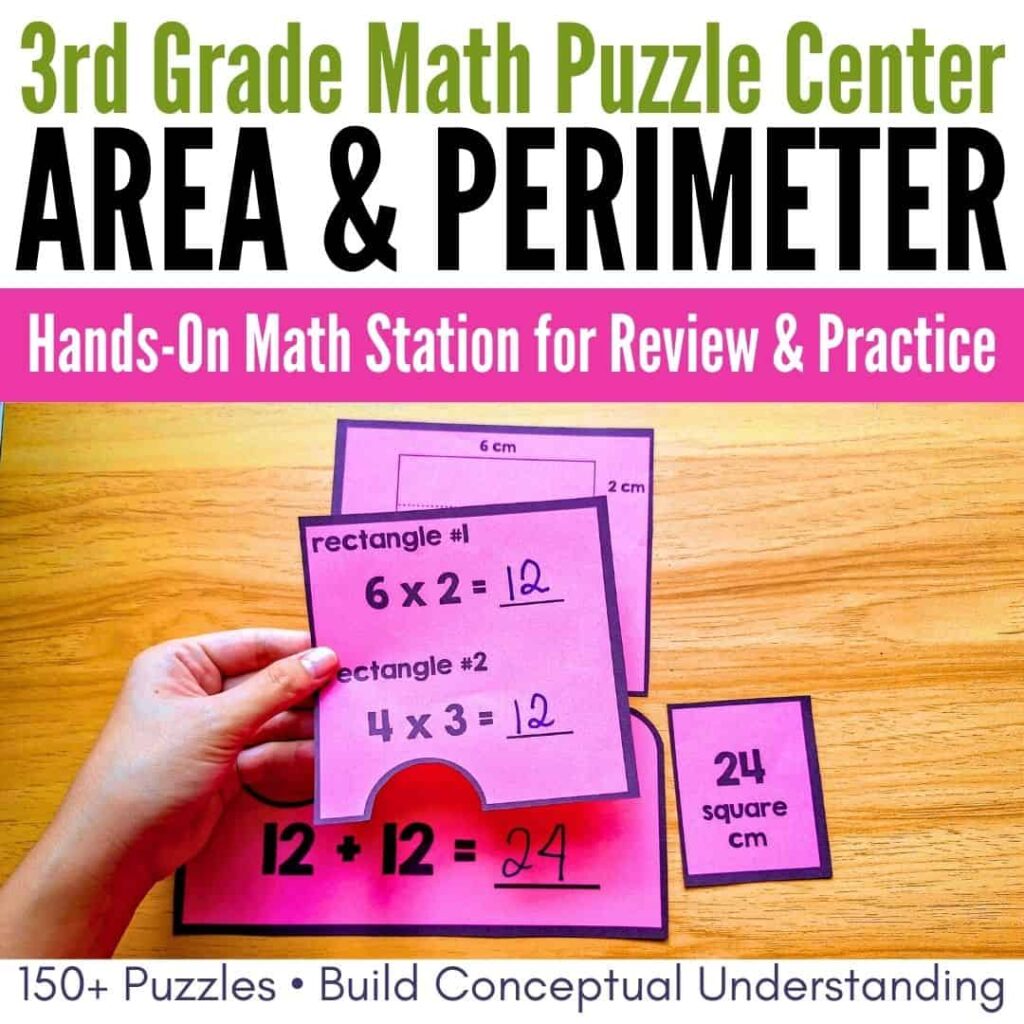
3rd Grade Area and Perimeter Puzzles | 3.MD.5–3.MD.8 Math Centers
Make area and perimeter practice hands-on with these 3rd Grade Area and Perimeter Number Puzzles! Students solve problems using models, equations, real-world contexts, unit squares, multiplication, additive area, unknown sides, and perimeter strategies. Perfect for math centers, small groups, review, early finishers, and hands-on practice with 3.MD.5–3.MD.8.
Teaching 4th Grade Geometry: Lines, Angles, and Classification
Fourth grade geometry introduces a set of concepts that feel new to students but build directly on what they already know about shapes and attributes. Lines, line segments, and rays require precision with vocabulary. Angles require understanding both what an angle is (two rays sharing an endpoint) and how to classify by size (acute, right, obtuse, straight). Symmetry adds a visual element that many students enjoy.
The classification work in 4th grade is where the polygon subcategory thinking from 3rd grade pays off. Students classify triangles by both angle type and side length, which means they’re applying two sets of attributes simultaneously. A triangle can be both right and isosceles. This requires the kind of flexible attribute-based thinking that good polygon instruction in 2nd and 3rd grade builds.
Parallel and perpendicular lines appear in the 4.G standards and in real-world contexts students can recognize — the lines on a basketball court, the sides of a rectangle, a plus sign. Connecting geometry vocabulary to things students can see and touch makes the concepts more concrete, especially for students who tend to experience math as abstract symbols.
The 4th Grade Geometry Test Prep Cut and Paste covers all 4.G standards with a format that has students match, sort, and explain rather than just fill in answers. The written explanation piece is the most valuable part for teachers: when students have to write why a triangle is acute or why two lines are parallel, you can see exactly where their understanding is solid and where it needs more work.

Fourth Grade Measurement & Geometry Test Prep Cut and Paste Math Activities
Cut and Paste Match Activities for EVERY fourth grade Measurement & Data and Geometry standard. The worksheets contain cut and paste problems as well as written answers and explanations.
Tips for Teaching Geometry in Elementary School
Lead with sorting before defining. For almost every geometry concept — shapes, polygons, quadrilateral categories, angle types — starting with a sorting task surfaces what students already think before you teach the formal definition. It also makes the definition feel like it answers a question students were already working on, rather than appearing out of nowhere.
Use non-examples deliberately. The not-a-polygon examples matter as much as the polygon examples. The shapes that almost fit a definition — the open figure, the curved figure, the figure that looks like a rhombus but has one unequal side — do more work to build understanding than a set of clear examples alone. Design instruction to include both.
Keep anchor charts up and usable. Geometry is a vocabulary-dense domain. When students are working through polygon classification or angle types, having a visual reference on the wall reduces cognitive load and keeps the focus on reasoning rather than remembering terms. An anchor chart that shows the quadrilateral hierarchy or the defining attributes of each triangle type earns its space all unit long.
Connect to measurement. Area and perimeter bridge geometry and measurement in ways worth making explicit. When students understand that area is measured in square units because you’re covering a two-dimensional region, the formula stops being a mystery. The geometry work and the measurement work reinforce each other — don’t treat them as separate units if you can help it. If your students are also working on measurement concepts, the post on teaching multiplication in elementary school covers the array and area model connections that tie directly into area instruction.
Final Thoughts on Teaching Geometry in Elementary School
The thread that runs through geometry instruction from kindergarten through 5th grade is attribute-based thinking. Students who learn to ask “What makes this shape what it is?” rather than “What does this shape look like?” are ready for every classification task the standards throw at them, from polygon sorting in 3rd grade to hierarchical classification in 5th. Build that habit early, and the rest of geometry instruction gets easier at every grade level.
Jessica BOschen
Jessica is a teacher, homeschool parent, and entrepreneur. She shares her passion for teaching and education on What I Have Learned. Jessica has 16 years of experience teaching elementary school and currently homeschools her two middle and high school boys. She enjoys scaffolding learning for students, focusing on helping our most challenging learners achieve success in all academic areas.