
4 Strategies to Solve Multi-digit Addition Problems
When teaching your students how to solve multi-digit addition problems, providing them with various place-value strategies is important. This will not only help students find the best method for them, but it will also give them a deeper understanding of the concept of multi-digit addition.

This blog post will explore three different addition strategies second-grade students can use to solve multi-digit problems. Each strategy leans on how place value works.
Why Teach Students Various Math Strategies As Part of Your Instruction?
When it comes to teaching 2nd grade students how to solve two-digit addition problems, various addition methods can be used. These place value strategies are a key component of the second-grade math curriculum.
There are several benefits to teaching students different ways to solve two-digit problems. First, it allows students to find the best method for them. This is important because everyone learns differently, and some students may prefer one method over another.
Second, teaching multiple methods helps students understand the concept of addition better. When they see how different math strategies produce the same answer, they begin to understand that addition is more than just putting numbers together.
Finally, teaching multiple methods can help students become more flexible problem solvers. If they encounter a problem they cannot solve using their usual method, they can try another approach until they find one that works.
Once students grasp two-digit addition using math manipulatives such as base ten blocks, they can move on to the place value strategies below that propel second-grade students toward efficiency in their mathematical thinking. Using an addition strategy instead of the standard algorithm will make teaching addition easier.
What are The Place Value Strategies for Addition?
Place value strategies are methods that students can use to help them solve multi-digit problems with regrouping and without regrouping. Three main strategies are commonly taught:
- the break-apart strategy, aka: partial sums addition
- using number lines
- the traditional algorithm
The break-apart strategy is where students break big numbers into smaller parts and solve each place value separately. Knowing how to compose and decompose numbers is a key prerequisite skill for this strategy. This addition strategy is called the partial sums strategy because part of the numbers are added together at a time.
Students add the hundreds, tens, and ones places separately, then combine the answers for each place value. This strategy is helpful for problems with regrouping or carrying over digits. There are variations to the break-apart strategy, which I note below.
Using number lines is a strategy where students use a number line to help them visualize the problem. Using this strategy, students find friendly numbers. This strategy is helpful for problems with larger numbers, as it can be difficult to keep track of all the digits in your head.
The traditional algorithm is the most commonly used method for solving addition equations. This algorithm involves carrying over digits and regrouping as necessary to solve the problem.
Break-Apart Strategy to Add Multi-Digit Numbers
The break-apart strategy is one way to solve multidigit two-digit addition equations in 2nd grade math. To use this strategy, you must start by separating each number into its place value parts.
For example, adding 37 + 24 would break down 37 into 30 + 7 and 24 into 20 + 4. Once you have done this, you can add the numbers in each place value separately. So, using our previous example, you would have 30 + 20 = 50 and 7 + 4 = 11. Therefore, the answer to 37 + 24 is 50 + 11, or 61.
You can use this strategy with any two-digit or three-digit number; it is a great way for students to visualize their actions. It is also a good strategy for students struggling with an algorithm because it helps break the problem down into smaller pieces.
Vertical Addition – Add Ones to ONes and Tens to Tens
This method is similar to the break-apart strategy but is done vertically and removes some of the visual supports. Students have to keep some of the numbers in their heads while adding. Vertical addition requires a higher level of number sense and place value.
I also call this strategy add ones to ones and add tens to tens; it is the same strategy. The ones are easily added together. The tens cannot be considered a single digit but a whole number based on the place value.
Using Number Lines to Solve Addition Problems
Another way to solve two-digit addition equations is by using number lines. To use this method, you must start by drawing a number line. An open number line is a great tool for solving multi-digit problems.
Students can use an open number line to solve problems in several different ways. The easiest way is to place the largest number on the number line and then count up the tens and ones of the smaller number.
For example, using the same problem, 37 + 24, place 37 on the number line. Count up two tens, from 37 to 47 to 57. Then count up four ones, from 57 to 61. Eventually, students will start to see that they can group the two tens together and move from 37 to 57 in one jump on the number line.
This method is helpful because it visually represents what happens when two numbers are added together. It also allows students to see that addition is simply counting up from one number to another.
Did you know you can turn a number line on its side and make it a vertical number line? Students benefit from seeing number lines both horizontally and vertically.
The Traditional Algorithm for Two-Digit Addition
Teaching an algorithm for adding two-digit numbers is important because it helps students move toward efficiency. We always want students to move toward efficiency. From using manipulatives, drawing it out, using place value strategies, and using an algorithm.
The traditional algorithm often involves regrouping or carrying over, which can be tricky for some students to understand. It is best to compare the algorithm to other multi-digit addition strategies. Students should be able to see the similarities between all of the addition methods and choose which method works best for the given problem.
Some students gravitate to using the algorithm because it’s what their parents do and where they get the most one-on-one help. A few use an alternate strategy, though, and it’s generally those students who have the most flexibility and sophistication in their mathematical thinking.
Compare the Different Place Value Strategies for Addition
Consider creating an anchor chart to help students see the similarities and differences between the different place value addition strategies. It is important for students to understand the relationships of the different addition methods so that they can choose the best method for each individual problem.
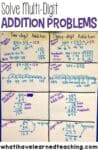
Two-Digit Addition and Three-Digit Addition Strategies Anchor Chart
Our class compared two-digit and three-digit addition strategies the other day. Earlier in the year, we practiced the two-digit addition strategies in depth with various activities. We recently started working on three-digit addition, and students needed a refresher on some of the strategies they had learned earlier in the year.
We created this addition strategies anchor chart that lists the strategy and shows the strategy with two- and three-digit problems. Students can see how the strategy changes with the problem and see the differences between the strategies.

I love this chart because it links up what we learned earlier in the year and allows students to connect what they’ve already learned and what they’re working on right now.
Students have a much deeper understanding of Addition
I love teaching students to think flexibly about how to solve problems and helping them embrace the fun in place value. By using these strategies-based methods, students learn to manipulate the numbers within addition problems.
I do not create this anchor chart unless students have worked individually and in-depth with each strategy. I usually create this anchor chart after winter break as we revisit and review our learning during the Fall.
My students had a good grasp of each of these strategies before we created the anchor chart, and my purpose in creating it was to help students see the similarities in applying the strategies between two-digit and three-digit addition. I also always make this chart a little differently each year, depending on the needs of my students, the sophistication of their thinking, and the words they have chosen to label the strategies. It’s really about the students making meaning and making connections.
Teachers can use many different strategies to help their students understand how to solve problems and strengthen their number sense. In this blog post, we explored four strategies: the break-apart strategy, using number lines, and an algorithm. By providing your students with various strategies, you will help them find the best method for them and give them a better understanding of the concept of addition.
Resources to help you teach Multi-Digit Addition
Are you teaching second-grade students to add multi-digit numbers? I have quite a few two-digit addition resources below and on TpT.
If you’re ready to build on these same place-value strategies with subtraction, these three-digit subtraction worksheets give students more practice applying them the same way.

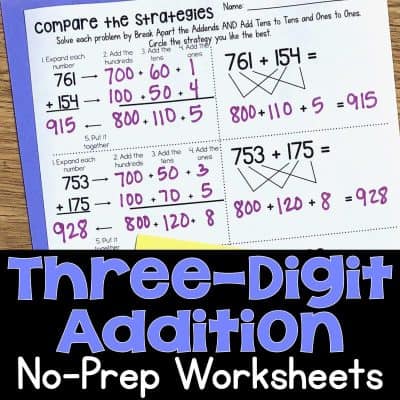
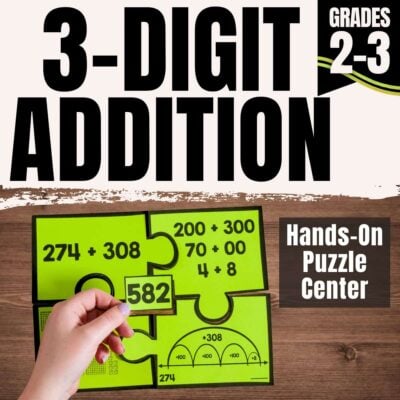
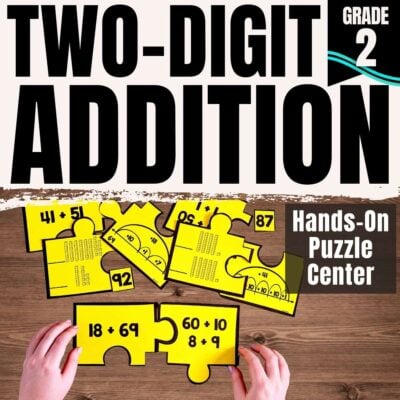


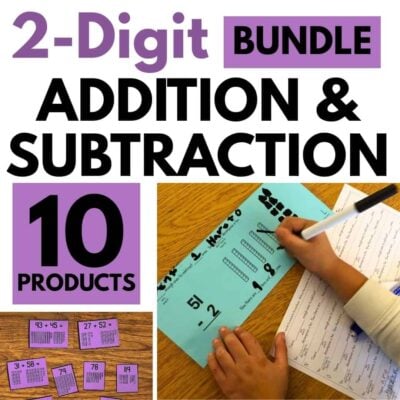
You might like a few pages from some of my two-digit addition and subtraction products if you teach second grade. I’ve compiled this PDF of resources as a sampler from several different products that really emphasize all the work we do in our classroom to develop these strategies in depth. Different sampler components can be used in whole or small groups and are perfect for helping your students think outside the box when it comes to solving multi-digit addition and subtraction.


What a great post! We’re working on two digit addition now, so this is very helpful! Keep up the great work, girl!
These are amazing ideas. Thank you so much for sharing. Also look at “OCEAN RAIDERS” math game for basic addition.