
Partial Sums Addition Method (Free 3-Digit Worksheets)
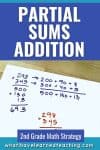
Teaching multi-digit addition in second grade isn’t just about getting the correct answer. It’s about helping students truly understand place value.

The partial sums addition method gives students a clear, logical way to add two- and three-digit numbers without jumping straight into regrouping. Instead of “carrying the one,” students break numbers apart, add by place value, and combine their partial sums.
And if you’d like ready-to-use practice, I’ve included free three-digit partial sums worksheets you can grab below.
In this post, you’ll see exactly how the partial sums method works, how to teach it step by step, and how it compares to traditional regrouping.
What is the partial sums addition method?
The partial sums addition method is a strategy where students:
- Add each place value separately
- Record each “partial sum”
- Combine those sums to find the final total
Instead of regrouping along the way, students focus on adding thousands to thousands, hundreds to hundreds, tens to tens, and ones to ones.
For example:
347 + 285
Students would add:
- 300 + 200
- 40 + 80
- 7 + 5
Then combine the partial sums.
This strategy is typically done left to right and is grounded in strong place value understanding.
Many teachers call this the ‘break-apart strategy,’ which helps students connect the method to expanded form work they already know.
Why Teach the Partial Sums Method in Second Grade?
The partial sums method strengthens number sense in ways traditional regrouping does not always make visible.
Here’s why it works so well:
It Reinforces Place Value
Students must understand what each digit represents. They can’t just “carry the one.” They have to know where that extra ten comes from.
It Builds Algebraic Thinking
When students write numbers in expanded form and combine like place values, they’re developing early algebraic reasoning.
It Reduces Regrouping Confusion
For students overwhelmed by regrouping, partial sums removes that immediate pressure. They see where numbers come from instead of memorizing steps.
It Helps Students Understand Why We Regroup
Teaching partial sums to all students first, before the traditional algorithm, gives students time to build that understanding. Some move quickly to regrouping. Others benefit from staying with partial sums longer. Either way, students understand why regrouping works rather than treating it as a memorized procedure.
How to Teach the Partial Sums Addition Method
Before introducing the partial sums method, students need strong expanded form skills. That foundation makes everything else click.
Step 1: Expand the Numbers
Students break each number into place value parts.
Example:
347 = 300 + 40 + 7
285 = 200 + 80 + 5
If students struggle here, pause and strengthen expanded form practice first.
Step 2: Add Each Place Value Separately
Students add matching place values starting with the largest place value.
For example: 347 + 285 Students would add:
300 + 200
40 + 80
7 + 5
Encourage them to line up place values carefully. Organization matters.
Step 3: Combine the Partial Sums
Once all place values are added, students combine their results.
500 + 120 + 12 = 632
This final step reinforces flexible thinking about numbers.

Should Students Write the Partial Sums Method Horizontally or Vertically?
The partial sums method can be written either way.
Horizontal Format
Writing it horizontally:
- Makes place value more visible
- Requires students to write expanded form
- Provides stronger scaffolding
This format is excellent for early practice.
Here is a video of the break-apart strategy with two-digit addition:
Vertical Format
Writing partial sums vertically:
- Requires more mental computation
- Looks more similar to traditional regrouping
- Often feels more efficient for students
Neither format is “better.” The goal is clarity, accuracy, and understanding.
Here is a video showing vertical addition:
Partial Sums Addition vs. Traditional Regrouping
At some point, it’s helpful to compare strategies.
Ask students:
- Which method shows more place value?
- Which requires more writing?
- Which feels faster?
- Which helps you understand what’s happening?
When students compare the partial sums method to regrouping, they start thinking about efficiency and accuracy — two powerful math habits.
When Should Students Move Beyond the Partial Sums Method?
Some students naturally transition to traditional regrouping once they understand place value deeply.
Others benefit from continuing with partial sums longer.
The goal isn’t speed. The goal is understanding.
When students truly understand that:
90 + 80 = 170
and
170 = 100 + 70
regrouping suddenly makes sense.

Why the Partial Sums Addition Method Builds Stronger Math Thinkers
When students use the partial sums addition method, they practice:
- Expanded form
- Place value reasoning
- Combining like units
- Flexible thinking
- Mental math connections
They aren’t memorizing a trick. They’re understanding numbers.
And that understanding sticks.
Free Three-Digit Addition Worksheets (Partial Sums Practice)
If you’re teaching the partial sums addition method and want ready-to-use practice, I’ve created a free set of three-digit addition worksheets you can grab below.
These worksheets give students structured practice using:
- The partial sums method
- Vertical adding by place value
- Base-10 block models
- Flexible strategy comparison
Each page reinforces place value thinking while giving students room to show their work clearly. You’ll find problems that support both horizontal and vertical formats of the partial sums method, so you can scaffold instruction based on what your students need.
They’re perfect for:
- Small group reteaching
- Math centers
- Homework practice
- Exit tickets
- Extra support before moving to regrouping
If you’re working with second graders who need more time understanding how numbers break apart and combine, these worksheets will give them meaningful practice without overwhelming them.
Grab the free three-digit addition worksheets by entering your email below, and start building stronger place value understanding tomorrow.

Final Thoughts on Teaching the Partial Sums Method
The partial sums method gives students a bridge between place value concepts and the traditional addition algorithm.
If you’re teaching second grade multi-digit addition, try introducing partial sums before regrouping. You may find that students feel more confident, make fewer errors, and understand their work at a deeper level.
And when regrouping comes later? It won’t feel like magic. It will make sense.
Jessica BOschen
Jessica is a teacher, homeschool parent, and entrepreneur. She shares her passion for teaching and education on What I Have Learned. Jessica has 16 years of experience teaching elementary school and currently homeschools her two middle and high school boys. She enjoys scaffolding learning for students, focusing on helping our most challenging learners achieve success in all academic areas.