
11 Addition and Subtraction Games with Dice for Elementary Students
Addition and subtraction games with dice are a simple way to make math practice more engaging for elementary students. Dice create a random number each round, which gives students repeated opportunities to practice mental math while playing a game.
These math dice games are easy to set up and require very few materials. Most activities only require two dice, paper, and a pencil. Teachers can use them during math centers, partner practice, early finisher time, or small group instruction.
Pair these dice games with the make 10, add 10, and use 10 strategies so students have both the thinking tools and a fun way to practice them.
Below you’ll find 11 addition and subtraction dice games that work well with first- and second-grade students. You can also adjust many of the games for older students by using additional dice or larger numbers.
Materials for Addition and Subtraction Dice Games
Most of the games in this list require only a few simple materials.
Common materials include:
- two six-sided dice
- paper and pencil for recording scores
- number charts or game boards
- counters or markers
To increase difficulty, teachers can use three dice, ten-sided dice, or twelve-sided dice.
Addition Games with Dice
These addition dice games help students practice adding numbers quickly while building confidence with mental math.
Make that Number Addition
Make That Number is a classic addition dice game that encourages students to think about number combinations.
Materials
- two or three dice
- number chart (2–12 for two dice or 3–18 for three dice)
How to Play
- Students take turns rolling the dice.
- They then add the numbers on the dice to find their total.
- Next, they mark off the corresponding number on their number chart.
- The game continues until all the numbers have been marked off or a winner is determined after a set number of rounds.
This game not only helps students practice their addition skills but also encourages them to think strategically and find different ways to reach the target number. It’s a great way to make math practice more engaging and interactive.
To vary the game, use dice with different numbers. Either put stickers over the dice to include numbers 7-10 or use a 1-12 or other variety of multi-sided dice. If you change the variables or numbers on the dice be sure to provide students with a number chart that matches their gameplay.
For more advanced students, encourage them to make their own number chart before playing the game. This will help them think about what expressions they need to reach their target numbers.
Variations
- Use larger dice values such as 7–12.
- Have students create their own number charts before playing.
- Ask students to record the addition equations they created.
Extend the Dice Game with Graphing and Probability
After playing Make That Number, students can analyze the results of the dice rolls.
Have students record which sums appeared during the game and create a class graph showing how often each number was rolled.
Students may notice that some numbers appear more often than others. This opens a discussion about probability and the number of ways certain sums can occur.
This extension helps connect addition practice to data, statistics, and probability concepts.
Race to 100
Race to 100 is one of the most popular addition dice games because it is simple and competitive.

Materials
- two dice
- paper and pencil
How to Play
- Each player takes a turn to roll the dice.
- Add the numbers on the dice and write the total.
- Keep a running total of your score.
- The first player who reaches 100 wins.
- If a roll takes you over 100, you don’t add it to your total.
Variations
- Partner teams race to 500
- Race to 150 or 200
- Use three dice for larger sums
Double Dice Sum
Double Dice Sum is a fun way for students to practice doubles and addition.
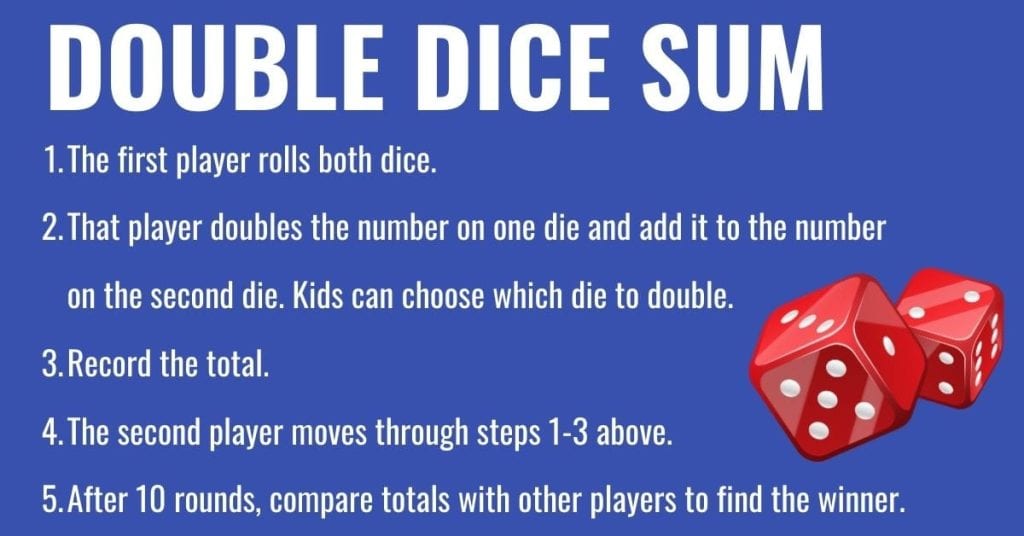
All you need are two dice and a piece of paper with a pencil for scorekeeping.
How to Play
Here are the game rules:
- The first player rolls both dice.
- That player doubles the number on one die and adds it to the number on the second die. Kids can choose which die to double.
- Record the total.
- The second player moves through steps 1-3 above.
- After 10 rounds, compare totals with other players to find the winner.
Lucky Seven
Lucky Seven is a game of chance and quick addition. Players aim to roll a total of seven to score points. This simple yet engaging game is perfect for younger learners, emphasizing quick thinking and basic addition.
Just two dice are required for this game.
How to Play
- Players take turns to roll both dice.
- If the sum is 7, you earn a point.
- After 10 rounds, the player with the highest score wins.
Variation
Use three dice and change the target number to 9, 10, or 11.
Addition Bingo
Addition Bingo combines a classic game format with addition practice.
Materials
- two dice
- bingo cards labeled 2–12
- counters or markers
Students can make their own bingo cards before playing the game, which makes it easy on the teacher and adds even more student buy-in.
How to Play
- Each player receives a Bingo card.
- Roll both dice, add the numbers, and if the sum is on your card, mark it.
- The first to get five in a row wins.
Variation
Vary the game by providing students with three dice and having them include numbers 2-18 on their cards.
Roll and Cover Dice Game
Roll and Cover gives students repeated addition practice in a simple format.
Materials
- two dice
- game board with numbers 2–12
- counters
How to Play
- Roll both dice.
- Add the numbers and cover the corresponding number on the board.
- The first to cover all their numbers wins.
Knockout Dice Game
Knockout adds suspense to addition dice games.
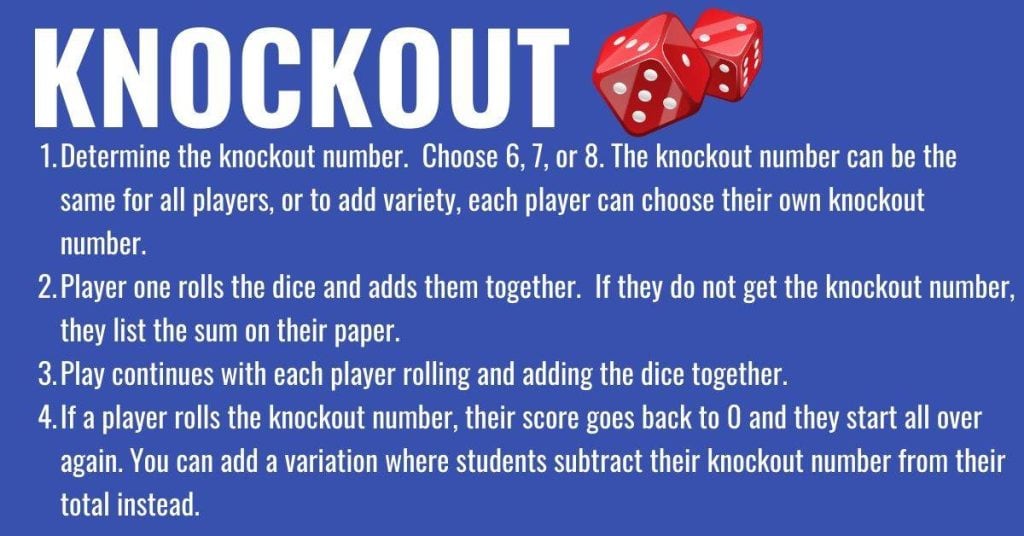
All you need to play knockout is two dice.
How to Play
- Determine the knockout number. Choose 6, 7, or 8. The knockout number can be the same for all players, or to add variety, each player can choose their own knockout number.
- Player one rolls the dice and adds them together. If they do not get the knockout number, they list the sum on their paper.
- Play continues with each player rolling and adding the dice together.
- If a player rolls the knockout number, their score goes back to 0 and they start all over again. You can add a variation where students subtract their knockout number from their total instead.
Roll-a-Value: Dice Game with Money
Roll-a-Value is a simple dice game that helps students learn about dimes, nickels, and pennies. This engaging activity combines fun math practice with a lesson on money. This game allows elementary students to develop their addition skills and learn about different coins and their values.
Materials
Students need two dice and a piece of paper.
How to Play
- Students start by rolling the dice and adding up the numbers they land on.
- Based on the sum, they determine which coins to use to make that value. For example, if they roll a 4, they can represent it as four pennies or as one nickel and four pennies.
- They then draw the coins onto the worksheet to visualize the value they rolled. For example, if the students roll a 7, they can represent it as seven pennies, one nickel, and two pennies, or as one dime and two pennies.
The possibilities allow students to explore different coin combinations. This game not only helps students practice their addition skills but also introduces them to the concept of counting money.
By engaging with real-world currency, students can understand the value of coins and how they can be used to represent specific amounts. The hands-on nature of this game makes it an enjoyable and effective learning activity for elementary students.
Subtraction Games with Dice
Dice games are also a fun and engaging way for students to practice their subtraction skills. These educational games not only reinforce subtraction concepts but also improve mental math skills and promote healthy competition among students. Here are a few subtraction games that use dice.
Subtraction Race
In Subtraction Race, players journey backward from 100 to 1 on a number line.
Materials
- two dice
- number line 1–100
How to Play
- Players place their marker on the number 100.
- Roll both dice and subtract the smaller number from the larger one.
- Move your marker back that many spaces.
- The first player to reach 1 wins.
Subtraction Snake
Subtraction Snake uses the same idea as Subtraction Race but on a snake-shaped board.
Players move from the snake’s tail to its head by subtracting the numbers rolled on the dice.
Materials
Two dice and a piece of paper with a snake drawn on it, segmented and numbered 1-100.
How to Play
- Place your marker at the snake’s tail (100).
- Roll both dice, subtract the smaller from the larger, and move forward.
- The first to reach the head (1) wins.
To simplify the game, subtract from 50-0. To make the game last longer, have students subtract from 1000.
Addition and Subtraction Dice Games
In the following strategy games, students practice both addition and subtraction facts.
Order of the Equations
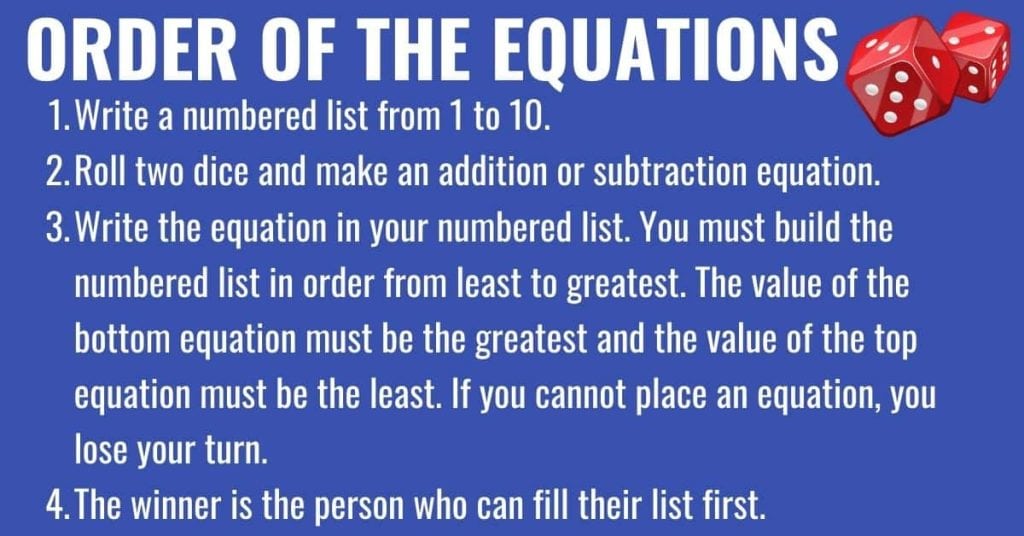
Order of the Equations challenges players to write 10 equations in order from least to greatest. This game tests both mathematical skills and strategic placement, making it ideal for older students.
Materials
This game calls for two dice, paper, and a pencil.
How to Play
- Write a numbered list from 1 to 10.
- Roll two dice and make an addition or subtraction equation.
- Write the equation in your numbered list. You must build the numbered list in order from least to greatest. The value of the bottom equation must be the greatest and the value of the top equation must be the least. If you cannot place an equation, you lose your turn.
- The winner is the person who can fill their list first.
Players must think about which equations they can write, based on the dice rolls, to fill their list correctly. Vary the game using three dice or creating a numbered list of 15 or 20 equations.
18 and out
18 and Out is an exciting addition and subtraction dice game that engages and challenges elementary students. To play 18 and out, students will take turns rolling three dice and adding or subtracting to reach a target number. This is similar to the above game, Make That Number, but also includes subtraction and uses three dice.
Materials
Students will also need a number chart that goes from 0-18.
How to Play
- Roll three dice.
- Add or subtract all three dice to get a number.
- Cross out that number on the chart.
For example, if a student rolls a 6, 3, and 2, they choose any of these sets of equations:
- 6-3=3 and 3-2=1
- 2+6=8 and 8-1=7
- 3+2=5 and 5+6=11
So, students could choose to mark off 1, 7, or 11 on their number chart. Challenge students by having them write down their equations as they play.
Variations
Vary the game by allowing students to use two or three dice. Increase the complexity by giving students four dice and using a number chart that goes to 24.
This game is not only a fun way to reinforce addition and subtraction skills but also helps students develop their strategic thinking and problem-solving abilities. Students will build confidence in their mathematical abilities and enhance their overall math fluency by actively engaging in mental math calculations.
Why Dice Games Work for Math Practice
Addition and subtraction games with dice work well because they combine practice with play.
Students solve many math problems while rolling dice, tracking totals, and competing with classmates.
Dice games help students:
- practice mental math
- develop number sense
- build math fluency
- stay engaged during math centers
Because the materials are simple, teachers can reuse the same games all year with different numbers or additional dice.
Other Math Dice Games to Try
Once students are comfortable with addition and subtraction dice games, teachers can extend the idea to other skills, such as:
- multiplication dice games
- place value dice activities
- probability investigations
- math strategy games
Using dice in math instruction provides endless opportunities for hands-on learning.
If you want more independent practice to go along with these games, these three-digit subtraction worksheets are an easy follow-up.
Engaging kids of all ages in math practice can be challenging, but these fun dice games offer an effective solution for any elementary classroom. These interactive and hands-on kids’ games provide an exciting way for students to reinforce addition and subtraction skills through gameplay. Consider incorporating these dice games into your lessons if you’re looking for engaging ways to make math practice more enjoyable for your elementary students.
Jessica BOschen
Jessica is a teacher, homeschool parent, and entrepreneur. She shares her passion for teaching and education on What I Have Learned. Jessica has 16 years of experience teaching elementary school and currently homeschools her two middle and high school boys. She enjoys scaffolding learning for students, focusing on helping our most challenging learners achieve success in all academic areas.