
Sentence Frames and Sentence Stems: Examples and How to Use
Sentence stems and sentence frames are powerful tools for helping elementary school students, particularly English learners, learn academic language. Providing a scaffold of language to build on, sentence frames, sentence stems, and even signal words can help young students develop their own understanding of the academic concepts they’re learning in content-area classrooms.
Sentence stems and frames also provide an effective way to support students with different levels of proficiency in English. By using these language supports, all students have the opportunity to demonstrate what they know about a topic while developing key language skills that will contribute to their future success both inside and outside the classroom.

Sentence Stems vs. Sentence Frames vs. Signal Words: What’s the Difference?
Instructional tools such as sentence stems, sentence frames, and signal words are used to improve students’ writing and speaking skills. These tools have distinct purposes and are utilized in various situations.
What is a Sentence Stem or a Sentence Starter?
A sentence stem is the beginning of a sentence that students complete with their own ideas. Also called a sentence starter, it gives students the first few words, like “I think that…” or “My favorite food is…”, and leaves the rest open. Sentence stems encourage students to express ideas in a structured way while generating most of the language themselves.
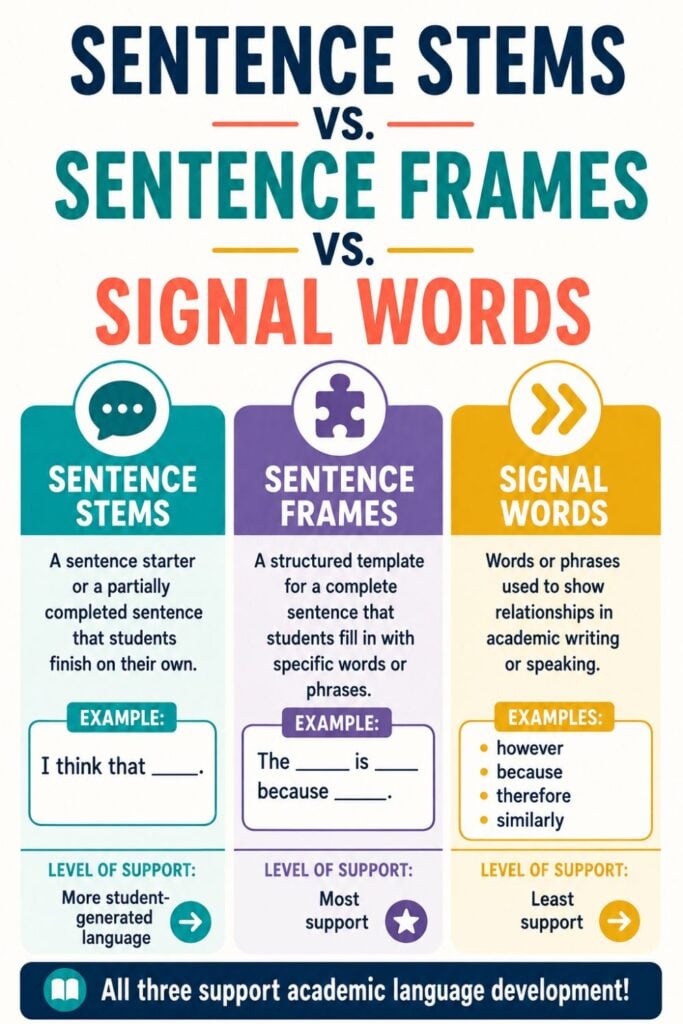
A sentence stem is a sentence starter or a partially completed sentence that students need to finish.
For example, “My favorite food is…” or “I think that…”.
Sentence stems are often used to encourage students to express their ideas, feelings, or opinions in a structured way. They can be particularly useful in promoting critical thinking and discussion.
What are sentence frames?
A sentence frame is a fill-in-the-blank template for a complete sentence that students finish with specific words or phrases. For example: “The ____ (noun) is ____ (adjective) because ____ (reason).” Sentence frames provide more support than sentence stems, which makes them especially useful for English learners and for introducing new vocabulary or concepts.
A sentence frame refers to a structured template for a complete sentence or paragraph that students need to fill in with specific words or phrases.
For example, “The _(noun) is _(adjective) because __(reason).”
Sentence frames are typically used to provide scaffolding for students who are learning new concepts or vocabulary, or who need extra support in constructing grammatically correct sentences. They are particularly useful when supporting English learners
What are signal words?
Signal words are words or phrases used in academic writing or speaking to indicate the purpose of the text or speech.
They can be transition words like “however,” “therefore,” and “despite,” or specific language used for certain language functions.
It’s important to teach these abstract words in the context of language acquisition, just like sentence starters and frames. Students can be encouraged or required to include them in their written and spoken communication.
All three language tools above provide structure and support for students, sentence stems require students to generate more of the sentence on their own, while sentence frames provide a more detailed scaffold for constructing sentences. Signal words provide the least amount of structure.
| Sentence Frames | Sentence Stems | Signal Words |
|---|---|---|
| A structured template for a complete sentence or paragraph that students need to fill in with specific words or phrases. Provides the most support. | A sentence starter or a partially completed sentence that students need to finish. More open-ended than a sentence frame. | Words or phrases used in academic writing or speaking to indicate the purpose of the text or speech. Provides the least amount of support. |
How can Sentence Stems and Frames be used in the classroom?
Teachers use both sentence stems and frames in the classroom to support and develop students’ language skills.
Using Sentence Stems in the Classroom
Here are a few ideas on how to use sentence stems in the classroom:
- Promote Discussion: Sentence stems can be used to guide class discussions. For example, during a debate or discussion, a teacher might provide stems like “I agree with… because…” or “Another perspective is…”.
- Encourage Reflection: Teachers can use sentence stems to encourage students to reflect on their learning. For example, “One thing I learned today is…”, “I was confused by…”, or “I want to learn more about…”.
- Support Writing: Sentence stems can also be used in writing assignments to help students structure their thoughts and ideas. For instance, “The main idea of the text is…”, or “The character’s actions suggest that…”.
If you are looking for questions or writing prompts, here are 67 questions you can use to build community in your classroom. These questions and prompts are a great opportunity to practice and apply sentence stems or sentence starters.
Using Sentence Frames to Support Academic Learning
Here are a few ideas on how to use sentence frames to support learning academic content in the classroom.
- Teach and Practice New Vocabulary: Sentence frames can be used when introducing new vocabulary words. For example, “An example of ____ (new vocabulary word) is ____ (context)”.
- Support Structured Responses: When students are asked to respond to reading or other content, sentence frames can help them structure their responses. For example, “The author argues that ___ because ___”.
- Aid in Writing: They can also be used in writing assignments to assist students in structuring their paragraphs or essays. For example, “In the story, ________ (character) faces a problem when ________ (event). This leads to ________ (outcome).”
With both sentence starters and sentence frames, the goal is to provide enough support to help students construct meaningful, grammatically correct sentences, while still requiring them to think critically and creatively about how to complete the sentence.
Sentence Frames for English Learners (ELL and ELD)
Sentence frames help English learners because they take away one of the two jobs a student is doing at once. When an English learner answers a question, they are building the content and the language at the same time. A sentence frame supplies the language structure so students can put their energy into the content.
Frames also give English learners a model of correct English syntax every time they speak or write. Students hear and use complete academic sentences from the start, instead of producing single words and hoping to expand later.
To differentiate by proficiency level, adjust how much of the sentence the frame provides. Newcomers might use a frame that needs only one word: “A ____ lives in the desert.” Intermediate students can use a frame with multiple blanks and a signal word: “Unlike ____, a ____ can ____.” Advanced students may only need a sentence stem, like “One difference between them is…” The goal is always to release support as language grows.
For visual scaffolding that works alongside sentence frames, these graphic organizers for differentiation give students a structure for organizing their thinking before they even get to the sentence level.
I use sentence frames during designated ELD lessons with fill-in frames and in content lessons like teaching cause and effect with soil erosion, where students practice the language of the content area while learning the content itself.
Examples of Signal Words for Language Functions
Signal words, also known as transition words or phrases, are used to guide the reader through the text or discussion to show relationships between ideas. Teachers often post signal words in their classrooms for word problems or writing genres. Singal words can also be used with a sentence frame. They are the word or phrase in the sentence frame that points to the function.
Here are some examples of signal words for common language functions:
- Compare: similarly, likewise, also, both, in the same way, just like, as well as, not only, but also
- Contrast: however, on the other hand, in contrast, unlike, while, whereas, but, nevertheless
- Cause and effect: because, so, If … then, for this reason, one reason, consequently, accordingly
Again, signal words are the functional part of the sentence frame and provide less syntactic support for students.
More Specific Sentence Frame Examples
As you have read, sentence frames are a powerful tool for teaching language concepts and helping students develop their academic writing and speaking skills. They provide structure and support to help students create meaningful sentences, while still requiring them to think critically and creatively about how to complete the sentence.
In this section, we will explore examples of sentence frames that can be used in various contexts such as citing evidence, comparing and contrasting ideas, and expressing opinions. By learning how to use sentence frames in the classroom, teachers can empower their students with the tools they need for success both inside and outside the classroom.
What are some sentence frames for compare and contrast?
Comparing and contrasting is a key skill in critical thinking, reading comprehension, and essay writing. It is one of the easiest comprehension skills to teach and is also one of the easier ways to teach students to use sentence frames.
Here are some sentence frames that can support students in expressing comparisons and contrasts:
- “Both ________ and ________ have ________ in common.”
- “________ and ________ are similar because they both ________.”
- “While ________ has ________, ________ on the other hand, has ________.”
- “Unlike ________, ________ features ________.”
- “The main difference between ________ and ________ is that ________.”
- “An important similarity between ________ and ________ is ________.”
- “Despite their difference in ________, ________ and ________ are similar in ________.”
- “Even though ________, ________ still ________.”
- “In contrast to ________, ________.”
- “Whereas ________ is ________, ________ is ________.”
These sentence frames provide scaffolding for students to structure their thoughts when comparing and contrasting, helping them articulate their ideas clearly and logically.


Learn how to teach compare and contrast using sentence frames and scaffolds.
What are some sentence frames that can be used for citing evidence?
Citing evidence is a crucial part of academic writing and argumentation. Students can learn to cite evidence when talking and writing about a piece of text.
Here are some sentence frames that can be used to help students cite evidence in their speaking and writing:
- “According to the text, ________.”
- “The author states that ________.”
- “In the article/book, it was mentioned that ________.”
- “On page ____, the text says ________.”
- “The data from the study suggests that ________.”
- “The graph/figure/table illustrates that ________.”
- “An example from the text is when ________.”
- “The results of the experiment show that ________.”
- “Directly quoting from the text, ‘_______’.”
- “As evidenced by _______, it’s clear that _______.”
These sentence frames provide a structured way for students to incorporate evidence into their arguments, helping them to strengthen their claims and develop their academic writing skills.
What are some sentence frames for opinion writing?
Opinion writing is a key component of many types of essays and assignments. It, along with the examples of citing evidence above, helps students tackle academic discourse.
Here are some sentence frames and sentence stems that can support students in expressing their opinions:
- “In my opinion, ________.”
- “I believe that ________.”
- “From my perspective, ________.”
- “I strongly agree/disagree with the idea that ________.”
- “It seems to me that ________.”
- “I am convinced that ________.”
- “Based on what I know, I feel that ________.”
- “My viewpoint on this topic is ________.”
- “Considering these points, I argue that ________.”
- “After researching this topic, it is clear to me that ________.”
These sentence frames provide a structure for students to articulate their thoughts and beliefs in a clear and organized manner, helping them strengthen their opinion-writing skills.

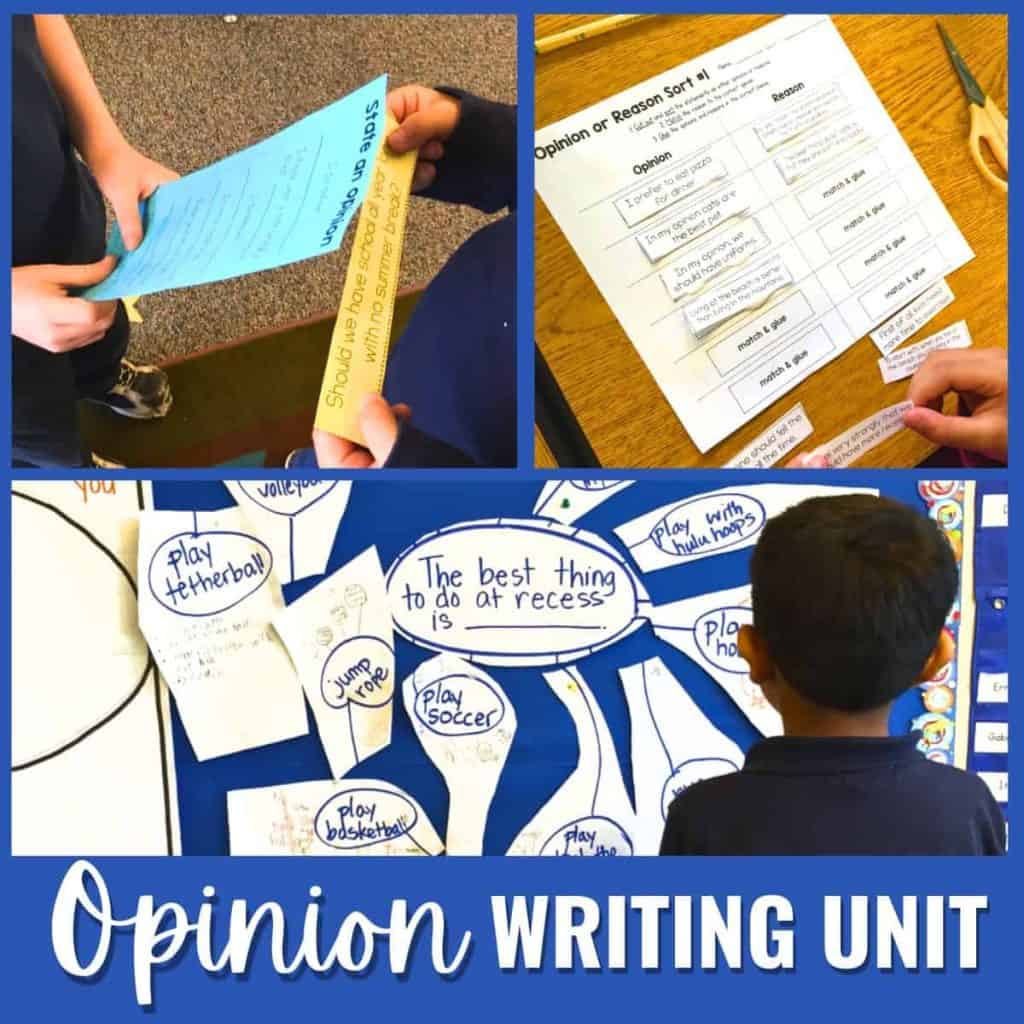
Read more about the opinion writing unit that uses sentence frames to scaffold learning.
Sentence Frames FAQ
More Ideas on How to Use Sentence Frames in the Classroom
Explore these innovative ideas on leveraging sentence frames in the classroom to provide valuable support for students as they engage in their academic journey. Discover how these powerful instructional tools can empower learners to effectively grasp and internalize complex content.
- Using Sentence Frames in Math
- Understanding Fractions with Sentence Frames
- Using Sentence Frames to Teach the Cause and Effect of Soil Erosion
Teaching Resources that Explicitly Use Sentence Frames to Teach Content
- Opinion Writing with Scaffolded Language
- Compare and Contrast Long Ago & Now
- Compare Urban, Rural, and Suburban
- Math Subtraction Flap Book
- Reading Comprehension Bookmarks with Language Support
- Graphic Organizers with Language Support
- Mathematical Practice Discussion Cards
Sentence stems, sentence frames, and signal words are powerful tools that can help teachers support their students in developing language skills, citing evidence for arguments, comparing and contrasting ideas, and expressing opinions. While they all provide structure to assist with the construction of meaningful sentences, sentence stems and signal words require more student-generated content, while sentence frames provide a more detailed scaffold.

Hi there, do you have any articles or papers that link to their efficacy? Doing some research into the subject and your explanation was very thorough.
Thank you! I’m glad you found the explanation helpful. There is research supporting the use of sentence frames as a language scaffold, particularly for multilingual learners and students developing academic language.
This overview from Colorín Colorado is a helpful starting point and includes additional references and professional learning resources:
https://www.colorincolorado.org/teaching-ells/ell-classroom-strategy-library/sentence-frames
You may also be interested in this peer-reviewed study examining the use of sentence frames to teach science vocabulary:
https://eric.ed.gov/?id=EJ1242824
The study found some advantages in students’ use of new vocabulary in their writing, with evidence that current and former English learners may have benefited more from the sentence frames. The researchers also noted limitations, including the small sample size, so I would view it as one useful piece of the larger research base rather than definitive evidence on its own.
The broader work of Lily Wong Fillmore on explicitly teaching academic language and Jeff Zwiers on structured academic conversations may also be useful avenues to explore. Their work supports the idea that students often need models, prompts, and language structures to participate successfully in academic speaking and writing.