
Describing Actions in Writing: Verb Activity + Examples for 2nd Grade
Teaching students to describe actions in writing is one of the most practical writing skills you can build in second grade. It comes down to verbs. Not just any verb — but the specific, deliberate verb that shows exactly how a character moved, reacted, or responded.

This post shares a two-day activity I used with my second graders to get them thinking about action verbs in context — and includes a list of descriptive verb alternatives you can use right away.
Descriptive Action Verb Examples for Elementary Writing
The difference between a weak action verb and a strong one is often the difference between a story that feels flat and one that comes alive. Instead of asking students to “add more details,” show them how the verb itself carries the detail.
Here are some common verbs second and third graders use, with stronger alternatives:
Walked → shuffled, trudged, tiptoed, marched, wandered, crept
Ran → dashed, sprinted, bolted, darted, scrambled, charged
Said → whispered, announced, grumbled, muttered, exclaimed, pleaded
Looked → peered, glanced, stared, spotted, watched, studied
Ate → nibbled, gobbled, devoured, munched, savored
Fell → tumbled, collapsed, tripped, slid, toppled
Before: The dog ran across the yard. After: The dog bolted across the yard, nearly knocking over the recycling bin.
Before: She said she didn’t want to go. After: She muttered that she didn’t want to go, staring at her shoes.
The goal is not to replace every simple verb — sometimes “walked” is exactly right. The goal is for students to choose verbs deliberately, which they can only do once they know the options.
Why is Describing Actions Hard for Students?
For many elementary English learners, using verbs extends only to forming simple, often progressive tense sentences.
The leap to more descriptive verbs requires an understanding of grammar, familiarity with a broader vocabulary, and the ability to match verbs to the narrative context.
This understanding is vital for students to express themselves clearly and vividly in their storytelling.
So, how do we guide children to enhance their use of descriptive verbs?
Strategies for Teaching Descriptive Verbs
One effective strategy is to incorporate vocabulary activities that focus on action words. These interactive, collaborative activities keep students engaged and encourage deeper learning. Here is one activity that I did with my elementary students.
Day 1: Brainstorming and Exploring Verbs
The first step in our two-day activity was a brainstorming session. During a designated reading time, students were asked to notice the verbs in the sentences they encountered.
This encouraged them to focus on the narrative and the specific words that animated the text.
Students can track the verbs on sticky notes or on paper folded into a bookmark.
Capturing and Utilizing the Verb List
I compiled the verb list on chart paper. This was a complete list of the verbs students encountered with no organization. I just had students popcorn the words, and I wrote them down.

Here is the full list our class came up with: open, roll, put, wrap, shook, chew, sniff, waggle, fly, bite, visit, walk, jump, hold, crawl, wake up, tap, skate, make, ask, yell, call, scream, knock, smell, dance, shout, hop, break, clap, close, throw, kick, punch, wag, drive, dream, run, disappear, give, lick, fake, cook, bounce, draw, eat, imagine, fix, sing, save, roller-skate, fall, snort, laugh, flick, push, skateboard, pull, slip, spit, flip, play, hang, sit, spin, help, melt, watch, raise, fight, hug, touch.
Note: If you create a list like this, leave more room between each word.
Once we had a list of verbs, I photographed it. I printed the photo and made photocopies for each table group to cut apart and use the next day.

Day 2: Sorting and Categorizing
The following day, groups were given the photograph and asked to cut out the verbs to sort them.

The sorting criteria were not predefined, allowing the students to exercise their reasoning and collaborative decision-making skills.

As a result, some groups arranged the verbs into columns, while others formed clusters based on their categorizations.
Facilitating and Naming the Categories
After sorting, I asked students to name their categories.
This wasn’t just about organization; it also helped students see connections between words and their uses.
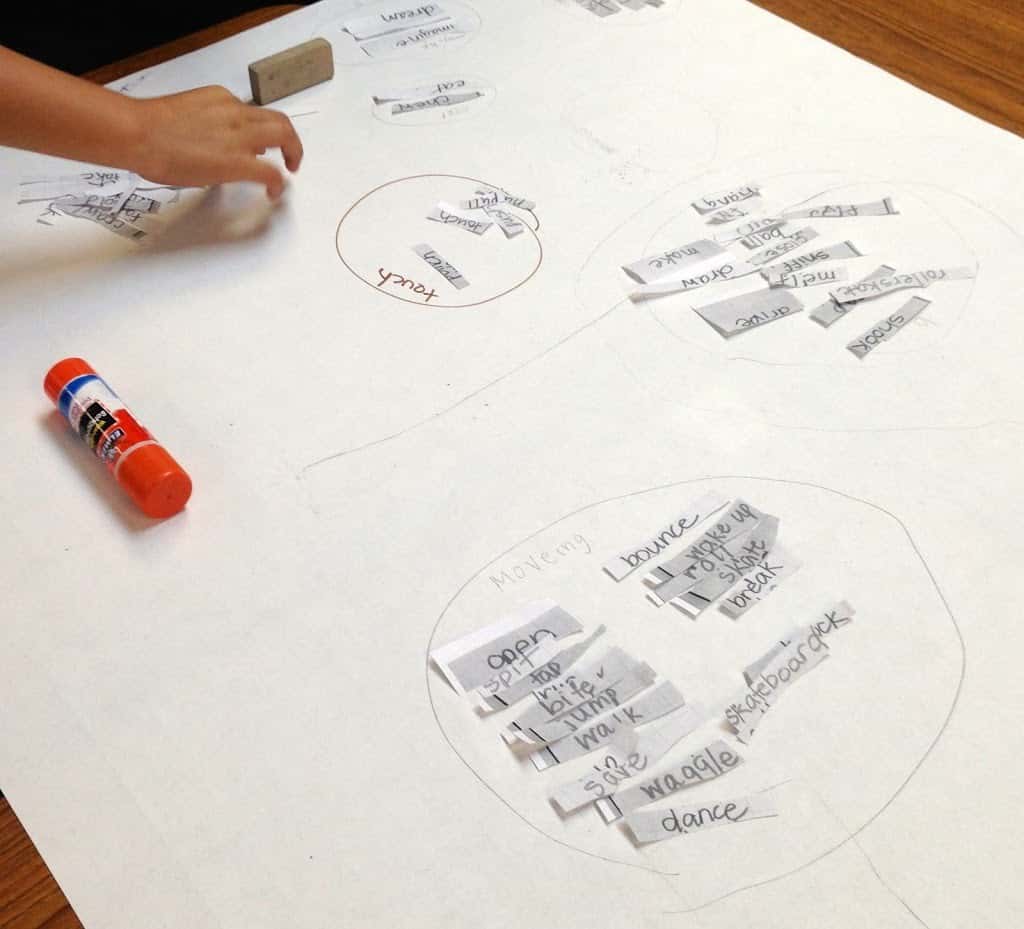
I helped synthesize names for some of the categories.
This activity was a fun, low-prep lesson that helped students focus on verbs.
The two-day sequence works because it starts with words students encountered themselves — verbs that already had context in a story — rather than a preprinted list. When students sort those words into categories they invented, they have to think about what the words mean and how they relate to each other. That is vocabulary acquisition through use, not memorization.
The activity also shows you, as the teacher, how students are thinking about verbs. A group that sorts “run, dash, sprint, bolt” together is beginning to understand shades of meaning. A group that puts “run” with “jump” and “dance” is categorizing by broader movement — which is also valid, and worth a conversation.

Woah! I’m really enjoying the template/theme of this site.
It’s simple, yet effective. A lot of times it’s difficult to get that “perfect balance” between superb usability and visual
appearance. I must say that you’ve done a fantastic job with this.
Additionally, the blog loads very fast for me on Safari.
Exceptional Blog!
Thank you so much! I love it for all those reasons, too!