
Use Quiz, Quiz, Trade to Promote Collaboration and Develop Comprehension & Academic Language
Quiz, Quiz, Trade is a Kagan cooperative learning technique that fosters academic review and reinforcement and cultivates an atmosphere of collaboration. It’s a fun cooperative learning strategy that gets students up and moving around the classroom while synthesizing new learning.
Quiz, Quiz Trade is one of my go-to cooperative learning strategies in my elementary classroom. I use it to help students develop academic language and to get them up and moving around the classroom.
This blog post explores the intricacies of the Quiz, Quiz, Trade strategy, providing educators with insights on how to implement it, its benefits for student learning, and creative ways to adapt it to various educational content.

What is the Quiz Quiz Trade Strategy?
The Quiz, Quiz, Trade strategy is an interactive, cooperative learning structure that encourages student engagement, knowledge review, and social interaction. It involves students quizzing each other on set questions and then trading cards containing these questions, ensuring that they interact with multiple peers and multiple questions throughout the activity.
So, how does quiz quiz trade work? Here’s a step-by-step overview:
- Preparation: I prepare question cards related to the lesson’s content. Each card has a question on one side and the answer on the other. The questions can cover various topics depending on the subject being taught. Questions can also be open-ended with the idea of having a short discussion vs. providing a specific answer.
- Distribution: Each student receives a question card.
- Quiz: Students are instructed to stand up, raise their hands, and find a partner. I use the Hand Up, Pair Up strategy when I ask students to find their partners. Once paired, one student quizzes the other by reading the question on their card. The student being quizzed attempts to answer. The quizzing student then provides feedback, using the answer on the card to confirm or correct. The roles are then reversed, with the second student quizzing the first with their card.
- Trade: After both students have asked and answered questions, they trade cards with each other and raise their hands to indicate they’re done. When all students are done, students find a new partner.
- Repeat: The process repeats several times, with students quizzing and trading cards with new partners each time. This ensures that each student interacts with many classmates and encounters various questions.
Tips for Classroom Management during Quiz, Quiz, Trade
Here are a few tips that make this learning strategy run smoothly in my classroom:
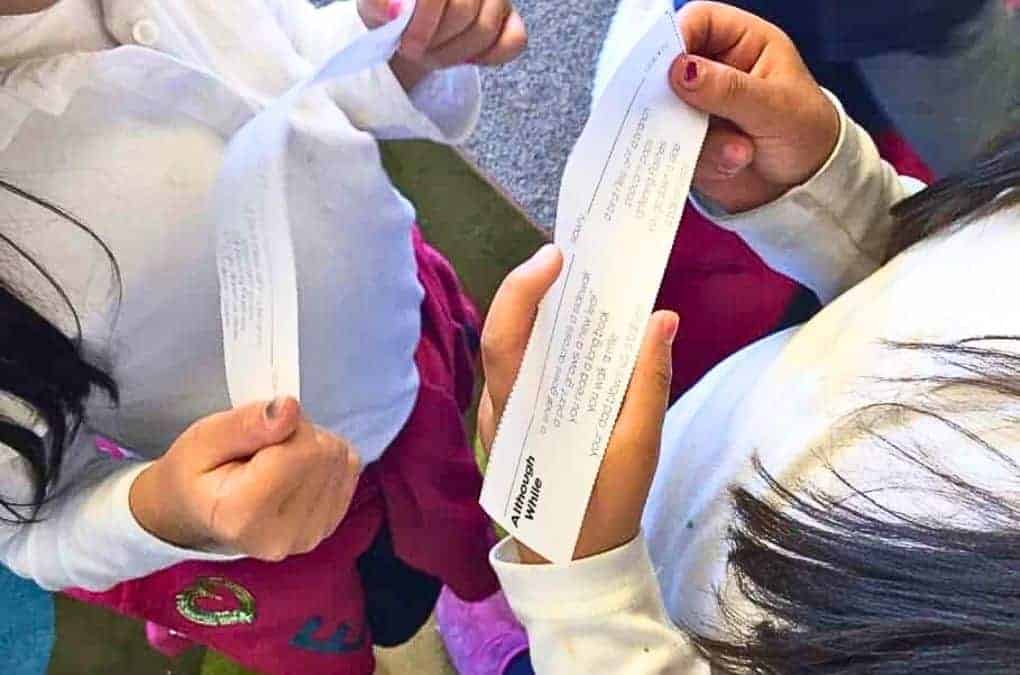
- Use sentence frames: I often use this strategy to develop academic language. I print sentence frames on paper strips and divide them evenly among the students. Students generally have the same question or prompt but give different structured responses based on the sentence frame.
- Have students pause between steps: Students do not move freely around the classroom. They have been trained to wait for instructions. When I ask students to find a new partner, they high-five in the air so that I know they are ready to go. They do the same after they are done sharing.
- All students move simultaneously: This ensures that student movement does not disrupt student output.
- Differentiate the Sentence Frames: If you have multiple levels in your classroom, print the sentence frames or questions on colored paper. Then, ask students to find a partner with the same colored paper that they have. This also ensures that certain students will never partner together if you need to keep two kids apart.
Why is the Quiz, Quiz, Trade Strategy Effective?
The Quiz, Quiz, Trade strategy is effective for several reasons:
- Active Engagement: It keeps students actively engaged in the learning process, as they must think about their answers and explain them to peers.
- Peer Learning: It promotes learning from peers, as students may explain concepts to one another in more relatable ways.
- Formative Assessment: It is a formative assessment tool for teachers to observe and gauge students’ understanding of the material. I can easily rotate between pairs and listen to students’ responses. I’ll often bring a clipboard or sticky notes and make notes about students’ ability to answer the prompts.
- Social Skills: It helps build social skills and classroom community by encouraging positive student interactions.
- Versatility: It can be adapted for any subject area and grade level, making it a versatile tool in the teacher’s toolkit. I have used this strategy in Kindergarten through Middle School.
What are Some Activities Teachers can do with Quiz, Quiz Trade?
Here are some engaging activities where teachers can apply the Quiz, Quiz, Trade strategy effectively:
Vocabulary Review
Create cards with new vocabulary words on one side and their definitions or sentences using the word on the other. This is especially useful for language arts, science, or any subject with specialized terminology. Most of our content resources come with three-part vocabulary cards that can easily be folded in half with the picture and word on one side and the definition on the other side.
Academic Language
Since this cooperative learning activity involves oral language, pair it with structured prompts and responses during your English Langauge Development (ELD) or English Language Arts time to help students practice newly learned language structures. This is one of my go-to uses of for this strategy. You can see it in action in my Opinion Writing Unit.
Math Fact Practice
For math, cards can have math problems on one side and the answers on the other. This can include basic arithmetic, algebraic equations, geometry problems, or any other math concept students are learning.
Historical Facts or Dates
In social studies, use the cards to review important historical events, figures, or dates. One side of the card might have a significant event, and the other side could have the date it occurred or a key fact about it.
Historical Figures
Use your biography sorting cards during this cooperative learning activity to review famous people and why they are important. You can either give students the person and ask them to come up with why they were important, or you can give them the cards with the important events and then ask who that person was.
Scientific Concepts
Cards can feature questions about scientific theories, processes, lab equipment, or the scientific method relevant to the current unit of study in science classes. Note: Our PLAY A GAME science stations come with question and answer cards that can easily be used with Quiz, Quiz, Trade.
Grammar and Punctuation Rules
Language arts classes can benefit from using this strategy to reinforce grammar rules, punctuation usage, parts of speech, and writing strategies.
Quiz, Quiz, Trade is an effective tool for reviewing and reinforcing content and for building a positive classroom environment where students feel comfortable and engaged in learning from one another. Students are actively engaged in constructing their understanding by merging the elements of quizzing, peer interaction, and movement.

Hi! Do you have a pdf of this that is easy to print? Thanks!
What would you like a PDF of: the blog post or the activity? The blog post can be printed from the browser window. Specify which pages to print to remove the images. The activity in the photos is from my Slow and Fast Changes resource: https://whatihavelearnedteaching.com/product/processes-that-shape-the-earth-earths-systems-1-c-how-the-earth-changes/