
How to Teach Compare and Contrast Text Structure in Social Studies Using Urban and Rural Areas – Scaffolded Writing Task for English Learners
Content writing is hard for most students. Not only are they learning new vocabulary AND new concepts, a receptive skill, but they are also expected to WRITE about this new learning in academically complex sentences that express a relationship of the content

Our Location and Map Skills Unit is built for second graders and includes support for students who need extra scaffolds for oral and written expression. Specifically, this unit builds off the skills developed in the previous unit, Long Ago & Now, and asks students to compare and contrast. By focusing on the same skill, I can build on students’
This post about Academic Language goes into a bit more detail about the components of academic language and the reasons for making it explicit with students.
Elicit Information about Urban & Rural Areas – List Vocabulary
For this social studies activity, we compared and contrasted urban and rural areas. We started by reading the chapter in our textbook about urban, rural and suburban areas.
We then made
These are the words from our text and that students came up with on their own from looking at the pictures. This is a good list, but if you need more words, consider showing students photos and talking about the objects in the photos or even the feeling of the photo, like busy vs peaceful.

This is just a pile of words, which is great. If I felt that my students didn’t know any of the words, I would have introduced the words prior to reading the text with picture support. However, I was pretty sure that most, if not all
Sort the Vocabulary Words to Help Students Form Sentences
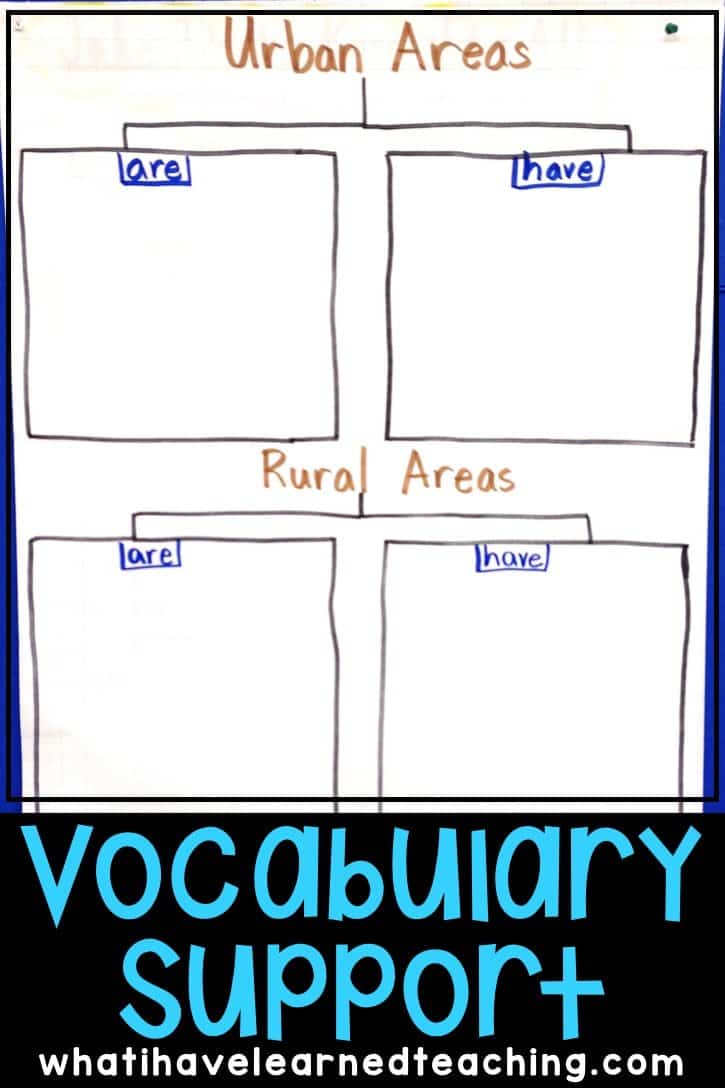
The second thing we did was sort the words so that students could make sentences. They did this with a substitute, so it didn’t come out quite right and needed some editing after the fact and I don’t have a completed photo.
This is a common pattern for early writers in kindergarten and first grade.
Orally Practice Putting the Words into the Sentence Frames
After we sorted the urban and rural words, we orally practiced putting the words into sentences that compared and contrasted the two areas. Really, students were simply contrasting at this point, but we will express similarities, too.
These compare and contrast sentences build from easy (two separate sentences) to more complex syntax. Students can use the “pile of words” to be able to talk about the similarities and differences between urban and rural areas.
Here are the sentence stems we used:

Write about Urban and Rural Areas Using a Compare and Contrast Text Structure
After our discussion, students went back to their seats and wrote a paragraph using these sentences. Most of the students just went down the chart, which was not my intention but okay for this first try.
Some students included an introductory sentence for their paragraph. Others did not. If the paragraph needed editing, we edited it and students rewrote it.
Students did an amazing job contrasting these two areas and putting their thoughts into writing. Some of my students struggled with the amount of writing, so I typed up the sentences into a paragraph frame, basically like you see in the below photograph. This paragraph frame still focuses on the academic language but takes away the amount of writing students have to do.
I love being able to scaffold concepts like this and have students be successful with complex academic language. It’s perfect for my English learners!
How to Purchase this Compare and Contrast Unit
I have an entire social studies unit focused on location and map skills. This activity is one component in that unit. Included are the concepts in this post with graphic organizers, sentence stems and sentence frames, think-pair-share activities, and scaffolded paragraph writing sheets.
Find out more about the Location and Map Skills Unit in this blog post.


Am I able to purchase the rural/suburban unit, as well as the map unit?
This is the resource with the map unit: https://whatihavelearnedteaching.com/product/map-skills-location-social-studies-unit/