
How to Teach Compare and Contrast in Elementary Grades
Teaching students to compare and contrast is a skill that shows up everywhere, from reading and writing to science and social studies. When students understand how to identify similarities and differences, they build stronger comprehension and deeper thinking skills.
The challenge is that many students can notice similarities and differences but struggle to explain them clearly. They may need support with organizing their ideas and using the language of comparison.
In this post, you’ll find simple strategies, activities, and tools to help you teach compare and contrast in your elementary classroom, including sentence frames, graphic organizers, and lesson ideas you can use right away.
What is Compare and Contrast?
Compare and contrast is a critical thinking strategy that involves identifying the similarities and differences between two or more subjects. It helps students build analytical skills and deepen their understanding of the subject matter.
The compare-and-contrast strategy is used across various subjects and grade levels. This method is not just about observing surface-level differences. Students need to analyze the text and draw on their understanding of the topic to identify similarities and differences.
To compare means to identify the similarities and differences between two things. Contrast, on the other hand, refers to identifying only the differences between two things. While the distinction between these two terms may seem subtle on the surface, students must accurately differentiate between the two concepts to answer questions and prompts accurately.
Why Teach Compare and Contrast?
Teaching students to compare and contrast builds strong critical thinking skills they use across all subject areas. When students identify similarities and differences, they analyze information, make connections, and develop a deeper understanding of what they are learning.
This strategy works in reading, writing, science, social studies, and even math. Whether students are comparing characters in a story, types of animals, historical events, or problem-solving strategies, they are practicing the same essential thinking skill in different contexts.
Prerequisite Skills Students Need
To compare and contrast, students must be able to describe. You may need to teach the function of describing something before students can use compare-and-contrast language.
For instance, students will need to be able to say and write sentences like:
- ___ has ___.
- ___ is ___.
- ___ can ___.
These are the most basic sentences students must know how to say and write before being taught to compare and contrast, since compare-and-contrast structures build on these foundational semantic structures.
How to Teach Compare and Contrast
Teaching compare and contrast effectively means starting with foundational skills and building toward more complex tasks over time. Here are the strategies I use to introduce and reinforce this skill across different subjects.
Start with Familiar Topics
When students are first introduced to compare and contrast, choose topics they already know. Students need a deeper understanding of the content before they learn a new strategy on which to apply that content knowledge.
Also, choose topics with enough in common and enough differences to describe in words students can easily understand.
Some easy, common topics to compare and contrast in K-2 classrooms:
- Pencil and marker
- Bats and owls
- Cats and dogs
- Lemons and oranges
- Apples and pumpkins
- The park and the museum
- Peanut butter and jelly
- Soccer and baseball
- Sharks and whales
- Cookies and cakes
More difficult topics that kids enjoy comparing and contrasting:
- Two books
- Two video games
- Urban and rural environments
- Characters in a story
- How a character changes from the beginning of a story to the end of the story
- The setting of two stories
- Book vs. movie
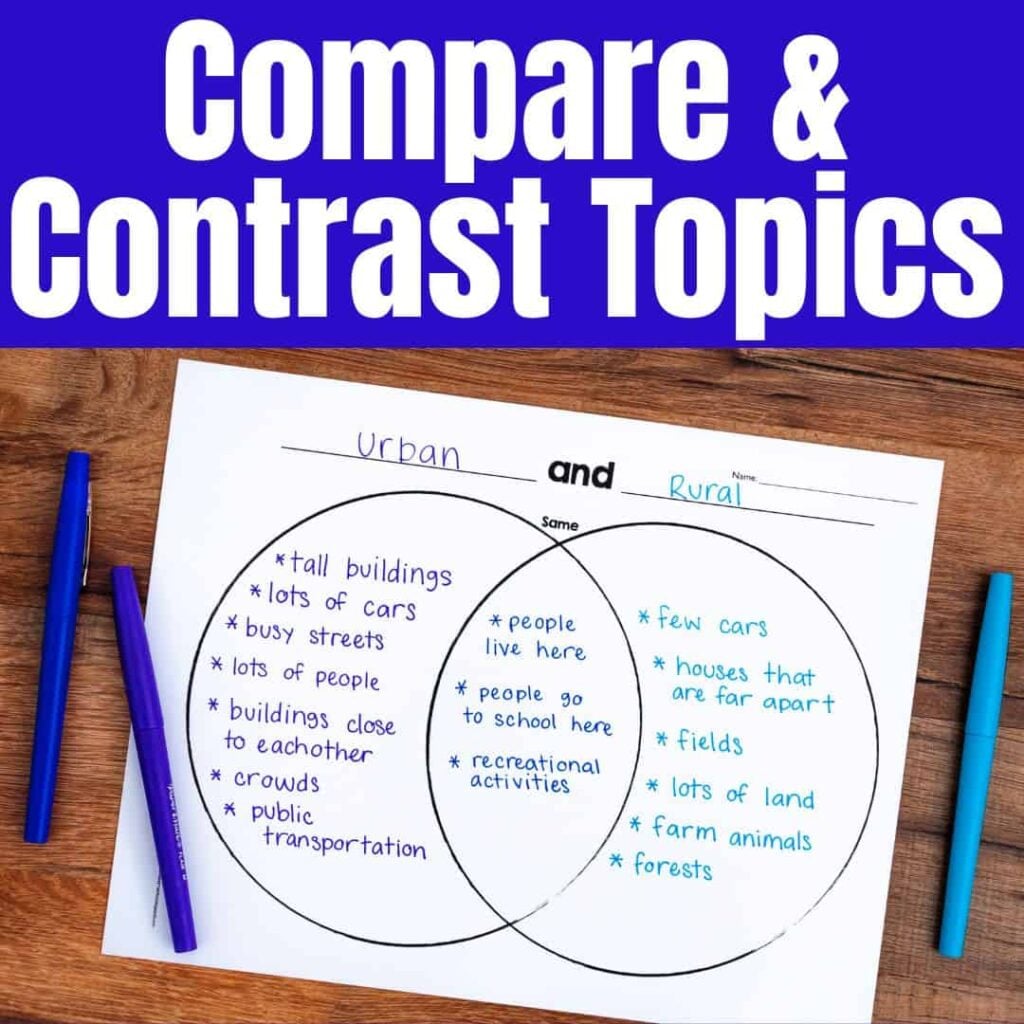
Need some more ideas of topics to compare and contrast? This post has some organized lists for you!
Use Real Life Objects
Consider using real-life, tangible objects that students can hold and manipulate when introducing compare and contrast. Here are some ideas of objects that kids can describe and then compare and contrast:
- Fruits and Vegetables: Compare an apple and an orange, a carrot and a cucumber, or a potato and an onion. Discuss aspects like color, taste, texture, and how they grow.
- Types of Clothing: Use a pair of jeans and a skirt, a T-shirt and a sweater, or sandals and sneakers. Talk about their uses, materials, and when they are worn.
- Writing Utensils: Compare pencils to pens, crayons to markers, or highlighters to chalk. Consider their uses, the marks they make, and whether they are erasable.
- Transportation Toys: Use toy models of a car and a bicycle, an airplane and a helicopter, or a boat and a train. Discuss their modes of transportation, where they are used, and how they move.
- School Supplies: Compare a backpack to a lunchbox, a notebook to a binder, or scissors to glue. Consider their uses, what they hold or do, and why students need them.
- Sports Equipment: Compare a soccer ball to a basketball, a baseball bat to a hockey stick, or a swim cap to goggles. Look at the sports they are used for, their shapes, and how they are used.

Use Graphic Organizers
You can use a variety of graphic organizers to teach compare and contrast.
The best way to compare and contrast two texts or objects is to use a Venn diagram. This visual way of organizing information allows students to see how two things differ and are the same.
Caveats of using a Venn Diagram:
- Sometimes, the ideas don’t line up, and students don’t understand that they must contrast two things with the same concept.

Use Sentence Frames to Build Language
I am a big proponent of giving students the tools they need to be successful, including the words they need to express their ideas. Sentence frames to scaffold compare and contrast can be differentiated based on grade level and the complexity of language output required of the student.
Simple sentence frames for compare and contrast include:
- ___ has ___. ___ has ___.
- ___ has ___, but ___ has ___.
- Both ___ and ___ have ___.
More complex sentence frames include:
- While ___ has ____, ___ has ___.
- Although ___ has ___, ___ has ___.
Can you see why developing students’ ability to describe something was important before asking them to compare and contrast two things? The language of description is embedded in the language of compare and contrast.

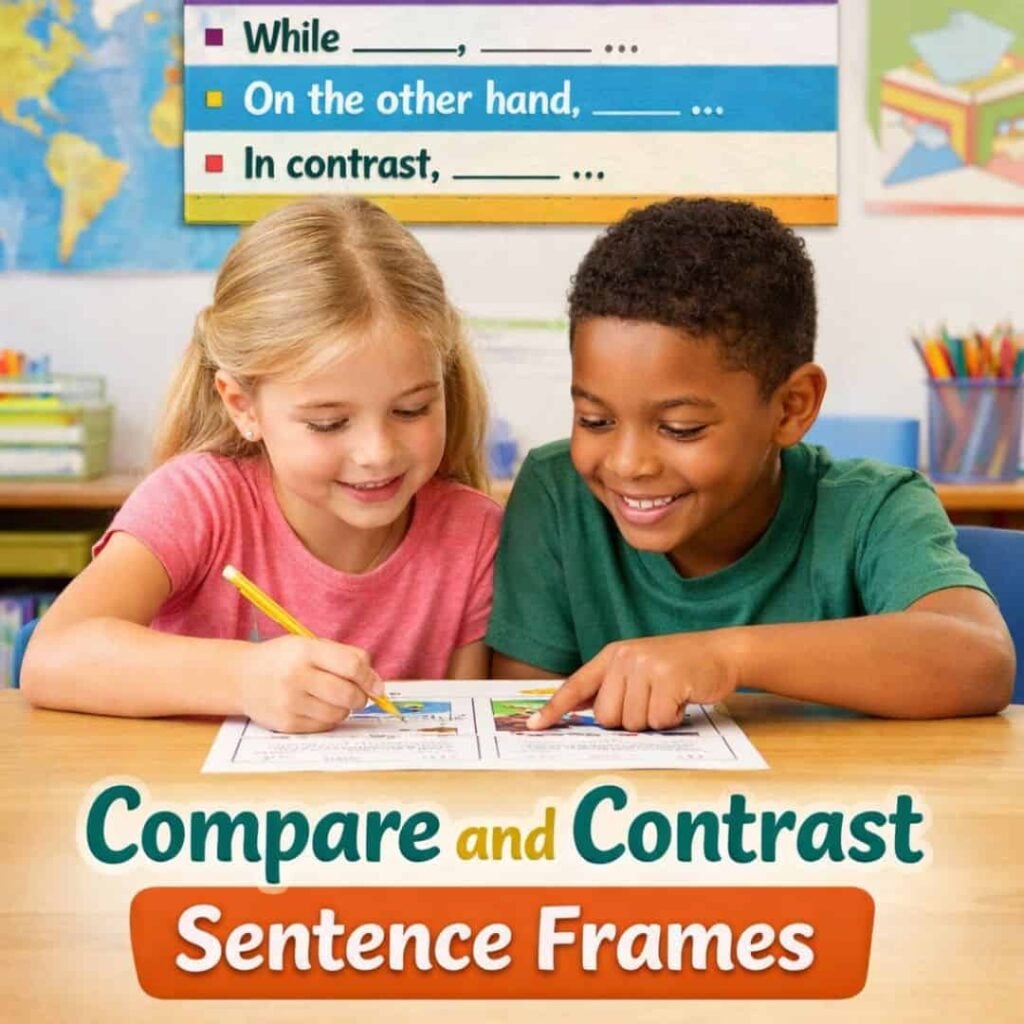
Here are sentence starters and sentence frames for teaching compare and contrast.
Compare and Contrast Unit
If you’re looking for a structured way to teach this skill, this Compare and Contrast Unit walks students through identifying similarities and differences, using sentence frames, and writing clear comparison sentences.
The unit includes:
- scaffolded sentence frame practice
- graphic organizers for comparing ideas
- activities for reading, writing, and content areas
- step-by-step support for building student understanding
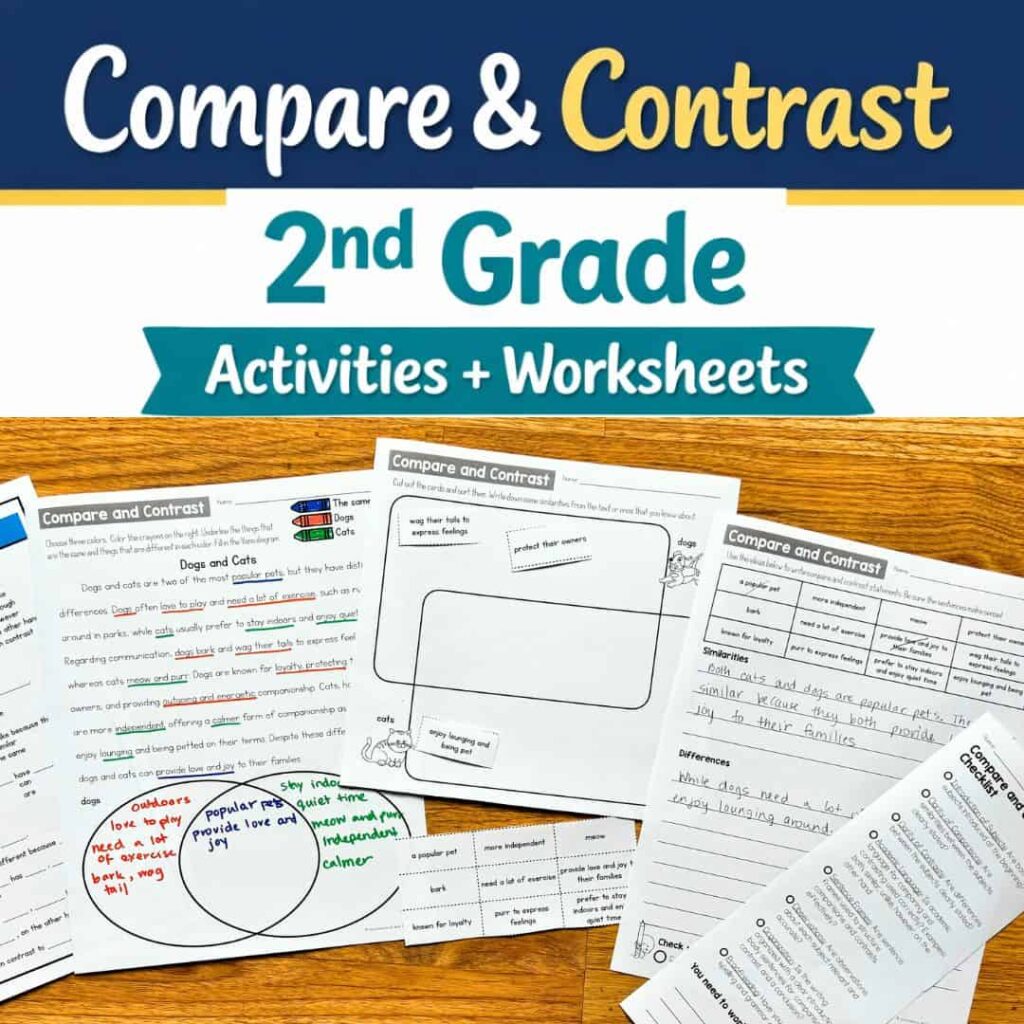
Check out the compare and contrast unit designed for 2nd and 3rd graders.
Use Clear Examples to Model the Skill
Students need to see what compare and contrast looks like before they can do it on their own. Clear, simple examples help students understand both the structure and the language of comparison.
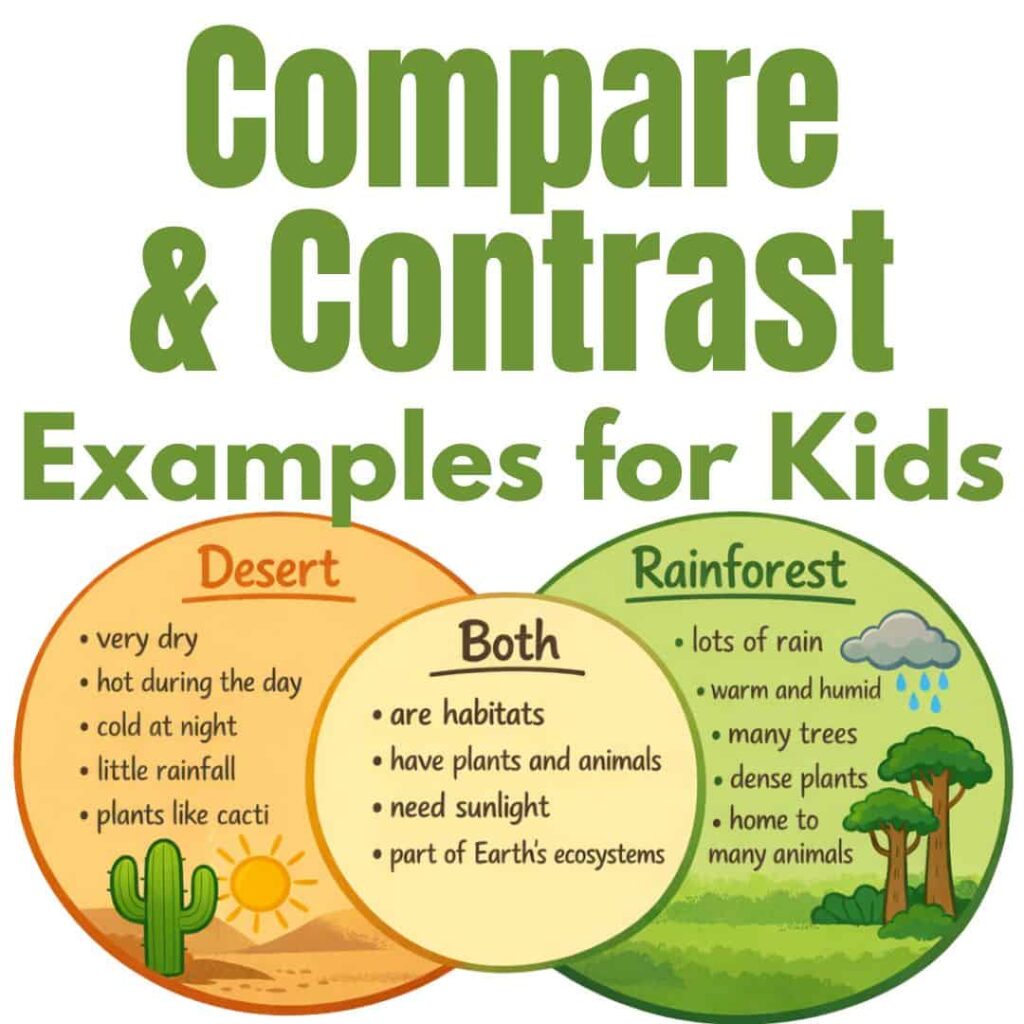
If you need a variety of examples at different levels, this collection of compare-and-contrast examples for students gives you sentence, paragraph, and essay models to use in your classroom.
Teach Compare and Contrast Across Subjects
Compare and contrast is not just for reading and writing. Integrating compare-and-contrast strategies across subjects can deepen students’ understanding and strengthen their critical thinking skills. Here are some ideas for incorporating compare and contrast in math, social studies, and science:
You can use it in math, social studies, science, and more. Here are some ideas of topics in different subjects:
Math
- Compare measurements
- Compare how a problem was solved
- Compare Numbers: Use Venn diagrams to compare and contrast properties of numbers, such as even and odd numbers, prime and composite numbers, or multiples and factors of given numbers.
- Geometric Shapes: Have students compare and contrast different geometric shapes based on their properties, such as the number of sides, angles, symmetry, or area and perimeter.
- Mathematical Methods: Present two methods for solving the same problem and have students compare and contrast the steps taken, efficiency, and ease of understanding.
- Data Analysis: Students can compare data sets using graphs and charts. They can analyze differences and similarities in trends, averages, medians, modes, or ranges.
Social Studies
- Compare urban and rural environments
- Compare the lives of two historical figures
- Compare two states
- Compare two holidays
- Historical Periods or Events: Compare and contrast historical periods or significant events, focusing on causes, effects, key figures, and outcomes. For example, compare the American Revolution with the French Revolution.
- Cultural Practices: Explore and compare different cultures or societies, examining their traditions, customs, beliefs, food, clothing, and ways of life.
- Economic Systems: Compare contrasting economic systems (capitalism vs. socialism), discussing their principles, advantages, disadvantages, and the impact on citizens’ lives.
- Government Types: Have students compare and contrast different forms of government, such as democracy and monarchy, focusing on structure, leadership, citizen participation, and rights
Science
- Compare two data sets from an experiment
- Living Organisms: Compare and contrast different species, looking at their habitats, adaptations, food chains, and life cycles. For example, compare mammals and reptiles.
- Physical States: Discuss the similarities and differences between the three states of matter (solid, liquid, gas), focusing on particle movement, shape, and volume.
- Energy Sources: Compare renewable and non-renewable energy sources and discuss their availability, sustainability, environmental impact, and societal uses.
- Planetary Characteristics: Have students compare and contrast planets in our solar system based on size, composition, distance from the sun, atmosphere, and known moons.
Incorporating compare and contrast activities across subjects reinforces this critical thinking strategy and encourages students to connect concepts and apply their knowledge in diverse contexts.
These activities can be adapted for various grade levels, providing a scaffolded approach to deepen understanding and engagement.
Use Books and Mentor Texts
Utilizing mentor texts and literature is a great way to teach comparing and contrasting. Books with contrasting characters or themes can help students explore beyond surface-level comparisons, encouraging deeper analysis and understanding. Selecting appropriate books for this purpose can significantly enhance the learning experience
To effectively use literature in teaching compare and contrast, consider the following strategies:
- Pair Books with Similar Themes: Choose books with a common theme but different settings, characters, or plots. For example, you might compare two books about friendship, but one is set in a modern city while the other takes place in a fantasy world. This allows students to explore how different authors approach the same theme.
- Character Comparisons: Select stories with strong, distinct characters and ask students to compare and contrast their traits, motivations, and development. Discuss how the characters’ decisions and actions influence the story’s outcome. This helps students understand character development and the role of characters in storytelling.
- Use Venn Diagrams: Provide graphic organizers like Venn diagrams to help students visualize the similarities and differences between two texts. This can be especially helpful for visual learners and can serve as a pre-writing activity for compare-and-contrast essays.
- Discussion and Debate: Encourage group discussions and debates about the similarities and differences between texts. This can foster deeper engagement and allow students to hear different perspectives, enhancing their understanding of the material.
- Thematic Studies: Conduct thematic studies where students read multiple books related to a single theme, such as courage or perseverance. After reading, guide students in comparing and contrasting how each book addresses the theme, providing a broader perspective.
- Interactive Read-Alouds: During read-aloud sessions, pause to ask questions that prompt students to think about similarities and differences. For instance, “How is this character similar to the one we read about yesterday?” or “What differences do you notice between the two settings?”
- Compare Texts and Their Adaptations: Have students compare a book with its film adaptation. This can lead to discussions about how different media portray the same story and about the changes made in the adaptation process.
- Writing Assignments: Assign writing tasks where students compare and contrast elements from different books. This reinforces their analytical skills and improves their writing abilities by organizing their thoughts clearly and coherently.
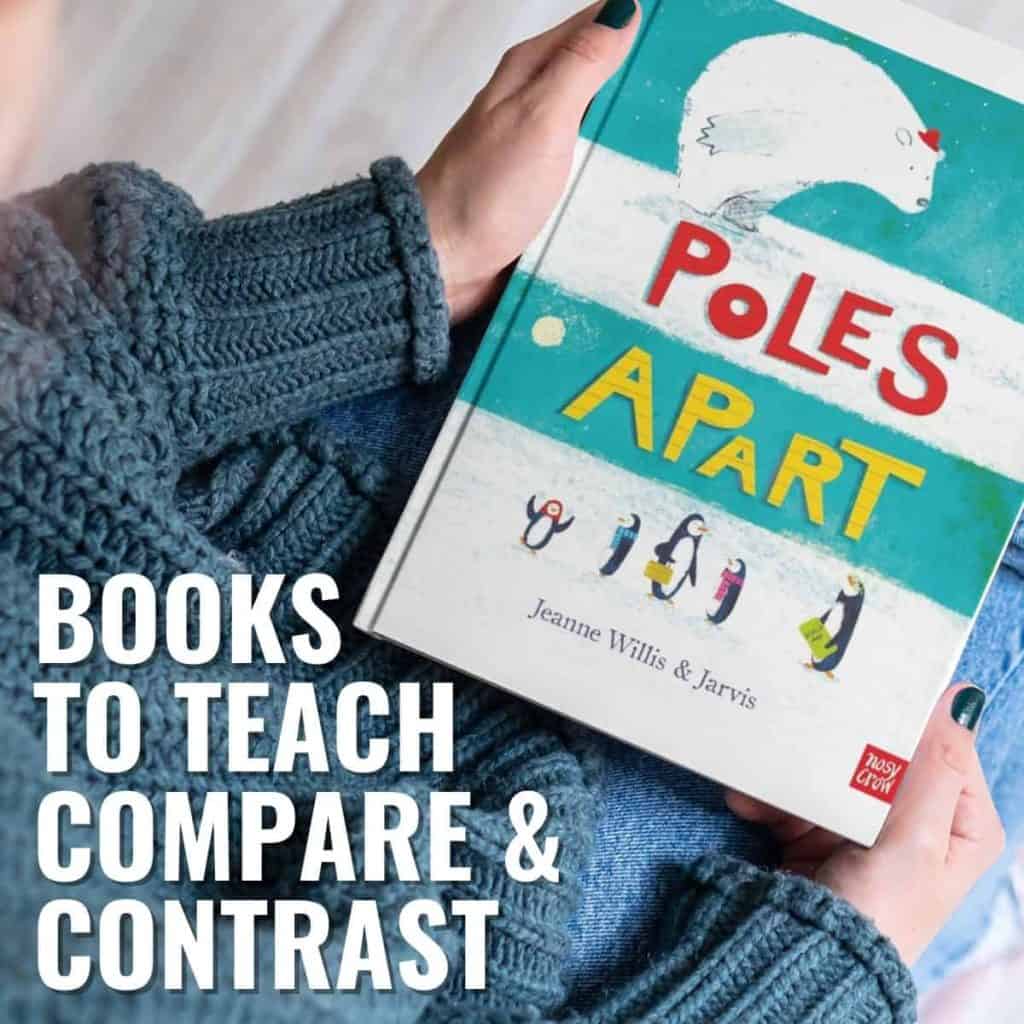
This list of books is great for teaching students to compare and contrast!
Teaching students how to compare and contrast gives them a foundation for deeper thinking across all subject areas. When students can clearly describe similarities and differences, they improve their reading comprehension, writing skills, and ability to analyze information.
Teaching students to compare and contrast gives them a foundation for deeper thinking in every subject. When students can clearly identify and explain similarities and differences, they improve their reading comprehension, their writing, and their ability to analyze information.
Starting with familiar topics, building toward more complex texts, and supporting students with sentence frames and graphic organizers makes this skill accessible to every learner in the room.
Jessica BOschen
Jessica is a teacher, homeschool parent, and entrepreneur. She shares her passion for teaching and education on What I Have Learned. Jessica has 16 years of experience teaching elementary school and currently homeschools her two middle and high school boys. She enjoys scaffolding learning for students, focusing on helping our most challenging learners achieve success in all academic areas.