
Comparing measurements is SO difficult for students, especially
Whew! That makes my brain hurt just thinking about it all!
While we have been doing quite a bit of work with measurement, measuring pumpkins and comparing inches and centimeters, we still have quite a bit further to go!

Here is how we practiced comparing measurements using academic language.
Measure our Hands and Feet
These lesson took place over a couple of days. This is the basic outline of what we did:
- We measured our hands and feet in centimeters.
- We compared our hands and feet to our classmates.
- We created a line plot to display our classroom data.
We did this activity with BOTH our hands and our feet. We used the same process below and repeated it for both appendages. Students were a bit stronger in their use of academic language for comparing measurements the second time around.
Step One: Draw our Hands or Feet
First, students worked with a partner and blank pieces of paper to outline their hand or foot. While you can have students take their shoes off, I opted to have students keep their shoes on, so really we outlined a shoe, not a foot.
Students then measured their foot or hand to the nearest centimeter. While in previous lessons we measured in both centimeters and inches, I wanted a two-digit number for our measurements. This allows students to find the difference in the measurements using larger numbers (16-25, I think). This worked well for second graders. If you have younger students, consider using inches, which will utilize one-digit numbers.
Step Two: Orally Practice the Sentence Frames
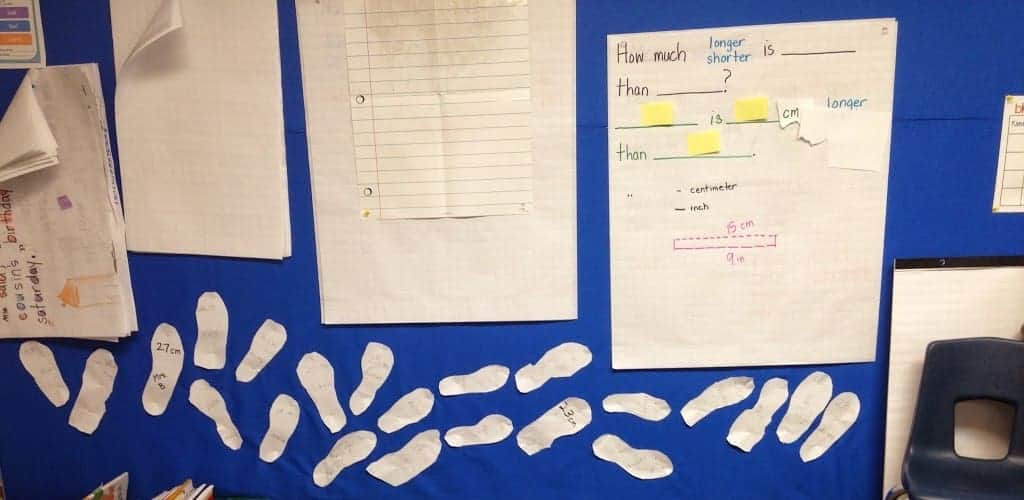
After students drew, measured, and cut out their feet, we placed all the feet on the wall near our carpet area.
We discussed the measurements on the feet. We talked about which feet were larger and which were smaller, in a general sense.
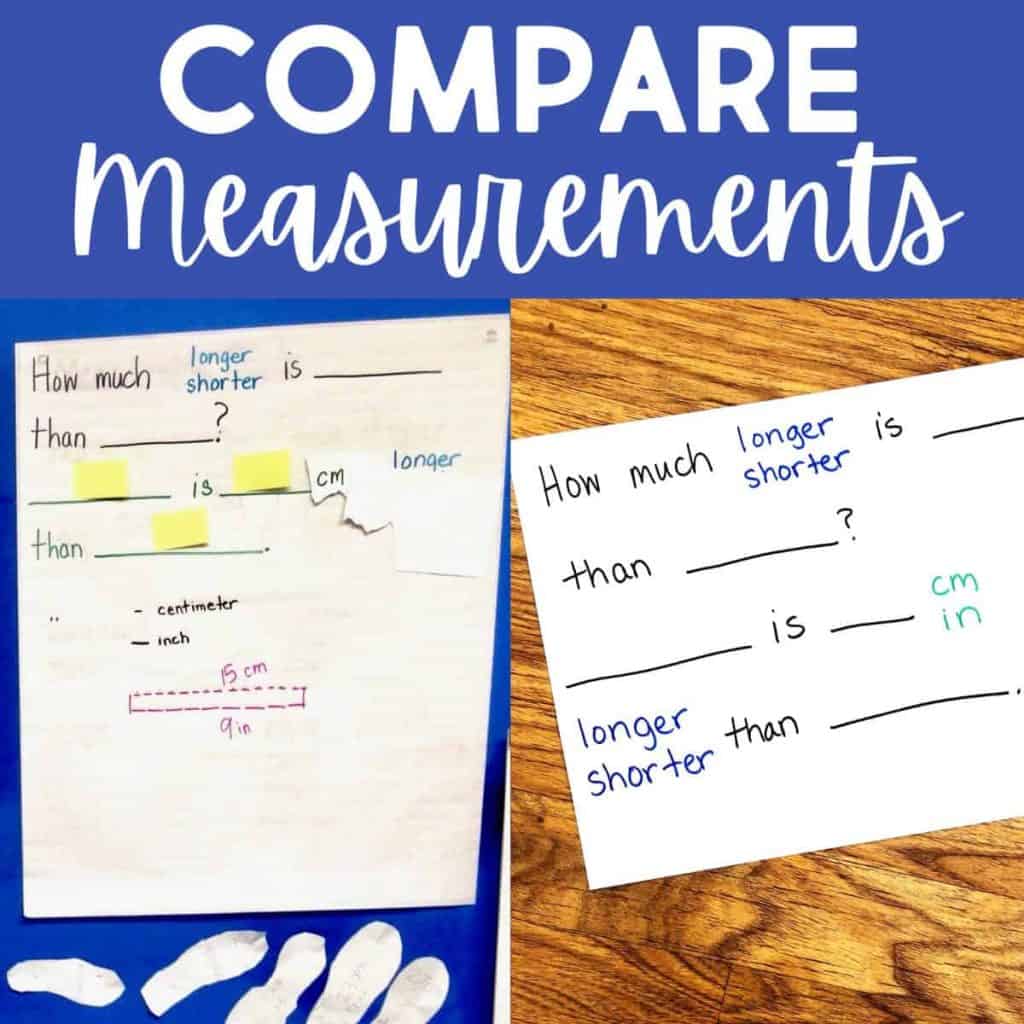
I showed students these sentence frames on chart paper. You can see the chart paper above. Here’s a close up of the sentence frames:

We discussed the meaning of question and answer and what goes in each blank.
In the photo above on my classroom wall, you can see paper covering some of the options. That was my way of “underlining” or pointing to certain options. I also used quite a few sticky notes to fill in the blanks on the chart paper.
We wrote down each child’s measurement and then talked about having to find the difference to tell “how much” longer one shoe is than another’s.
Practice the Sentence Frames as a Whole Group
We practiced using the sentence frames on the chart paper to talk about how much longer or shorter one shoe was than someone else’s. It took three different days of this before students got the hang of the complex language pattern.
Conceptually it’s difficult to know which noun goes in which place when you’re discussing whether something is longer or shorter.
It takes a lot of thinking power!
For the whole group practice, I mainly used a call and response type of practice. I would create the sentence or elicit the sentence from a student. I would say the sentence and
Practice in Partners
We also did a lot of partner practice. Partner practice took one form or another of a think-pair-share. Sometimes students just turned to a partner. Sometimes we did hands up, pair up. Other times, we did inside outside circle.
All of those are variations of ways for students to practice asking and answering questions with a partner.
How did students do?
We had varying degrees of success over the week. Some students got the concept right away. These are my native English speakers or students with higher levels of academic language.
Some students weren’t sure how to find the difference between the two shoes.
I had one little girl who very bravely raised her hand and said, “Ivan’s shoe is larger than Sam’s shoe.” She knows she’s supposed to compare, but totally missed the math in the question “How much . . . ?”
I also had a few kiddos who aren’t able to answer, “How much
I wonder what they’re missing. Any ideas? Do you think it’s a math or a language issue? Sometimes it’s hard to tell if it’s an academic or a language issue that is getting in the way.
Create a Line Plot
After we measured all of our feet and hands, we created a class line plot using the measurement data. We actually created two line plots. One for FEET and one for HANDS. This was one more way I could use the data that we had gathered as a class and address one more standard in our math
I drew a line on the board. We determined the range of the measurements and I drew tick marks for each whole measurement. Groups of students then came to the board and placed
After creating the line plot, we asked and answered questions about it. I started by asking questions and having students answer the questions.
We then moved onto having students asking questions and other students answering the question. After that, I had students find a partner and ask and answer questions about the line plot.
More Ideas for Using Sentence Frame in Math
Here are a few more blog posts about how I have used sentence frames in math:
FREE Compare Hands and Feet Worksheets
While much of the work we did was oral, I did have students write down the measurements and use sentence frames to compare measurements on paper. Do you want a copy of the worksheets? Click below to download it.
Do you have some go-to measurement activities in your classroom? I’d love to hear how you help students compare measurements and create line plots! Leave me a comment below and tell me about it!

I find your way of putting students academic work in a less stressful way for them to learn.