
An ice cube, a glass of water, and the steam off a hot cup are all the same stuff in three different forms. That’s the whole idea behind the states of matter, and it’s one of the first big science concepts elementary students meet. Understanding solids, liquids, and gases, how we describe them, and how they change gives students a foundation for everything from weather to chemical reactions.
This post explains the states of matter in kid-friendly terms, covers the properties that let us classify matter, walks through how matter changes state, and shares activities and teaching ideas for K-5.
What Are the States of Matter?
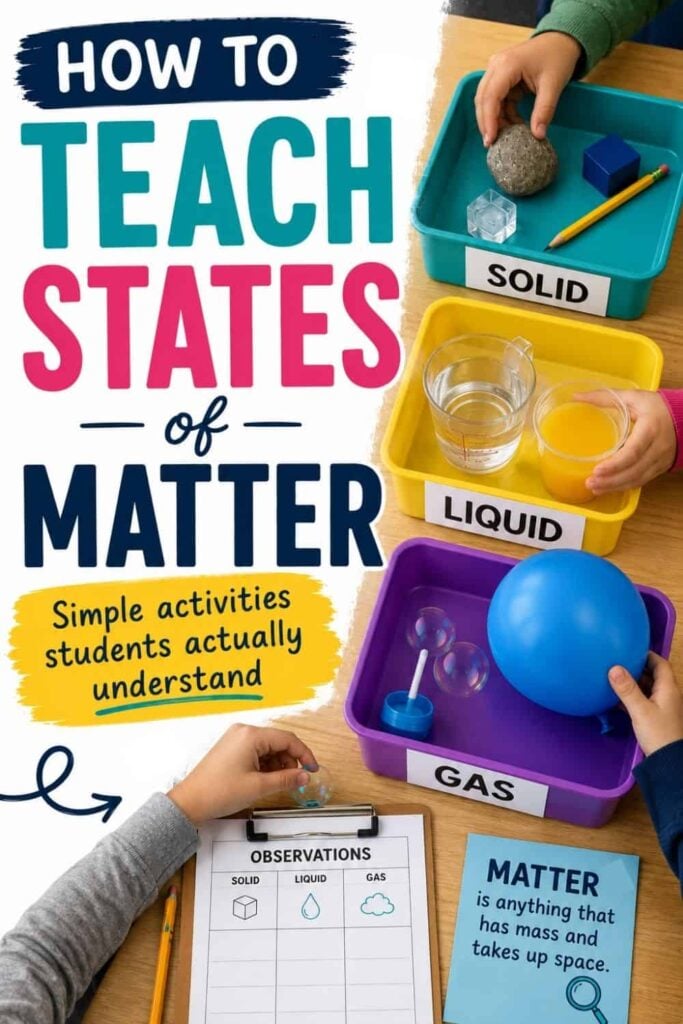
Matter is anything that has mass and takes up space, which is just about everything around us. For elementary students, matter comes in three main states:
- Solid: Holds its own shape and takes up a set amount of space. Examples: a rock, a pencil, an ice cube.
- Liquid: Takes the shape of its container but keeps the same amount of space. Examples: water, milk, juice.
- Gas: Spreads out to fill whatever space it’s in and has no set shape. Examples: the air in a balloon, steam, the helium in a party balloon.
Students sometimes hear about a fourth state, plasma, but the three above are what elementary science focuses on.

A quick sorting activity is one of the best ways to check that students can tell them apart. My states of matter sort has students classify everyday objects as solid, liquid, or gas.
Properties of Matter
Beyond its state, we describe matter by its properties, the traits we can observe and measure. Teaching students to describe matter by its properties is a core part of the standards, and it’s how scientists classify and compare materials. Common properties students explore include:
- Color, texture, and hardness
- Shape and how much space it takes up
- Whether it floats or sinks
- Whether it’s attracted to a magnet
- Whether it can be bent, stretched, or squished
These physical properties help students decide which material is best for a job, why we build a bridge from steel and a raincoat from plastic. For hands-on practice classifying matter by its properties, my 2nd grade properties of matter stations and 5th grade properties of matter stations walk students through it.
How Matter Changes State
One of the most important ideas for students is that matter can change from one state to another, and heating or cooling is usually what causes it. Water is the go-to example because students can see it in all three states:
- Melting: A solid warms up and becomes a liquid (ice to water).
- Freezing: A liquid cools and becomes a solid (water to ice).
- Evaporation: A liquid warms and becomes a gas (water to water vapor).
- Condensation: A gas cools and becomes a liquid (water vapor to droplets on a cold glass).
These are all physical changes: the water is still water, just in a different form, which means they can be reversed. That’s a great lead-in to which changes can be undone and which can’t. My reversible and irreversible changes sort builds that idea, and once students are ready for changes that make new substances, my physical and chemical changes post takes it further.

States of Matter Activities and Experiments
Matter is easy to make hands-on because students can hold, watch, and change it. A few activities that work well:
- Sort real objects. Give students a tray of items and have them sort by state, then by properties such as being magnetic or floating.
- Watch ice melt and refreeze. Students observe a solid become a liquid and back again, timing and describing the change.
- Trap a gas. Blow up a balloon or watch bubbles to show that gas is real matter that takes up space, even when we can’t see it.
- Run science stations. Rotating through short investigations allows students to explore states, properties, and changes within a single unit. These work well as part of a phenomenon-based lesson.
How to Teach States of Matter by Grade
Matter shows up across the elementary grades, getting deeper each time. In 2nd grade, students focus on observing and describing solids, liquids, and gases and their properties, and on changes caused by heating and cooling (NGSS 2-PS1). You can read the standard at the Next Generation Science Standards site.
By 5th grade, students learn that matter is made of particles too small to see, and they investigate what happens when substances mix and whether new substances form (NGSS 5-PS1). That’s where the particle view comes in, and my atoms and molecules stations help students picture the matter they’ve been describing all along.

Atoms & Molecules Science Station BUNDLE
These Atoms & Molecules Next Generation Science Stations include eight different science stations where students deepen their understanding of atoms and molecules, including the structures and properties of matter. The focus is on 5-PS1-1.
Frequently Asked Questions
Bringing It All Together
States of matter is a topic students can see, touch, and change, which makes it one of the most satisfying to teach. Start by sorting solids, liquids, and gases, then move into the properties that describe them, and finally show how heating and cooling change matter from one state to another. From there, students are ready for the bigger ideas of particles and chemical change.
Want it ready to teach? My states of matter sort is a quick way to start, and my properties of matter science stations for 2nd grade and 5th grade give students hands-on practice with states, properties, and changes, all aligned to NGSS.
Jessica BOschen
Jessica is a teacher, homeschool parent, and entrepreneur. She shares her passion for teaching and education on What I Have Learned. Jessica has 16 years of experience teaching elementary school and currently homeschools her two middle and high school boys. She enjoys scaffolding learning for students, focusing on helping our most challenging learners achieve success in all academic areas.