
Reversible and Irreversible Changes Science Station Sort
Teaching students about reversible and irreversible changes is an important part of elementary physical science. Students begin to understand that some changes to materials can be undone, while others create permanent changes.

A hands-on sorting activity is a simple way to help students explore this concept. When students analyze pictures and examples, they begin to recognize patterns in how heat and physical forces change materials.
This Reversible and Irreversible Changes Sort Science Station gives students an engaging way to practice identifying different types of changes while working independently or collaboratively.
Reversible and irreversible changes are a key part of the 2nd grade physical science standards. My physical science guide for elementary students has the full breakdown of 2nd–5th grade physical science concepts, standards, and activities.
What Are Reversible and Irreversible Changes?
A reversible change is a change that can be undone. The material can return to its original form.
Examples include:
- Ice melting into water
- Water freezing into ice
- Chocolate melting and hardening again
An irreversible change is a permanent change that cannot easily be reversed.
Examples include:
- Baking a cake
- Frying an egg
- Burning wood
- Cooking popcorn
Many irreversible changes happen when heat causes a new substance to form, which is a key idea students explore in second grade science.
Sorting activities help students practice identifying these patterns through visual examples.
What Is Included in the Reversible and Irreversible Changes Sort Station?
The station includes multiple options so it can be used in small groups, centers, or independent work.
Included in the station:
- Large table-group color sorting cards
- Cut-and-paste sort worksheet for individual practice
- Differentiated questions including short answer, fill-in-the-blank, and multiple choice
- Task cards and worksheets
- Answer keys
These options make it easy to adjust the activity to fit different classroom structures.
Reversible and Irreversible Changes Sort for Table Groups
One way to use this station is as a collaborative table-group activity.
Students examine each card and decide:
- Did the object experience a reversible change?
- Or did it experience an irreversible change?
Each card includes both an image and short text, which supports different types of learners.
Students discuss their reasoning and place the card into the correct category.
The visual examples help students think about how heat, cooling, or physical forces change materials.

Cut and Paste Science Sort Option
The second option is a cut-and-paste worksheet version.
Students first read a short informational passage about reversible and irreversible changes. They then analyze the pictures and sort them into the correct categories.
Teachers often use the activity in two steps:
- Whole-group card sort
- Individual cut-and-paste practice
The worksheet version is black and white, making it easy to print for independent work or homework.

Differentiated Responses to Meet the Needs of All Learners
Each science station includes multiple response formats so students can demonstrate their understanding in different ways.
Options include:
- Short-answer questions
- Fill-in-the-blank responses
- Multiple-choice task cards
This allows teachers to adjust the level of support depending on the needs of their students.

How This Station Supports NGSS Science Standards
This activity aligns with Next Generation Science Standards for second grade, where students explore how materials change when heated or cooled.
Through sorting and discussion, students learn to:
- Identify examples of reversible and irreversible changes
- Observe how heat affects materials
- Explain why some changes cannot be undone
Hands-on activities help students move beyond memorizing definitions and begin thinking like scientists.
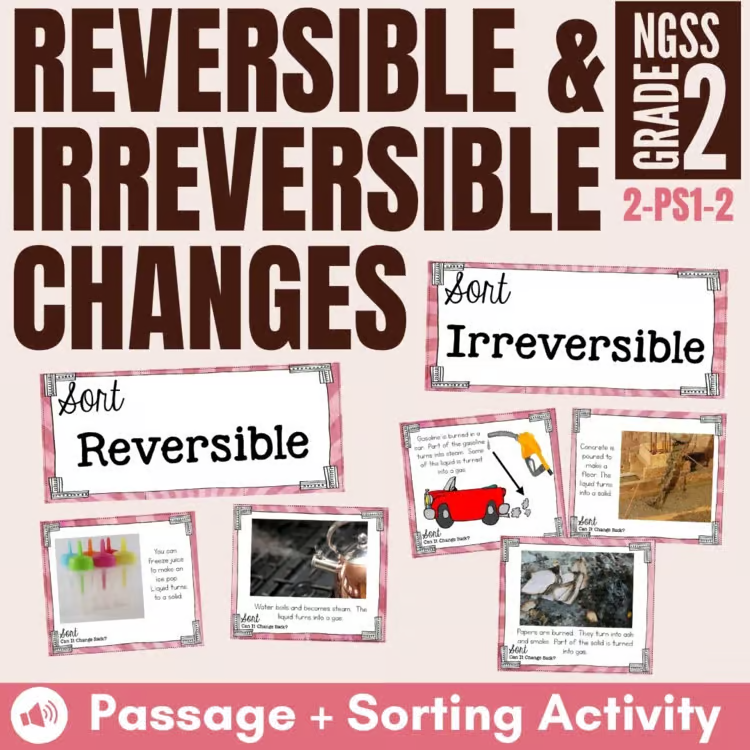
These no-prep science worksheets provide clear, age-appropriate practice in identifying how heating, cooling, and mixing can cause matter to change—and whether those changes can be undone.
Reversible and Irreversible Changes Science Station Resource
This Reversible and Irreversible Changes Sort Science Station is available on Teachers Pay Teachers.
It can be purchased:
- As an individual science station
- As part of a Reversible and Irreversible Changes station set
- Inside the Second Grade NGSS Science Stations Bundle
The bundle includes multiple science stations designed to support inquiry-based science instruction.
Would You Like a Free Science Station?
If you would like to try science stations in your classroom, you can download a free set of science stations for grades 2–4.
The free stations give you an example of how the activities work and how they can be used in science centers.

Jessica BOschen
Jessica is a teacher, homeschool parent, and entrepreneur. She shares her passion for teaching and education on What I Have Learned. Jessica has 16 years of experience teaching elementary school and currently homeschools her two middle and high school boys. She enjoys scaffolding learning for students, focusing on helping our most challenging learners achieve success in all academic areas.