
Morphology Morning Work: Daily Word-Part Practice
When a student hits a word like “unbreakable” and freezes, the fix usually isn’t sounding it out one more time. It’s seeing that the word is built from parts: un, break, and able. Teaching students to take words apart and put them back together is the heart of morphology, and Morphology Morning Work makes it a quick daily habit.
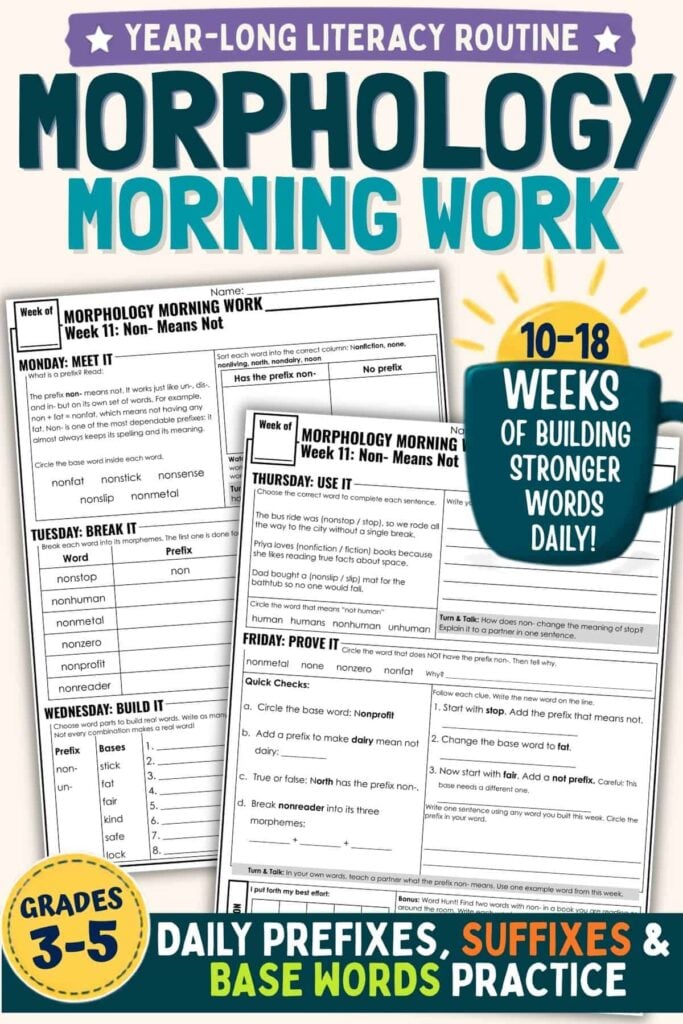
This post explains what morphology is, why it matters so much for readers and writers, how to teach it well, and how a short daily routine can build the skill without adding to your prep.
Want to try it first? Grab the free two-week starter and use the routine in your classroom tomorrow.
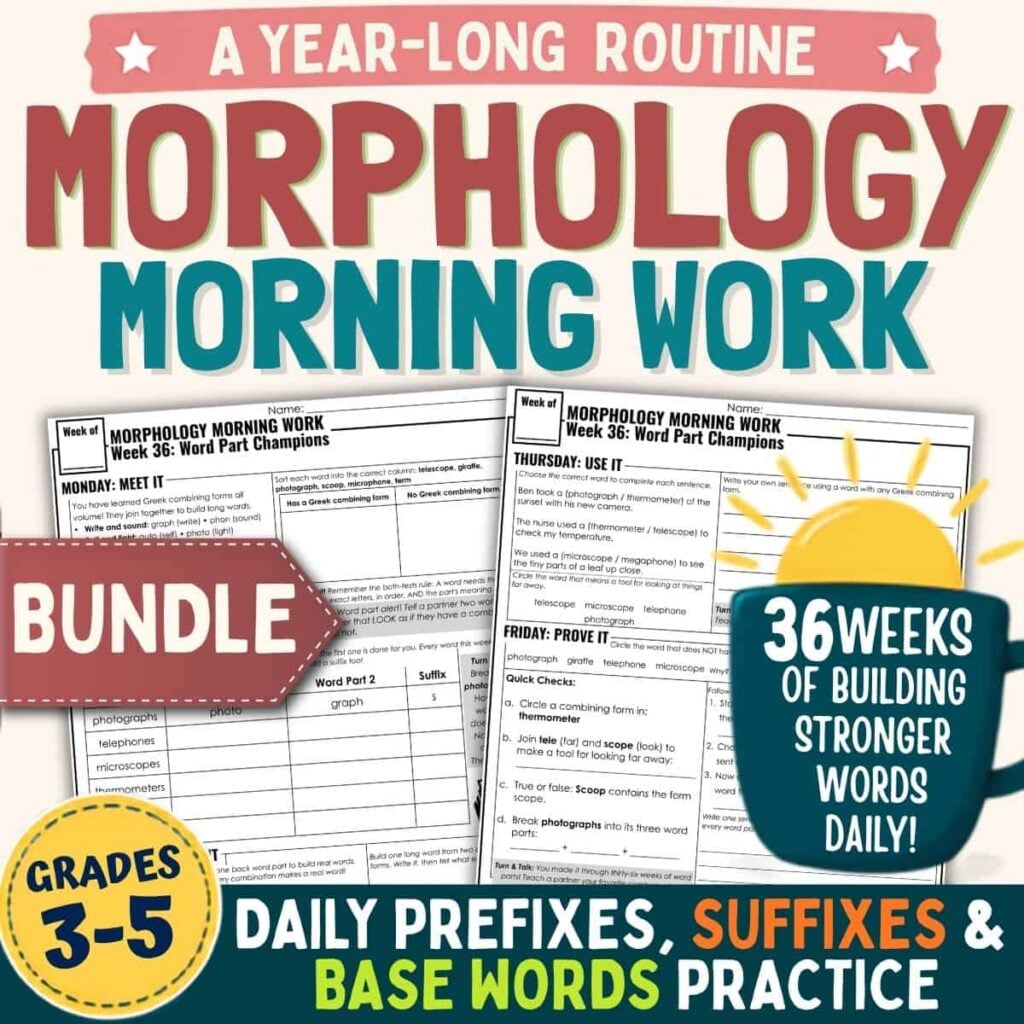
Morphology Morning Work Bundle | 36 Weeks of Prefixes, Suffixes, Latin Roots & Greek Combining Forms
Make morphology instruction simple and consistent all year long with this 36-week Morphology Morning Work Bundle! Students build vocabulary, decoding, spelling, and word-analysis skills through daily practice with prefixes, suffixes, base words, Latin roots, and Greek combining forms. Each week follows the same five-day routine, making this no-prep resource perfect for morning work, literacy warm-ups, word study, intervention, and spiral review.
What Is Morphology?
Morphology is the study of morphemes, the smallest units of meaning in a word. A base word like “help” is a morpheme, and so are the parts we add to it, like the prefix “un” or the suffix “ful.” Put them together, and you get “unhelpful,” a new word whose meaning you can figure out from its parts.
The goal of morphology instruction is morphological awareness: students recognizing that words are built from meaningful parts, and using those parts to read, spell, and understand new words. Once students see that “unbreakable” is un plus break plus able, they can unlock thousands of words they’ve never seen before.
Why Teach Morphology?
Morphology is one of the highest-leverage things you can teach in upper elementary, and the science of reading backs it up. A few reasons it earns daily time:
- It unlocks vocabulary at scale. More than half of English words come from Greek and Latin roots, and in the technical texts students meet in the upper grades, that number climbs toward three-quarters. Word parts are the key to that vocabulary.
- It supports decoding. Long words stop being scary when students can break them into chunks. Morphology pairs naturally with multisyllabic decoding and syllable division.
- It improves spelling. Understanding that “jumped” is jump plus ed helps students spell by meaning, not just by sound. It fits right alongside your spelling activities.
- It reaches every reader. Morphology gives strong readers a new challenge and gives striving readers a strategy, so the whole class grows.
The research on this is clear, and Edutopia’s overview of teaching morphology in elementary school is a good place to read more.
How to Teach Morphology
The most effective morphology instruction is explicit, consistent, and light on memorizing lists. A reliable routine looks like this: read the base word, add the prefix or suffix, read the new word, explain how the meaning changed, and use it in a sentence. When the steps stay the same, students can focus on the thinking instead of the directions.
A few principles that make it work:
- Teach fewer morphemes, deeply. One word part at a time, practiced across a week, beats a long list students memorize and forget.
- Name the traps. Words like “uncle” and “under” look like they start with the prefix “un,” but they don’t. Teaching students a quick take-away test (“does a real base word remain?”) builds real understanding instead of pattern-matching.
- Build words, don’t just label them. Give students a bank of bases and word parts and let them build as many real words as they can. Deciding which combinations are real is where the learning happens.
- Spiral back. Keep earlier word parts in play, so students combine them, reading three-morpheme words like “unhelpful” once they know un and ful.
- Hunt for words. Have students find the week’s morpheme in their reading. Real-world word hunts turn morphology into something they notice all day.
How Morphology Morning Work Builds the Routine
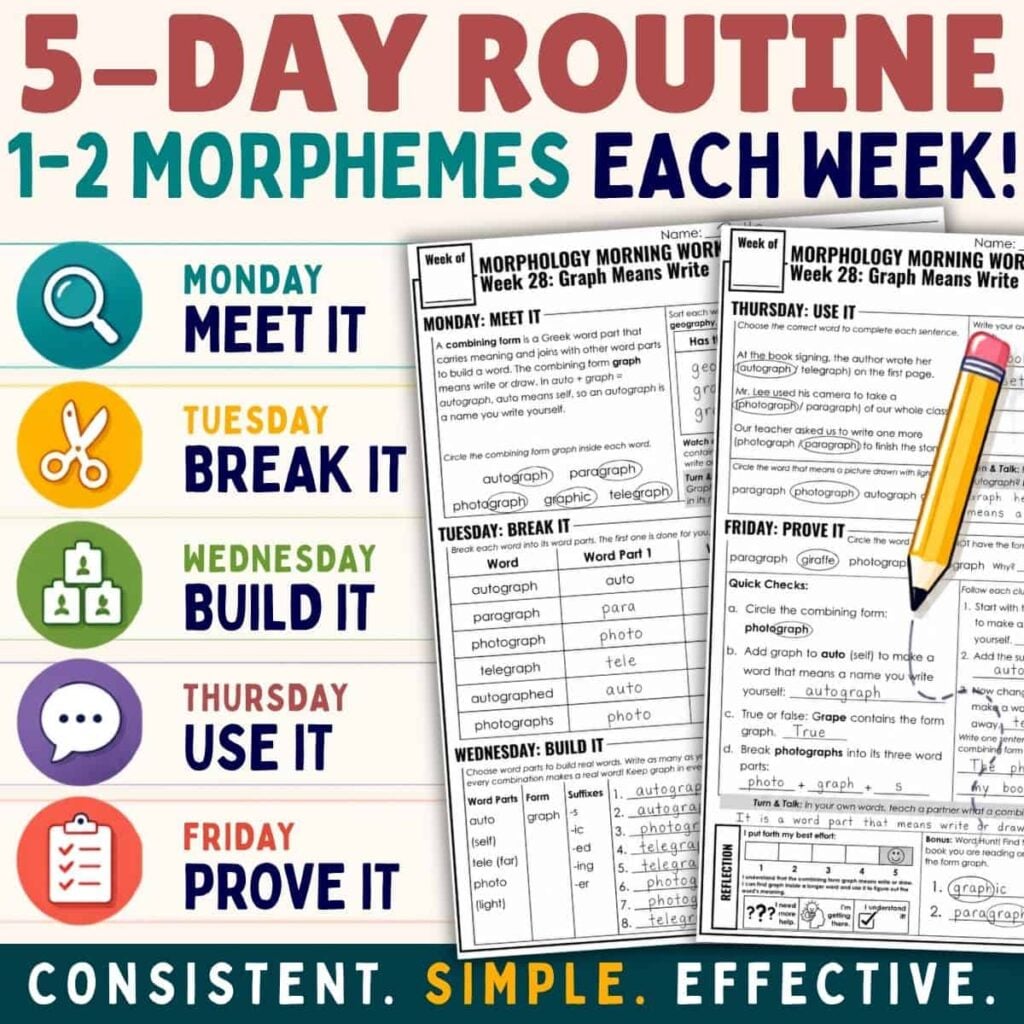
Doing all of that well, every day, is a lot to plan. That’s exactly why I built Morphology Morning Work: it turns the routine above into a no-prep daily sheet. Each week focuses on one morpheme, and the five-day pattern never changes, so students learn the structure once and only the word part changes:
- Monday, Meet It: Students read a short definition of the week’s morpheme, sort words into “has it” and “does not,” and learn the take-away test for the lookalike traps.
- Tuesday, Break It: Students break words into their morphemes in a table, reviewing earlier word parts as they go.
- Wednesday, Build It: Students use a bank of word parts to build as many real words as they can, applying the morpheme to fresh bases.
- Thursday, Use It: Students choose the right word to finish each sentence, then write their own.
- Friday, Review: Students pull the week together, rate their understanding on a reflection scale, and finish with a Word Hunt bonus.
Every day ends with a Turn and Talk, an oral partner task that stretches thinking without adding writing, and the built-in spiral review means earlier word parts keep coming back. It prints front to back as a single sheet per week, with no cutting or prep.
If you want the same word-part practice in a print-and-go format, my morphology worksheets follow a build, sort, write, and compare routine that works for morning work or centers.
Try Two Weeks of Morphology Morning Work for Free
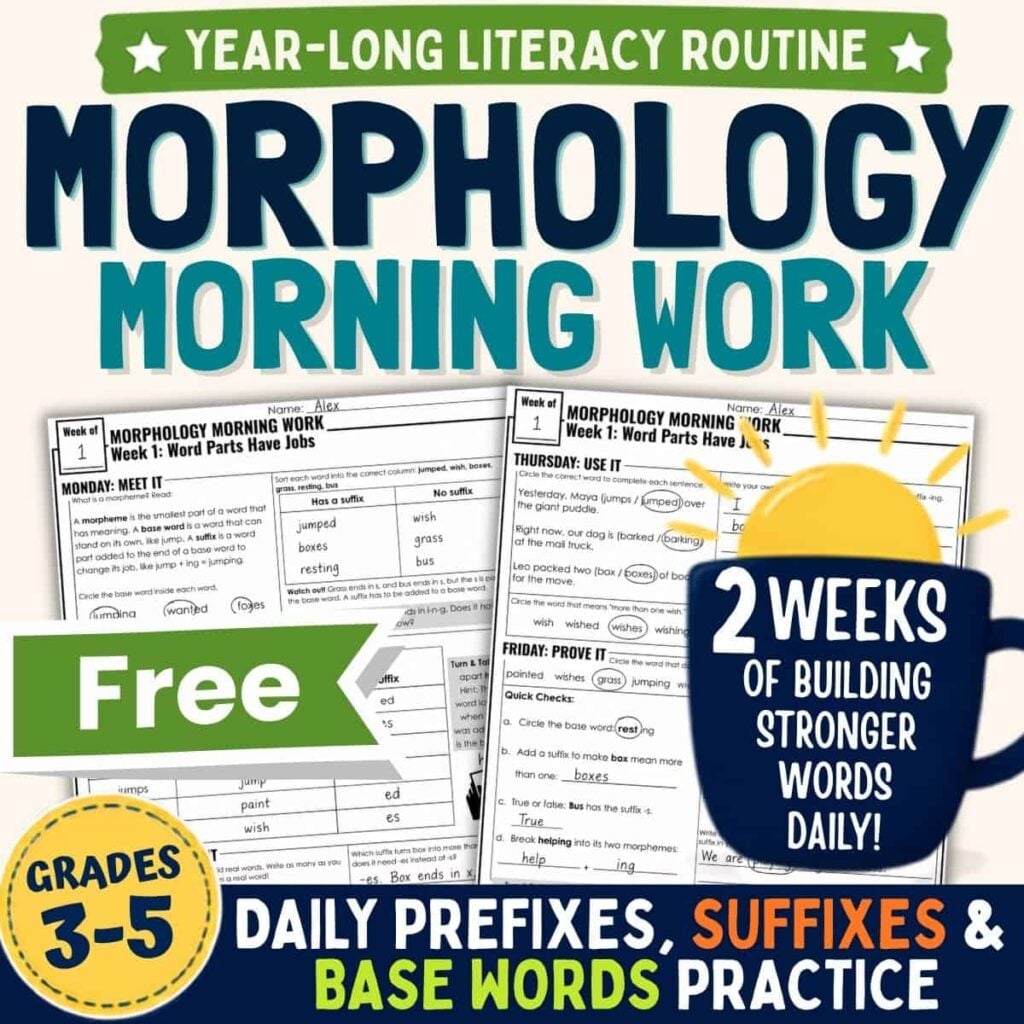
Want to see how the routine runs before you commit to a full year? Grab the free two-week starter. It’s the first two weeks of Morphology Morning Work, ready to print and use tomorrow, with no cutting and no prep. Here’s what’s inside:
- Week 1: Word Parts Have Jobs. Students meet the three terms they’ll use all year: morpheme, base word, and suffix, and learn to spot the endings -s, -es, -ed, and -ing.
- Week 2: Un- Means Not. Students meet their first prefix, learn the take-away test for spotting real word parts, and break their first three-part words.
- A full answer key for both weeks, including the Turn and Talk discussion answers.
Enter your email below, and I’ll send the free two-week starter straight to your inbox.
Which Morphemes to Teach First
A good scope and sequence starts with the parts students meet most and builds from there. Morphology Morning Work follows this order:
- Base words with the common suffixes -s, -es, -ed, and -ing
- The prefix un- (not), then re- (again), then dis- (not)
- pre- (before) and mis- (wrongly)
- The shape-shifting “not” prefixes in-, im-, ir-, and il-, and on through more prefixes and suffixes
Starting with suffixes students already use, then adding one prefix at a time, keeps the load manageable and gives students quick wins before the trickier, spelling-changing parts arrive.
Frequently Asked Questions
Final Thoughts
Morphology is one of those skills that quietly powers everything else, reading longer words, spelling by meaning, and understanding the academic vocabulary that fills upper-grade texts. Teach one word part at a time, keep the routine steady, and give students daily reps, and word parts become a tool they reach for on their own.
Morphology Morning Work Bundle | 36 Weeks of Prefixes, Suffixes, Latin Roots & Greek Combining Forms
Make morphology instruction simple and consistent all year long with this 36-week Morphology Morning Work Bundle! Students build vocabulary, decoding, spelling, and word-analysis skills through daily practice with prefixes, suffixes, base words, Latin roots, and Greek combining forms. Each week follows the same five-day routine, making this no-prep resource perfect for morning work, literacy warm-ups, word study, intervention, and spiral review.
Jessica BOschen
Jessica is a teacher, homeschool parent, and entrepreneur. She shares her passion for teaching and education on What I Have Learned. Jessica has 16 years of experience teaching elementary school and currently homeschools her two middle and high school boys. She enjoys scaffolding learning for students, focusing on helping our most challenging learners achieve success in all academic areas.