
What Is Morphology? A Teacher’s Guide to Teaching Word Parts
A student reads the word unbreakable and stops cold. But break it into un, break, and able, and the meaning falls right out: not able to be broken. That move, using the parts of a word to figure out the whole, is the heart of morphology, and it is one of the most powerful tools you can give a reader. So what is morphology, exactly? It is the study of morphemes, the smallest units of meaning in words, and how they combine.
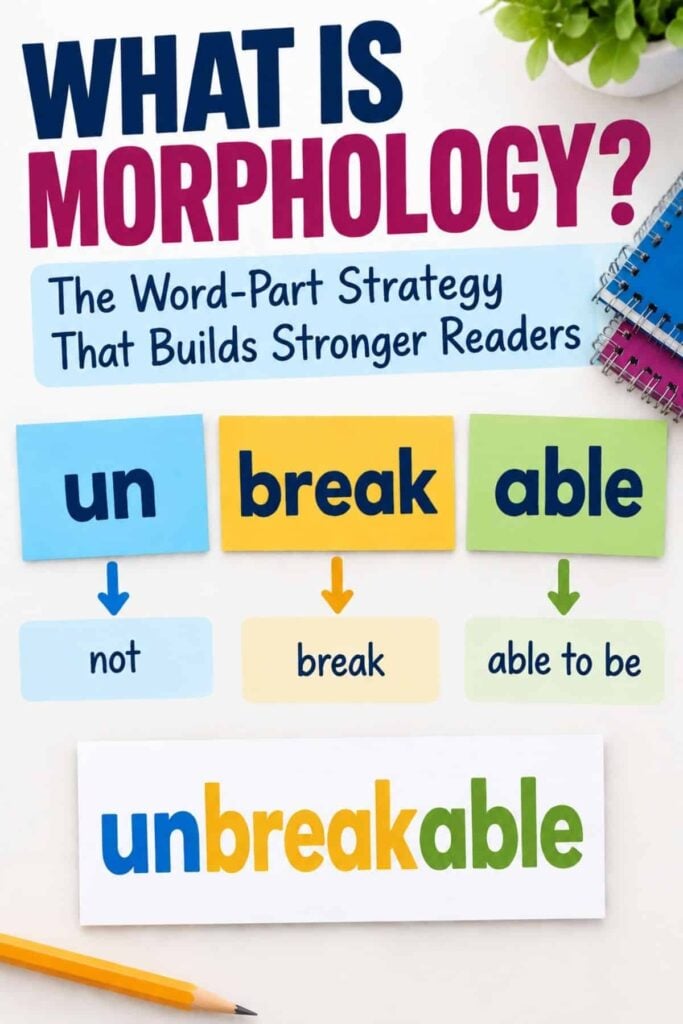
This post explains what morphology means, why it matters so much for reading, the kinds of word parts students learn, and how to teach it across the elementary grades.
What Is Morphology?
Morphology is the study of morphemes, the smallest units of meaning in a language, and how they fit together to build words. A morpheme can be a whole word on its own, like dog or run, or it can be a part that carries meaning but does not stand alone, like the prefix re- or the root struct.
Morphological awareness is the related skill: a student’s ability to notice that words are made of these smaller parts and to use them to read, spell, and understand new words. When a student sees rebuild and recognizes re- plus build, they are showing morphological awareness. That is the skill morphology instruction is designed to grow.
Why Morphology Matters for Reading
Morphology is a core piece of the science of reading, and its value grows as students move up the grades. Phonological awareness and phonics carry the heaviest load in the early years, but morphological awareness becomes increasingly important through upper elementary and beyond, exactly when texts fill up with long, multi-part academic words. The International Dyslexia Association has a helpful overview of morphological awareness and its place in literacy.
Teaching morphology pays off in four connected areas:
- Vocabulary. One root or affix unlocks a whole family of words, so students learn many words for the price of one part.
- Decoding. Breaking a long word into meaningful chunks makes it far easier to read than sounding out letter by letter.
- Spelling. Knowing that -tion is a spelling chunk, or that sign hides inside signal, helps students spell words that do not follow simple phonics rules.
- Comprehension. When students can unlock unfamiliar words on their own, they keep hold of the meaning of what they read instead of losing the thread.
How Morphology Fits With Phonics
Morphology is one of three tools students use to read words, alongside phonological awareness and phonics, and teachers often wonder how they fit together. Phonics connects sounds to letters, which is what beginning readers lean on most. Morphology works with meaning, the parts of words rather than the sounds. The two are partners, not competitors: phonics gets a student through a short, regular word, and morphology takes over as words grow longer and more meaning-based, as they do in the upper grades.
A quick example shows the difference. Sounding out signal letter by letter is tricky because of the silent g in its relative sign. But a student who knows the base sign can both read and spell signal, signature, and design. That is morphology doing work phonics alone cannot, which is why strong reading instruction includes both.
The Kinds of Morphemes Students Learn
Word parts fall into a few categories. Students do not need the technical labels to benefit, but the categories help you plan what to teach.
- Base words: A complete word that can stand alone and take on parts, like play in replaying.
- Compound words: Two base words joined to make a new one, like rainbow or playground. These are the earliest morphemes students work with, often in kindergarten and 1st grade.
- Prefixes: Parts added to the front of a word that change its meaning, like un-, re-, pre-, and dis-.
- Suffixes: Parts added to the end that change meaning or the word’s job in a sentence, like -ed, -ing, -ful, and -tion.
- Roots: Word parts, often from Latin or Greek, that carry meaning but usually do not stand alone, like port (carry) or graph (write).
Roots are powerful in the upper grades, since one root unlocks so many academic words. My post on common Latin and Greek roots has a full list with meanings and examples, plus which roots to teach at each grade.
Morphology in Action
The skill comes to life when students break a word into its parts and build the meaning back up. Model the move out loud a few times, and it becomes a habit:
- unhelpful: un (not) + help + ful (full of). Not full of help. Three morphemes, and students can define the whole word from the parts.
- rebuilding: re (again) + build + ing (happening now). Building again, right now. Students see how a prefix and a suffix wrap around a base word.
- transportation: trans (across) + port (carry) + ation (the act of). The act of carrying across, which is exactly what transportation is.
A word web is a simple way to make this visible: put a base word or root in the middle and branch out to every word students can build from it. The routine is always the same, find a part you know, figure out its meaning, and check that the whole word makes sense in the sentence.
How to Teach Morphology
You do not need a separate block in your schedule to teach morphology. It works best as short, consistent practice woven into what you already do. A few principles keep it effective:
- Start from words students know. Introduce a part through a familiar word, then peel it back, rather than starting with the part in isolation.
- Build and break words. Have students combine parts to make words and split big words into parts. Word webs and word building make the parts visible.
- Keep it short and daily. A few minutes a day beats one long lesson. Morphology is a natural fit for morning work or a warm-up.
- Make it visible. Post taught parts where students can see them and add example words as students find them in reading.
Two routines make this easy to sustain. A daily word-study warm-up introduces one part at a time so the learning stacks across the year, and a word wall keeps the parts in front of students the whole time. My morphology morning work handles the daily routine, and my morphology word wall keeps the parts visible and active.
Once students understand how word parts work, they need repeated practice building words themselves. A set of morphology worksheets gives them a consistent routine for combining roots with prefixes and suffixes.
How Morphology Helps Struggling Readers and Multilingual Learners
Morphology is especially powerful for the students who need the most support. A striving reader who finds long words overwhelming gets a way in: instead of facing an intimidating string of letters, they look for a part they recognize. Breaking a word into meaningful chunks lightens the load and gives them a strategy they can actually use on their own.
It pays off for multilingual learners too. Many academic words in English share Latin and Greek roots with Spanish and other languages, so a student who knows familia already has a bridge to familiar and family. Teaching word parts makes those connections explicit and helps students transfer what they already know. Because one root unlocks a whole family of words, morphology is one of the most efficient ways to grow the academic vocabulary these students need.

When to Start Teaching Morphology
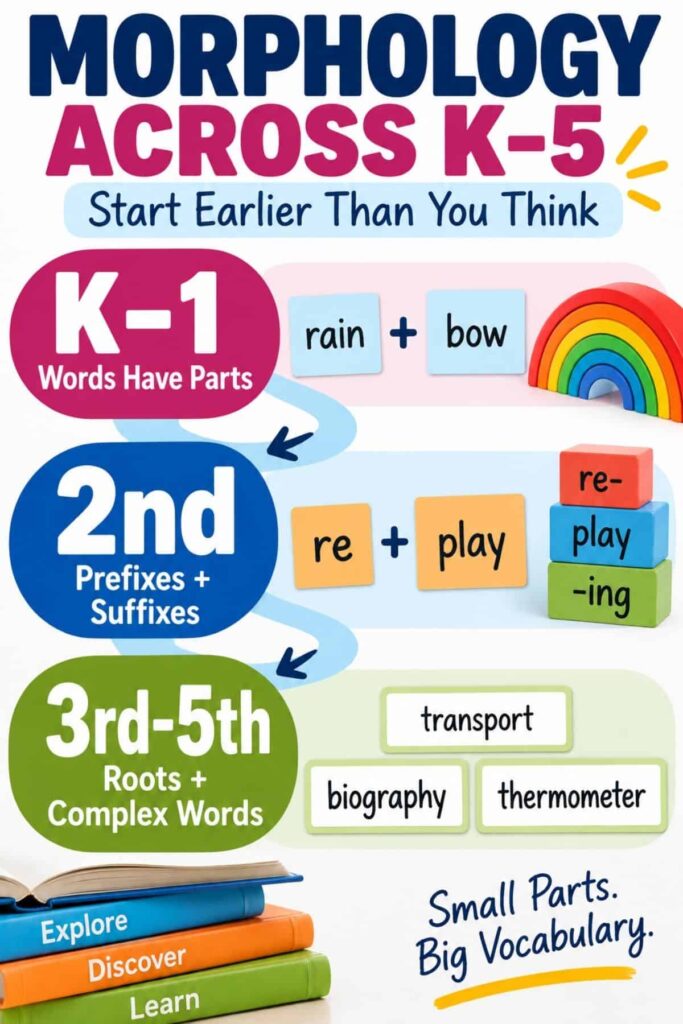
Morphology begins earlier than many teachers expect. In kindergarten and 1st grade, it looks like compound words and the idea that words have parts. In 2nd grade, students work with common prefixes and suffixes on base words they know. By 3rd through 5th grade, students take on Latin and Greek roots and start using word parts as a real strategy for unlocking academic vocabulary in their reading. The skill is the same all the way up; the words just get more sophisticated.
Morphology also strengthens vocabulary before students even reach a text. For more on that, my post on pre-teaching vocabulary activities shows how word parts fit into getting students ready to read.
Related Morphology Posts
Ready to go deeper? These posts build on the ideas here:
- Common Latin and Greek Roots, a full list with meanings, examples, and a grade-by-grade plan.
- How to Build a Morphology Word Wall, keeping word parts visible and active all year.
- Morphology Morning Work, a daily routine that builds one word part at a time.
- Pre-Teaching Vocabulary Activities: how word parts help students before they read.
Frequently Asked Questions
Bringing It All Together
Morphology gives students a strategy that keeps working long after any single lesson: when they meet an unfamiliar word, they can look for the parts they know. Start where your students are, teach a few parts deeply, keep them visible, and make the practice short and daily. Once students start noticing morphemes on their own, their reading, spelling, and vocabulary all grow together.
Want it ready to teach? My Morphology Morning Work builds prefixes, suffixes, and roots through a short daily routine, and my Morphology Word Wall Cards give you ready-to-post cards for the word parts as you teach them.
Jessica BOschen
Jessica is a teacher, homeschool parent, and entrepreneur. She shares her passion for teaching and education on What I Have Learned. Jessica has 16 years of experience teaching elementary school and currently homeschools her two middle and high school boys. She enjoys scaffolding learning for students, focusing on helping our most challenging learners achieve success in all academic areas.