
Common Latin and Greek Roots: A List and How to Teach Them
Teach a student the root port, and you have not taught them one word. You have handed them a key to transport, import, export, portable, and porter. That is the power of roots. Common Latin and Greek roots are the building blocks of thousands of English words, and once students can spot them, they can make sense of unfamiliar vocabulary on their own instead of guessing or skipping.
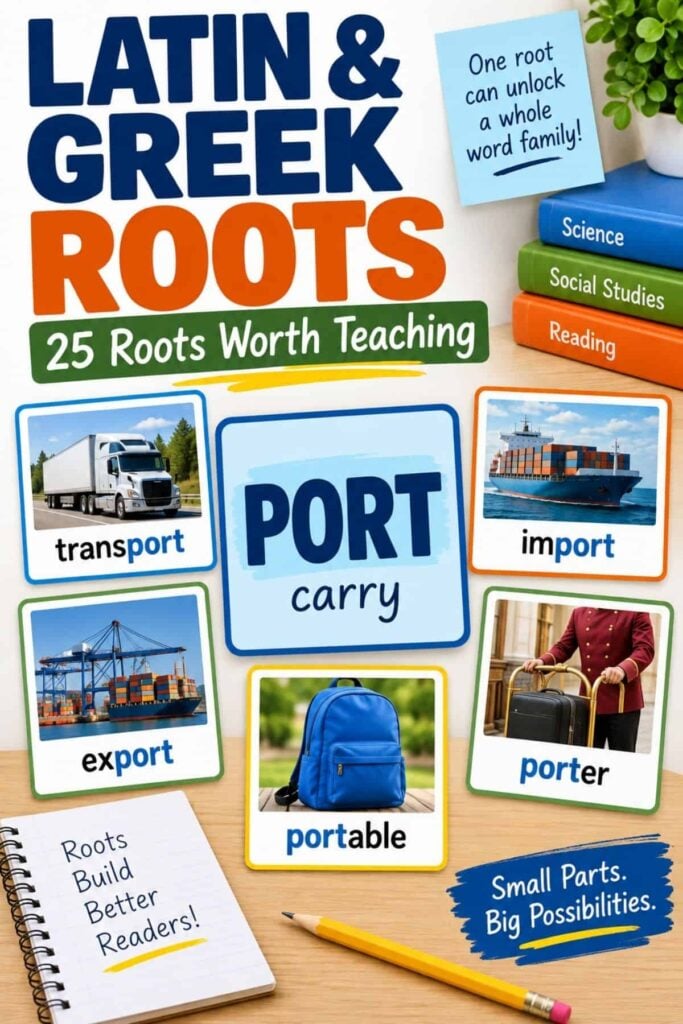
This post gives you a usable list of the most useful roots with their meanings and examples, shows what to focus on at each grade level, and walks through how to teach them so they stick.
Why Teach Latin and Greek Roots?
A large share of the academic vocabulary students meet in science, social studies, and math is built from Latin and Greek parts. Teaching the roots gives students a strategy that keeps paying off: instead of memorizing words one at a time, they learn a part that unlocks a whole family. Research on morphological awareness, the ability to notice and use meaningful word parts, links it to stronger vocabulary, decoding, and reading comprehension, especially as texts get harder in the upper grades. The literacy nonprofit Reading Rockets has a helpful overview of roots and affixes.
Roots also build independence. A student who knows therm means heat can reason their way through thermometer, thermal, and thermostat without a dictionary. That is exactly the kind of thinking you want readers doing on their own.
A List of Common Latin and Greek Roots
Here are some of the highest-value roots to teach in elementary school, chosen because they show up often and unlock many words. The list mixes Latin and Greek roots, since students benefit from both.
| Root | Origin | Meaning | Example Words |
|---|---|---|---|
| port | Latin | carry | transport, import, portable |
| dict | Latin | say, tell | dictate, predict, dictionary |
| struct | Latin | build | construct, structure, destruct |
| spect | Latin | look, see | inspect, spectator, respect |
| scrib / script | Latin | write | scribble, describe, script |
| tract | Latin | pull, drag | tractor, attract, subtract |
| rupt | Latin | break | rupture, interrupt, erupt |
| form | Latin | shape | transform, uniform, reform |
| aud | Latin | hear | audio, audience, auditorium |
| vis / vid | Latin | see | vision, video, visible |
| cred | Latin | believe | credit, incredible, credible |
| terr | Latin | earth, land | territory, terrain, terrarium |
| bio | Greek | life | biology, biography, biome |
| geo | Greek | earth | geography, geology, geometry |
| graph | Greek | write, draw | autograph, paragraph, graph |
| photo | Greek | light | photograph, photosynthesis |
| tele | Greek | far, distant | telephone, television, telescope |
| phon | Greek | sound | phonics, telephone, symphony |
| therm | Greek | heat | thermometer, thermal, thermos |
| meter / metr | Greek | measure | thermometer, perimeter, diameter |
| scope | Greek | look at, examine | telescope, microscope, periscope |
| -logy | Greek | study of | biology, zoology, geology |
| aqua | Latin | water | aquarium, aquatic, aqueduct |
| ped | Latin | foot | pedal, pedestrian, centipede |
| man / manu | Latin | hand | manual, manufacture, manicure |
| ject | Latin | throw | eject, project, reject |
| mit / miss | Latin | send | transmit, mission, submit |
| duc / duct | Latin | lead | conduct, produce, educate |
| sign | Latin | mark | signal, signature, design |
| fract / frag | Latin | break | fracture, fragment, fraction |
| path | Greek | feeling | sympathy, empathy, pathetic |
| chron | Greek | time | chronological, chronicle, synchronize |
| astro / aster | Greek | star | astronaut, asteroid, astronomy |
| micro | Greek | small | microscope, microwave, microphone |
| cycl | Greek | circle, wheel | bicycle, cycle, recycle |
You do not need to teach all of these at once. A few well-chosen roots taught deeply beat a long list rushed through. A morphology word wall is a good way to keep the ones you have taught visible; my morphology word wall post shows how to build and use one.
What to Teach at Each Grade Level
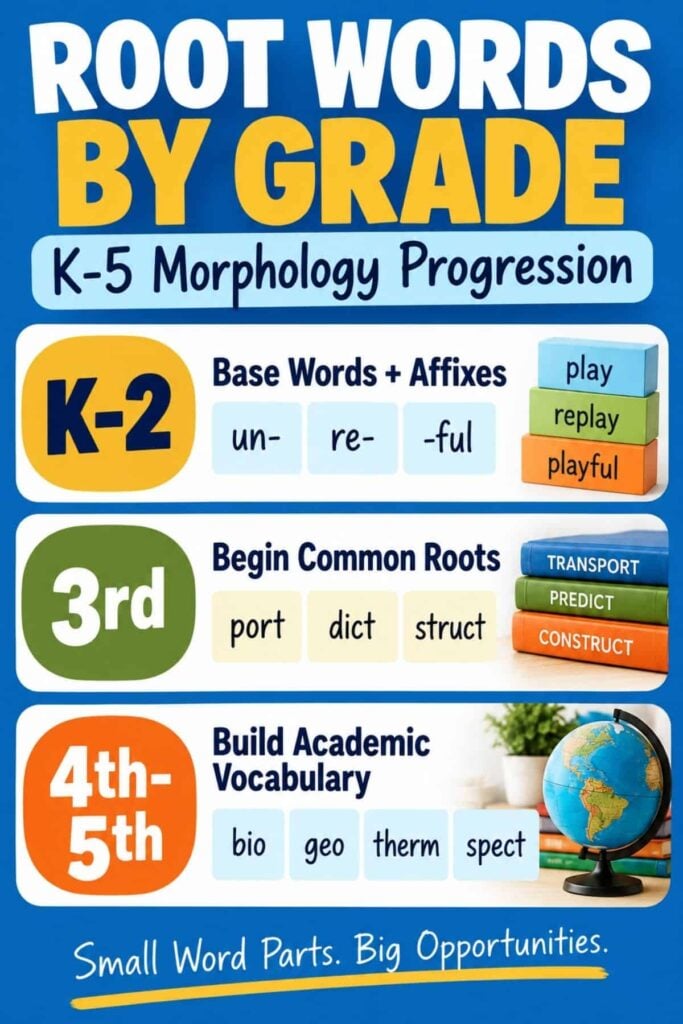
Root work grows across the grades, moving from the most familiar word parts to true academic roots. Here is a sensible progression.
Kindergarten and 1st Grade
Formal roots are not the focus yet. At this stage, build the foundation: compound words, base words students already know, and the most common inflectional endings like -s, -ed, and -ing. The goal is simply the idea that words have parts and that parts carry meaning. Noticing that rain and bow combine to make rainbow is the earliest form of this thinking.
2nd Grade
Introduce the most common prefixes and suffixes, like un-, re-, pre-, -ful, and -less, and keep working with base words. Students learn that adding a part changes a word’s meaning. Introduce a few concrete Greek roots that show up in their world, like photo and tele, through familiar words such as photograph and telephone.
| Root | Meaning | Example |
|---|---|---|
| photo | light | photograph |
| tele | far, distant | telephone |
| phon | sound | phonics |
3rd Grade
This is where dedicated root instruction usually begins. Students are ready for a steady diet of prefixes and suffixes plus a handful of concrete, high-frequency roots like port, dict, form, and struct. Teach one root at a time, connect it to words students already know, and have them build new words from it.
| Root | Meaning | Example |
|---|---|---|
| port | carry | transport |
| dict | say, tell | predict |
| form | shape | transform |
| struct | build | construct |
4th Grade
Pick up the pace to several roots across a couple of weeks, and bring in more Greek roots that power science vocabulary, like bio, geo, graph, therm, and meter. Fourth graders can start combining parts, seeing that thermometer is therm plus meter, heat plus measure.
| Root | Meaning | Example |
|---|---|---|
| bio | life | biology |
| geo | earth | geography |
| graph | write, draw | paragraph |
| therm | heat | thermometer |
| meter | measure | perimeter |
5th Grade
Fifth graders can handle more abstract roots and multi-part words, and they should be using roots as a real strategy for unlocking unfamiliar academic vocabulary in their reading. Roots like spect, tract, cred, and rupt fit here, and students can analyze longer words by breaking them into prefix, root, and suffix. For upper grades, teaching three to four roots per week gives students enough exposure to start seeing patterns on their own.
| Root | Meaning | Example |
|---|---|---|
| spect | look, see | inspect |
| tract | pull, drag | subtract |
| cred | believe | incredible |
| rupt | break | interrupt |
How to Break a Word Into Its Parts
The whole point of teaching roots is that students can use them on a word they have never seen. Model the move out loud a few times, and it becomes a habit. Here is the thinking, walked through on three words:
- transportation: trans (across) + port (carry) + ation (the act of). Put it together, and you get the act of carrying something across, which is exactly what transportation does.
- thermometer: therm (heat) + meter (measure). A tool that measures heat. Students who know the two parts can define the word without ever being told.
- unbreakable: un (not) + break + able (able to be). Not able to be broken. This one shows how a root or base word sits between a prefix and a suffix.
Teach students a simple routine: find a part you know, cover the rest, and ask what the part means. Then put the parts back together and check whether the meaning makes sense in the sentence. That last step matters, because a student’s first guess is a starting point, not a final answer.
To put these roots to work, students can build words from them on Greek and Latin root worksheets rather than just memorizing a list.
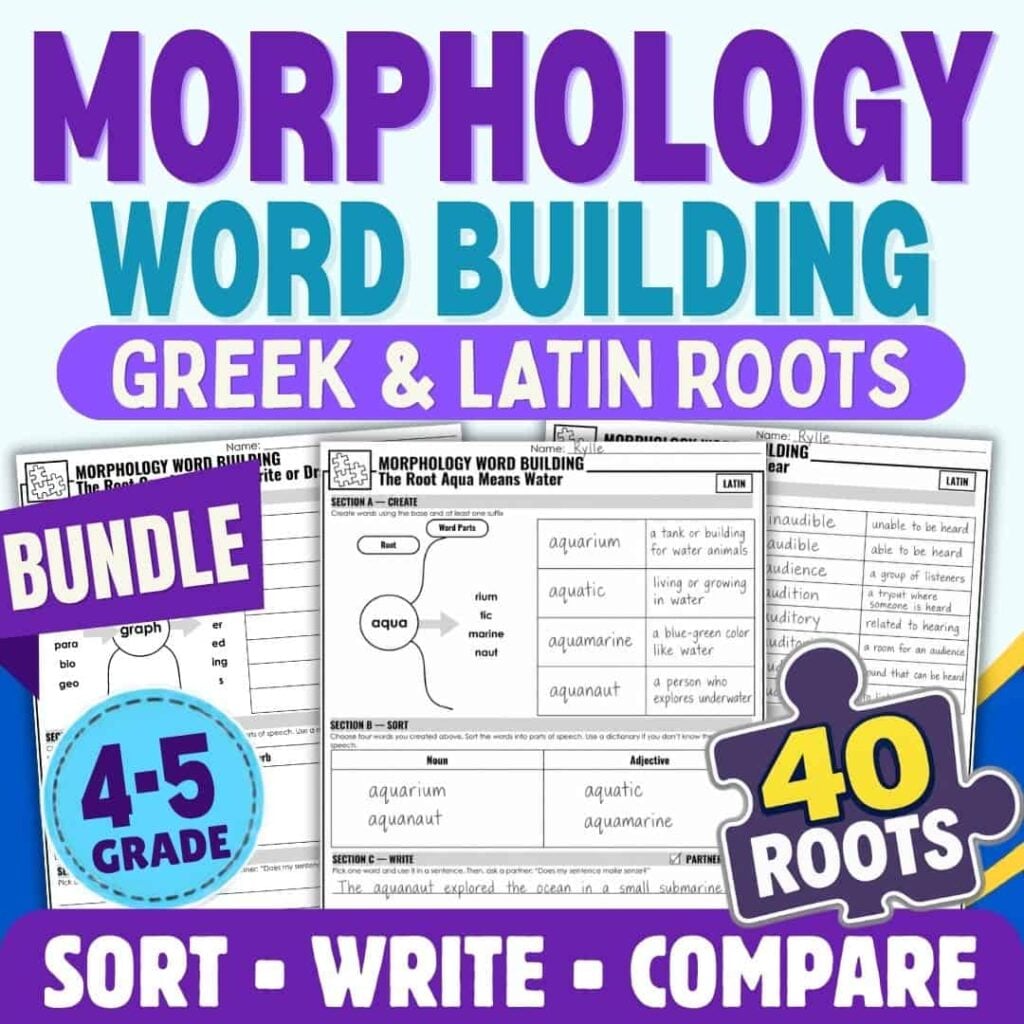
This morphology word building bundle gives 4th- and 5th-grade students structured practice with Greek and Latin roots, prefixes, suffixes, word building, sorting, sentence writing, and word-meaning comparisons.
A Few Cautions About Roots
Roots are a strategy, not a guarantee, and it helps to be honest with students about that. A few things to keep in mind:
- Not every match is real. A word can contain the letters of a root without using its meaning. Report carries the port meaning, but portion does not really mean to carry. Teach students to check the meaning against the sentence.
- Roots change spelling. Many roots shift form, like scrib becoming script, or duc becoming duct. Point this out so students still recognize the root when it looks a little different.
- The goal is a good guess, then a check. Roots give students a strong starting point for an unfamiliar word. The last step is always to test that meaning against the text, not to stop at the first guess.
Framing roots as a smart first guess keeps students using the strategy while staying flexible, which is exactly how strong readers use word parts.
How to Teach Latin and Greek Roots
Whatever grade you teach, a few moves make root instruction stick:
- Start from a word students know. Introduce port through transport, then peel back to the root, rather than starting with the root in isolation.
- Build word families. Give students a root and have them generate as many words as they can, then discuss what the words share.
- Keep it short and daily. A few minutes a day beats a long lesson once a week. Root work is a natural fit for morning work or a warm-up.
- Make it visible. Post taught roots on a word wall and add example words as students find them in reading.
A consistent daily routine is the easiest way to make room for this. My morphology morning work introduces one word part at a time in a predictable Monday through Friday flow, so roots, prefixes, and suffixes build across the year without taking over your reading block. For the bigger picture on how word parts build reading, see my what is morphology post.
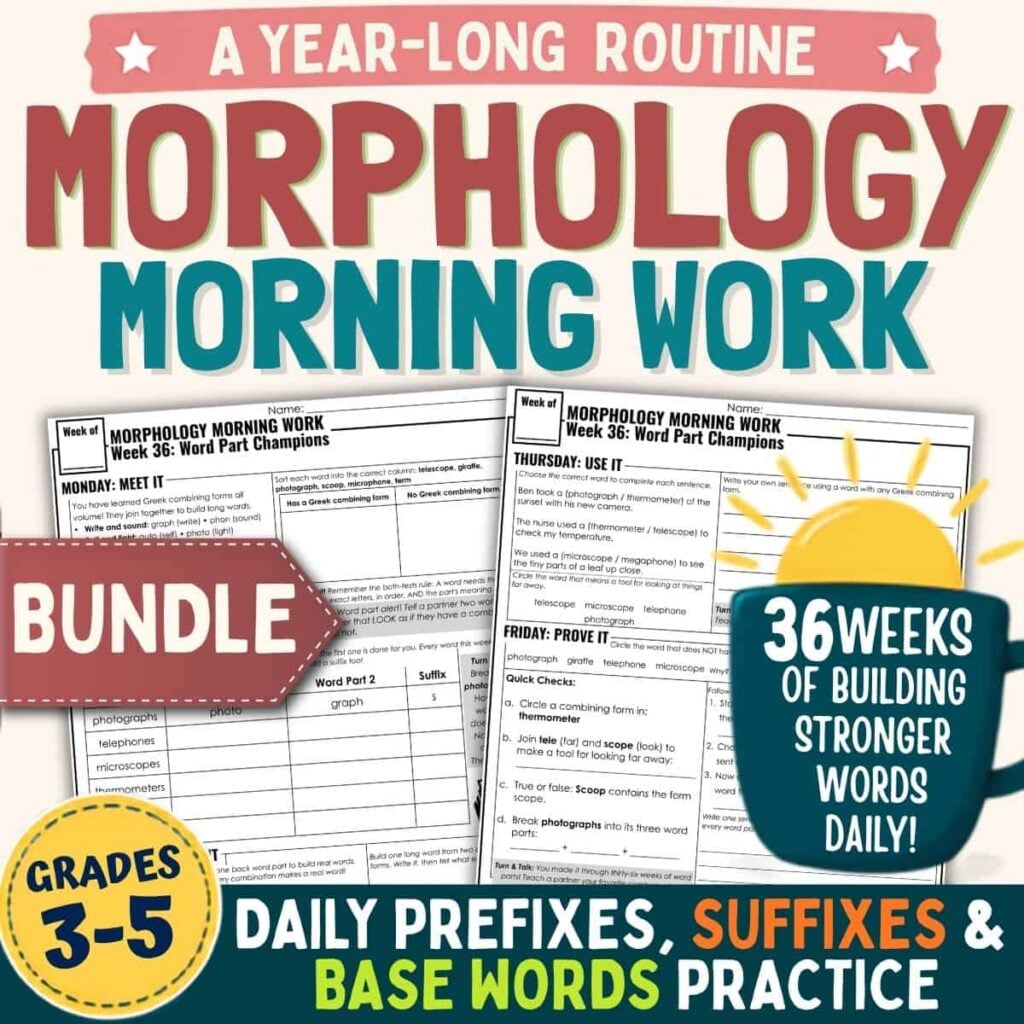
Morphology Morning Work Bundle | 36 Weeks of Prefixes, Suffixes, Latin Roots & Greek Combining Forms
Make morphology instruction simple and consistent all year long with this 36-week Morphology Morning Work Bundle! Students build vocabulary, decoding, spelling, and word-analysis skills through daily practice with prefixes, suffixes, base words, Latin roots, and Greek combining forms. Each week follows the same five-day routine, making this no-prep resource perfect for morning work, literacy warm-ups, word study, intervention, and spiral review.
Frequently Asked Questions
Bringing It All Together
Common Latin and Greek roots give students a strategy that keeps working long after the lesson ends. Start where your students are, teach a few roots deeply, connect them to words students already know, and keep them visible. Once students start noticing roots in their reading, their vocabulary grows on its own.
Want it ready to teach? My Morphology Morning Work builds prefixes, suffixes, and roots through a short daily routine, and my Morphology Word Wall Cards give you ready-to-post cards for the roots and affixes as you teach them.
Jessica BOschen
Jessica is a teacher, homeschool parent, and entrepreneur. She shares her passion for teaching and education on What I Have Learned. Jessica has 16 years of experience teaching elementary school and currently homeschools her two middle and high school boys. She enjoys scaffolding learning for students, focusing on helping our most challenging learners achieve success in all academic areas.