
Multisyllabic Decoding: What Is It & Why Teach It
Multisyllabic decoding refers to a student’s ability to read and spell words with more than one syllable. As texts become more complex in the upper elementary grades, this skill becomes essential for fluency, comprehension, and spelling accuracy.

Strong readers don’t guess at long words. They apply patterns, vowel knowledge, and syllable division strategies to break words apart and read them accurately. Teaching multisyllabic decoding gives students the tools they need to approach unfamiliar words with confidence.
What is Multisyllabic Decoding?
Multisyllabic decoding is the process of breaking longer words into manageable parts, reading each part accurately, and blending the parts back together. According to the National Reading Panel, the majority of words in printed text contain more than one syllable, which makes this skill critical for developing readers.
Decoding multisyllabic words requires students to:
- Identify vowel sounds
- Recognize common phonics patterns
- Divide words into syllables when needed
- Blend syllables smoothly to form the whole word
Why Explicitly Teach Students to Decode Multisyllabic Words?
Teaching multisyllabic decoding is critical because a large portion of the words students encounter in text contain more than one syllable.
For one, as we just mentioned, a large majority of the words students will encounter in their reading are multisyllabic. Therefore, students must have a strong understanding of how to decode these types of words.
In addition, research has shown that students who can decode multisyllabic words are better able to comprehend what they’re reading. This is because they’re not spending all of their time and energy trying to figure out each word; instead, they can focus on understanding the meaning of the text as a whole.
Finally, being able to decode multisyllabic words can help students become better spellers. This is because they develop an understanding of how different letter patterns work together to form specific sounds. As a result, when they encounter a new word, they’re often able to sound it out and spell it correctly without too much difficulty.

What Do Students Need Before Reading Multisyllabic Words?
Before students can successfully decode multisyllabic words, they need a few foundational skills in place. These skills allow students to apply decoding strategies rather than guess at longer words.
Recognize Vowels and Consonants
Students need to accurately identify vowels and consonants within words. Multisyllabic decoding depends on locating vowel sounds and noticing how many consonants appear between them. Without this awareness, students struggle to decide where words can be divided.
Being able to quickly spot vowels in a word supports every step of the decoding process.
Read Common Phonics Patterns in One-Syllable Words
Students should already be comfortable reading a range of phonics patterns in single-syllable words. This knowledge transfers directly to decoding longer words.
Common patterns students apply during multisyllabic decoding include:
- vowel-consonant-e patterns
- vowel teams
- r-controlled vowels
- vowel digraphs (pain, boat)
- diphthongs (pout, coin)
When these patterns are automatic in one-syllable words, students can focus on blending syllables rather than figuring out individual sounds.
Count and Hear Syllables in Words
Students also benefit from understanding what syllables are and how to identify them in spoken words. Being able to count syllables supports pronunciation and helps students approach unfamiliar words more confidently.
Syllable counting works well as an early phonemic awareness skill and continues to support decoding as words increase in length.
Now that we’ve covered some of the basics, let’s take a look at how teachers can explicitly teach multisyllabic decoding in their classrooms.
Multisyllabic Decoding Strategies to Use with Students
One effective way to teach multisyllabic decoding is through the use of syllable types and rules. By introducing a few simple rules, students can begin to decode multi-syllabic words on their own without needing to memorize every single word.
How Syllable Types Support Multisyllabic Decoding
Students rely on their prior knowledge of syllable types when decoding longer words. Understanding how vowel patterns behave in closed, open, vowel-consonant-e, r-controlled, vowel team, and consonant-le syllables allows students to make accurate decisions when breaking apart unfamiliar words.
A full explanation of syllable types and division rules is covered here:
Master Syllable Division Rules: Teach Students to Divide Words into Syllables
In multisyllabic decoding instruction, syllable types are not memorized in isolation. Instead, students use them as tools to determine how vowels should sound once a word has been divided.
Keep a list of irregular syllables
It is important for students to be aware of irregular syllables in words as it can help with pronunciation and decoding unknown words. When students know which syllables are irregular, they can apply that knowledge to other words that may follow the same pattern. This can be helpful when reading multisyllabic words, as it can make the decoding process easier.
Teachers can help students become familiar with irregular syllables by keeping a list of them and providing examples of words that follow each pattern. This can be a part of early elementary phonics routines and will help students become more confident readers.
Common irregular syllables include:
- -tion
- -sion
- ture
- ly
- able / ible
- al
- ous
- ance / ence
A Simple Teaching Routine for Decoding Two-Syllable Words
A consistent routine helps students approach longer words with confidence rather than guessing. When decoding two-syllable words, students can follow these steps:
- Locate the vowels in the word.
- Count the consonants between the vowels.
- Decide where to divide the word:
- Two consonants → divide between them
- One consonant → try dividing before the consonant first
- Read each syllable separately.
- Blend the syllables to read the whole word.
If the word does not sound right, students adjust the division and try again.
How This Routine Sounds in Practice
When modeling this routine, I guide students through the thinking process aloud:
- “Where are the vowels?” (Students point to them.)
- “How many consonants are between the vowels?”
- If there are two, we divide between them.
- If there is one, we try dividing before the consonant first.
When there is one consonant, students read the word using an open syllable first. If the word does not sound correct, they shift the division and try again.
This routine reinforces flexibility and problem-solving, helping students rely on patterns rather than memorization.
Why This Matters
Multisyllabic decoding is a critical skill for developing readers. With clear routines and repeated practice, students learn to approach unfamiliar words strategically, which supports accuracy, fluency, spelling, and overall comprehension.
To build this skill in the classroom, begin with explicit modeling, provide daily opportunities for guided practice, and offer feedback that helps students reflect on their decoding choices.
Resources You Can Use for Multisyllabic Decoding
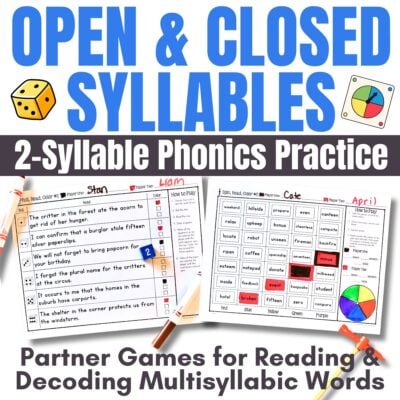
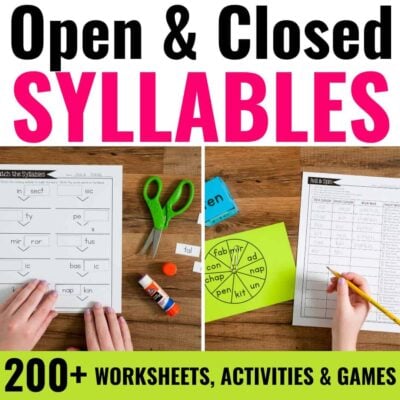
Are you diving into decoding multisyllabic words? Check out these resources to meet the needs of your learners.

Multisyllabic decoding instruction builds independence. It gives students the tools they need to tackle increasingly complex texts with accuracy and confidence.
Jessica BOschen
Jessica is a teacher, homeschool parent, and entrepreneur. She shares her passion for teaching and education on What I Have Learned. Jessica has 16 years of experience teaching elementary school and currently homeschools her two middle and high school boys. She enjoys scaffolding learning for students, focusing on helping our most challenging learners achieve success in all academic areas.