
Syllable Division Rules: How to Divide Words into Syllables
When a student hits a long word and stops cold, syllable division is often the missing skill. Breaking multisyllabic words into smaller chunks is one of the most transferable decoding strategies in phonics instruction. Once students know the patterns, they can tackle unfamiliar words independently rather than guessing or skipping.

This post walks through the six syllable division rules, with examples for each pattern, plus practical teaching ideas for the classroom.
What Are the Syllable Division Rules?
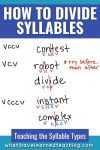
Syllable division rules are the patterns that tell readers where to split a word between syllables. There are six main rules, each based on the consonant and vowel pattern in the word: VCCV (divide between the two consonants), VCV (divide after the vowel if it is long, or after the consonant if it is short), VCCCV (divide the consonant cluster), VV (divide between adjacent vowels), C+LE (the consonant before -le stays with that syllable), and Affix (divide before a prefix or after a suffix). Each rule is explained with examples below.
Understanding Syllable Division: The Basics
A syllable is a unit of sound that forms the basis of a word. It typically consists of a vowel sound and may be accompanied by one or more consonant sounds. Syllable types describe how syllables are structured, whereas multisyllabic decoding focuses on how readers use those structures to read longer words.
Syllable division is the process of breaking a word into its constituent syllables. This is important because it helps us understand the structure of words and how they should be pronounced.
To divide a word into syllables, students need to identify the vowel sounds and determine where to place the division. Several rules and patterns can guide us in this process, which we will explore in more detail later in this blog post.
For example, let’s consider the word “elephant.” This word has three syllables: “el-e-phant.” The first syllable “el” contains the vowel sound /ɛ/, the second syllable “e” contains the vowel sound /i/, and the third syllable “phant” contains the vowel sound /æ/.
The Importance of Syllable Division in Reading
Syllable division plays a crucial role in reading comprehension. By breaking words down into smaller units, students can better understand their meaning and pronunciation.
In terms of reading comprehension, syllable division helps us decode unfamiliar words. When students encounter a long or complex word, dividing it into syllables allows us to focus on smaller chunks of information, making it easier to process and understand. This is particularly beneficial for individuals learning English as a second language, as it helps them navigate through unfamiliar vocabulary.
In terms of pronunciation accuracy, syllable division provides a guide for how words should be pronounced. By identifying the vowel sounds and placing the division correctly, students can ensure that they are pronouncing each syllable accurately.
Incorrect syllable division can lead to misunderstandings in both reading and pronunciation. For example, dividing a word between two consonants can change the meaning of the word. Consider the word “present.” If students divide it as “pre-sent,” it would be interpreted as the act of giving a presentation. However, if students divide it as “pres-ent,” it would be interpreted as a gift.
Rules for Syllable Division
There are six main rules for syllable division in English. These rules provide guidelines for determining where to place the division when dividing words into syllables.
These syllable division rules guide where words are split based on vowel and consonant patterns.
| Syllable Division Rules | Examples |
|---|---|
| VCCV Rule: Divide between two consonants when the first consonant is followed by a vowel and the second consonant is not part of a blend or digraph. | hap-pen sun-set |
| VCV Rule: Divide after the consonant when the first vowel has a short sound. Divide before the consonant when the first vowel is long. This is the Open or Close Syllable rule. | cab-in ro-bot ba-sic se-cret (CR is a blend) rock-et (CK is a digraph) |
| VCCCV Rule: Divide between two consonants. Keep blends and digraphs together. | in-stant in-struct com-plex with-stand (TH is a digraph and ST is a blend) pump-kin (MP is a blend) |
| VV Rule: Do not divide between two vowels that make one sound. Do divide between two vowels that make two distinct sounds. The first vowel is an open syllable. The second vowel is part of the closed syllable. | boat-ing rain-bow di-et li-on |
| Consonant-L-E Rule: Divide before the consonant before the final “le.” | ap-ple lit-tle ta-ble sam-ple can-dle |
| Affix Rule: Divide between the prefix or suffix and the base word. | help-ful dis-like pre-school |
Students apply these rules after identifying vowel patterns and syllable types within a word.
Remembering these rules can be challenging, but there are some tips that can help. For example, creating mnemonic devices or using visual cues can aid in memorizing the rules. The VCCV Rule can be called the Rabbit Rule and students can be taught to remember a rabbit with two separate ears that are similar, but separate.
One other thing to remember is that some letters always stay together:
- digraphs – keep digraphs together, like th, sh, ph, etc.
- vowel teams – vowel teams will stay together, but two vowels next to each other that make two separate sounds will most often be divided, like the word di-et and li-on
- r-controlled vowels
- silent e – goes with the closest vowel
- blends
- glued sounds like old, ost, olt, ind, ild, ing, ink, ank, ang
Practicing with words that follow these rules can reinforce the understanding and application of syllable division.

Open and Closed Syllables Two-Syllable Words
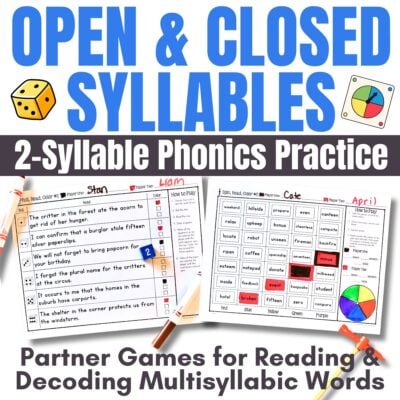
This unit focuses on syllabic patterns for VCCV, VCV, VCCCV. Included are some consonant digraphs and blends, as well as some VCE patterns in one of the syllables. This unit is perfect for students who know how to read cvc and vce words, but struggle with two-syllable decoding.
Common Syllable Types and How to Identify Them
In addition to the rules for syllable division, there are also common patterns that can help us identify syllables in words. These syllable types form the foundation for syllable division and later support multisyllabic decoding.
What Are Syllable Types?
Syllable types are categories that describe how a syllable is structured and how the vowel sound behaves. In English, there are six common syllable types that readers learn to recognize. Understanding these syllable types helps students apply syllable division rules and decode longer words with confidence.
The most common syllable types students learn include:
- closed syllables
- open syllables
- vowel-consonant-e (VCE) syllables
Other syllable types students commonly encounter include:
- r-controlled syllables
- vowel team syllables
- consonant-le syllables
These syllable types follow consistent vowel patterns and are often taught in depth during multisyllabic decoding instruction.
A closed syllable is a syllable that ends with a consonant sound and has a short vowel sound. For example, in the word “cat,” the syllable “cat” is closed because it ends with a consonant sound (/t/) and has a short vowel sound (/æ/).
An open syllable is a syllable that ends with a vowel sound and has a long vowel sound. For example, in the word “go,” the syllable “go” is open because it ends with a vowel sound (/o/) and has a long vowel sound (/oʊ/).
A vowel-consonant-e syllable is a syllable that has a long vowel sound followed by a consonant and a silent “e.” For example, in the word “cake,” the syllable “cake” is a vowel-consonant-e syllable because it has a long vowel sound (/eɪ/), followed by a consonant sound (/k/) and a silent “e.”
Identifying these patterns can help us determine where to place the division when dividing words into syllables. For example, in the word “rabbit,” students can identify the closed syllable “rab” and the open syllable “bit,” resulting in the division “rab-bit.” In “hopeful” we can see the VCE word “hope”.
When students understand syllable types, syllable division becomes a reasoning task rather than a guessing game.
Tips and Tricks for Mastering Syllable Division
Mastering syllable division can be challenging, but there are several strategies that can help. Students can break down words into smaller parts and create rules to remember the syllable patterns.
Explicitly Teach the Syllable Division Rules
Explicitly teach students the syllable division rules. Go beyond having them count syllables and have them divide syllables with paper and pencils.
Take the word “umbrella” as an example. It has three syllables: um, brel, and la.
- The first syllable “um” is a closed syllable. It ends in a consonant, giving it a short vowel sound: /ŭ/.
- The second syllable “brel” is also closed. The consonant blend br moves to this syllable, and it ends in the consonant l, giving the short vowel sound /ĕ/.
- The third syllable “la” is open. It ends in a vowel, following the open syllable pattern.
Tips for Explicitly teaching Syllable Division Rules
- Look for vowels to identify the syllables
- Look for patterns like VC, CV, VCCV, VCe, C+le, VCV, VV, Vr
Break Down Unfamiliar Words into Smaller Parts
By identifying familiar prefixes, suffixes, and root words, students can better understand the structure of the word and determine where to place the division. For example, in the word “unhappiness,” we can identify the prefix “un-,” the base word “happy,” and the suffix “-ness.” This allows us to divide the word as “un-hap-pi-ness.”
Create Mnemonic Devices or Visual Cues
Another strategy is to create mnemonic devices or visual cues to remember the rules and patterns for syllable division. For example, for the vowel-consonant-e rule, students can imagine a superhero named “VCE Man” who always appears before the final silent “e” to divide the word into syllables.
Practice with a Variety of Words that Match Different Rules
Create a daily routine where students are given a couple words and asked to break them apart and name the syllable division rule. One procedure might be:
- Find the vowels
- Label the consonants and vowels underneath
- Look for patterns, irregular syllables, affixes, and base words
- Divide according to the syllable division rules
- Mark the vowels as long or short
- Read the word aloud
Doing this routine with 5-10 words a day over the course of the year will help students internalize the routine, the patterns, the syllable division rules, and ultimately read complex words.
Practice Activities for Students
There are several interactive exercises for practicing syllable division. These exercises provide opportunities to apply the rules and patterns in a variety of words. Below are some easy-to-implement practice activities teachers can do with students:
- Diagram syllables using the above routine
- Cut words into syllables and match them back up
- Sort syllables into groups. Start by using a closed sort. Once students are familiar with the syllable groups, have them do an open sort.
- Create a syllable patterns chart and have students record their words into groups. This is a form of a written sort vs. a hands-on sort.
- Search for syllables around the room or in books. When syllables are found, have students add them to their chart.
- Create a syllable dictionary sorted by pattern. This is similar to the chart, but is a way to create longer lists of syllables.
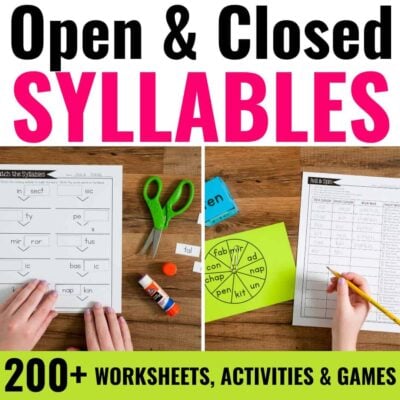
If your students are ready to practice, the open and closed syllables resources in my store are a natural next step. The Open and Closed Syllables Two-Syllable Wordspack and Phonics Partner Games for Two-Syllable Words give students structured practice applying the VCCV and VCV rules to real words. The bundle combines both open and closed syllables and irregular syllables activities at a discount.


Identifying syllables is a key component of multisyllabic decoding. As per the National Reading Panel, about two-thirds of the words found in printed text consist of multiple syllables. This highlights the significance of teaching students to break words into syllables.
Common Mistakes to Avoid in Syllable Division
There are some common mistakes that individuals make when dividing syllables. One common mistake is always dividing between two consonants. This can result in mispronunciations and misunderstandings. For example, dividing the word “castle” as “cas-tle” instead of “cast-le” can change the meaning of the word.
Another common mistake is ignoring silent letters. Silent letters are not pronounced but still affect syllable division. For example, in the word “knee,” the silent “k” affects the division, resulting in “knee” instead of “ne-e.”
It is important to be aware of these common mistakes and practice accurate syllable division to improve reading comprehension and pronunciation accuracy.

Thank you for the informative text. However, please double check your VCV Rule which says: “Divide after the consonant when the first vowel has a short sound. Divide after [sic – should be ‘before’] the consonant when the first vowel is long.” The examples like “ro-bot” are divided *before* the consonant appear to be right, but if your rule were followed as written, it would incorrectly be “rob-ot”.
Oh darn! Pesky typos! Thanks so much for letting me know about it. I appreciate it!