
Open and Closed Syllables Games and Activities
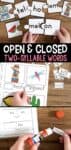
Open and closed syllable games and activities give students the hands-on practice they need to move from recognizing syllable types to reading and spelling multisyllabic words independently. Open syllables end in a vowel and make a long vowel sound (like the “ro” in robot). Closed syllables end in a consonant and make a short vowel sound (like the “hab” in habit). Once students have the concept, the real work is repetition through varied practice.

The Open and Closed Syllables Bundle has over 12 activities and games designed for small group reading, literacy stations, and independent practice. Below is a look at what’s included and how to use each activity.
What are Open and Closed Syllables?
One of the first steps in helping students understand multisyllabic decoding is learning about open and closed syllables.
Open syllables happen when there is a vowel at the end of the syllable. The vowel makes a long vowel sound, like the word robot. The first syllable, ro, has a long o. Here are a few more examples
- ba / by
- pi / lot
- ho / tel
Closed syllables happen when there is a consonant at the end of the syllable. The vowel sound in the syllable makes a short vowel sound, like habit. The first syllable, hab, has a short a. A few more examples include:
- sub / mit
- lem / on
- mag / net
There are exceptions to these rules, but they occur often enough that it is beneficial to explicitly teach the concept to students. I don’t necessarily teach my younger learners the names open and closed syllables, but instead, teach and give practice about the concept.
Why teach Open and Closed Syllables?
It is a foundation for multisyllabic reading. Larger words are built off the smaller chunks of two-syllable words. When reading and spelling multisyllabic words, students should be able to break the word apart into syllables and then decipher each syllable independently to build the word.
Like reading, teaching open and closed syllables is great for spelling. Words that have a double consonant are often difficult to spell. Students only hear one of the consonants when spelling. However, if students are taught that a consonant follows a short vowel, they will learn that mit/ten must have two “t’s”.
Resources and Activities
I created a product to help my students master reading two-syllable words and then created a complementary product for open and closed irregular syllables. The Open and Closed Syllables sets include over 12 activities and games for use during small-group reading or independent reading. All the games and activities focus on students’ reading and breaking apart words into syllables.
These activities work for first through fourth grade, depending on where students are in their phonics progression. First- and second-graders typically work with basic open and closed two-syllable words; third- and fourth-graders apply the same concepts to multisyllabic words.
Irregular syllables don’t follow standard decoding practices. Examples include able, ible, tion, ance, etc.
The two sets of syllable work have similar components and include the following resources and activities:
- Anchor Charts
- Syllable Cards and Word Cards
- Sorts
- Read Words by Syllables
- Fluency Strips
- Break Apart into Syllables
- Puzzles
- Cut & Paste
- Roll & Spin
- Match Missing Syllable
- Flip Books (great for Interactive Notebooks!)
- Board Games
- Coloring Sheets
Answer Keys are included for all worksheets. Below are a few descriptions and photos from the Open and Closed Syllables packet.

Open and Closed Syllables Two-Syllable Words
This unit focuses on syllabic patterns for VCCV, VCV, VCCCV. Included are some consonant digraphs and blends, as well as some VCE patterns in one of the syllables. This unit is perfect for students who know how to read cvc and vce words, but struggle with two-syllable decoding.
Open and Closed Syllables: Missing Syllables
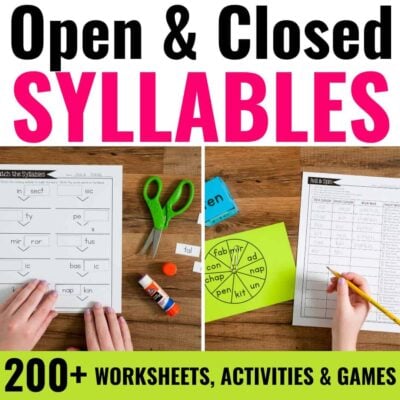
In this activity, students match the missing part of the syllable to create a complete word. You can laminate the cards, cut them apart, and put them on a ring to make it all a bit more organized. Color-coding the cards and missing syllables is worth the extra prep. It cuts down the time students spend sorting and lets them spend more time reading.
The missing syllable cards are designed so that, when possible, the text is justified based on whether it is the first or second syllable of the word. This will also help students see patterns in the syllables.

Open and Closed Syllables: Puzzles
My students love working with puzzles. There’s just something about them that makes an activity ten times more engaging. The puzzle-piece shape already tells students which syllable comes first, removing one source of confusion for newer readers.

Open and Closed Syllables: Roll & Spin
Since there are two parts to the words, this roll and spin game is a perfect addition to any reading station. Students spin the spinner for the first syllable and roll the dice for the second syllable. Put the two together and figure out if it is a real word! This is a great activity to help with spelling, as students are expected to write down each syllable, then put the word together.
I have students say each syllable aloud before writing it. This extra step makes the spelling practice stick better than writing alone.

Open and Closed Syllables: Syllable or Not Syllable
This worksheet is a great way for your learners to discover patterns in syllables, namely that a syllable must contain a vowel. It also helps students familiarize themselves with common syllable chunks.

Open and Closed Syllables: Match the Syllables
Like the above worksheet, this one deals with syllable chunks. Students match the missing part of the word to the given part then write the whole word on the blank space. Not only does this focus on becoming familiar with a variety of chunks of words, but it also helps students put the two parts together into the word.

Open and Closed Syllables Two-Syllable Words
This unit focuses on syllabic patterns for VCCV, VCV, VCCCV. Included are some consonant digraphs and blends, as well as some VCE patterns in one of the syllables. This unit is perfect for students who know how to read cvc and vce words, but struggle with two-syllable decoding.
How to Purchase the Open and Closed Syllables Resource
You can purchase either set of syllable games and activities on my website or on Teachers Pay Teachers.
-
 Product on saleOpen Syllables and Closed Syllables Activities and Irregular Syllables Activities BUNDLEOriginal price was: $21.34.$17.07Current price is: $17.07.
 -
-

Read More about Teaching Students about Syllables
Master Syllable Division Rules: Teach Students to Divide Words into Syllables
Multisyllabic Decoding: What is it and why teach it?
Two-Syllable Phonics Games
Jessica BOschen
Jessica is a teacher, homeschool parent, and entrepreneur. She shares her passion for teaching and education on What I Have Learned. Jessica has 16 years of experience teaching elementary school and currently homeschools her two middle and high school boys. She enjoys scaffolding learning for students, focusing on helping our most challenging learners achieve success in all academic areas.