
15 Science Review Games That Are Easy to Run (No Prep Required When You Have the Right Cards)
Science review games give elementary students a reason to actually think through what they’ve learned, and they work far better than another round of worksheets. Whether you’re wrapping up a unit on natural hazards, plate tectonics, or ecosystems, these low-prep science review games for 2nd through 5th grade are easy to run and require minimal materials.
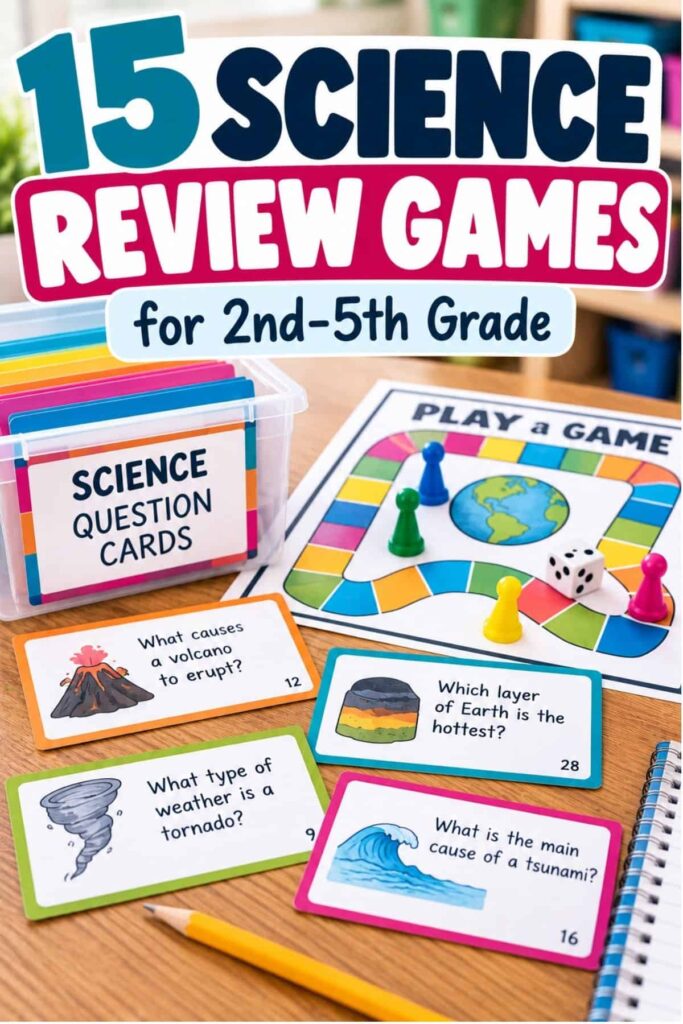
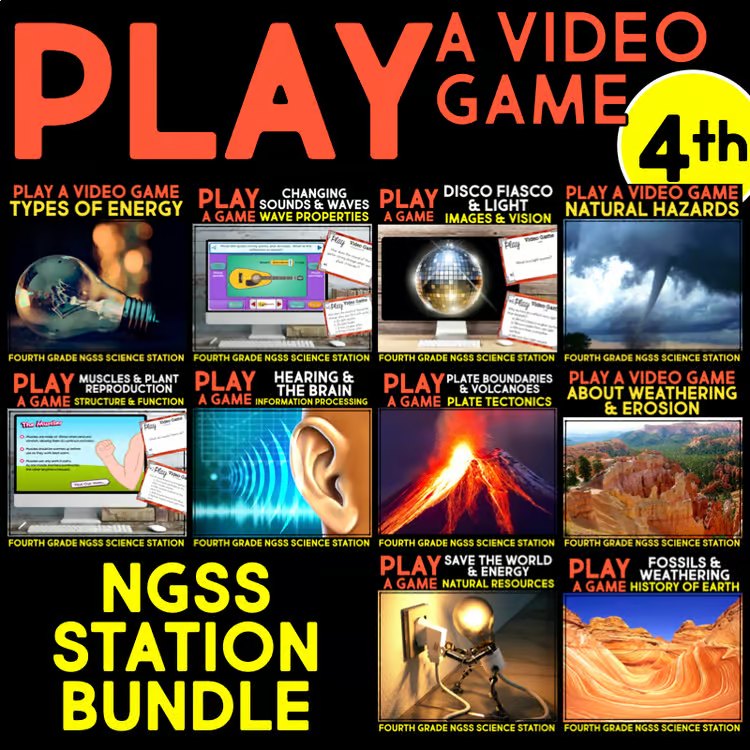
The biggest barrier teachers face with review games isn’t finding ideas. It’s the prep. Writing questions for every game, every unit, every standard takes time most teachers don’t have. That’s exactly why the PLAY a Game science stations were designed the way they were. Each station includes a full set of ready-made question and answer cards, aligned to a specific science standard, so you can pull out those cards and run any of the games below without writing a single question yourself. In addition, all of our science units come with vocabulary cards that can also be used to play these games. One more source of questions is the science stations themselves. Each station comes with 4-8 short-answer and multiple-choice questions.
Keep reading for 15 tried-and-true science review game formats, each one written with those pre-made question cards in mind.
Why Science Review Games Work Better Than Drill Practice
When students play a review game, they’re retrieving information in a different way than they do during a lesson or a worksheet. The low-stakes competition, the movement, and the social element all work together to make retrieval feel worth doing. Research on retrieval practice consistently shows that students retain more when they’re asked to recall information repeatedly over time, and a well-run review game does exactly that.
Games also help you quickly spot which concepts students have locked in and which ones still need reinforcement. When a student hesitates on a question about the difference between convergent and divergent plate boundaries, that’s information you can act on before the assessment.
And when the question cards are already printed and ready to go? You actually run the game instead of spending your Sunday writing questions.
15 Science Review Games for 2nd Through 5th Grade
These games work across science topics and grade levels. Most need nothing beyond the materials already in your classroom. Every game below can be run using the question cards from your PLAY a Game science station, which means the content prep is done for you before the game even starts.
1. PLAY a Game Board Game
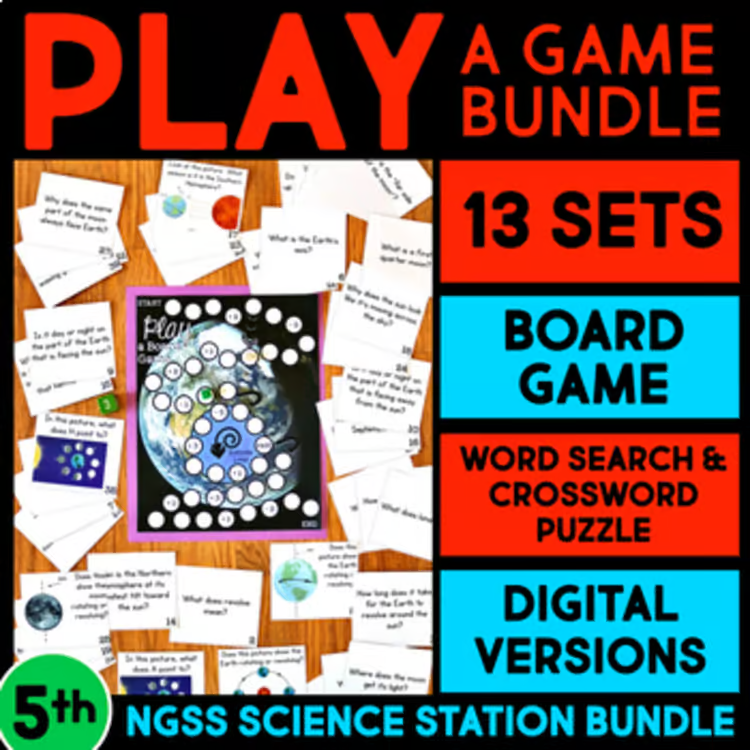
This one is already built. If you’re using the PLAY a Game science stations, the board game is right there in the pack alongside the question cards. Two students play against each other while a third student acts as the referee, holding the answer key card. Players take turns rolling the die, drawing a question card, and answering it. A correct answer means they move ahead the number of spaces shown on the die. An incorrect answer means they stay put. The referee keeps it honest.
What makes this work so well is the structure. Everyone has a job, which keeps all three students engaged, not just the one answering. The student holding the answer key is reading along and checking every response, so they’re reviewing the content too.
The Natural Hazards set, for example, includes 54 question-and-answer cards covering earthquakes, tsunamis, tornadoes, hurricanes, blizzards, plate boundaries, convection currents, Earth’s layers, and more. That’s enough cards for multiple rounds without repeating the same questions back-to-back.
Run this as a partner activity during station rotations or as an early finisher option while you pull a small group.

2. Pass the Question
Students sit in a circle and pass a small object while music plays. When the music stops, the student holding it draws a question card from the PLAY station deck and reads it aloud before answering. If they answer correctly, they stay in. If not, do a quick 30-second review with the class and move on.
This is a great warm-up or transition game. Five minutes at the start of science class goes a long way, and because the question cards are already pulled from the station pack, you’re not scrambling to come up with questions on the spot. The cards stack neatly, so one student can even manage the draw pile while you run the music.
3. Matching Pairs (Memory)
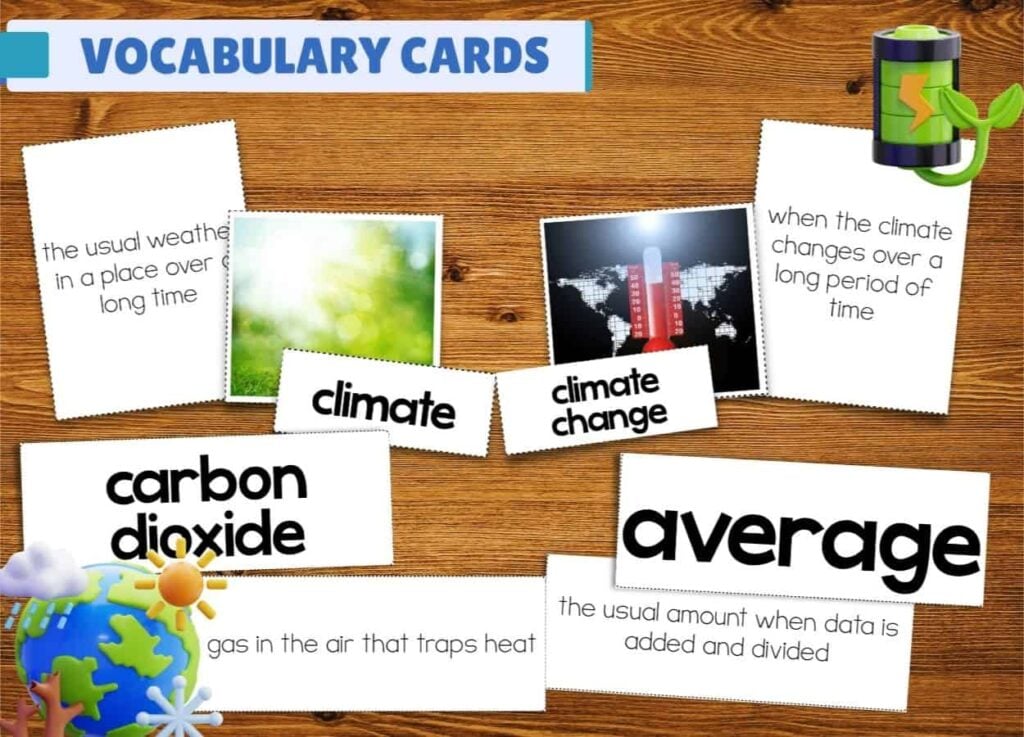
You can do this two ways. Either use the question cards themselves as one half of the pair and create a matching answer card set, or simply select terms and definitions from the station content and build your own card set. Each of our science units includes vocabulary and content that lend themselves naturally to this format: plate boundary types, natural hazard characteristics, Earth’s layers, and cause-and-effect relationships all pair cleanly. Make it more challenging by matching a word, definition, and picture with our three-part vocabulary cards.
Lay them face down and have students flip two at a time to find matches. A pair like “convergent boundary” matched with “plates moving toward each other” becomes something students have seen six times by the end of the game, far more memorable than reading it once in a passage. This is a quiet format that works well at a station or as partner work when you need the room to be calm.
4. Science Scavenger Hunt
Print out a selection of question cards from the PLAY station pack and post them around the room. Student pairs move from card to card, read the question, record their answer on a recording sheet, and move on. The first team to answer all questions correctly wins.
Because the PLAY cards already have content specific to your science standard, you don’t have to write a single question. Just decide how many cards to post, number them, and send students off. This works particularly well with units that have a lot of connected vocabulary, plate tectonics, the water cycle, and Earth’s layers, because students are essentially self-quizzing through the content while moving around the room.
5. Popcorn Questions
One student is chosen to start. They read a question card from the PLAY station deck and call on a classmate to answer. That student answers, then picks up the next card and calls on someone else. The question “pops” from student to student around the room.
No balloons to inflate, no slips to cut. The question cards do the work. A student can manage the card deck, a teacher can call the questions, or you can pass the deck around as part of the flow. This is a great format for the last ten minutes of class when you want engagement without much setup. Students tend to stay alert because they don’t know when they’ll be called on next.
6. Question Ball Toss
Students stand or sit in a circle and toss a soft ball to a classmate. When a student catches the ball, another student draws the next question card from the PLAY deck and reads it aloud. The student who caught the ball answers. Correct answer? They toss to someone new. Incorrect? Quick class discussion, then the card goes to the back of the deck.
This is a much easier version of the classic beach ball game, where you’d write questions directly on the ball with a permanent marker. With the PLAY cards handling the content, the ball is just the mechanism for choosing who answers next. No marker required, and the questions rotate every time you use it.
7. Dice Review
Label the six sides of a die with content categories from your science unit. For a natural hazards unit, that might look like: 1 = Earthquakes, 2 = Plate Boundaries, 3 = Severe Weather, 4 = Earth’s Layers, 5 = Water Cycle, 6 = Student’s Choice. Divide your PLAY question cards into category-specific piles, then have students roll and draw from the matching pile.
Partners or small groups can run this independently while you pull a small group for targeted review. It’s self-managed once students know the routine, and the PLAY cards make it easy to split the deck by topic since the content is organized around specific standards.
8. Around the World
One student stands next to a seated classmate. A student volunteer (or the teacher) reads a question card from the PLAY station deck aloud. The first of the two students to answer correctly moves on to challenge the next student. The goal is to make it all the way around the room.
This is a whole-class game that builds energy quickly and keeps everyone watching, even when it’s not their turn. Use the PLAY cards for the questions so you’re not improvising, and consider having a student read the cards and check answers against the answer key. That keeps your hands free and gives one more student a meaningful role.
9. Stand Up, Sit Down
Read a statement from your science content, and have students stand if they think it’s true and sit if they think it’s false. After everyone responds, reveal the answer and discuss briefly. You can pull true/false type questions directly from the PLAY card set, or adapt them: if a question card asks “What is a convergent boundary?” you can turn it into a true/false statement using the answer card, like “A convergent boundary is where two plates move apart from each other.”
This takes two minutes and requires nothing beyond the question cards or answer sheet. It’s the game to reach for when you have five minutes before lunch and want a quick content check without any setup at all.
Sample true/false adapted from a Natural Hazards PLAY card: “Most tsunamis are caused by earthquakes on the ocean floor.” (True)
10. Bucket Toss
Label buckets or bins with science categories and set them up across the room. A student draws a question card from the PLAY deck, reads it, and answers it. If correct, they identify which category the question belongs to and toss a beanbag into the matching bucket.
This adds a physical challenge to content review, which helps students who need movement to stay focused. The PLAY cards naturally sort into content categories, so students have to both answer the question and consider where it fits within the broader unit. That categorization step is a layer of thinking beyond simple recall.

11. Science Showdown
Divide students into teams. A student volunteer reads a question card from the PLAY station deck. All teams write their answers on small whiteboards or index cards. When time is called, all teams reveal simultaneously. Teams with correct answers earn a point. Check answers against the answer key printed on the PLAY station.
This eliminates the disadvantage slower processors face in verbal games. Every student has time to think and write before answers are revealed. It’s one of the fairest formats for whole-class review, and having a student run the card deck and answer key means you can watch the room instead of managing materials.
12. Concept Sort
Pull the question cards from the PLAY station deck and ask students to sort them into categories on their desks or on the floor. For a natural hazards unit, categories might be “Earthquakes,” “Severe Weather,” “Plate Boundaries,” and “Other Earth Processes.” Students work in pairs or small groups, talk through their reasoning, and adjust as they go.
The conversation that happens during sorting is where the real learning takes place. Students have to decide whether a question about a tsunami belongs under “Earthquakes” (since most tsunamis are caused by underwater earthquakes) or somewhere else, which is a much richer thinking task than answering a question straight. This is a low-noise, high-engagement format that works well as a station activity.
13. True or False Line
Mark two lines on the floor with tape: one for “True” and one for “False.” Adapt a question from the PLAY card deck into a statement and read it aloud. Students walk to the line they believe is correct. Ask one student on each side to explain their reasoning before you reveal the answer.
This is a more deliberate version of Stand Up, Sit Down that works well when you want students to talk, not just move. Because the PLAY cards cover specific, content-rich questions, adapting them into debatable statements is easy: most questions have built-in common misconceptions, and those make the best true/false prompts.
14. Tower Challenge
Students compete in teams. For each question answered correctly, the team earns a block (use wooden unit blocks, LEGOs, or any stackable materials). At the end of the game, teams use their earned blocks to build the tallest tower. Read the questions directly from the PLAY card deck and check answers against the answer key.
The final building element keeps students invested throughout. Even students who struggle with the content have something to work toward, and teams are motivated to help quieter members answer because every correct response means another block. Run this as a five-minute end-of-class game or extend it into a 20-minute unit review.
15. Act It Out
Students take turns acting out a science term or process while their team guesses. This works best for process-based content: earthquakes, volcanic eruptions, plate movement, the water cycle, and convection currents. You can use the vocabulary from the PLAY station question cards as your source for terms to act out.
Physical acting requires students to visualize a concept rather than just recall a word. For earth science topics, this means miming the slow collision of tectonic plates, showing convection current movement with arms, or acting out the stages of a hurricane. It works particularly well for any content with motion or sequence. Use the PLAY card deck to draw terms, and let students take turns as the actor and the referee.
How to Use Science Review Games With Your PLAY Stations
The PLAY a Game science stations are designed to be one stop in a multi-station rotation, not just a standalone game. Students spend time at the Play Station during the unit, working through the board game or other formats with a partner. Then, at the end of the unit, you pull out the same question cards and use them to run any of the games above as a whole-class review.
Students feel more confident during whole-class review because the content isn’t new. They’ve already seen those questions during station time. The games feel like a recap, not a test, and that shift in how students approach review makes a real difference in participation.
A few ways to build these games into your routine:
End-of-unit whole class review: Choose one higher-energy game (Popcorn Questions, Science Showdown, Around the World) as the capstone activity before your assessment. Keep it to 20 minutes and use the PLAY cards to run it without any additional prep.
Station rotation game: Set up Matching Pairs, Dice Review, or Concept Sort as one station in your rotation. Students run it independently using the PLAY card deck while you work with a small group.
Daily warm-up: Pass the Question and Stand Up, Sit Down, take five minutes, and require no prep once you have the PLAY cards on hand. Use them to open science class and activate prior knowledge before the lesson.
Early finisher option: The PLAY Board Game and Concept Sort serve as self-paced partner activities for students who finish station work before others.
Making Science Review Games Work for Every Student
A few small adjustments make these games accessible across your range of learners without requiring separate materials for every student.
For students who need additional support, pair verbal games like Around the World and Popcorn Questions with a visual reference card that students can check during their turn. In team games, place students who need more support near stronger partners so peer conversation can naturally fill in gaps. For Concept Sort, reduce the number of cards so students work with the most essential vocabulary rather than the full set.
For students ready for extension, ask them to explain why an answer is correct rather than just stating it. In Act It Out, have students act out a complete process (the full sequence of plate movement from collision to mountain formation) rather than a single term. For Concept Sort, challenge students to write a connecting sentence for each category grouping after the sort is complete.
Ready-Made Question Cards for Every Science Standard
If you want the question cards already built and aligned to your science standards, the PLAY a Game science stations are designed exactly for this. Each pack covers a specific science standard for grades 2 through 5 and includes question-and-answer cards, a board game, and additional game formats, allowing students to review the same content in different structures throughout the unit.
The Natural Hazards set includes 54 question-and-answer cards covering earthquakes, plate boundaries, tornadoes, hurricanes, tsunamis, blizzards, convection currents, the water cycle, and Earth’s layers. That’s enough content to run every game on this list without writing a single question yourself.
Find the PLAY science station packs for your grade level and standards at the What I Have Learned TPT store.
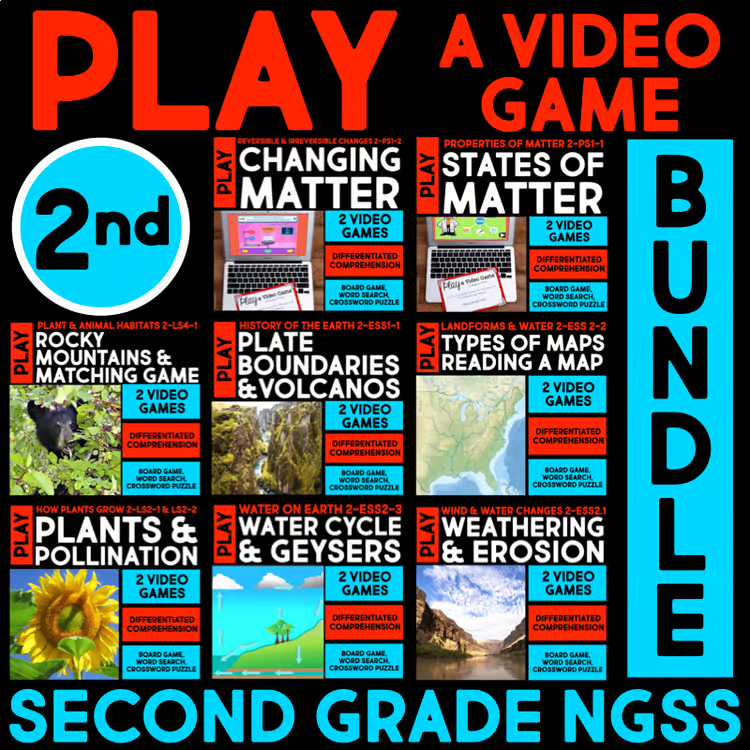
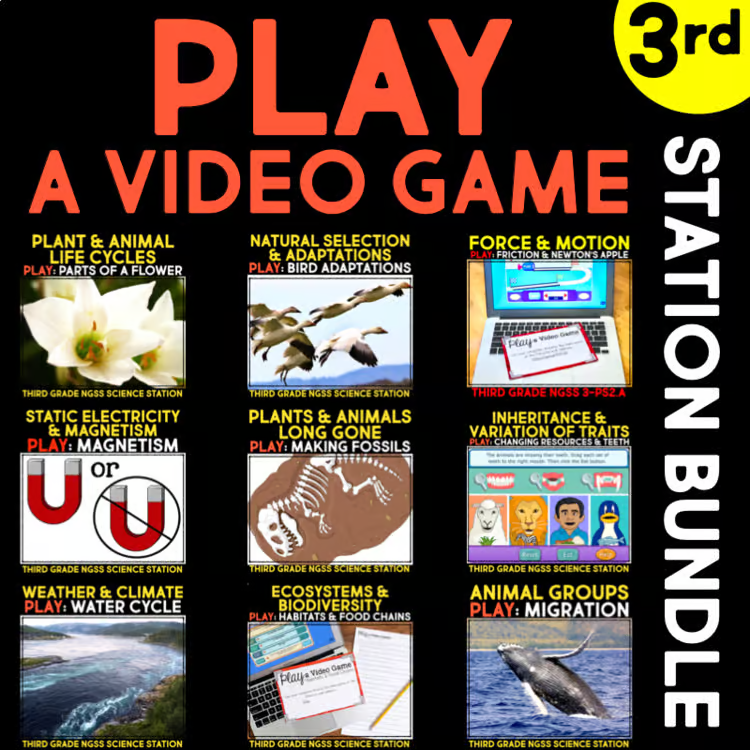
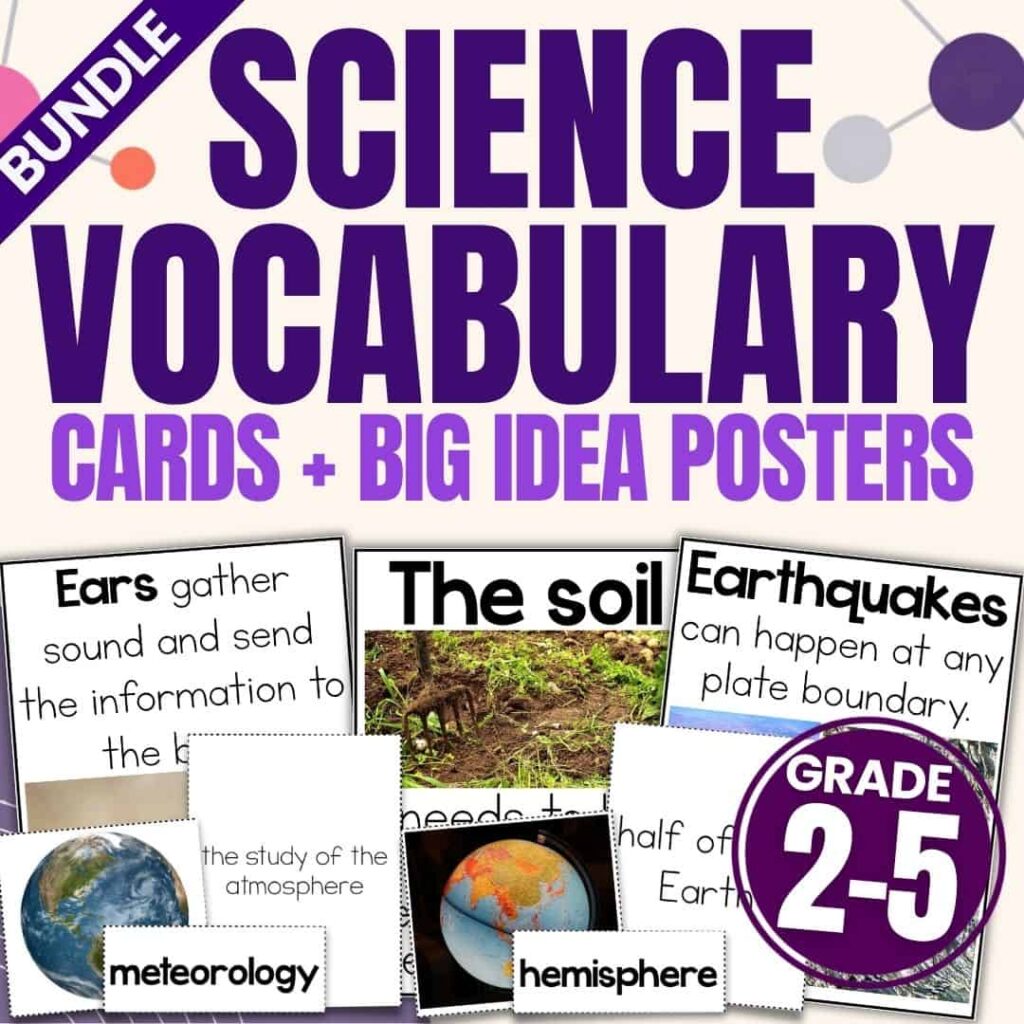
Science Vocabulary Cards & Big Idea Posters – 2nd, 3rd, 4th, and 5th Grades BUNDLE
This is a BUNDLE of Second, Third, Fourth, and Fifth Grade Next Generation Science Vocabulary Cards and Big Idea Posters. These Vocabulary Cards and Posters are a great tool for teaching all second, third, and fourth-grade science topics and make a great science word wall and visual display.
Bringing It All Together
Science review games give students the repetition they need to retain content without the drag of drill practice. The key is removing the prep barrier so you actually run the games instead of just planning to. When the question cards are already done, you can pick a format on Monday morning and run it by Monday afternoon.
Whether you set up the PLAY Board Game during station rotations, run a five-minute Popcorn Questions before the lesson, or close out the unit with a Science Showdown, the structure stays consistent: students retrieve content, get immediate feedback, and walk into the assessment having seen the material multiple times in different contexts. Pick two or three formats that fit your classroom routines and rotate through them across the year. Once students know the games, the setup takes minutes, and the review takes care of itself.
Jessica BOschen
Jessica is a teacher, homeschool parent, and entrepreneur. She shares her passion for teaching and education on What I Have Learned. Jessica has 16 years of experience teaching elementary school and currently homeschools her two middle and high school boys. She enjoys scaffolding learning for students, focusing on helping our most challenging learners achieve success in all academic areas.