
Science Vocabulary Activities for the Elementary Classroom
Science vocabulary cards are one of those simple tools that can do a lot of heavy lifting in your classroom. Whether you’re teaching life science, earth science, or physical science, clear vocabulary helps students understand concepts, explain their thinking, and make connections across topics.
Instead of introducing vocabulary once and moving on, you can reuse the same set of cards all week through a variety of science vocabulary activities. With the right mix of hands-on practice, discussion, and application, students move from simply recognizing words to actually using them in meaningful ways.
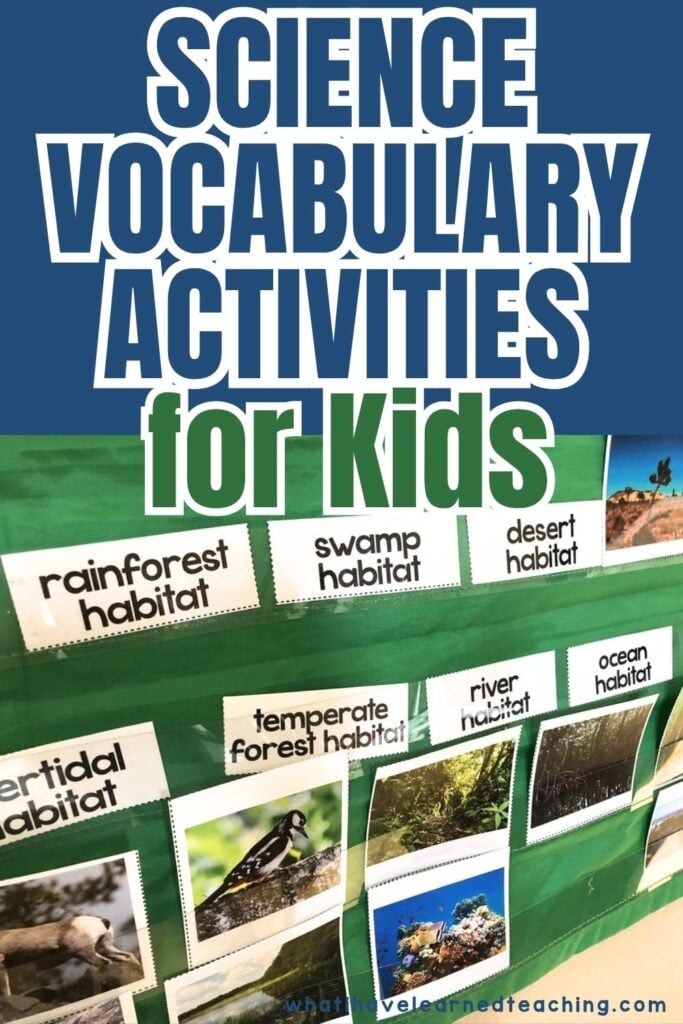
If you’re looking for ideas beyond just “read and memorize,” here are classroom-tested science vocabulary activities you can use with your students.
Why Science Vocabulary Is So Hard
Before the activities, it helps to know why science vocabulary trips students up. The words are specialized and abstract, so students rarely meet evaporation or adaptation outside of science class. Many terms come from Latin and Greek roots, which makes them long and unfamiliar. And students often have little background knowledge to hang the words on, which hits struggling readers and multilingual learners hardest. That is why copying definitions falls flat: a definition students cannot connect to anything is just words.
Introduce Science Vocabulary With the Phenomenon, Not the Definition
The single biggest shift in teaching science vocabulary is to lead with experience. Instead of defining a term and then investigating it, let students see or do the thing first, then attach the word. If students watch water bead up and disappear off a warm tray, the word evaporation lands on something real. This is especially powerful for terms students confuse, like rotation and revolution or solute and solvent. It also means students meet the vocabulary before they hit it in a reading, which supports comprehension. My post on pre-teaching vocabulary activities goes deeper on front-loading words before students read.
Use Vocabulary Cards for Matching Activities
Matching is a simple entry point and works well for all learners.
Students can:
- match the word to the definition
- match the word to a picture
- match the definition to a picture
You can increase the challenge by mixing all three. This works well for centers, early finishers, or review days.

Turn Vocabulary Practice into a Game
Vocabulary doesn’t need to feel repetitive. A few small changes can make it engaging.
Memory Game
Students flip cards over and try to find matching word-and-definition pairs.
Partner Quiz
One student reads a definition, and the other gives the word. Then they switch roles. Provide students with a word bank to make recall just a little bit easier.
These options build repetition without feeling like drill practice.
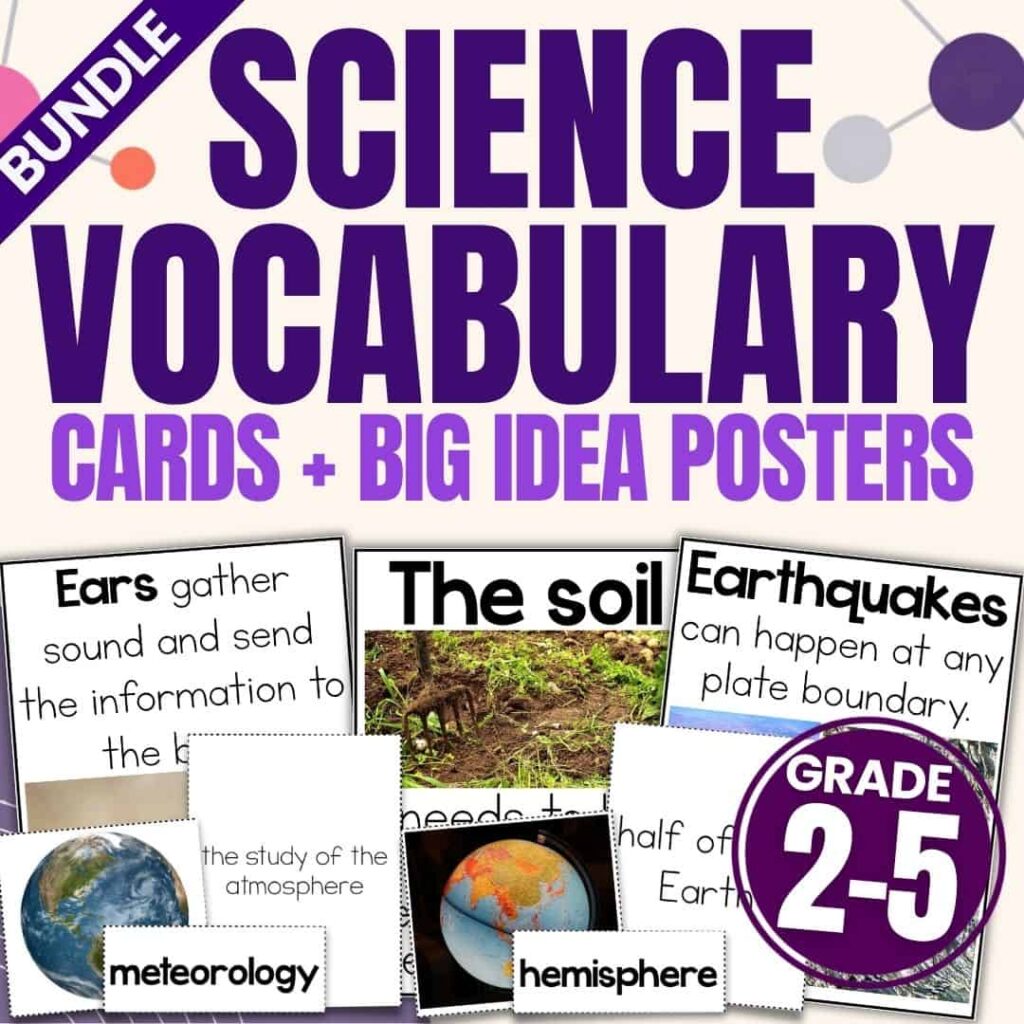
Science Vocabulary Cards & Big Idea Posters – 2nd, 3rd, 4th, and 5th Grades BUNDLE
This is a BUNDLE of Second, Third, Fourth, and Fifth Grade Next Generation Science Vocabulary Cards and Big Idea Posters. These Vocabulary Cards and Posters are a great tool for teaching all second, third, and fourth-grade science topics and make a great science word wall and visual display.
Add Movement with a Scoot Activity
Number the definition cards and place them around the room. Give students a recording sheet or have them number a piece of paper.
As students rotate, they might:
- write the correct vocabulary word
- draw a quick example
- answer a short application question
This keeps students active and works well when attention is low, especially at the end of the day.
Use Vocabulary Cards in Small Group Centers
Vocabulary cards fit naturally into center rotations.
You might include:
- a matching station
- a sorting station
- a writing station
- a drawing or labeling station
Each center can focus on a different way of interacting with the same vocabulary.
Sort Vocabulary into Categories
Sorting helps students organize their thinking.
Depending on your unit, students might sort by:
- living vs. nonliving
- types of energy
- stages of a process
- observable vs. non-observable
You can give categories with a closed sort or let students create their own and explain their reasoning. In fact, consider having small groups of students do an open sort of the words. Then have each table group report out how they sorted the words and why.
Build Speaking Skills with Structured Talk
Vocabulary cards are a great tool for discussion.
Students can use sentence frames like:
- “This word means…”
- “An example of this is…”
- “This happens when…”
You can turn this into partner talk or whole-class activities like “I Have, Who Has?” To do this, give each student a definition and a word that do not match. Students will say “Who Has?” for the word and “I have” when they hear the definition.
Connect Vocabulary to Writing
Students need many opportunities to use vocabulary in context.
Try:
- writing sentences using science terms
- explaining a process step-by-step
- describing an experiment or observation
Sentence frames support students who need them:
- “______ happens when ______.”
- “One example of ______ is ______.”
Add Drawing and Visual Representation
Drawing helps students process meaning.
Students can:
- sketch the concept
- label diagrams
- match drawings to vocabulary cards
This is especially helpful for visual learners and English learners.
Create a Science Word Wall
Display vocabulary cards as you teach each concept.
You can:
- group words by topic
- add cards throughout the unit
- refer to them during lessons and discussions
This gives students a consistent reference point and is especially helpful for activities that ask students to recall a specific word.
Practice Real-World Connections with a variety of science vocabulary activities
One of the most effective ways to build vocabulary is to connect words to real-life situations. Instead of only matching words and definitions, students apply what they know to everyday examples.
Give students short scenarios and have them identify the correct vocabulary word, explain their thinking, or describe what is happening using scientific language.
Example Activities
1. Identify the Vocabulary Word
Read a scenario and have students choose the correct term.
“The sky is completely covered with gray clouds.” → overcast
“A puddle disappears after a warm, sunny day.” → evaporation
“Water droplets form on the outside of a cold glass.” → condensation
2. Multiple Choice or Card Match
Provide 2–3 possible answers using your vocabulary cards.
- “Frozen water falls from the sky as ice crystals.”
- rain
- snow ✔️
- sleet
3. Explain What Is Happening
Students answer using a complete sentence.
- “Why do you see water on the outside of a cold cup?”
→ Condensation happens when water vapor in the air cools and turns into liquid.- “What is happening when clothes dry outside on a sunny day?”
→ Evaporation is happening because the liquid water turns into a gas.
4. Connect to Student Experiences
Ask students to think about their own observations.
- “When have you seen fog?”
- “What kind of weather do you see when it is sunny?”
- “What happens after it rains?”
Students can respond orally or in writing.
5. Sort Real vs. Not Real Examples
Give students examples and non-examples.
- Steam rising from a pot → evaporation
- Ice melting into water → not evaporation
Students explain why.
These types of activities help students move from simply recognizing vocabulary to actually using it to describe and explain the world around them.
Use for Quick Checks and Exit Tickets
Vocabulary cards make assessment simple.
You can:
- show a definition and have students write the word
- show a word and ask for an explanation
- ask for an example of the concept
These quick checks give immediate insight into student understanding.
Why Science Vocabulary Cards Matter
Science concepts can feel abstract for elementary students. When students see the word, read a clear definition, and interact with it in multiple ways, they build a stronger understanding over time.
Using vocabulary cards throughout a unit helps students:
- develop academic language
- explain their thinking clearly
- connect ideas across lessons
- feel more confident during discussions and writing
Teaching Science Vocabulary by Grade
The approach stays the same across the grades, but the load and depth shift:
- Grades K-1: Focus on a few concrete words per unit, always paired with a picture and an experience. Keep definitions short and oral.
- Grades 2-3: Students can handle more terms and start recording them with a picture and their own definition. A science word wall becomes a strong anchor.
- Grades 4-5: Vocabulary gets dense and academic, especially in physical science. Lean on word parts, sorting by big idea, and using the terms in writing and CER to keep up. My common Latin and Greek roots post has the roots that show up most in science.
Frequently Asked Questions
Looking for Ready-to-Use Science Vocabulary Cards?
If you want a done-for-you set that works across your entire science curriculum, these vocabulary cards and posters include key terms for earth, life, and physical science.
They’re designed to be used as:
- word walls
- centers
- review activities
- small group support
You can use the same set of cards all year long and plug them into any science unit.
Science Vocabulary Cards & Big Idea Posters – 2nd, 3rd, 4th, and 5th Grades BUNDLE
This is a BUNDLE of Second, Third, Fourth, and Fifth Grade Next Generation Science Vocabulary Cards and Big Idea Posters. These Vocabulary Cards and Posters are a great tool for teaching all second, third, and fourth-grade science topics and make a great science word wall and visual display.
Jessica BOschen
Jessica is a teacher, homeschool parent, and entrepreneur. She shares her passion for teaching and education on What I Have Learned. Jessica has 16 years of experience teaching elementary school and currently homeschools her two middle and high school boys. She enjoys scaffolding learning for students, focusing on helping our most challenging learners achieve success in all academic areas.