
Nonfiction Daily Sentence Practice to Support Paragraph Writing
Most nonfiction sentence practice looks the same: a worksheet with a few unrelated sentences to fix, expand, or combine. Students complete the task and flip it over. The sentences don’t connect to anything, so nothing accumulates. By the end of the week, there’s nothing to look back at, nothing to build on. It’s just five days of isolated tasks.
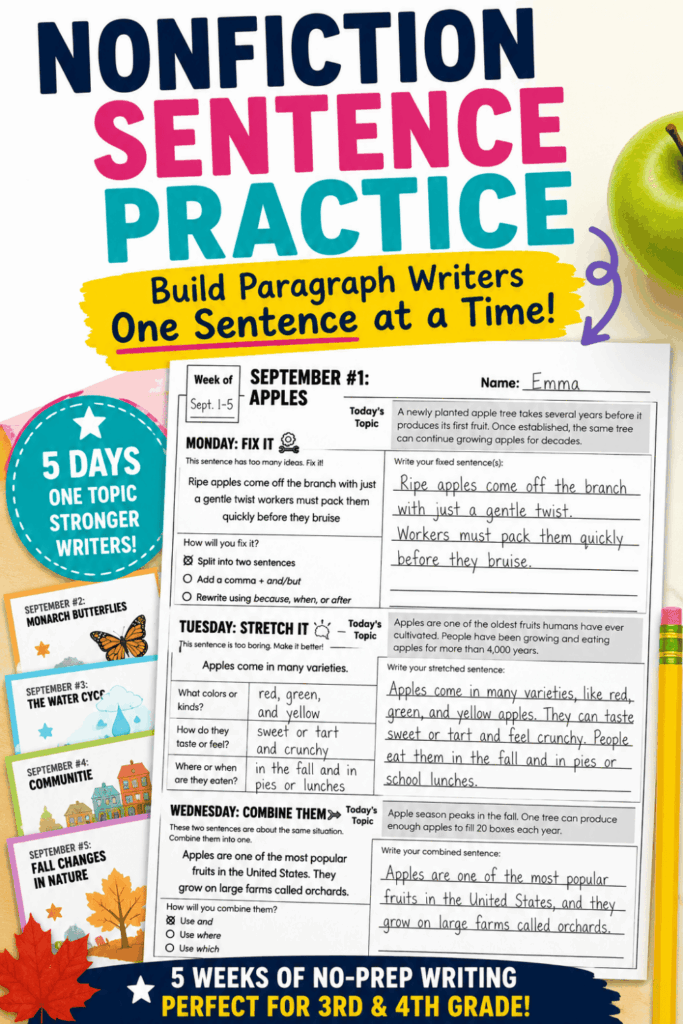
There’s a more useful version of the same practice, one where every sentence in the week is about the same topic, so the skills and the content build together. By Friday, students have four sentences they wrote themselves, each approaching the topic from a different angle, ready to be read as something that looks a lot like a paragraph.
Why Topic-Focused Nonfiction Sentence Practice Is Different
When all five days of sentence practice center on one topic, something shifts. Students aren’t starting fresh each morning. They’re returning to something they already know a little about from the day before. The context bar at the top of each day’s page, just one or two sentences of background, gives a new fact or angle on the same subject. By Wednesday, students are genuinely curious about what they’ll learn next.
That curiosity matters for sentence-level writing. Students write better, more specific sentences when they have something to write about. A student who has spent four days learning about monarch butterflies from different angles has more to say on Friday than one who is encountering the topic for the first time. Topic knowledge and sentence skills reinforce each other in ways that isolated practice cannot replicate.
Research on effective writing instruction consistently points to the importance of giving students something meaningful to write about. Nonfiction sentence practice built around a single weekly topic does exactly that, without needing a separate read-aloud, article, or research task to set it up.
How Each Day’s Nonfiction Sentence Practice Builds on the Last
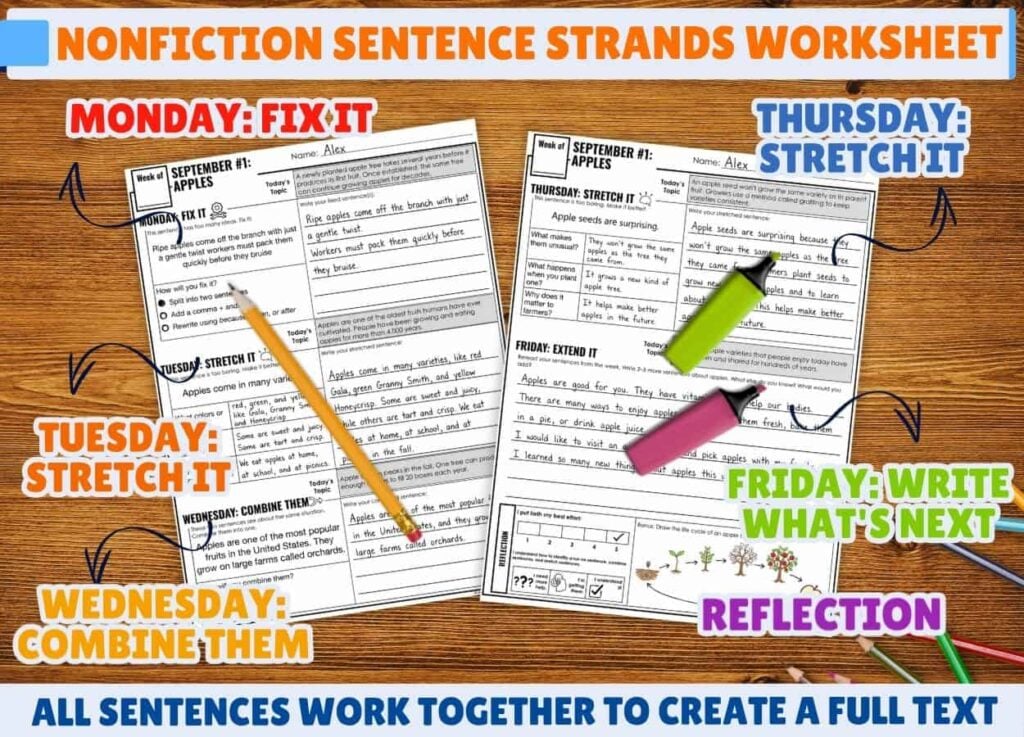
The structure is the same each week: five days, one topic, one sentence skill per day. What makes it work is that each skill touches the topic from a different direction. By the end of the week, students have produced four sentences that cover four different facets of the same subject, not four sentences that say the same thing four different ways.
Here’s what that looks like for a week on apples:
- Fix It (Monday): Students read a run-on sentence about apple harvesting and choose how to fix it. The corrected sentence is about the pace and precision of harvest work, specifically how apples get from tree to market.
- Stretch It, Easier (Tuesday): Students expand “Apples come in many varieties.” Three planning boxes prompt them to think about colors and kinds, how apples taste or feel, and where or when they’re eaten. The expanded sentence incorporates sensory detail that a flat sentence cannot convey.
- Combine Them (Wednesday): Students merge two sentences about apple orchards into one, choosing a combining word that shows the relationship. The resulting sentence is about how apples are grown commercially, a different angle than variety or harvest.
- Stretch It, Harder (Thursday): Students expand “Apple seeds are surprising.” The planning boxes push toward more complex thinking: what makes them unusual, what happens when you plant one, and why it matters to farmers. The expanded sentence ends up being about apple genetics and grafting.
- Extend It (Friday): Students reread the four sentences they wrote Monday through Thursday. Then they write 2-3 more sentences to further develop the topic. A bonus drawing prompt (draw the life cycle of an apple tree) gives early finishers something productive to do.
Look at what students have at the end of that week: a sentence about harvest, a detailed sentence about apple varieties, a combined sentence about orchards, and a sentence about seeds and grafting. Four sentences. Four different angles. One topic. That’s the architecture of an informational paragraph. Students built it one skill at a time without ever being asked to write a paragraph.
The Hidden Paragraph-Writing Payoff
One of the harder things to teach 3rd and 4th graders about informational writing is that a strong paragraph doesn’t just repeat the same idea in slightly different words. It explores one topic from several angles. That’s an abstract concept when you try to explain it directly. It becomes much clearer when students can see it in their own writing.
On Friday, when students reread their four sentences before extending the topic, many of them notice on their own that they’ve already written about a lot. Some are surprised by how different each sentence is. That’s a productive moment of reflection, a chance to name what good informational writing does without making it feel like a lesson about paragraphs.
The Five Weekly Nonfiction Topics
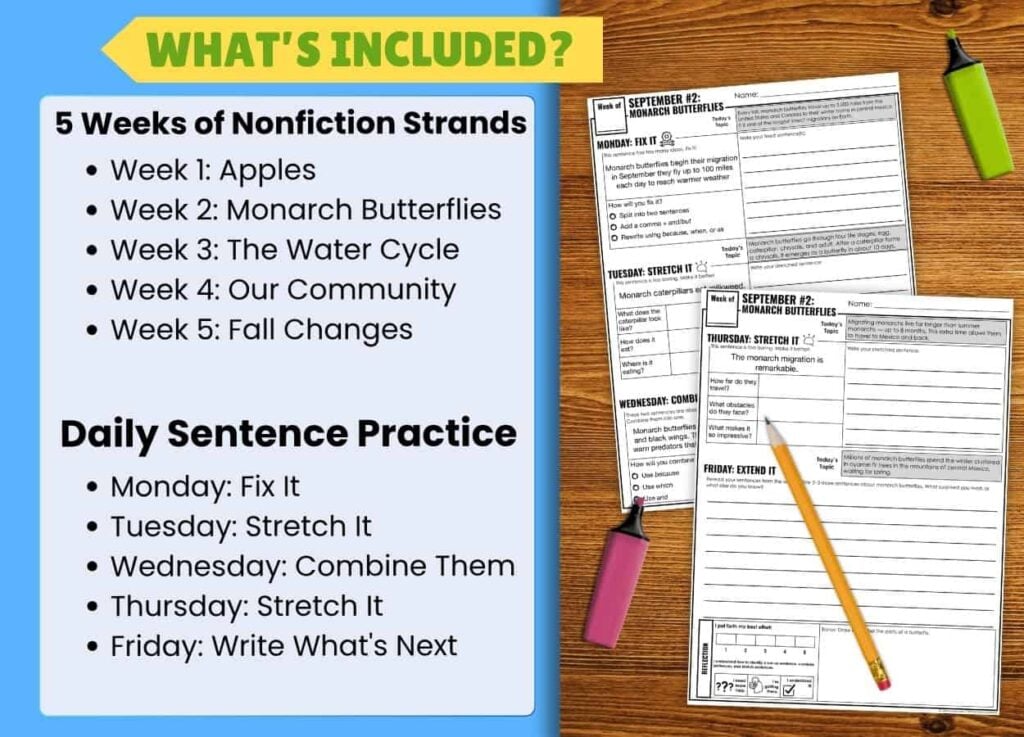
For a fall-themed set, five weeks of nonfiction sentence practice works well when the topics draw on science and social studies content students are already encountering or about to encounter. Topics that are broad enough to support four different sentence angles in a single week tend to work best: one topic per week, one sheet per week, printed front-to-back.
Five topics that work well for 3rd and 4th grade in September and early fall are apples, monarch butterflies, the water cycle, communities, and fall changes in nature. Each of these has enough facets to support a Monday run-on sentence, two stretch sentences from different angles, a combining activity, and a Friday extension, without running out of interesting things to say. Students who already know something about the topic bring that knowledge to their Friday extension, which is part of what makes Fridays worth listening to aloud. Two students writing about monarch butterflies rarely end up with the same paragraph.
What Each Nonfiction Sentence Practice Skill Contributes
Each day’s skill isn’t random. It’s deliberately chosen to develop a different aspect of sentence quality. Over time, students build a repertoire rather than a single technique.
Fix It (Monday) builds sentence control. A student who can hear a run-on and identify the break point is starting to understand how ideas are bounded in writing. The three fix strategies (split, add a comma and conjunction, or rewrite with a joining word) give students options rather than a single formula. Using different joining words week to week (because, when, while, as, since) builds a vocabulary of connections that shows up in their own writing over time.
Stretch It (Tuesday and Thursday) builds specificity. The planning boxes do two things: they lower the barrier to writing by breaking “expand this sentence” into three smaller questions, and they model the kind of thinking that produces a specific, detailed sentence rather than a vague one. Tuesday’s version uses a simpler base sentence and more accessible questions. Thursday raises both the complexity of the sentence and the depth of the planning box prompts.
Combine Them (Wednesday) builds sentence variety. Offering three combining word options rather than one is intentional. Students who try all three and then choose the best one are making a decision about meaning and effect, not just following directions. That’s close reading and revision thinking, even if it takes less than ten minutes.
Extend It (Friday) builds synthesis. Reading back over your own work before continuing it is a habit that strong writers develop. Doing it every Friday makes it a routine rather than a request.
Differentiating Nonfiction Sentence Practice
Because all students are working with the same topic and the same daily structure, differentiation is a matter of depth, not separate activities.
For Students Who Need Support
- Read the topic bar aloud together before students begin each day. Students with limited background knowledge on the topic need that context before they can engage with the sentence task.
- For Fix It, have students read the run-on aloud before they mark anything. The break point often becomes clear when they hear the sentence, even if they struggle to find it visually.
- For Stretch It, spend 60 seconds as a class brainstorming one or two words for each planning box before students write independently. This removes the blank-box hesitation without removing the writing task.
- For Combine Them, allow partner work. Talking through the three options before writing usually produces more deliberate choices.
- On Fridays, let students draw first and use the bonus drawing prompt as a planning tool. Students who draw the water cycle or a monarch butterfly before writing tend to write more specific sentences.
For Students Who Are Ready for a Challenge
- On Fix It days, challenge students to rewrite the run-on two different ways using two different fix strategies, then decide which version is stronger and explain why.
- On Stretch It days, ask students to add at least one detail beyond what the planning boxes prompted. Where did that detail come from? What do they already know about this topic?
- On Combine Them, have students try all three combining options, choose the best one, and explain in a sentence why they chose it.
- On Fridays, challenge students to write 4-5 sentences instead of 2-3, or to include a fact they already knew that never appeared in the week’s topic bars. That second option prompts students to connect the practice to their own knowledge base, which is exactly what good nonfiction writers do.
Frequently Asked Questions About Nonfiction Sentence Practice
Final Thoughts on Nonfiction Sentence Practice
Grammar practice doesn’t have to produce a pile of isolated, forgettable sentences. When each day’s sentence connects to the same topic, the skills and the content build together. Students get better at fixing run-ons, combining sentences, and adding specific detail. They also walk away from every Friday with something they actually wrote: a set of sentences about apples or monarch butterflies or fall changes that, read together, sound like theirs.
If you want a ready-to-use option, September Nonfiction Sentence Strands gives you five weeks of topic-focused daily sentence practice built around fall, science, and social studies topics: apples, monarch butterflies, the water cycle, communities, and fall changes. One sheet per week, printed front-to-back, no prep required.
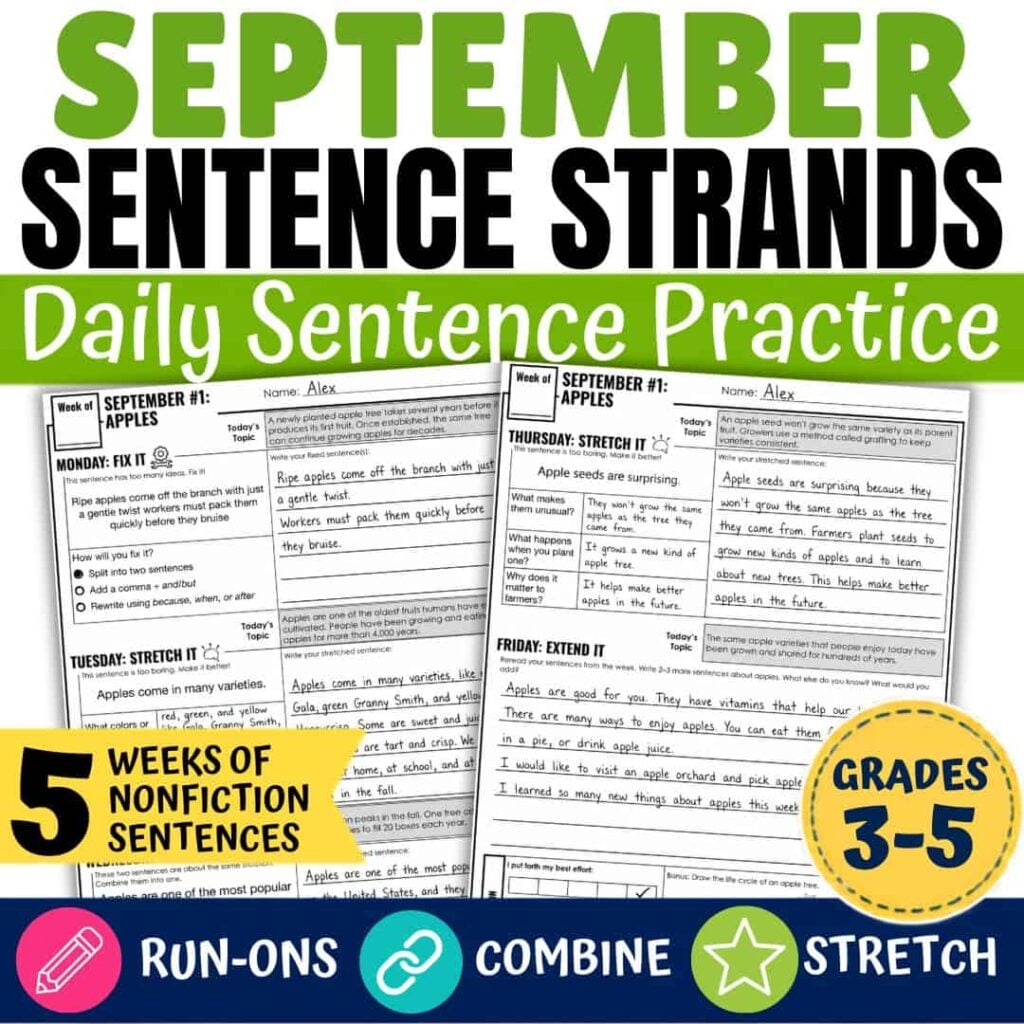
This September nonfiction sentence practice provides a focused stretch-a-sentence routine with run-on sentences, sentence combining, and daily grammar activities connected to engaging science and social studies topics.
Jessica BOschen
Jessica is a teacher, homeschool parent, and entrepreneur. She shares her passion for teaching and education on What I Have Learned. Jessica has 16 years of experience teaching elementary school and currently homeschools her two middle and high school boys. She enjoys scaffolding learning for students, focusing on helping our most challenging learners achieve success in all academic areas.