
Daily Sentence Practice with Connected Stories for 3rd & 4th Grades
Many 3rd- and 4th-grade classrooms have a stack of sentences waiting for students every morning. Students fix them, turn them over, and forget them by lunch. Daily sentence practice has a reputation as the part of grammar instruction students tolerate rather than engage with. That reputation is earned when the sentences connect to nothing students care about. That changes when the sentences are part of a story.
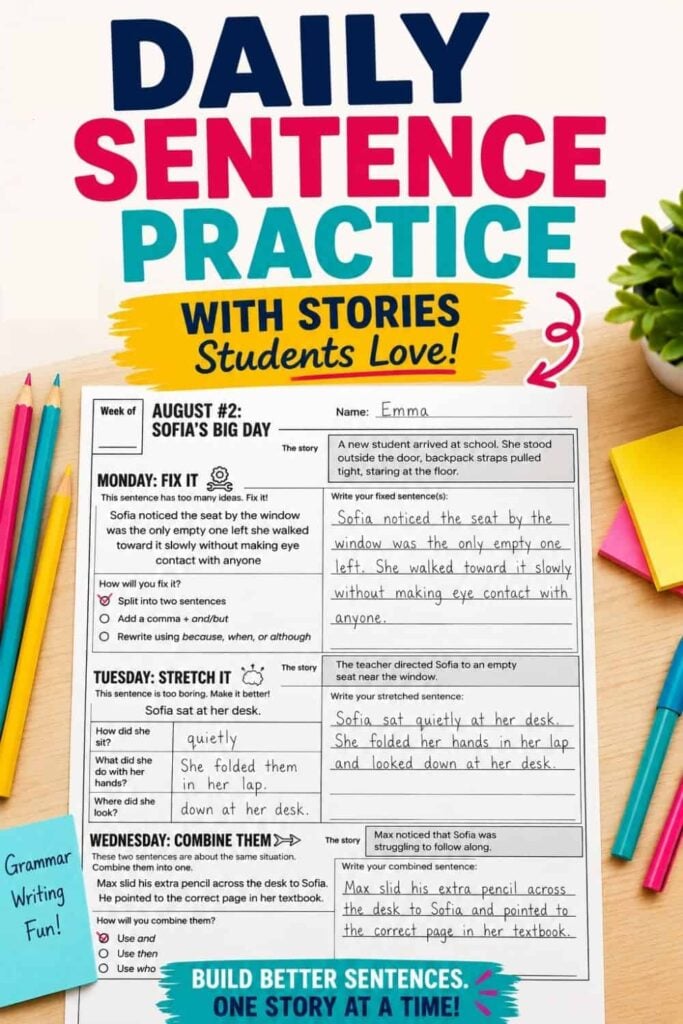
Why Daily Sentence Practice Matters for 3rd and 4th Graders
By 3rd grade, students understand sentences well enough to read them. What they often struggle with is writing them with any variety, precision, or control. Run-on sentences are common. Most sentences are short and flat. Combining two related ideas into one sentence is a skill many students don’t attempt on their own without a nudge.
Consistent practice is one of the most effective ways to build these skills because it spreads repetition across time. Ten to fifteen minutes of sentence work five days a week adds up to more than an hour of focused practice without ever pulling a long chunk of instructional time away from something else. For 3rd- and 4th-graders, that consistency matters more than any single lesson.
The challenge is keeping that daily practice from feeling mechanical. Students need a reason to actually read the sentence in front of them before they start fixing it. And that reason, more often than not, is a story.
The Problem with Isolated Sentence Practice
Most grammar worksheets present sentences as disconnected observations. Students fix them, combine them, or expand them, then move on. There is no reason to be curious about what comes next. No character to root for. No detail that carries meaning because it connects to something students already know.
This is not just an engagement problem. When students don’t care about a sentence’s content, they focus only on the mechanical task at hand. They miss the bigger picture: that good sentences tell something specific, create a feeling, or move a story forward. The skill and the purpose get separated.
Connecting sentence practice to a continuing story closes that gap. Students are not just fixing a random run-on. They are fixing a sentence about a character they have been following all week.
What Story-Connected Daily Sentence Practice Looks Like
Each day begins with a short story bar at the top of the page – one or two sentences that set the scene before students begin their work. The story bar provides context, builds anticipation, and reminds students where they left off yesterday.
By Tuesday, students already know what happened Monday. By Wednesday, they’re invested in the outcome. On Friday, they reread the four sentences they wrote themselves across the week and use them as a launching point to finish the story. That sense of continuity is what makes the practice feel different from a grammar worksheet.
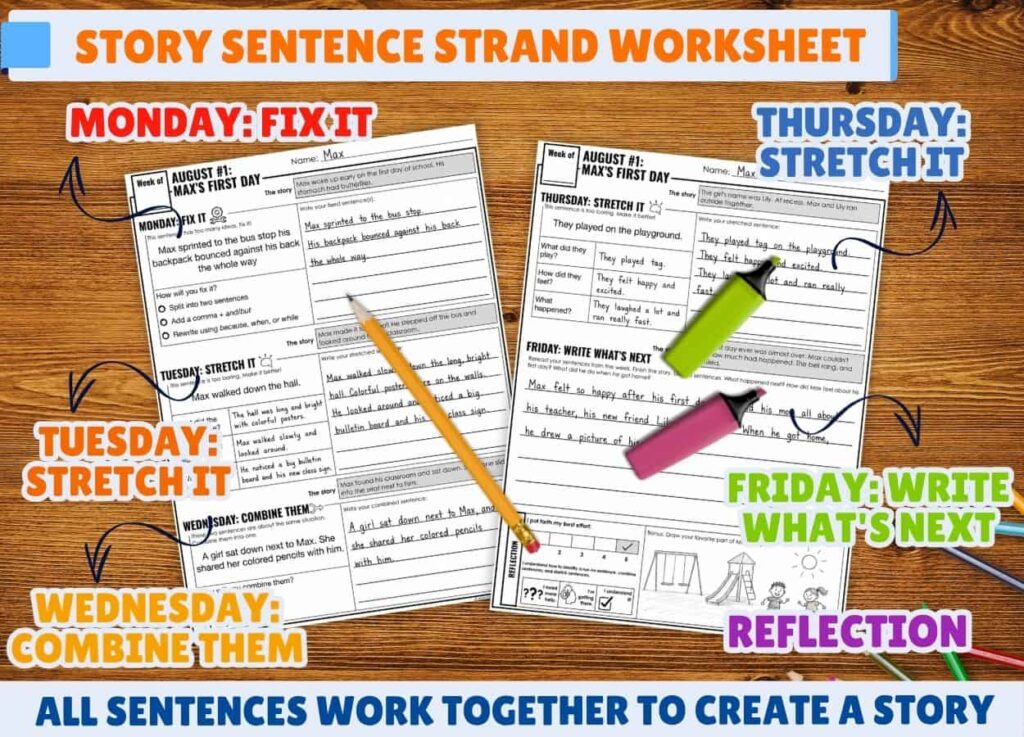
How the Daily Sentence Practice Skills Build Across the Week
Each day targets a different sentence skill, and each skill connects back to that week’s story moment. Here is what a typical week looks like:
- Monday – Fix It: Students read a run-on sentence connected to that week’s story, identify where the sentence breaks, and choose a fix strategy: split into two sentences, add a comma and conjunction, or rewrite using a joining word such as because, when, or although. Three options are shown so that students can make a genuine choice rather than follow a single formula.
- Tuesday – Stretch It (Easier): Students take a short, flat base sentence and expand it using three planning boxes that prompt descriptive thinking: what does the character look like, how are they moving, where are they? The boxes guide students toward manageable detail before they write.
- Wednesday – Combine Them: Students merge two related story sentences into one, choosing from three combining word options. Each option is plausible but produces a meaningfully different sentence. This is a good opportunity for students to read their combined sentence aloud and decide which sounds best.
- Thursday – Stretch It (Harder): Same structure as Tuesday, but the base sentence is slightly more complex, and the planning boxes push toward more specific or layered detail. By Thursday, students have more context from the week’s story to draw on.
- Friday- Write What’s Next: Students reread the sentences they wrote Monday through Thursday, then write 2-3 sentences to continue the story from a specific moment. A bonus drawing prompt gives early finishers something concrete to do. On Friday, it’s worth asking two or three students to share their story endings aloud – students are often surprised by how differently the same story can end in each other’s hands.
Each day builds on the last. By Friday, the story students finish is, in part, a story they helped tell. Research on effective writing instruction consistently points to the value of giving students authentic reasons to write. Connected sentence practice builds exactly that into a quick daily routine.
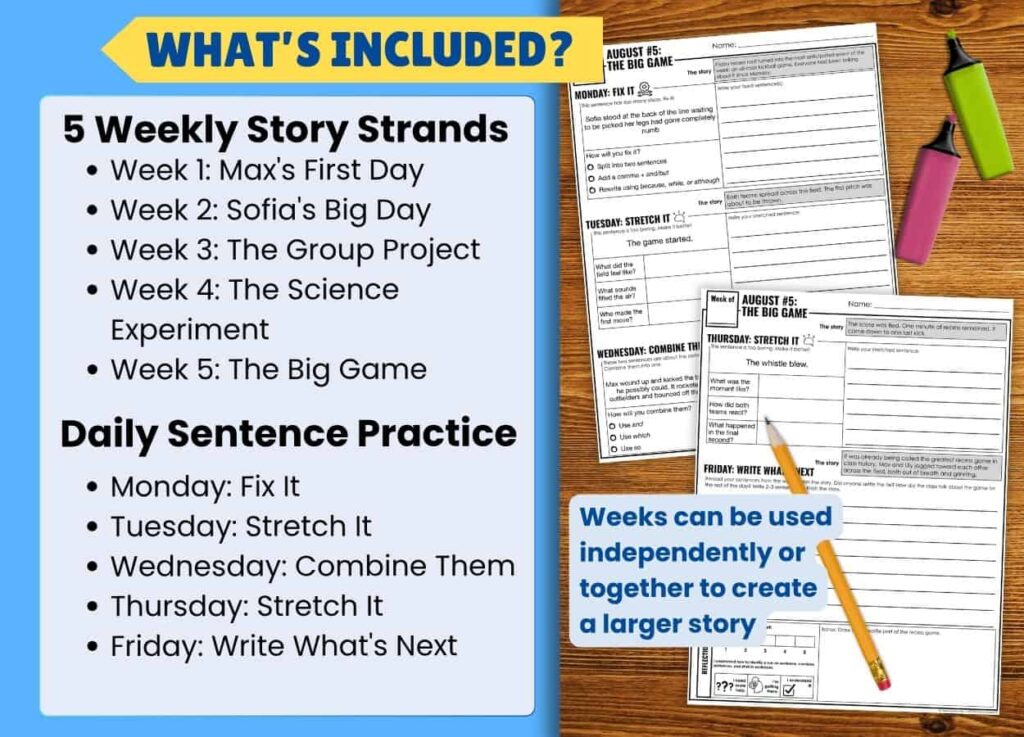
How Five Weeks of Daily Sentence Practice Builds Into One Larger Story
One connected week of sentence practice is engaging. Five connected weeks, all following the same cast of characters, is something students start looking forward to.
When all five weeks carry the same characters through a series of related story moments, students arrive on Monday of Week 2 already knowing who the characters are. They remember what happened in Week 1. They are curious about what comes next. That curiosity is doing real work for you. Students arrive at the sentence task already primed to read carefully and write specifically.
For back-to-school stories in 3rd and 4th grade, five weekly arcs might trace a natural progression through the first weeks of school:
- a student’s nervous first day
- a new student joining the class
- a group project that isn’t going smoothly
- a science experiment with an unexpected outcome
- and a high-stakes kickball game at recess that the whole class has been talking about since Monday.
The same characters carry through all five weeks. The stakes build. Students are reading each Monday’s story bar not just to get context for the Fix It sentence – they’re reading because they want to know what happens next.
This is the kind of investment that isolated sentence practice simply cannot create.
Differentiating Daily Sentence Practice for Every Student
Because every student is working with the same story and the same daily structure, differentiation here is about depth of thinking rather than a separate activity.
For Students Who Need Support
- Read the story bar aloud together as a class before students begin each day. Even 30 seconds of shared reading gives struggling readers the context they need to engage with the sentence task.
- For Fix It, ask students to read the run-on aloud first. They often hear the break point before they can identify it on paper.
- For Stretch It, brainstorm one or two words for each planning box as a class before students write independently. This reduces the blank-page hesitation without removing the writing task.
- Allow partner work on Wednesday’s combining activity. Talking through the options together before writing usually produces stronger sentences than working silently.
- On Fridays, let students draw the story moment first, using their drawing as a planning tool before they write their 2-3 sentences.
For Students Who Are Ready for a Challenge
- On Fix It days, challenge students to rewrite the sentence two different ways using two different strategies, then decide which version sounds better and explain why.
- On Stretch It days, ask students to add at least one detail that goes beyond the planning boxes – something they noticed themselves that the boxes didn’t prompt.
- On Combine Them, have students try all three combining options and write the one that works best, then explain their choice in a sentence.
- On Fridays, challenge students to write 4-5 sentences instead of 2-3, or to add a twist the story bar didn’t set up.
Frequently Asked Questions About Daily Sentence Practice
Final Thoughts on Daily Sentence Practice
Daily sentence practice does not have to be something students tolerate. When the sentences are connected to a story students care about – and when those stories carry through from day to day and week to week – students arrive at the task already curious. The grammar skills are still front and center. But students have a reason to bring their attention to every word.
If you want a ready-made option, August Story Sentence Strands gives you five weeks of story-connected daily sentence practice built around five back-to-school story arcs. The same characters – Max, Sofia, and Lily – carry through all five weeks, from a nervous first day all the way to the greatest kickball game in class history. One sheet per week, printed front-to-back, no prep required.
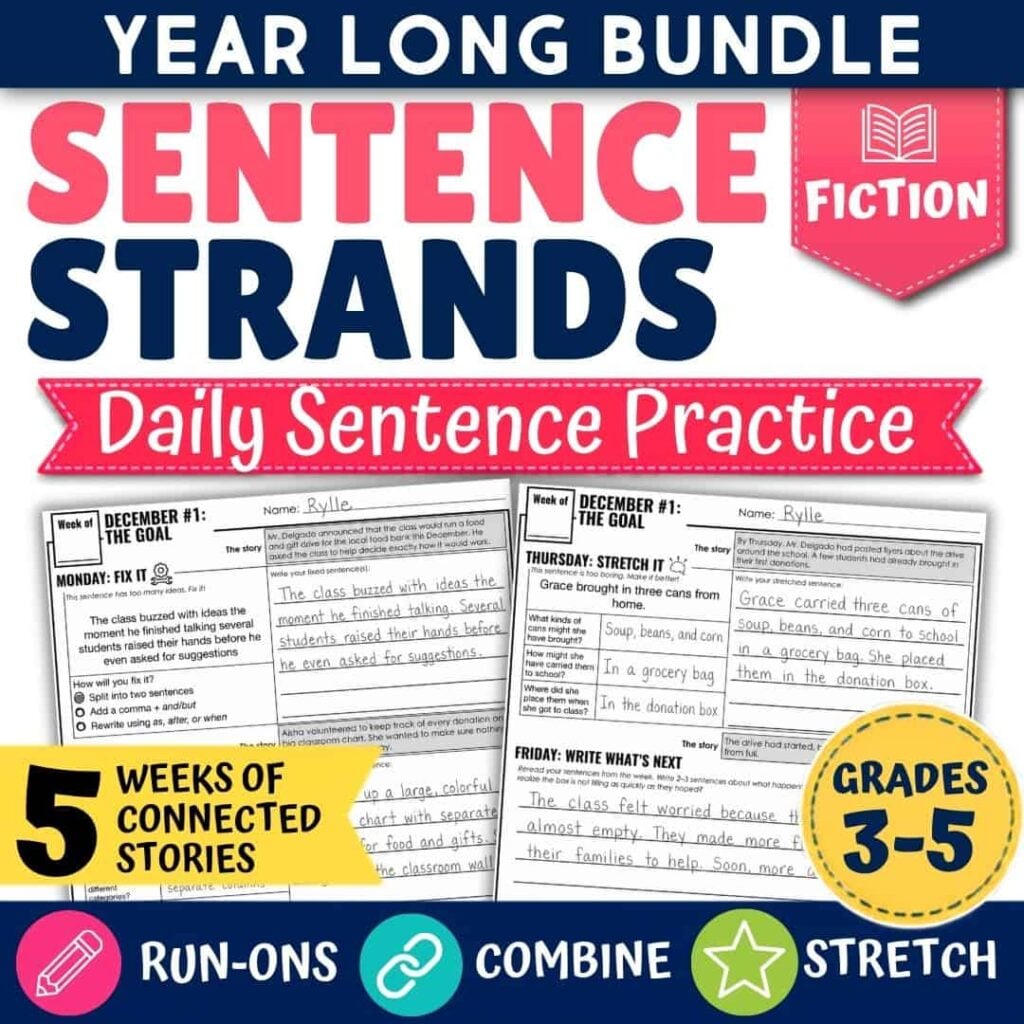
Students build stronger sentences through a daily routine featuring connected back-to-school stories, sentence expansion, editing, and creative writing.
Jessica BOschen
Jessica is a teacher, homeschool parent, and entrepreneur. She shares her passion for teaching and education on What I Have Learned. Jessica has 16 years of experience teaching elementary school and currently homeschools her two middle and high school boys. She enjoys scaffolding learning for students, focusing on helping our most challenging learners achieve success in all academic areas.