
How to Play Four Corners: Classroom Game for Review
Some of the best classroom activities need no prep, materials, or screen. The four corners classroom game is one of them. It gets every student up and moving in under a minute, and with one small tweak, it turns into a review game you can run before any test. If your class has been sitting too long, or testing season is coming and you want practice that doesn’t feel like a worksheet, reach for this game.
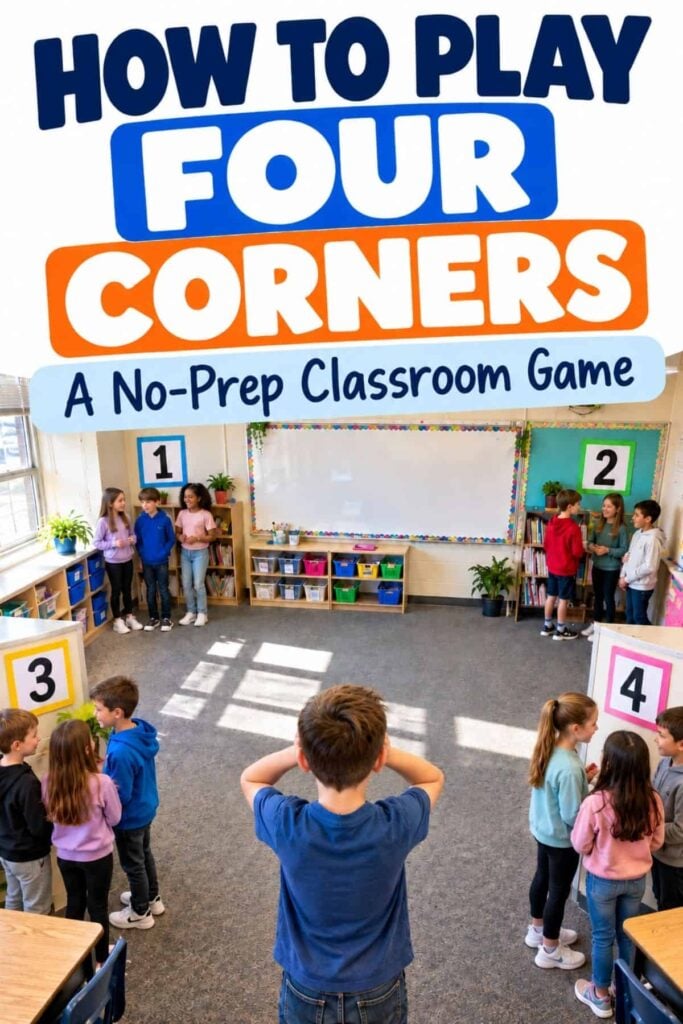
Here is how to play Four Corners, how to adapt it for content review, and ready-to-use questions you can read straight off the page.
What Is the Four Corners Classroom Game?
The 4 corners classroom game is a group game where you label the four corners of your room, one student is “it” and covers their eyes while everyone else quietly moves to a corner, then “it” calls out a corner. The students standing there are out. Play continues until one student is left. It is simple, active, and works in any classroom.
Where the game comes from
Four Corners started as a party and PE game, the kind played at birthday parties and in gyms for years. Teachers borrowed it as an indoor movement break for rainy days and long afternoons, then realized the same structure could review content. That is the version that earns a spot in your teaching toolkit.
Why it works as a classroom activity
The game works because it does two things at once: it gets students moving, which resets attention, and it can carry academic content without feeling like a quiz. Students who freeze up on a paper test will happily walk to a corner to show an answer. It also needs nothing but your room, which makes it a true no-prep option. It works easily for K-5, and the review version scales up to middle school with harder questions.
How to Play Four Corners in the Classroom (Step by Step)
Materials you need
Almost nothing. Label each corner 1 through 4, or A through D, with a paper sign, or just point and name them aloud. No other supplies are needed, and the game works with any class size.
Step-by-step rules
- Label the four corners 1 to 4 or A to D with signs, or name them out loud.
- Pick one student to be “it.” They stand at the front or center, cover their eyes, and count aloud to ten.
- While “it” counts, the rest of the class walks silently to any one of the four corners.
- When the count ends, “it” calls out a corner without looking.
- Everyone standing in that corner sits down and is out.
- Repeat until one student is left. That student becomes “it” for the next round.
How a round ends
A round ends when only one student remains, or simply when your time is up, since the game pauses cleanly at any point. The last student standing earns the role of “it,” which keeps students invested round to round.
How to Adapt Four Corners for Content Review
This is where the four corners classroom activity earns its keep. Instead of choosing a corner at random, students choose the corner that matches their answer. The movement stays; the guesswork becomes thinking.
Turning corners into answer choices
Label the corners A, B, C, and D, exactly like a multiple-choice test. Read a question with four answer choices, and have students walk to the corner that matches the answer they think is correct. This version drops the closed-eyes step, since the goal is content, not hiding. Once students are in their corners, you reveal the correct answer.
Adding a Discussion Component
Once students have chosen their corner, have them discuss their answer and why they chose it. Do this either before or after you reveal the answer, depending on the question being asked.
Running a review round
Read the question aloud and give students a few seconds to think before they move. Once everyone has committed to a corner, call out the right answer. Students who choose correctly cheer, and you get an instant read on who understands the concept, since you can see at a glance how the class split across the corners.
Scoring without elimination
You have two ways to score. Elimination style matches the original game: students who pick the wrong corner sit out, and you play down to a winner. Non-elimination style keeps everyone in for every question, which is better for review because students who need the most practice aren’t the first to sit down. For a review warm-up, keep everyone standing and answering throughout.
Example Questions and Topics for Four Corners Review
Here are questions you can read verbatim. Swap in your own content, and the format works for any subject.
Math examples
- What is 7 x 8? A) 54, B) 56, C) 64, D) 48
- Which number is greater? A) 452, B) 425, C) 445, D) 454
- How many sides does a hexagon have? A) 5, B) 6, C) 7, D) 8
Reading and vocabulary examples
- Which word means the same as happy? A) angry, B) joyful, C) tired, D) quiet
- What is the root of “unbreakable”? A) un, B) break, C) able, D) breakable
- Which is a complete sentence? A) Ran fast, B) The dog barked, C) Under the table, D) Because it rained
Test-prep and true/false examples
For true/false review, use only two corners: corner 1 for True and corner 2 for False. For example, “A triangle has four sides. Corner 1: True, Corner 2: False.” The week before a unit test or state testing, pull questions straight from the upcoming test and run them through the game. Students get the review they need, standing up and moving, right when they need it most.
Four Corners Game Variations
Silent elimination version (the original)
The classic version with no academic content is a pure brain break. Students move silently, “it” calls a corner, and play continues to a winner. Use this when the class just needs to move and reset.
Music version
Play music while students move between corners, then pause it to signal them to freeze before “it” calls a corner. The music adds energy and gives a clear, fun cue to stop moving.
Two-corner true/false version
Use just two corners for quick true/false or either/or checks. This is faster than the four-corner version and works well for a rapid fact review.
Numbers vs. letters for corners
Number your corners 1 to 4 for general trivia and random play, and letter them A to D when you want the game to mirror the multiple-choice format students will see on a test. Matching the labels to the test format gives students a little extra familiarity with how answers are laid out.
Four Corners fits right alongside other no-prep options. For more, see my roundup of quick classroom games and my calm indoor recess games for rainy days.
Tips for Managing Movement and Noise
A game with everyone out of their seats can tip into chaos without a few ground rules. These keep it orderly and fair.
Set a quiet-movement signal
Agree on a signal that means “freeze and go silent,” like a clap pattern or a raised hand, and use it before every corner call. Teaching the signal first makes the whole game run smoothly. If you don’t already have one, my post on classroom hand signals has options you can adopt.
Keep the game fair
Require walking, not running, and make it a rule that students commit to a corner before the count ends, with no last-second darting. Rotate who gets to be “it” so the same few students do not dominate. A quick reminder of these expectations before you start heads off most problems. For more on keeping active lessons orderly, see my post on reducing classroom disruptions.
When to use it
Four Corners shines as a five-minute brain break after lunch, during a long block, or on an indoor recess day. As a review tool, it works best in the days before a test, when students need practice but are tired of worksheets. Because it is also a cooperative, whole-group activity, it fits naturally with other cooperative learning activities early in the year.
Four Corners Classroom Game FAQ
Bringing It All Together
The 4-corners classroom game proves that the best activities are often the simplest. In its original form, it is a quick, fun way to get students moving, and with answer-choice corners, it becomes a review game you can run with zero prep the day before a test. Teach a freeze signal, keep the movement fair, and you have a no-materials activity that works for everything from a brain break to test prep.
Jessica BOschen
Jessica is a teacher, homeschool parent, and entrepreneur. She shares her passion for teaching and education on What I Have Learned. Jessica has 16 years of experience teaching elementary school and currently homeschools her two middle and high school boys. She enjoys scaffolding learning for students, focusing on helping our most challenging learners achieve success in all academic areas.