
6 Practical Ways to Reduce Classroom Disruptions
Time. We all have the same amount, right? So how can you use the time you have in your classroom most effectively? Realistically it’s easy to lose ten to fifteen minutes a day due to classroom disruptions. And from where does the time come? Instruction. We all know we can’t afford to lose instructional time. While students can disrupt the class in many ways, most disruption can be traced back to talking in some form. Here are some tried and true tips for reducing disruption in the classroom.

Stop Excess Talking to Reduce Classroom Disruptions
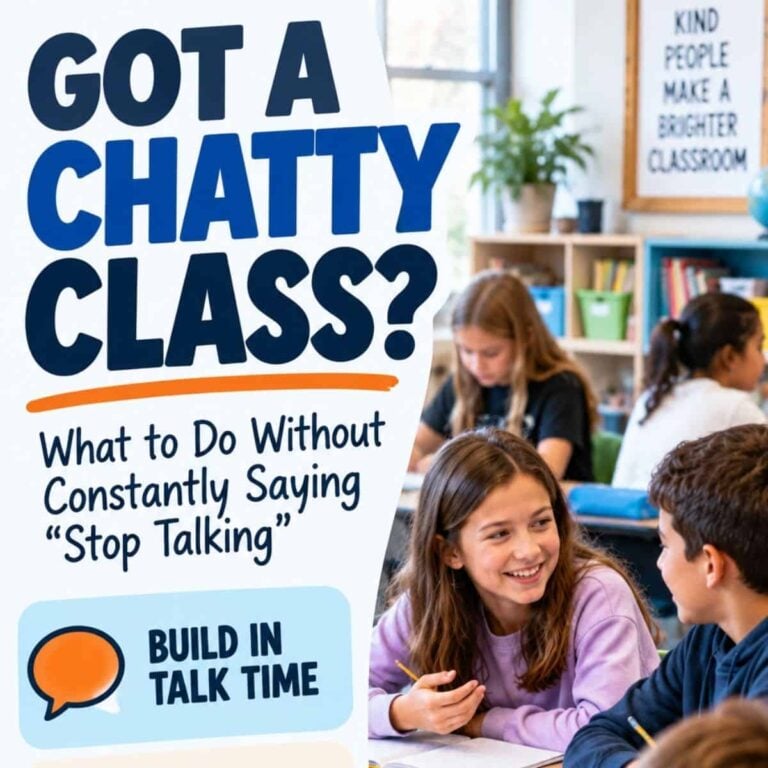
Talking in class can be anything from side conversations about the content or just outright ignoring teacher lectures and instructions or other student input. Here are some tips to help with too much talking in your elementary classroom.
Call and Response
Most disruption in the classroom happens when multiple students are talking. Luckily, there are many efficient ways to get a class to be quiet. Quieting strategies include echo clapping (you clap a pattern, and students clap it back), attention grabbers (You say “Hey class!”- they respond. “Hey yes!”), and ringing a chime or bell, to name just a few.
No matter the signal used, it is critical that the teacher waits for nearly complete silence before proceeding. This is important. If half the class is still talking, nothing will change.
Goal Setting
Getting every student quiet will take longer in the beginning. Setting a class goal can be helpful in seeing how quickly the whole class can get quiet. This can be a fun activity – many students love to compete and potentially “beat” their previous time. Goal setting can also be done individually, particularly for students who have a hard time controlling excess talking.
Brain Breaks
I find when students get a little too chatty, they may need a brain break. Switch it up and try one of 80 different brain breaks or sponge activities to let your students play and switch tasks before getting back to business! Brain breaks are a great way to begin class and transition between activities as well as take a needed break!
Beat the Blurting to Reduce Disruption in the Classroom
Student blurting costs lots of valuable time. So what is blurting? How is blurting different from talking? What are some methods of reducing blurting within the classroom?
Blurting happens when a student shouts out during the whole group (lesson/discussion.) without raising a hand. Your student could be saying the answer to a math problem, asking a question, or offering a suggestion. Blurting (shouting out) causes other students to shift their focus from the teacher’s lesson to the student who is shouting out. Talk about a major disruption in the classroom!
“Talking” generally applies to a larger group of students, or perhaps the whole class, while “blurting” is specific to one or two students. Strategies for fixing blurting are different than those employed to address whole-class talking.
Blurting can often happen even when the student is engaged and interested in what they are learning or you are teaching. Even if they are wanting to learn the content, blurting can often keep the “blurter” and other students from learning.
Review Expectations
It is standard practice to review school and classroom rules, which should address talking and blurting. When you’ve addressed the rule multiple times to no avail, it’s time to employ some other strategies to curb blurting in your classroom.
Identify Blurting Behavior
In extinguishing blurting behavior, it is important to make students aware of their behavior. This can be done by using tokens, popsicle sticks, or other small manipulatives to indicate “chances.” The student begins the day with three of these items, losing one each time she blurts. This can be done subtly without drawing a lot of attention to the student.
Use a Blurt Board
Identifying blurting behavior can also be done with a blurt board. To begin, the blurt board has five spaces for students. It takes very little prep to use in your classroom.
First, print on card stock, cut out the monsters, and laminate the board and monsters. Next, write each student’s name with an erasable marker or on removable post-its. The blurt board fits 3-4 monsters per row. A blurt means a loss of a monster. For the students that still have all their monsters, they receive a reward.
Like any behavior, a good teacher-student relationship will help things take a positive turn. The biggest factor in changing any behavior is consistency. Once identified and targeted, a behavior will usually get worse before it gets better but do not lose heart. Stand your ground and quiet your emotions. When your students realize you mean what you say, they will fall in line. That’s when disruption in the classroom will decrease, and we can all get back to the classroom business of teaching and learning.
Are you looking for MORE Management Ideas for Your Classroom?
Take a look at these ideas to level up your classroom management processes and make your school year the best year ever!
Want to Reduce Disruptions So You Can Actually Teach?
Check out this 100% FREE Micro Training
from my friend Linda over at Teach 4 the Heart.
Creating a calm classroom environment can be hard…and you probably didn’t learn everything you needed to about classroom management in college. (I know I didn’t!)
But there is hope and a way to make your teaching experience more fulfilling and less stressful.
Watch this quick 28-minute training to learn how you can minimize disruptions so you can actually teach your content (and get to do the projects & activities that make learning more fun for EVERYONE!
Linda WON’T just tell you to “build relationships” because, frankly, even the best connections can’t eliminate all classroom challenges. Achieving a smooth-running class requires a more nuanced approach.

So join me for this FREE 28-minute training and discover their Calm Classroom Blueprint, used by thousands of teachers to:
- Significantly reduce disruptions during lessons & work times.
- Gain confidence In handling challenging situations (that previously left them dumbfounded).
- Lower daily stress levels and find joy in teaching again!
Jessica BOschen
Jessica is a teacher, homeschool parent, and entrepreneur. She shares her passion for teaching and education on What I Have Learned. Jessica has 16 years of experience teaching elementary school and currently homeschools her two middle and high school boys. She enjoys scaffolding learning for students, focusing on helping our most challenging learners achieve success in all academic areas.