
Five Cooperative Learning Activities to do on the First Day of School

Cooperative learning activities on the first day of school do something routines alone can’t: they give students an immediate reason to talk to each other. When students collaborate, listen, and share from the very start, it signals the kind of classroom this is going to be.
These five activities work across K–5 and require very little prep. Each one includes a reflection component, which is where the real community-building happens.

Why Use Cooperative Learning on Day One?
One of the most important things you can do on the first day of school is model how you want students to treat each other and how you’ll treat them. When students experience collaboration, kindness, and inclusion on the first day, it sets the tone for everything that follows.
Cooperative learning activities:
- Create a sense of belonging
- Help students practice listening and speaking respectfully
- Encourage peer interaction in a safe, structured way
Don’t Skip the Reflection Piece!
Before we dive into the activities, here’s a powerful tip: always include reflection.
After each cooperative learning activity, pause for students to reflect on their experience. This could be through journal writing, a class discussion, or a community circle. Some great reflection prompts include:
- How did you respond to others?
- What did you do that helped or hurt your group?
- What might you do differently next time?
Reflection helps students internalize the social-emotional skills behind the fun.
Five Cooperative Group Activities for the First Day of School
Here are several cooperative learning activities I use in the first week of school. I use different ones for different grade levels, depending on their skill level.
Interview A Classmate
The interview is pretty simple. For younger students, use pictures; for older students, brainstorm a list of questions and let them choose which ones to write down. The basic idea is that two students will be paired and interview each other.
The student who conducted the interview will report on the interviewee. This reporting can take place over the course of a week or so. My students can’t sit still to hear about all 20+ students. I tend to do the interviewing on one day and the reporting over several days.
Perfect for: Grades 1–5
Supplies: Question list or picture prompts
Pair students up to interview each other, then share what they learned. For younger students, provide visual prompts. For older ones, brainstorm questions as a class.
Don’t try to share all interviews at once. Spread them out over the week as a brief “Get to Know You” moment each morning.
Find Someone Who
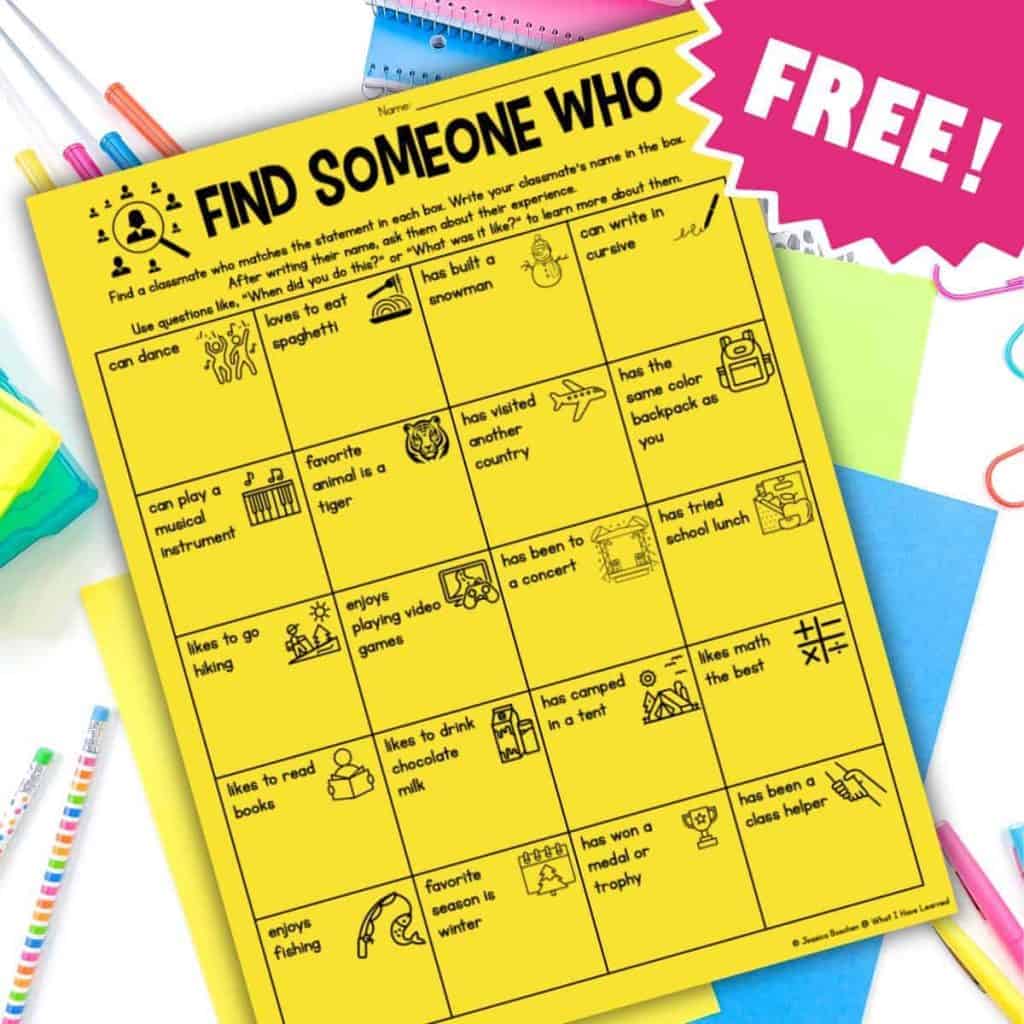
This is similar to an interview: students ask questions, but in this version, each student asks only one question to another student. Again, determine the questions based on the student’s age level. Instead of questions, you can also put attributes, which is how the game is originally supposed to be played. Either way, the idea is that students are talking to multiple classmates.
For my second graders, I create a grid, usually 4 x 3, and write down 12 questions or attributes, one in each box. Students find another student, ask one question, and then have the student sign their name in that box.
Perfect for: Grades 2–5
Supplies: 3×4 grid with prompts or traits
This classic icebreaker gets students moving and talking to multiple classmates. Give each student a grid filled with prompts (e.g., “Has a pet,” “Loves pizza”). They must find classmates who match each item and have them sign the box.
You can download the one below or create your own editable version tailored to your students’ age and interests.
Spider Web
This one is so much fun, and it’s perfect for all ages! You will need a ball of string or yarn; any color will do. Have students sit in a circle on the carpet or in chairs. This game can also be played outside.
Start with yourself. Say your name and one thing about yourself. Then choose another student around the circle and roll or hand the ball to them. That student says his name and one thing about himself. Play continues until all students have had a turn, and a web of string crisscrosses the circle.
Reflect on how each person is part of the web, which represents the classroom; you are all holding a piece of the classroom, and without that piece, the classroom wouldn’t be complete. When you are finished with the reflection, have one student let go of their string to demonstrate what happens if one person isn’t included in the web. It collapses. We don’t want our web (or classroom) to collapse!
You can make the game simpler, where students choose the next student, or more complicated, where students have to tell one thing about themselves, like their favorite food or something. Either way, it’s a fun game that shows the inclusion of all students.

Graffiti Boards
This is one of my favorite cooperative learning activities, especially for older students. In this activity, I create six pieces of chart paper, each with one statement. I group students and give each student a marker.
Students rotate through the pieces of chart paper, responding to the prompt on the paper. Each student has to write something since each student is holding a marker. At the beginning of the year, I make the statements more low-key, but as the year progresses, I increase their complexity, even using academic questions to review content.
Perfect for: Grades 3–5
Supplies: Chart paper, markers
Hang 5–6 pieces of chart paper around the room, each with a different open-ended prompt. In groups, students rotate to each paper and add their responses with markers.
Here are some suggestions for topics at the beginning of the year:
- Favorite moment
- What I wonder about
- What I want to be when I grow up and why
- Things that scare me
- Things that get me excited
- What I like about school
- What I dislike about school
- Things people do that annoy me
- Things that people do that I like
- I feel sad when
Each student writes their own answer, promoting both individual voice and collaborative conversation.

For more open-ended prompts you can use throughout the year, check out 67 Questions to Ask Students at the Beginning of the Year.
Squiggly Line Drawing
The squiggly line drawing is an individual activity that can be turned into a cooperative learning activity during the reflection piece. Basically, you’d take a piece of writing paper with a space to draw at the top. Draw a line in the top space that has a curve to it, and photocopy that page for each student in your class.
Students spend some time drawing a picture incorporating that curved line, and then write about their picture below.
During the reflection time, students can partner up and share their picture and writing with a partner, or they can sit in a circle and share with the whole group. The beauty of this activity is that it gives students some downtime on a busy first day.
BONUS: Community Building Puzzle
Want something easy to set up while you’re greeting families on the first morning?
Set a blank puzzle piece on each desk, along with a box of crayons. As students arrive, they color their piece however they like. Later, combine all the pieces into a class puzzle to display.
It’s a beautiful visual reminder that every student is an important part of your classroom.

Community Building Puzzle Activity Back to School Team Building
Build classroom community with this collaborative community building puzzle activity! Students decorate individual puzzle pieces, work together to assemble the class puzzle, and create a meaningful back-to-school display that celebrates teamwork and belonging.
Favorite Resources for Cooperative Learning
One of my favorite books for cooperative learning activities is Reaching All by Creating Tribes Learning Communities. The book is much more than cooperative learning activities, but those have been the best takeaways for me.
Another good book is Keys to the Classroom. It, again, is much more than cooperative learning activities but has a few good ones in there, too.


One Final Tip…
Start small. Don’t feel like you have to cram everything into the first day. Choose 1–2 activities that feel right for your students, and build from there.
The first day of school isn’t just about routines. It’s about relationships. Cooperative learning activities give students a structured, low-pressure way to start building those connections from day one.
* Some of the links above contain affiliate links.
Want to Reduce Disruptions So You Can Actually Teach?
Check out this 100% FREE Micro Training
from my friend Linda over at Teach 4 the Heart.
Creating a calm classroom environment can be hard…and you probably didn’t learn everything you needed to about classroom management in college. (I know I didn’t!)
But there is hope and a way to make your teaching experience more fulfilling and less stressful.
Watch this quick 28-minute training to learn how you can minimize disruptions so you can actually teach your content (and get to do the projects & activities that make learning more fun for EVERYONE!
Linda WON’T just tell you to “build relationships” because, frankly, even the best connections can’t eliminate all classroom challenges. Achieving a smooth-running class requires a more nuanced approach.

So join me for this FREE 28-minute training and discover their Calm Classroom Blueprint, used by thousands of teachers to:
- Significantly reduce disruptions during lessons & work times.
- Gain confidence In handling challenging situations (that previously left them dumbfounded).
- Lower daily stress levels and find joy in teaching again!

Great ideas! I love your reasons for revisiting these activities during the year.
Hi, I love co-operative learning and if you use it with a new class it sets the tone for an upbeat, positive year. I led co-operative learning in my previous school and now use it all the time in my new role as a primary school German teacher, where i think the strategies are particularly suited to language learning. Inside/outside circle is a good one to use for introduction activities at the start of the year but Ialso love turn toss, quiz quiz trade and people hunt.
Quite an interesting collection of ideas that will promote collaboration, communication and creativity within the classroom. I am especially excited about the suggested ines to do on the first day of school. I feel like I could intgrate ideas to create other fantastic activities. Thanks so much for sharing!
What a great collection of ideas! Thanks for sharing!
Griffiti is a cool idea! When some kids are writing at the chart paper, what are other students doing? I know you mentioned that everyone has a marker, but there are only six charts. How do you manage rotating them through? Thanks for the ideas!
I have five or six papers with questions on them. Students rotate through all the papers, each holding a marker. So, all students are writing at the same time. I have students spend about 8 minutes at each poster, some less as the activity goes on.
Thank you for sharing these great ideas. I can’t wait to start using them:)
Love these activities. I may be teaching first grade for the first time this year so I can definitely use these!
Excellent post!!. Great collections.. It’s really helpful to us.I follow blog for tips and guidelines.
Atlas Adventure
I really like the squiggly line drawing activity because it incorporates creativity in both drawing and writing. This activity might also help the kids explore their talents in abstract thought and projection. I think you have some awesome activity tips!