
Comprehension Question Stems for Guided Reading (By Skill)
You are three minutes into a guided reading group. A student finishes reading, looks up, and you need a comprehension question right now. One that pushes thinking instead of just checking that they read. If you have ever stalled in that moment, question stems are the fix. These ready-to-use reading questions, also called questioning stems, are sentence starters you finish with details from whatever book is on the table, so you always have a strong question ready without planning for one specific text.
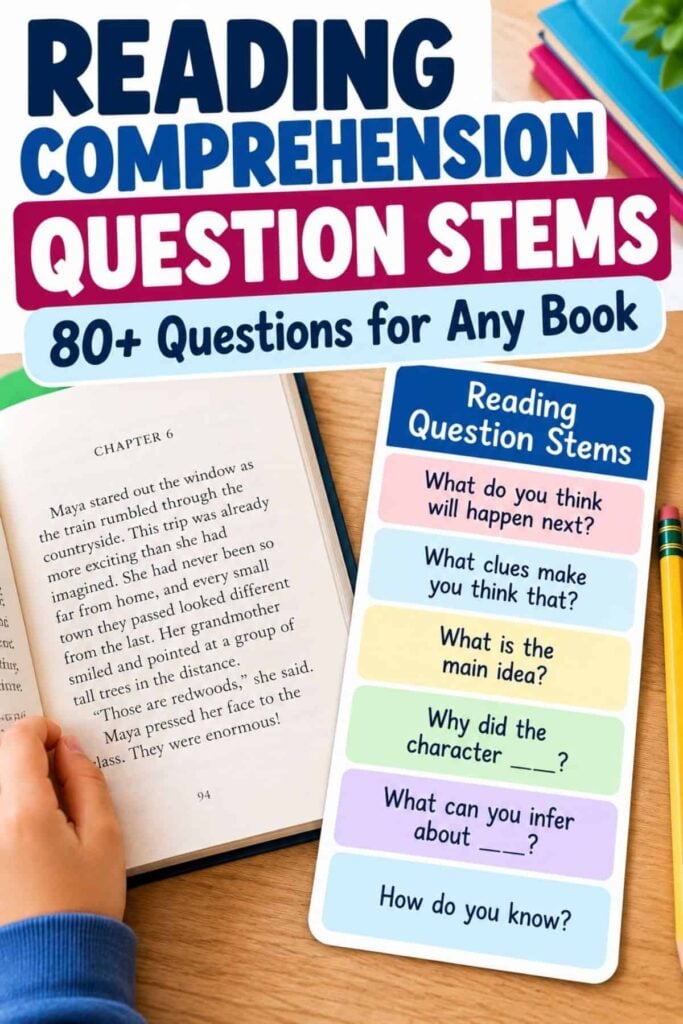
This post gives you more than eighty comprehension questions as fill-in-the-blank stems, organized by the comprehension skill you are targeting, plus a simple way to use them in guided reading groups. Print the list onto a bookmark, and you will never scramble for a question again.
What Are Reading Question Stems?
A question stem is a sentence starter you finish with the book in front of you. Instead of writing “Why did Charlotte spin the words in her web?” for one specific text, you keep the stem “Why did [character] decide to [action]?” and drop in any character and any action. The stem is reusable; the full question changes with the book.
That reusability is what makes stems different from a list of questions written for a single title. “Questioning stems” and “question stems” mean the same thing, and both do the same job: they let one short list carry you through a whole year of books. This post takes the other approach: stems sorted by skill.

If you also want a longer set of ready-made questions, my post on 40+ reading response questions to use with any book gives you full questions organized by before, during, and after reading.
How to Use Question Stems in Guided Reading Groups
Stems only help if you use them with intention. Reading with questions and comprehension in mind means choosing the right question for the moment, not just filling the silence. Four habits make the stems work in a group:
- Pick the stem that matches your skill for the day. If you are teaching inferring, pull an inferring stem, not a random recall question. The skill you target should drive the question you ask.
- Model answering it aloud once. Before you ask students, show them what a strong answer sounds like with one think-aloud. This is especially important the first few times you use a new stem.
- Always follow up for evidence. After any answer, ask “How do you know?” or “Show me the part that tells you that.” This one move turns a guess into evidence-based comprehension.
- Keep a few stems at the table. Write three to five stems per skill on an index card or bookmark and keep it at your guided reading table. Flipping through notes mid-group kills the momentum; a bookmark keeps the next question a glance away.
Question Stems by Comprehension Skill
Here is the heart of the post: question stems, and questioning stems grouped by the comprehension skill they build. Each section opens with what the skill develops, then lists fill-in-the-blank stems. Pull from the group that matches your focus for the day.
Story Elements (Character, Setting, Plot)
These stems build students’ grasp of how a story is put together, which is the foundation for deeper analysis.
- Who is the main character, and what do they want?
- How does the setting affect what happens in the story?
- What is the main problem in the story, and how is it solved?
- How does [character] change from the beginning to the end?
- What is the most important event in the story, and why?
- Where and when does this story take place, and how do you know?
- Who are the other important characters, and how do they help or hurt [main character]?
- What happened at the beginning, middle, and end?
- What is [character] like? Use three words and find proof for each.
- How would the story change if it took place somewhere else?
Predicting
Predicting stems push students to use what they already know and what the text has shown so far to think about what will happen next.
- Based on the cover and title, what do you think this book will be about?
- What do you think will happen next, and why?
- What clues make you think that?
- How do you think [character] will solve the problem?
- What do you expect to learn in the next chapter?
- Was your prediction correct? What in the text confirmed or changed it?
- How do you think the story will end?
- What might [character] do now that this has happened?
- If you were [character], what would you do next?
- What problem do you predict is coming, and what makes you say so?
Inferring and Drawing Conclusions
Inferring stems ask students to read between the lines, combining text clues with what they already know to reach ideas the author did not state outright.
- What can you infer about [character] from their actions?
- What clues tell you how [character] is feeling?
- Why do you think [character] did that?
- What is the author hinting at here without saying it directly?
- What can you conclude about [situation] based on what you read?
- What does this tell you about [character] that the author never says?
- How do you think [character] feels about [other character]? How do you know?
- What evidence in the text supports your idea?
- What is really going on in this scene?
- What do you think [character] learned, even though the book did not say it?
Main Idea and Summarizing
These stems help students separate the key points from the details and say what a text is mostly about in their own words.
- What is this book mostly about?
- How would you summarize chapter [X] in two sentences?
- What are the most important ideas on this page?
- What is the main idea, and what details support it?
- If you had to tell a friend about this book in one sentence, what would you say?
- What is the lesson or message of this story?
- Which detail is the most important, and which could you leave out?
- What happened in this section? Tell it in order using your own words.
- What is the author trying to teach us?
- What title would you give this chapter, and why?
Author’s Craft and Purpose
These stems move students past what happened to why the author made the choices they did, building awareness of craft and purpose.
- Why do you think the author chose to start the book this way?
- What words create the mood in this passage?
- Why do you think the author wrote this book?
- How does the author make you feel [emotion] here?
- Why did the author include this part?
- What is the author’s message or point of view?
- How would the story be different if it were told by another character?
- What does the author do to keep you wanting to read on?
- Why do you think the author chose this title?
- What picture does this description put in your mind, and which words did it?
Vocabulary in Context
These stems teach students to figure out a word’s meaning from the surrounding text rather than skipping an unfamiliar word.
- What does the word [word] mean in this sentence?
- What context clues help you figure out [word]?
- What is another word the author could have used instead of [word]?
- Why do you think the author chose the word [word] here?
- What part of the word helps you understand its meaning?
- How would the sentence change if we swapped [word] for [simpler word]?
- Which words in this part are new to you, and how can you figure them out?
- What does [word] tell you about how [character] is acting?
Vocabulary and comprehension grow together, so it helps to front-load a few key words before students read.

Compare and Contrast
These stems ask students to hold two things side by side and notice how they are alike and different.
- How is [character A] different from [character B]?
- How are [character A] and [character B] alike?
- How is this book similar to another one we have read?
- How is the beginning of the story different from the end?
- How are these two settings different?
- How did [character] feel before and after [event]?
- What would you rather do, what [character A] did or what [character B] did? Why?
- How is this version of the story different from one you already know?
Nonfiction and Informational Text Stems
These stems are built for informational text, where students navigate features, author’s purpose, and key facts.
- What is the author’s purpose for writing this article?
- What text features helped you find information?
- What are the key facts on this page?
- What did you learn that you did not know before?
- How is this information organized?
- What does the heading tell you this section will be about?
- How does the diagram or photo help you understand the text?
- What question do you still have after reading this?
- What is the most important idea the author wants you to know?
- How could you use the information in this text?
Comprehension Questions You Can Ask About Any Book
When a moment catches you unplanned, these comprehension questions for any book work across genres and grades. Keep this short list handy as your go-to for the days you did not pick a skill ahead of time:
- What is happening in this part of the book?
- What is this mostly about?
- What do you think will happen next, and why?
- How is [character] feeling, and how do you know?
- What is the most important thing that happened so far?
- What surprised you, and why?
- What does this part make you think or wonder?
- Would you recommend this book? Why or why not?
- What is one question you would ask the author?
- How do you know? Show me the part that tells you.
Here is one filled in: With Charlotte’s Web, the stem “What do you think will happen next, and why?” becomes “What do you think will happen next to Wilbur, and why?” The stem stays the same; you just add the character. For a longer ready-made set organized by before, during, and after reading, see my 40+ reading response questions to use with any book.
What Makes a Good Reading Comprehension Question?
Good reading comprehension questions ask students to use the text as evidence, not just recall a fact. A question like “What color was the door?” checks whether a student read the words. A question like “Why do you think the character hesitated at the door?” asks them to think and then prove it with the text. The strongest questions are open-ended, require students to point back to the text, and can be answered more than one way as long as the evidence holds up. That is why the “How do you know?” follow-up matters so much: it turns any question, even a simple one, into one that builds real comprehension.
FAQ: Quick Answers About Comprehension Questions
Build a Go-To Stem Bank
Comprehension questions stop being a scramble once you have stems ready at the table. Print the skills you teach most onto an index card or bookmark, keep it at your guided reading group, and reach for the stem that matches your focus for the day. For the full instructional picture behind these questions, my post on how to teach reading comprehension walks through the gradual-release framework, and if you are building out stations, these stems fit naturally into a literacy center rotation.
Jessica BOschen
Jessica is a teacher, homeschool parent, and entrepreneur. She shares her passion for teaching and education on What I Have Learned. Jessica has 16 years of experience teaching elementary school and currently homeschools her two middle and high school boys. She enjoys scaffolding learning for students, focusing on helping our most challenging learners achieve success in all academic areas.