
How to Teach Reading Comprehension in Elementary Classrooms
Teaching reading comprehension can feel like one of the hardest parts of literacy instruction. You’ve read the story together, asked the questions, maybe even used a graphic organizer, and still, some students stare back at you like you just asked them to explain rocket science.
If you’ve ever wondered how to teach reading comprehension in a way that actually helps students think, not just complete an activity, you’re not alone. Comprehension isn’t a single skill you teach once and move on from. It’s something students build over time through repeated practice, clear modeling, and meaningful interactions with texts.
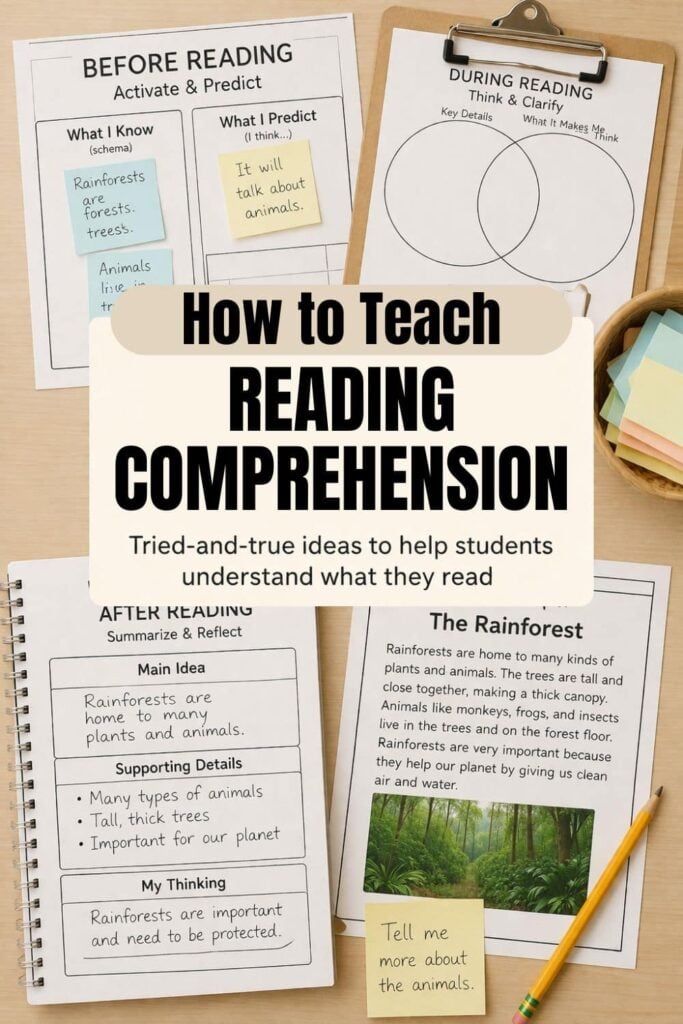
The good news is that strong reading comprehension instruction comes down to a few key pieces working together: building background knowledge, teaching vocabulary, modeling how to think while reading, practicing specific skills, and giving older readers structured ways to talk and write about what they understand.
In this post, we’ll walk through how to teach reading comprehension step by step. You’ll see how all the pieces fit together, from before reading to after reading, and how to move students from supported practice to independent thinking. Whether you’re working with struggling readers, English learners, or a whole class with mixed abilities, these strategies will help you build a classroom where comprehension actually sticks.
What Is Reading Comprehension?
Reading comprehension is the ability to understand, think about, and respond to a text. It’s not just about reading the words. It’s about making meaning from them.
For students, a simple way to explain it is:
“Reading comprehension means understanding what you read and being able to talk or write about it.” That definition gives them something concrete to aim for. It shifts the focus away from just “getting through the text” and toward making meaning.
Many students can decode words but still struggle to understand what they read. That’s where explicit instruction comes in. Comprehension requires background knowledge, vocabulary, and practice with thinking skills.
Why Comprehension Is So Hard to Teach (and Learn)
Let’s break it down. Reading comprehension is a complex cognitive process that asks kids to:
- Decode words
- Understand vocabulary
- Recognize text structure
- Infer meaning
- Connect ideas
- And then talk or write about it clearly
That’s a lot for a 9-year-old who just learned how to tie their shoes. Even with the best intentions, many students get stuck, not because they aren’t smart, but because they don’t yet have the language to express their thinking.
And that’s the piece many comprehension lessons forget: kids need support not just to think, but to say and write what they’re thinking.
The Big Picture: How Reading Comprehension Develops Over Time
Reading comprehension isn’t something you teach in a single lesson or even a single unit. It develops gradually as students build knowledge, learn vocabulary, and practice applying thinking skills across different texts.
Students need repeated exposure to the same types of thinking in different contexts. They also need to see how all the pieces fit together. Without that structure, comprehension instruction can feel scattered, and students may not transfer what they learn from one lesson to the next.
The Gradual Release of Responsibility (I Do, We Do, You Do)
One of the most effective ways to teach comprehension is through the gradual release model. Students need to see how a proficient reader thinks before they are expected to do it themselves.
These are the steps in the gradual release of responsibility:
- I Do: Model your thinking out loud
- We Do: Practice together with support
- You Do: Students try it independently
This structure helps students move from watching to doing. Skipping any of these steps often leads to confusion or shallow understanding.
Before, During, and After Reading Framework
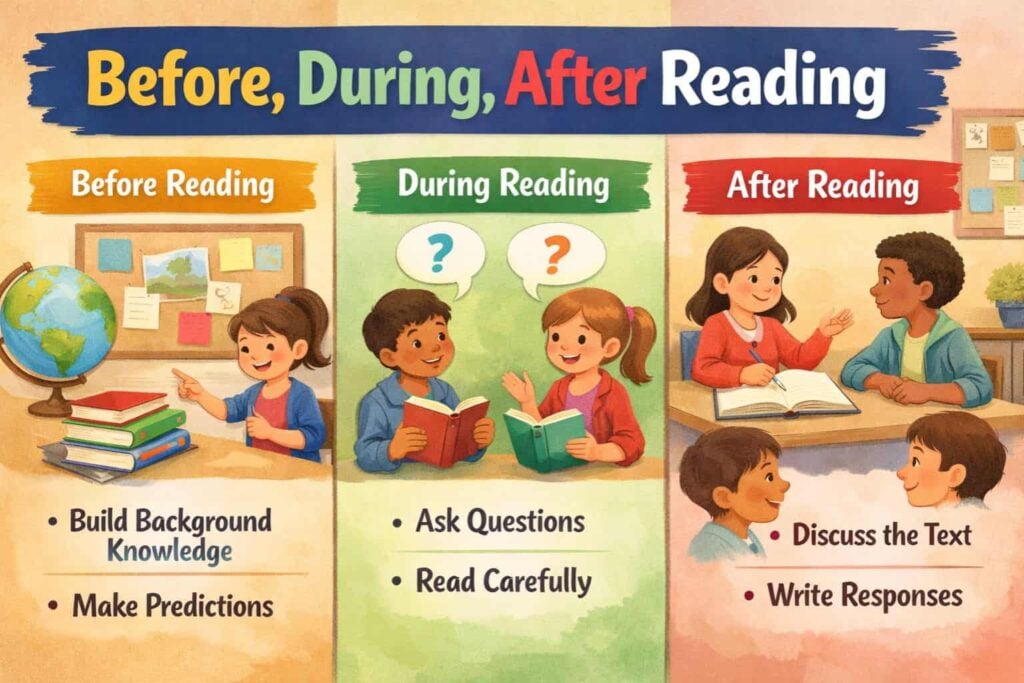
Another structure that supports students’ comprehension is organizing instruction into before-, during-, and after-reading.
- Before reading: Prepare students for the text by activating knowledge and setting a purpose
- During reading: Guide thinking, monitor understanding, and interact with the text
- After reading: Reflect, respond, and extend learning to apply what they learned.
Both the gradual release of responsibility model and the before, during, and after reading framework give consistency to your lessons and help students know what to expect.
Build Background Knowledge
Background knowledge plays a major role in comprehension. When students already know something about a topic, they can connect new information to what they understand. When they lack background knowledge, even a simple text can feel extremely confusing.
Before Reading: Activate and Build Knowledge
Before students even open the text, you can set them up for success by giving them just enough context to make the reading feel familiar instead of overwhelming. A quick preview of the topic helps students anchor their thinking and start forming ideas about what they’re about to read.
Here are some ideas for activating prior knowledge:
- Preview the topic with a short explanation in student-friendly language
- Show visuals such as photographs, diagrams, or real-life images
- Play a short video clip to introduce the concept
- Use a quick class discussion to surface what students already know
- Create a simple KWL (Know, Want to Know, Learned) chart
- Introduce key concepts through a short read-aloud or mini passage
- Use real objects (realia) when possible to make ideas concrete
- Ask students to make predictions based on the title or images
- Connect the topic to students’ personal experiences
- Preteach a few critical vocabulary words tied to the concept

Here are 10 in-depth ways to elicit prior knowledge with students.
During Reading: Connect to What Students Already Know
As students read, they need opportunities to pause and make connections between the text and their existing knowledge. This is where comprehension really starts to deepen, as students actively process what they’re reading rather than passively moving through it.
Here are some ideas you can use to help students make connections to the text:
- Pause at key points to ask, “What does this remind you of?”
- Encourage students to make text-to-self, text-to-text, and text-to-world connections
- Stop and clarify unfamiliar concepts or confusing sections
- Think aloud to model how you connect ideas while reading
- Ask guiding questions that link new information to prior knowledge
- Have students turn and talk to share connections with a partner
- Use sticky notes or annotations to jot down connections
- Revisit visuals or vocabulary introduced before reading
- Compare the new information to what students predicted earlier
- Highlight important details that build on known concepts
After Reading: Extend Understanding
After reading, students solidify and expand their understanding. This is the time to help them connect what they’ve learned to bigger ideas and apply it in meaningful ways.
Here are some ideas to build background knowledge after reading:
- Facilitate a class discussion about what students learned
- Revisit the KWL chart and fill in the “Learned” section
- Ask students to explain how their thinking changed
- Make real-world connections to the topic
- Have students write about what they learned using sentence frames
- Compare the text to real-life examples or current events
- Create a simple project, drawing, or diagram to represent learning
- Engage students in partner or small group discussions
- Ask students to teach the concept to a peer
- Connect the topic to future lessons or units
These small shifts before, during, and after reading can make a big difference in how deeply students understand a text.
Teach Vocabulary and Word Knowledge
Vocabulary instruction is closely tied to comprehension. If students don’t understand key words in a text, they will struggle to understand the overall meaning.
Tiered Vocabulary
One helpful way to think about vocabulary instruction is through tiered vocabulary. Not all words carry the same weight, and trying to teach every unfamiliar word will overwhelm both you and your students. Instead, words can be grouped into three tiers.
Tier 1 words are everyday words students usually already know, like house, run, or happy. These rarely need direct instruction.
Tier 2 words are where most of your teaching should happen. These are high-utility words that appear across many texts, such as compare, describe, result, and effect. They are essential for comprehension and often appear in academic tasks.
Tier 3 words are content-specific words tied to a particular topic, like evaporation, legislature, or habitat. These are important for understanding a specific text or unit, but they don’t always transfer across subjects.
Focusing your instruction on Tier 2 and key Tier 3 words helps students get the most impact without overload.
Before Reading: Introduce and Prepare Key Vocabulary
Before reading, the goal is to give students access to the most important words so the text feels understandable rather than overwhelming. This is not about frontloading every unfamiliar word, but about choosing the few that unlock meaning.
Here are a few before reading ideas to develop vocabulary:
- Select 3–5 essential Tier 2 or Tier 3 words that are critical to understanding the text, and create a Frayer Model for each one
- Introduce words using student-friendly definitions instead of dictionary language
- Show visuals or real-life examples to make abstract words more concrete
- Act out verbs or concepts to build understanding through movement
- Use a quick “turn and talk” where students predict how the words might connect to the topic
- Sort words into categories (known vs unknown, concrete vs abstract)
- Provide simple examples and non-examples to clarify the meaning
- Connect new vocabulary to words students already know
- Create a quick vocabulary anchor chart to reference during reading
- Have students sketch or represent the meaning of each word in a notebook
During Reading: Make Meaning Using Context and Discussion
During reading, vocabulary instruction shifts from introduction to application. This is where students learn how to figure out meaning in context and monitor their understanding.
Here are a few ideas for helping students understand vocabulary during reading:
- Pause when encountering key vocabulary and model thinking aloud
- Reread sentences to use context clues for meaning
- Ask guiding questions like, “What might this word mean based on what’s happening?”
- Highlight or underline unfamiliar words to revisit later
- Use partner discussions to talk through possible meanings
- Replace the unknown word with a synonym to check understanding
- Break apart words into prefixes, suffixes, or root words
- Connect vocabulary to visuals or diagrams within the text
- Keep a running list of important words on the board
- Encourage students to ask questions when a word doesn’t make sense
After Reading: Reinforce and Apply Vocabulary
After reading is where vocabulary sticks. Students need opportunities to use new words in meaningful ways so they move from recognition to ownership.
These after reading activities build on the before and during reading vocabulary tasks:
- Use sentence frames to help students write using new vocabulary
- Have students explain words in their own words, not just repeat definitions
- Create word sorts based on meaning, category, or usage
- Ask students to use vocabulary in a short written response about the text
- Engage in partner or group discussions using target vocabulary
- Match words to definitions, examples, or images
- Have students create illustrations or diagrams that represent word meanings
- Play quick review games like charades, Pictionary, or matching
- Add words to a classroom word wall for ongoing reference
- Ask students to identify where the word appears in real life or other texts
These activities help students move from exposure → understanding → application, which is what actually builds vocabulary knowledge over time.
Teach Students to Ask and Answer Questions
One of the clearest signs of comprehension is when students begin asking their own questions. Good readers don’t passively move through a text. They actively think about what is happening, noticing when something makes sense and when it doesn’t. Teaching students to ask and answer questions improves understanding by keeping them engaged and helping them monitor their thinking as they read.
It’s also important to move students beyond literal questions that focus only on recalling facts. While those have a place, deeper comprehension comes from questions that ask students to explain, connect, and think critically. When students begin asking “why,” “how,” and “what does this mean,” they shift from simply finding answers in the text to actually making meaning from it.
Before Reading: Ask Predictive Questions
Before reading, questioning helps students focus their thinking and creates a clear reason for reading. Instead of jumping into the text, students begin with curiosity and expectations.
- Ask students to generate questions based on the title, headings, or images
- Model how to turn a heading into a question
- Have students predict what they will learn and explain their reasoning
- Use sentence stems like “I wonder…” or “What might happen if…”
- Create a class chart of questions to revisit after reading
- Sort questions into “right there” (literal) and “thinking” (deeper) questions
- Encourage students to ask “why” and “how” questions, not just “what”
- Connect questions to prior knowledge to build interest
- Have students write one question they want answered while reading
- Discuss which questions will require thinking beyond the text
During Reading: Monitor Understanding with Questions
During reading, questioning keeps students actively engaged and helps them notice when they are confused. This is where students move beyond literal understanding and begin thinking more deeply about the text.
- Pause and model thinking with questions like “Why did that happen?” or “What does this mean?”
- Encourage students to stop when something doesn’t make sense and ask a question
- Use sticky notes to jot down questions while reading
- Have students turn and talk to discuss their questions with a partner
- Ask questions that require evidence, not just recall
- Guide students to revise their thinking as they read new information
- Encourage “how” and “why” questions to push deeper thinking
- Identify which questions can be answered directly and which require inference
- Reread sections to answer more complex questions
- Keep a running list of student questions to revisit
After Reading: Reflect and Deepen Thinking
After reading, questioning helps students consolidate their understanding and extend their thinking beyond the text. This is where deeper comprehension becomes visible.
- Revisit questions from before reading and discuss which were answered
- Ask students to explain their answers using evidence from the text
- Encourage students to generate new questions based on what they learned
- Discuss questions that require thinking beyond the text
- Use sentence frames to support complete responses
- Have students write responses to higher-level questions
- Engage in group discussions focused on “why” and “how.”
- Compare different students’ answers and reasoning
- Ask students how their thinking changed from beginning to end
- Connect questions to real-world ideas or other texts
Teaching students how to ask and answer questions moves them from passive readers to active thinkers.
Teach Comprehension Skills and Strategies with Targeted Text Work
Comprehension skills such as identifying the main idea, summarizing, comparing and contrasting, understanding cause and effect, and recognizing text structures are closely tied to standards. These skills give students specific ways to analyze how a text works and how ideas are connected, and they are typically what we assess.
Explicitly Teach Text Structures
Text structures help students understand how information is organized in a text. When students recognize whether a text is describing, sequencing events, comparing ideas, explaining causes, or presenting a problem and solution, they are better able to follow the author’s thinking.
Instead of reading word by word, students begin to read with a framework in mind. They can anticipate what information will come next and organize it more effectively. This makes complex texts feel more manageable and helps students focus on meaning rather than just decoding.
You can introduce common text structures such as:
- description
- sequence
- compare and contrast
- cause and effect
- problem and solution
As students encounter these structures across different texts, they begin to recognize patterns and use those patterns to guide their thinking, discussions, and written responses.
Teach Summarizing
Summarizing is one of the most powerful ways to check comprehension because it requires students to determine what is most important in a text. Instead of repeating everything they read, students must decide which ideas matter and explain them clearly.
This pushes students beyond surface-level understanding and helps them organize information in a meaningful way. It also naturally connects to other skills, such as identifying the main idea and recognizing text structure, since students must understand how ideas fit together before they can summarize them.
Summarizing also serves as a bridge between reading and writing. When students can clearly explain a text in their own words, they are better prepared to respond to it in writing with clarity and purpose.
Distinguish Between Reading Comprehension Skills and Comprehension Strategies
It also helps to distinguish between skills and strategies, since they are not the same thing. Skills are the outcomes we want students to demonstrate—such as identifying the main idea, explaining cause and effect, or recognizing how a text is structured. Strategies, on the other hand, are the tools students use to reach those outcomes.
These strategies include asking questions, rereading, making connections, and visualizing. They are what students do while they are reading to help them make sense of the text.
For example, if the skill is compare and contrast, a student might use the strategy of asking, “How are these two ideas alike? How are they different?” or use a graphic organizer to sort their thinking. If the focus is text structure, a student might look for signal words or identify how the information is organized across the text.
When students understand both the skill and the strategy, they are more likely to approach texts with purpose and independence instead of guessing what the teacher wants.
Being clear about this distinction helps instruction feel more focused. You are not just teaching a worksheet or an activity—you are teaching students how to think in a way that leads to a specific outcome.
Use Graphic Organizers to Structure Thinking
Graphic organizers can be powerful tools for helping students organize their thinking, especially when they are learning a new skill. They provide a visual structure that makes abstract ideas more concrete and gives students a place to capture their ideas as they read.
It’s important to remember that organizers support—not replace—thinking. The goal isn’t to complete the organizer; it’s to understand the text. Organizers are most effective when they guide students’ thinking, not when they become the task itself.
Use graphic organizers when students need structure—such as when introducing a new comprehension skill, organizing complex information, or helping students see relationships between ideas. They are especially helpful during modeling and guided practice, when students are still learning how to approach a skill.
At the same time, it’s important to avoid over-reliance. If students use organizers for every task, they may struggle to think independently without them. Over time, you want to gradually remove that support so students can apply the same thinking strategies without needing a worksheet in front of them.
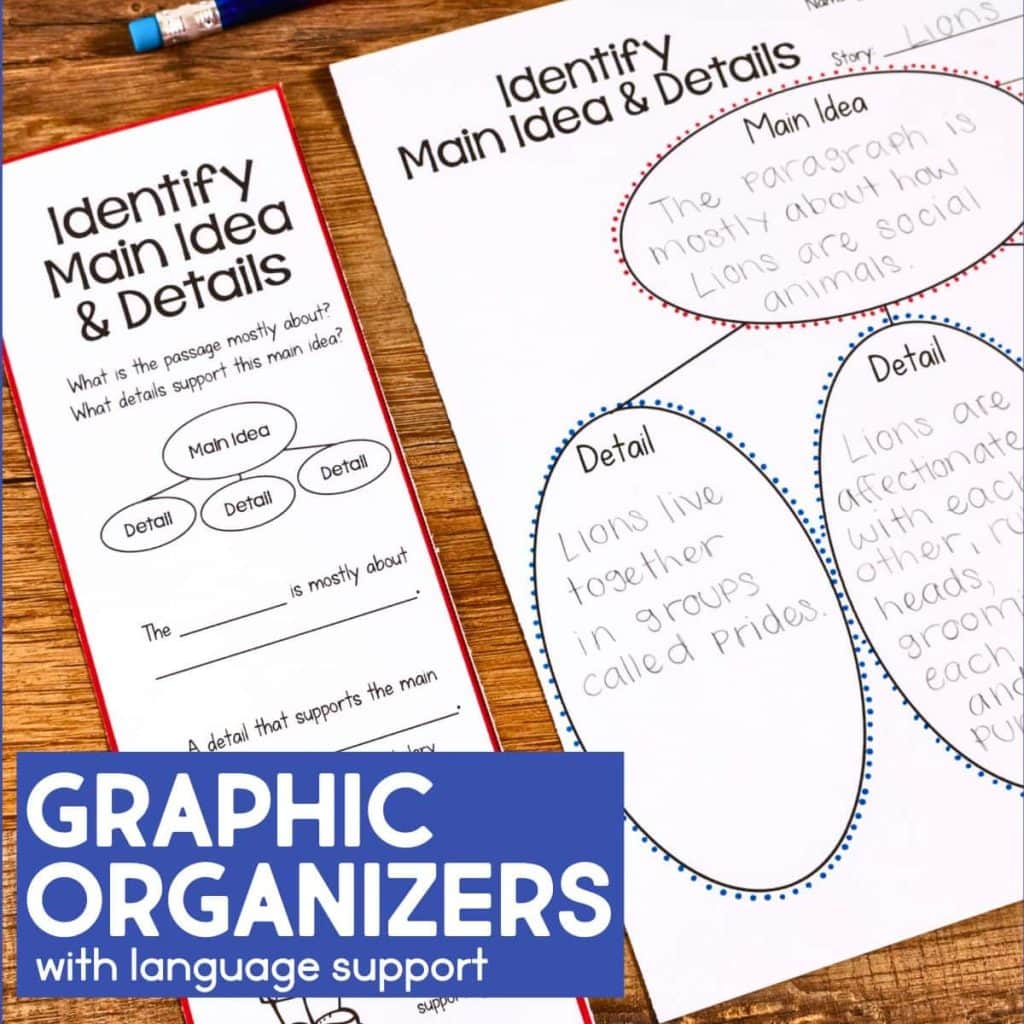
Take a look at these graphic organizers to help students express their understanding of a variety of texts.
Support Academic Language with Sentence Frames
Many students—especially English learners and struggling writers—understand more than they can express. Sentence frames help bridge that gap by giving students the language they need to explain their thinking clearly and completely.
This support is essential as students move from thinking → speaking → writing. First, they develop an idea. Then, they practice saying it out loud with support. Finally, they transfer that idea into writing. Without this progression, students often get stuck, not because they don’t understand, but because they don’t have the language to express their understanding.
Another important distinction is between academic language and conversational language. Many students can explain an idea in everyday terms but struggle to express it in a more precise, academic way. For example, a student might say, “They are the same,” instead of “These two texts are similar because…” or “It happened because of this,” instead of “The cause of the event was…”
Both types of language are valuable, but academic language is what students need for reading comprehension, discussions, and written responses. That’s why it’s important to model and practice using more specific language during instruction. Sentence frames give students a starting point, helping them structure their responses in a clear and organized way.
As students gain confidence, they begin to move more naturally from conversational to academic language. Their explanations become more precise, and their comprehension becomes more visible—not just in what they understand, but in how they communicate that understanding.

Learn about the components of academic language and how to use them in your reading lessons.
Before Reading: Introduce Language Structures
Before students begin reading, this is the time to set them up with the language they’ll need to explain their thinking later. Instead of waiting until after the reading for complete responses, you’re giving students the tools up front so they know how to talk about what they’re about to learn.
Start by modeling sentence stems that align with your lesson objective. If students will be identifying cause and effect, you might model: “The cause of ___ was ___.” If they are comparing texts, you might use: “These two texts are similar because…” Say the sentences out loud, think through how you would complete them, and show students what a strong response sounds like.
It’s helpful to write these stems where students can see them and briefly practice using them before reading begins. This lowers the language barrier and gives students confidence as they enter the text. Instead of wondering how to answer later, they already have a structure in mind.
During Reading: Practice Oral Language
During reading, students need opportunities to use language in a low-pressure way. This is where partner talk using sentence frames becomes powerful. Speaking allows students to rehearse their thinking before they are expected to write it.
As you pause during reading, prompt students to turn and talk using a specific frame. For example, “The main idea of this section is ___ because ___,” or “I think this happened because…” This keeps students focused on the purpose of the lesson while also strengthening their language skills.
Circulate and listen as students talk. You’ll hear where they are successful and where they need more support. You can quickly model stronger responses or clarify misunderstandings in the moment. This kind of structured talk helps all students participate, not just the ones who are already comfortable speaking.
Over time, students begin to rely less on the frames and more on their own language, but the structure is what helps them get started.
After Reading: Use Frames in Writing
After reading, students are ready to move from speaking to writing. This is where sentence frames continue to support them, especially as they organize their ideas into complete responses.
Provide structured written responses that align with the frames students practiced during the discussion. For example, students might complete a response like: “The cause of the event was ___, which led to ___.” Because they’ve already said the idea out loud, writing becomes more manageable.
Model what a strong written response looks like and, if needed, write one together as a class before asking students to work independently. This gives students a clear expectation and reinforces the connection between speaking and writing.
As students gain confidence, you can gradually remove or shorten the frames so they begin generating their own sentences. The goal is not for students to rely on sentence frames forever, but to use them as a stepping stone toward clear, independent writing that reflects their understanding.
Take Reading Comprehension Into Writing
Writing is one of the clearest places where comprehension becomes visible. When students write about a text, they can’t rely on guessing or short answers—they have to organize their ideas, use evidence, and explain their thinking in a way that makes sense to someone else.
This is why writing serves as evidence of understanding. It shows not just whether students read the text, but whether they truly understood it. When students can clearly explain a main idea, describe a cause-and-effect relationship, or compare two ideas in writing, you can see their comprehension in action.
Connecting reading to writing helps move students from simply recognizing ideas to fully processing and communicating them. Over time, this strengthens both their comprehension and their ability to express what they know.
How to Teach Reading Comprehension
When all of these pieces come together, a comprehension lesson feels connected rather than scattered. Students begin by building background knowledge and learning key vocabulary. As they read, they think about the text, ask questions, and focus on a specific skill. After reading, they discuss and write about their understanding.
Each part of the lesson builds on the previous one, helping students move from initial exposure to deeper understanding and, finally, to independent thinking. This structure creates consistency, which helps students focus on thinking instead of trying to figure out what they are supposed to do.
A Simple Flow for Comprehension Lessons
- Build background
- Teach key vocabulary
- Set a clear purpose for reading
- Read and think (model and guide comprehension)
- Ask and answer questions during reading
- Apply a specific comprehension skill
- Use a graphic organizer or notes to structure thinking
- Engage in partner or group discussion
- Write about the text using academic language
When these components work together, students begin to see how comprehension develops across a lesson, making their thinking more organized, intentional, and easier to transfer to new texts.
Common Mistakes When Teaching Reading Comprehension
Even with strong planning, it’s easy for reading comprehension instruction to fall into patterns that don’t fully support student understanding. Being aware of common pitfalls can help you make small adjustments that lead to much deeper thinking and stronger outcomes.
- Trying to teach too many strategies at once can overwhelm students and lead to confusion. Students benefit from focusing on one skill at a time and practicing it across multiple texts so the thinking becomes more automatic.
- Skipping modeling and moving straight to independent work often leaves students unsure of what to do. When students don’t see how a proficient reader thinks, they are more likely to guess than apply a clear strategy.
- Relying heavily on worksheets can result in surface-level responses. Without discussion, modeling, and thinking built into the lesson, students may complete the task without truly understanding the text.
- Focusing only on correct answers can limit deeper comprehension. When the emphasis is on getting it “right,” students may avoid explaining their thinking or taking risks with more complex ideas.
- Not connecting reading to writing can make comprehension harder to assess. Writing gives students a way to show what they understand, and without it, their thinking often stays hidden.
- Using graphic organizers for every lesson can create dependence. While organizers are helpful, students also need opportunities to think and respond without that structure.
- Moving too quickly through texts without pausing to think can reduce understanding. Students need time to process, question, and discuss ideas as they read.
- Not building background knowledge before reading can make texts feel inaccessible. When students lack context, even simple passages can become confusing and frustrating.
Being intentional about avoiding these common mistakes helps create a classroom where students’ comprehension is built through thinking, discussion, and meaningful practice.
Putting It All Into Practice
Teaching reading comprehension is not about finding the perfect strategy or resource. It’s about building a system where students consistently engage with texts, think about what they read, and express their understanding.
Some lessons will go smoothly, and others will feel messy. That’s part of the process. Over time, with clear modeling and consistent practice, students begin to take ownership of their thinking.
When that happens, you’ll see the shift. Students won’t just read the words on the page—they’ll start making meaning from them. And that’s where real comprehension begins.
Jessica BOschen
Jessica is a teacher, homeschool parent, and entrepreneur. She shares her passion for teaching and education on What I Have Learned. Jessica has 16 years of experience teaching elementary school and currently homeschools her two middle and high school boys. She enjoys scaffolding learning for students, focusing on helping our most challenging learners achieve success in all academic areas.