
How to Use Frayer Models in 2nd Grade (Yes, They Can Do It!)
If you’re looking for a clear Frayer Model example or wondering how to use a Frayer Model in 2nd grade, you’re in the right place.
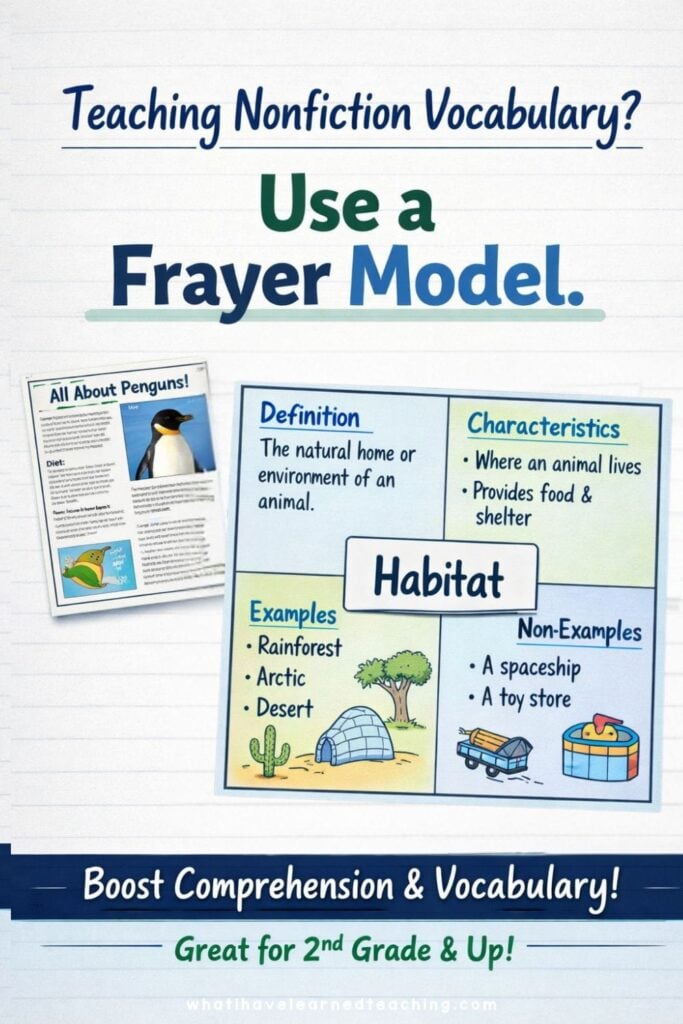
A Frayer Model is a simple four-square vocabulary graphic organizer that helps students understand words through definition, characteristics, examples, and non-examples. While many teachers use a Frayer Model template in upper grades, it can be incredibly effective in second grade with the right modeling and support.
In this post, I’ll show you exactly how to introduce a Frayer Model in an elementary classroom, how to scaffold it for young learners, and how to use it with nonfiction texts like animal articles and biographies. You’ll see practical classroom routines and a complete Frayer Model example that you can use right away.
What Is a Frayer Model?
A Frayer Model is a four-square graphic organizer that helps students deeply understand a vocabulary word.
Each section includes:
- Definition – What does the word mean?
- Characteristics – What are its features or traits?
- Examples – What are real examples of the word?
- Non-examples – What is not the word?
In the center is the vocabulary term students are studying.
It’s simple. It’s structured. And it pushes students beyond copying a definition.
Why Frayer Models Work So Well in 2nd Grade
Second graders are ready to move beyond surface-level word knowledge, but they still need structure and support.
Frayer Models:
- Build critical thinking
- Help students sort ideas into categories
- Strengthen academic language
- Support English learners with clear categories
- Connect reading and writing
Instead of asking, “What does marine mammal mean?” and hoping for an accurate definition, you guide them through thinking about what it is, what it looks like, what counts, and what doesn’t.
That last box, non-examples, is where the real learning happens.
Why Non-Examples Build Deeper Understanding
Anyone can copy a definition. Students can even memorize one. But when they have to decide what does not fit the word, they have to think more deeply. They must compare, analyze, and justify their reasoning.
When a student says, “A shark is not a marine mammal because it’s a fish and doesn’t breathe air with lungs,” they are doing far more than defining a word. They are identifying key characteristics, distinguishing between categories, and correcting common misconceptions.
Non-examples force students to clarify boundaries. They answer the question: What makes this word different from similar words? That kind of thinking builds stronger vocabulary, better comprehension, and more precise academic language.
This is the same compare-and-contrast thinking behind skills like compare and contrast writing, just applied to a single vocabulary word instead of two whole topics.
It’s also where misunderstandings surface. If a student places “sea turtle” in the examples box, you immediately know what needs reteaching. The non-example section gives you instant formative assessment without a quiz.
And honestly, it’s the moment when the vocabulary shifts from memorized to understood.
Step-by-Step: How to Use a Frayer Model in 2nd Grade
Here’s a simple routine that works beautifully.
1. Model It First (Whole Group)
Second graders need to see it done.
Put one Frayer Model under your document camera and complete it together.
Let’s use marine mammal as an example:
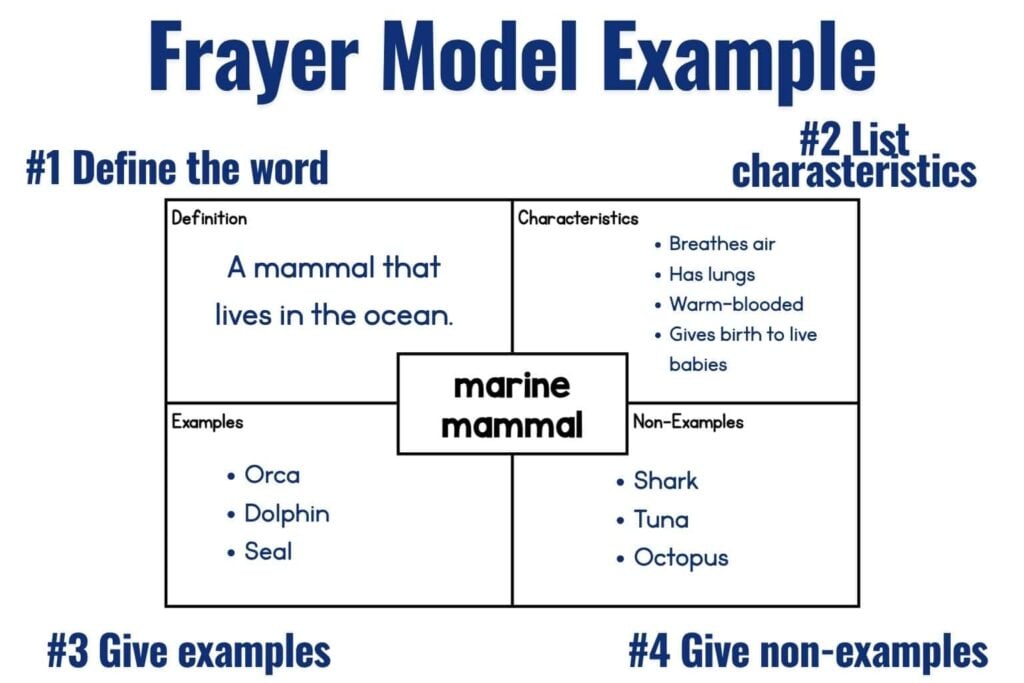
Definition (teacher-guided):
A mammal that lives in the ocean.
Characteristics:
- Breathes air
- Has lungs
- Warm-blooded
- Gives birth to live babies
Examples:
- Orca
- Dolphin
- Seal
Non-examples:
- Shark
- Tuna
- Octopus
Talk through your thinking out loud. That verbal modeling is everything.
What a Frayer Model Looks Like in a Real Classroom
This is an example of a whole-group Frayer Model anchor chart created during a life cycle unit. Notice how the vocabulary word “metamorphosis” is placed in the center, and students helped fill in each quadrant together.
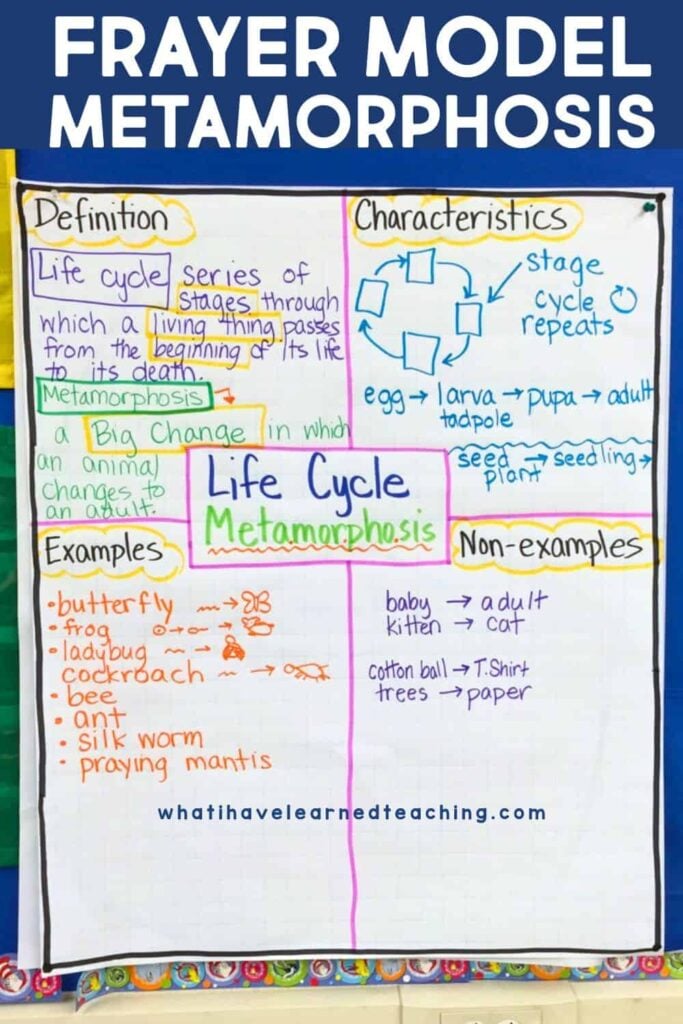
in 2nd-grade science.
Instead of copying a definition from a textbook, students:
- Defined the word in their own language
- Listed key characteristics (stages, repetition, life cycle)
- Brainstormed real examples like butterflies and frogs
- Identified non-examples to clarify misconceptions
This kind of anchor chart makes the thinking visible. It also gives students a reference point they can return to when completing their own Frayer Models independently.
When you build the chart with students, you are modeling the process — not just the final product. That modeling is what makes the strategy successful in 2nd grade.
2. Use Sentence Frames
Second graders thrive with scaffolds, like sentence frames. Try:
- A ___ is a ___ that ___.
- One characteristic is ___.
- An example of ___ is ___.
- A ___ is not a ___ because ___.
This helps students produce academic language without feeling stuck.
3. Keep It Short at First
For 2nd grade, you don’t need paragraphs in every box.
Start with:
- 1–2 sentences in the definition
- A short bullet list for characteristics
- 2–3 examples
- 2–3 non-examples
You can build from there as the year progresses.
4. Do Partner Frayer Models
Once students understand the format, try:
- Assigning one vocabulary word per pair
- Having them complete it together
- Sharing their word with the class
It turns vocabulary into a mini research task instead of silent worksheet time.
5. Connect It Back to the Text
After completing the Frayer Model, ask:
- Where did we see this word in the article?
- Why did the author use it?
- How does understanding this word help us understand the text?
Now the vocabulary has purpose.
What About Abstract Words?
Concrete science terms (like fossil or predator) are easier to use in Frayer models.
Abstract words like distinctive take more modeling.
Here’s how that might look:
Definition:
Something that makes a person or thing different from others.
Characteristics:
- Unique
- Easy to notice
- Stands out
Examples:
- A zebra’s stripes
- An orca’s black and white coloring
- A person’s bright red glasses
Non-examples:
- Plain
- Common
- The same as everyone else
When students compare examples and non-examples, they begin to see the concept, not just the dictionary meaning.

How to Differentiate for Struggling Readers
If you have students who need more support:
- Pre-fill the definition and have them complete the other boxes.
- Provide a word bank for examples and non-examples.
- Complete it orally and have students illustrate instead of writing full sentences.
- Use pictures in the examples box.
You can even turn it into a cut-and-sort activity before transferring answers to the Frayer Model.
How Often Should You Use Them?
You don’t need one for every vocabulary word.
Try:
- 1–2 keywords per article
- One word per day during a nonfiction unit
- One word per week in science or social studies
The goal is depth, not quantity.
Why Teachers Love Using Them with Nonfiction
Frayer Models pair beautifully with:
- Animal articles
- Biographies
- Science units
- Content-area reading
They help students break apart domain-specific vocabulary without overwhelming them.
And when vocabulary is stronger, comprehension follows.
Final Thoughts
If a Frayer Model feels “too advanced” for 2nd grade, the key isn’t removing it. It’s modeling it well.
When students learn to define, describe, categorize, and compare, they aren’t just learning one word. They’re building the thinking skills they’ll use across every subject.
And honestly? Watching a second grader confidently explain why a shark is not a marine mammal is a pretty great moment.
Structured vocabulary instruction does not have to be complicated. Sometimes it just needs four boxes and a really good conversation.
Jessica BOschen
Jessica is a teacher, homeschool parent, and entrepreneur. She shares her passion for teaching and education on What I Have Learned. Jessica has 16 years of experience teaching elementary school and currently homeschools her two middle and high school boys. She enjoys scaffolding learning for students, focusing on helping our most challenging learners achieve success in all academic areas.