
Ask and Answer Questions about Thanksgiving
Learning how to ask and answer questions about historical events is an important skill for students to develop throughout the year. In this blog post, I show how we practiced it with our Thanksgiving Unit. Students learn to ask and answer questions about Thanksgiving through a fun, interactive cooperative learning activity.

This is PART TWO of a series of blog posts about a Thanksgiving thematic unit for middle elementary grades. In part one, we created a timeline about the events that lead up to the first Thanksgiving. You can access PART ONE and PART THREE as well.
Through this unit, students learned how to create a timeline, how to describe how events are connected to each other and how to ask and answer questions about historical events. This has been developed into a full product that is described in this blog post.
This series of blog posts focus on the second grade Common Core Standard that asks students to “describe the connection between a series of historical events . . . in a text.” Over several weeks, we learned how to connect the events, but we started with the timeline and moved onto asking and answering questions about the timeline.
Practice Asking and Answering Questions Orally
As we created our timeline, read our books, and dove deep into the events leading up to the first Thanksgiving, we continually asked questions about what we learned. The first step to helping students write questions is to help them ask questions orally.
While students were asking questions, I wrote the questions down on sticky notes. One stick note per question.
Create an Anchor Chart & Sort the Questions
After several days of reading books and adding to our timeline, we switched our focus and worked on asking and answering questions specifically. I created an anchor chart and we sorted the questions students had already asked.
We also came up with a few more questions and added those to the chart as well.

Write Questions
After establishing that there are six main types of questions, we set out to do some individual writing. I gave students an Asking and Answering Questions worksheet. This was likely the day after we created the above anchor chart.
The instructions were to write six questions, one for each question type. BUT they were specifically told not to answer the question.
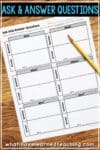
Here is what the sheet looked like:

I created it so that each question would be easy to cut up.
Because this was a skill assessment, not a remembering information assessment, I let students use the timeline. I did remove the questions we had practiced as a whole group and attached to our Asking Questions anchor chart, though. That would have been too easy!
Cooperative Learning Activity to Answer Questions
I had intended to do a scoot type of activity where students rotated around to each of their desks and answered the questions, but I overestimated their ability to ask questions. Only 8 of my students could ask good questions. Good being grammatically correct, starting with a question word, and making sense. I had emphasized that the students had to be able to answer the question that they asked, so I didn’t get too many questions that were not focused on the timeline. However, not all the questions I received were good questions that other students could answer in writing.
Given my lack of good questions, I had to refigure the Day 2 activity. I highlighted the good questions or at least those I thought students might be able to answer.
I cut apart the sheets and put three questions on each student’s desk. When they came in from recess, students went to their desks and answered the questions that were on their desks.
I made sure that students had three different types of questions and I might have ensured that certain students didn’t have too difficult of a question. I also gave them a red pen to answer the question, rather than a pencil. I didn’t want them to erase and rewrite the question and I also wanted to see what they could do without erasing. Some of my kiddos have a problem erasing too much!
I did read and interpret questions when needed as some of the spelling and word order was not quite communicative. Overall though, I thought students did a great job and I was able to get a good idea of their ability asking and answering questions.
Here are some examples of their responses:
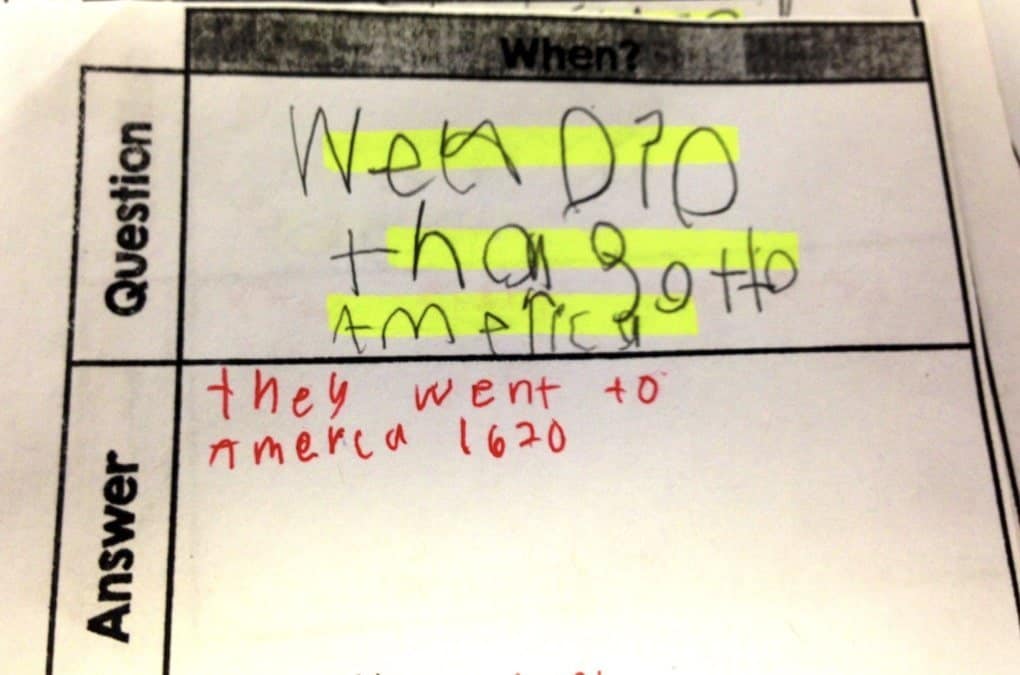
A: They went to American in 1620.
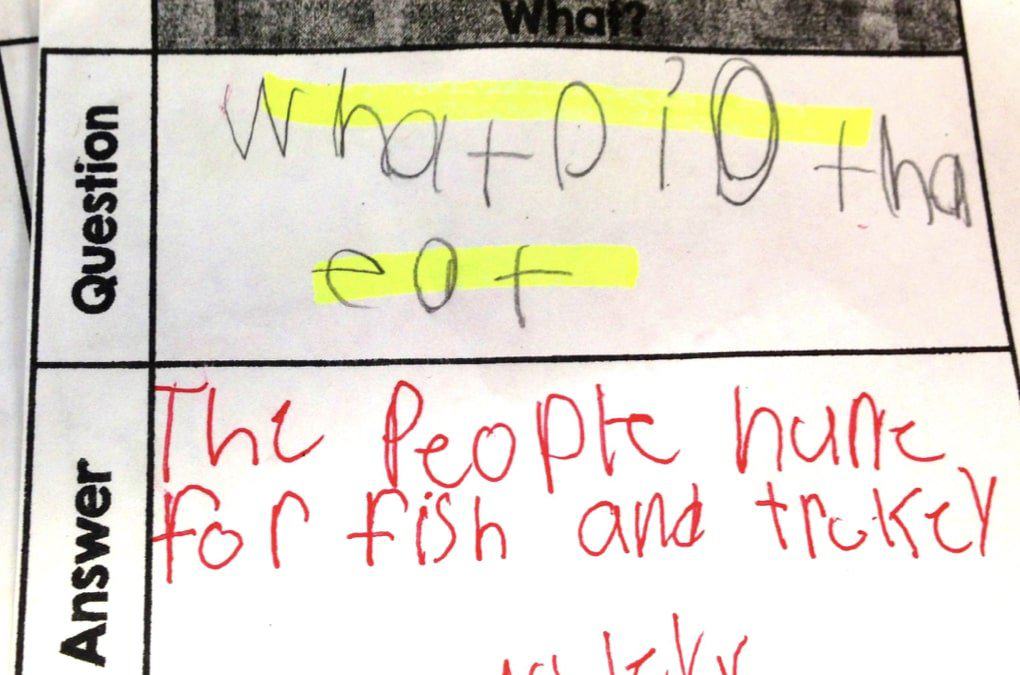
A: The people hunted for fish and turkey.
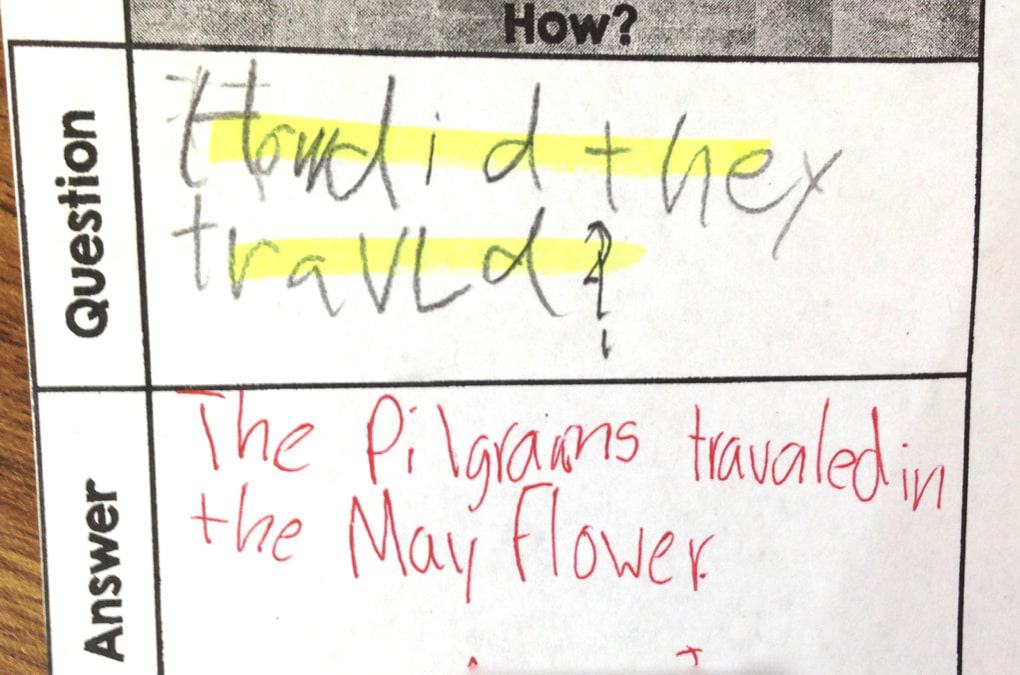
A: The Pilgrims traveled on the Mayflower.
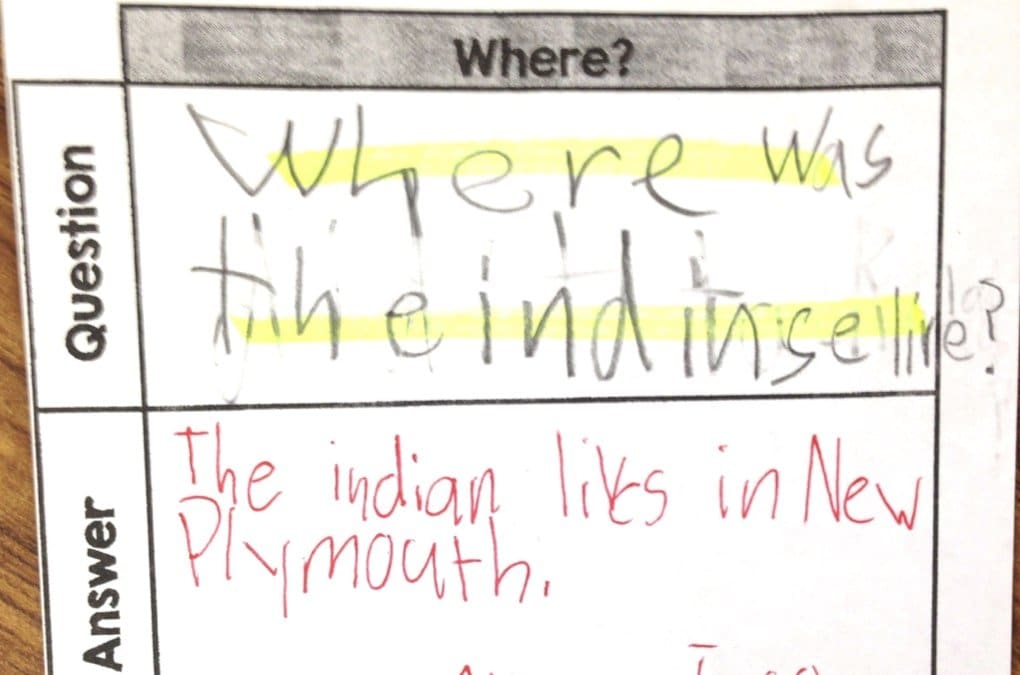
A: The Indians lived in New Plymouth.
Reflection on Asking and Answering Questions
I really enjoyed this activity and the process. Not only did we practice the questions ahead of time (although I think they could have used much more practice), I was able to assess both the asking and answer of questions separately, on two different days.
We had studied the content for several days and we were able to go deeper into the skill because it was more familiar for students. I will definitely do this again with other nonfiction text and content.
If I had tried to do a KWL chart or asked students what questions they had about Thanksgiving without doing the timeline, their questions would have been all over the map, not focused on the historical perspective of Thanksgiving.
Presenting the timeline and rough outline of the events gave students enough of a framework and background knowledge to be able to ask good questions about the historical events leading up to the first celebration of Thanksgiving.
More Information
The asking and answering questions sheet above is part of the Thanksgiving Resource.
You can read PART ONE of the series where I discuss how we developed a timeline as well as PART THREE where we dive into making connections between historical events.

This is a great activity! I feel the same way that you do about my students being able to do high leveles of critical thinking and analyzing text independently. We do much better orally as a whole class with LOTS of scaffolding. Then I have 5-6 students that are right on level! Thanks for this idea. We’ve been learning about farming and George Washington Carver so far this month and will focus only on the first thanksgiving this week.
Also… do you have the asking/answering questions sheet you used? I’d love to use it tomorrow!
This looks like a very useful graphic organizer that could be used in small as well as whole group. Where can I download it?
This is a link to the product described in this blog post: https://whatihavelearnedteaching.com/product/thanksgiving-make-connections-between-a-series-of-historical-events/