
Thanksgiving History Timeline Activity for Second Grade
Thanksgiving history timeline activities give students a way to hold the story together across multiple read-alouds. When students can see the events arranged chronologically — from Plymouth, England to the first harvest — they have a structure to connect information as each book adds new details.
This is Part One of a three-part series built around a Thanksgiving social studies unit for second grade. In this post, I walk through how we built a living class timeline over five days of read-alouds, adding vocabulary and details as students encountered new information in each book. Parts Two and Three cover asking and answering questions about the timeline and describing the connections between events.

This is PART ONE of a series of blog posts about a Thanksgiving thematic unit for middle elementary grades. You can access PART TWO and PART THREE as well.
Through this unit, students learned how to create a timeline, how to describe how events are connected to each other and how to ask and answer questions about historical events. This has been developed into a full product that is described in this blog post.
This series of blog posts focus on the second grade Common Core Standard that asks students to “describe the connection between a series of historical events . . . in a text.” Over several weeks, we learned how to connect the events, but we started here with the timeline, where we recorded the events.
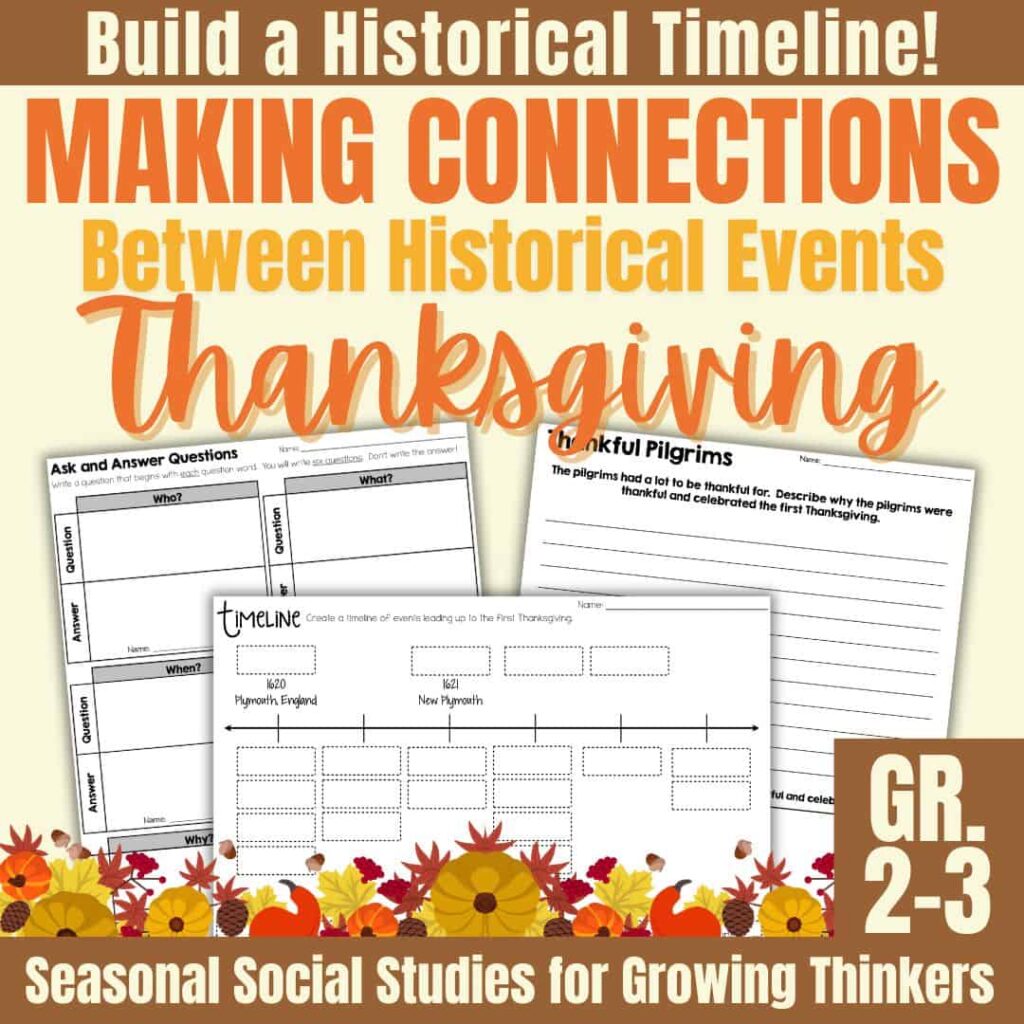
Thanksgiving Make Connections between a Series of Historical Events
This mini-unit helps students understand the events leading up to the first Thanksgiving and gives them tools to make connections between those events.
Thanksgiving History Timeline Activity for Second Grade
The first step in the process was to create a timeline for our class. I used a piece of butcher paper, drew a line down the middle and added tick marks for each of the major events.
I drew a rough outline on a black piece of paper before drawing the tick marks, to ensure I had enough of them for the events I wanted to cover over the weeks we were studying about Thanksgiving. I decided that we were covering 6 major events on our timeline.

Prior to reading aloud any books, I built the timeline with students to give them some background knowledge about Thanksgiving and the events.
Events Leading Up to the First Thanksgiving
The six events below form the backbone of the timeline. These are the events students learn about across the week of read-alouds, and the same events covered in the printable vocabulary cards and student timeline included in the unit.
- Plymouth, England (Fall 1620): The Pilgrims faced unfair laws in England and wanted religious freedom and a better life.
- Setting Sail (Fall 1620): The Pilgrims sailed on the Mayflower to America — 102 passengers over 65 days.
- Arriving in America (Winter 1620-1621): When the Pilgrims arrived in New Plymouth, it was winter. The harsh weather was difficult, and many people died.
- Meeting Squanto (Spring 1621): Squanto, a member of the Wampanoag people, taught the Pilgrims how to survive by hunting, planting, and building shelter.
- The Harvest (Fall 1621): The Pilgrims had a large harvest that fall.
- The First Thanksgiving (Fall 1621): The Pilgrims and the Wampanoag celebrated together — the celebration lasted three days.
The vocabulary cards, student cut-and-paste timeline, and writing assessment for this unit are all available in the Thanksgiving History Unit.
Tell the Story of Thanksgiving. Add to the Timeline.
Above is what the timeline looked like when students first saw it. I then told the “story” of Thanksgiving in rough form, giving students the key details and filled the timeline in with the printed words below.
At this point, we still hadn’t read any books or researched the topic at all.
Most of my students were familiar with the Thanksgiving Holiday and that we celebrated it because of the pilgrims and Indians that helped them out. I added a few more details, like the dates, locations, names of people and objects, and why the pilgrims left England.

Read a Lot of Books. Add to the Timeline.
After the above storying telling, we read a lot of books. We probably read 5-6 books over the week about different aspects of the pilgrims’ journey.
After reading a book, we added more details to the timeline, which are the hand-written papers. While I started with some key ideas, students discovered so much more in the texts that we were reading.
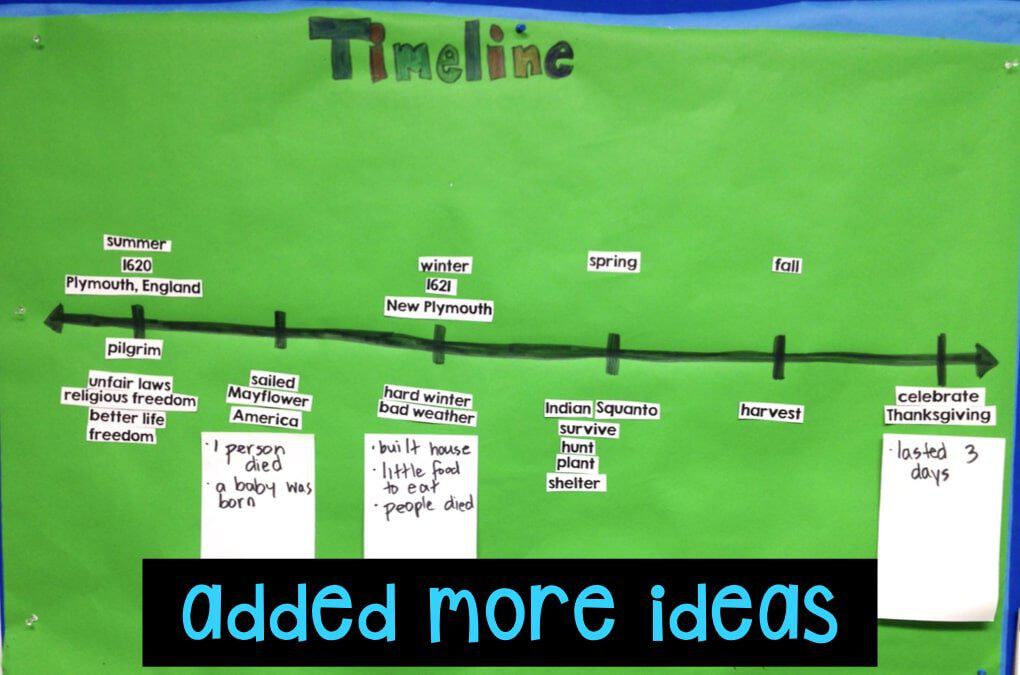
Each day we read a book and we added more details to the timeline.
The Finished Timeline
This was the finished timeline. It’s messier than I would like, but it was built with the students. We constructed it as we went along and grew in our understanding of historical events.

The pictures at the top of the timeline are photocopies from some of the books that we read. I added them so that students to could visualize the harsh conditions and events along the timeline.
Read Aloud Books for a Historical Perspective of Thanksgiving
Since we’re focusing on events leading up to the first Thanksgiving, we read quite a few books that went deeper with the historical events rather than the holiday itself.
Here are a few books and resources that we read throughout the week:
- Squanto’s Journey
- Thanksgiving Is
- The Pilgrim’s First Thanksgiving
- The Pilgrims of Plimoth
- The First Thanksgiving
- On the Mayflower
If you have additional books that you love reading about Thanksgiving that focus on the history of the holiday, I’d love to hear about them in the comments below.
Ask and Answer Questions about the Timeline
One of the comprehension skills we focused on during this unit is Asking and Answering Questions. To help facilitate the formal lesson, which was coming later in the unit, we practiced asking and asking questions orally about the timeline each day before and after we did the read aloud.
The students came up with some great questions about the timeline. I emphasized that they couldn’t ask yes or no questions and that the questions had to start with who, what, where, when, why, or how.
The next blog post in the series, PART TWO, is about a routine I used to formally teach students to Ask and Answer Questions about the timeline.
Thanksgiving Make Connections between a Series of Historical Events
This mini-unit helps students understand the events leading up to the first Thanksgiving and gives them tools to make connections between those events.
Jessica BOschen
Jessica is a teacher, homeschool parent, and entrepreneur. She shares her passion for teaching and education on What I Have Learned. Jessica has 16 years of experience teaching elementary school and currently homeschools her two middle and high school boys. She enjoys scaffolding learning for students, focusing on helping our most challenging learners achieve success in all academic areas.